
Add ₹999 more to unlock FREE SHIPPING!
Your sacred cart is currently empty.
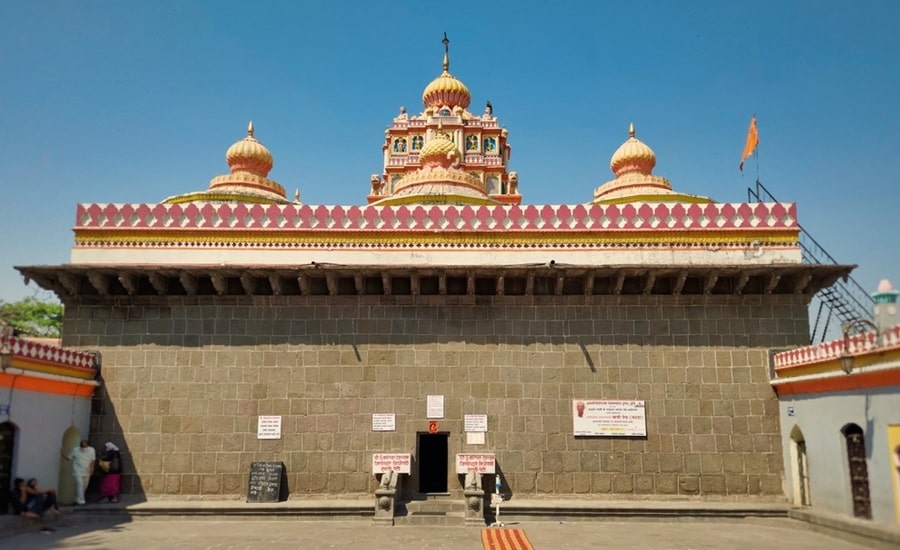
Shop Photo FramesThe Omkareshwar Temple, situated on the banks of the Mutha River in Shaniwar Peth, Pune, is a significant site blessed with religious and historical heritage. Known as ‘Gayautar’ in the sixteenth and seventeenth centuries, the construction of the temple in this area was completed in the eighteenth century by Chimaji Appa, the Commander-in-Chief of the Maratha Empire. This temple, which witnessed many secret meetings during the Indian freedom struggle, remained safe even during the massive Panshet flood of 1961. As a fine example of Peshwa-era architecture, the temple’s nine dome-shaped spires and intricate carvings continue to attract many devotees and tourists from across the country and abroad.
As the Maratha Empire expanded at the beginning of the eighteenth century, the importance of Pune grew. During that period, Chimaji Appa, the younger brother of Shrimant Bajirao Peshwa, resolved to build this Shiva temple. According to historical records in the Peshwa Daftar, the actual construction of the temple began on 26 October 1736 and was completed on 18 June 1738. The responsibility for the creation of this expansive structure was entrusted to the Peshwas’ spiritual guru and architect, Shivram Bhat Chitrav. Chimaji Appa had allocated one thousand rupees per month for six consecutive years for this temple. Records indicate that seven hundred rupees were spent at that time to install the special Shiva Linga Bana, brought from the Narmada River in 1738, in the sanctum sanctorum.
Chimaji Appa had a special affection for this temple and visited it for darshan every year during his lifetime. After his passing, his wife, Annapurna Devi, performed Sati here alongside her husband; consequently, the memories of both are preserved in the temple premises in the form of samadhis. Along with members of the Peshwa family, the samadhis of great saints such as Kalu Maharaj, Keshavrao Maharaj Deshmukh, and Nana Maharaj Sakhare can be seen in this area. Witness to many important familial and political events in Maratha history, this place became renowned not only as a spiritual center but also as an important social hub during the Peshwa era.
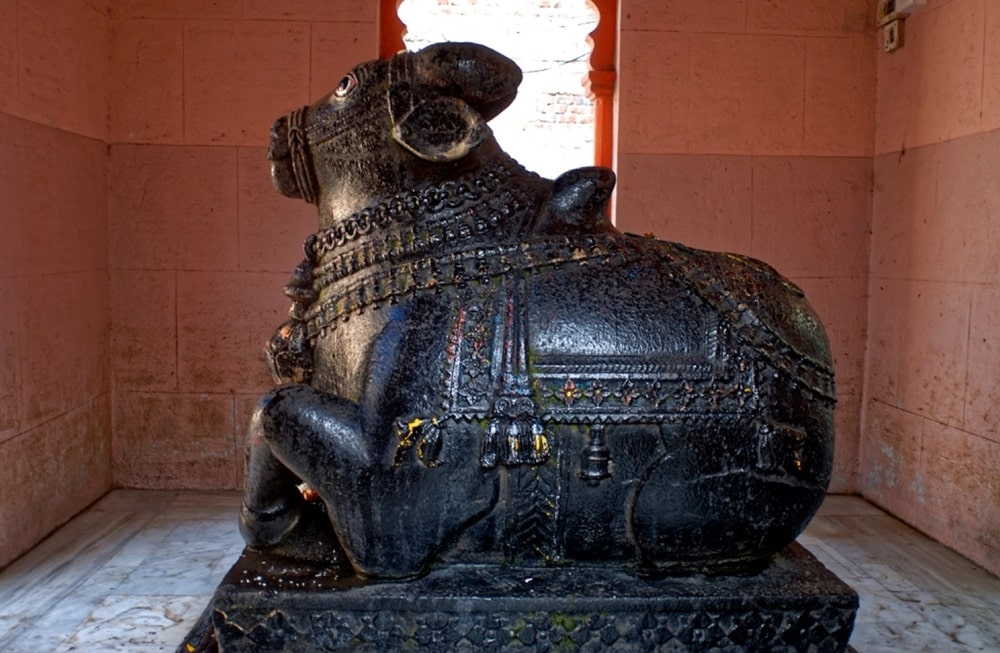
In the late nineteenth and early twentieth centuries, this temple became a vital center for the Indian freedom struggle. Legendary leaders like Lokmanya Tilak and Swatantryaveer Savarkar regularly gathered here for secret meetings. In 1906, the first historical plan for the boycott of foreign goods was drafted under Savarkar’s leadership in the open space under the temple spire, known as the ‘Talim’. The greatest proof of the structural strength of this temple in modern times was witnessed during the Panshet dam burst of 1961. Even though the temple was completely submerged in the massive flood of the Mutha River, the main structure and its spire survived without any damage. Although the heavy stone Nandi in front of the temple was shifted from its place due to the immense force of the water, this incident proved the robustness of the architectural design.
The architecture of the Omkareshwar Temple, a blend of Maratha and North Indian styles, is truly magnificent. The two-story main entrance, set within the strong stone fortification surrounding the temple, faces east. The tradition of playing the nagara (kettledrum) every Saturday at 7.30 PM in the well-maintained Nagarkhana above the entrance is still preserved today. Inside the entrance, separate rooms for guards can be seen. Crossing this grand gateway, one enters a courtyard surrounded by cloisters that were used as a dharmashala (pilgrims’ rest house) in ancient times.
In the vast courtyard of the temple stands a tall and beautiful deepmala (lamp tower). The gold-plated lamps placed on the deepmala look beautiful at night. In front of the main temple is an independent Nandi Mandapa made of black stone. This Nandi Mandapa, with sculptures of deities like Lord Kalbhairav and Suryanarayan carved on its outer walls, is unique. The Nandi idol is placed on a large vajrapitha (diamond-shaped pedestal), and the circular roof features a small spire and kalash.
In the Yajna Mandapa located in front of the Nandi Mandapa, religious rituals and yajnas are performed during special festivals. The premises also house small temples dedicated to Vishnu, Hanuman, Ganesha, and Shani Maharaj.
One enters the Sabha Mandapa (assembly hall) through the main entrance of the temple. This hall is supported by numerous stone pillars, both circular and square, featuring intricate designs. Along with these uniquely carved pillars, various lotus flower patterns are carved into the ceiling. The entrance to the sanctum sanctorum is covered with brass plating. On the lintel of the entrance, an idol of Ganesha and sculptures of fly-whisk-bearing attendants on both sides can be seen. The sanctum, which is about three feet below ground level, houses the Shiva Linga with the Bana brought from the Narmada River. There is a circumambulation path (pradakshina marg) around the sanctum.
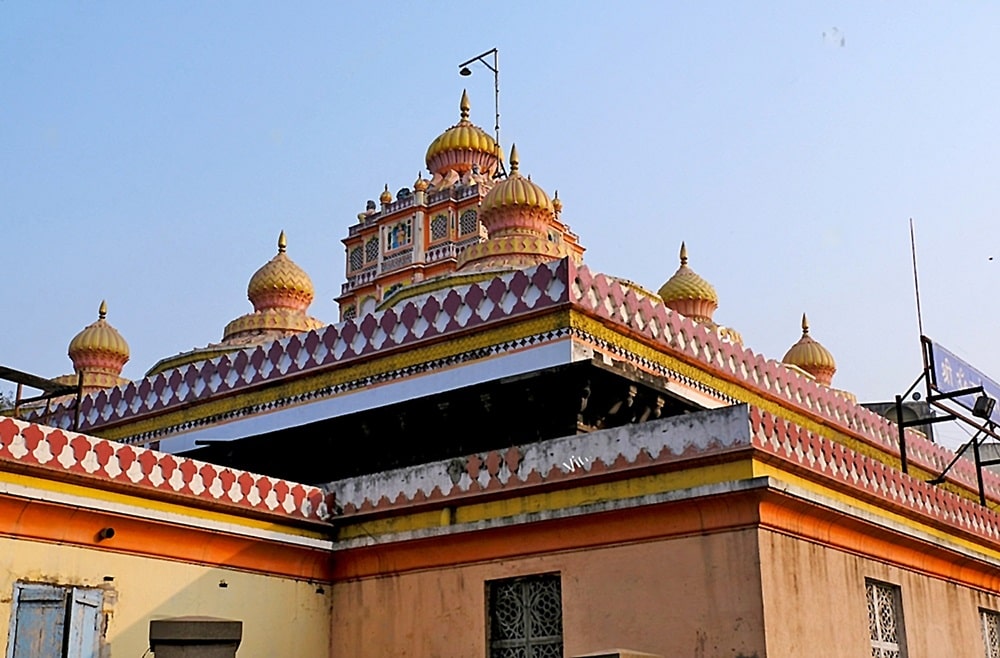
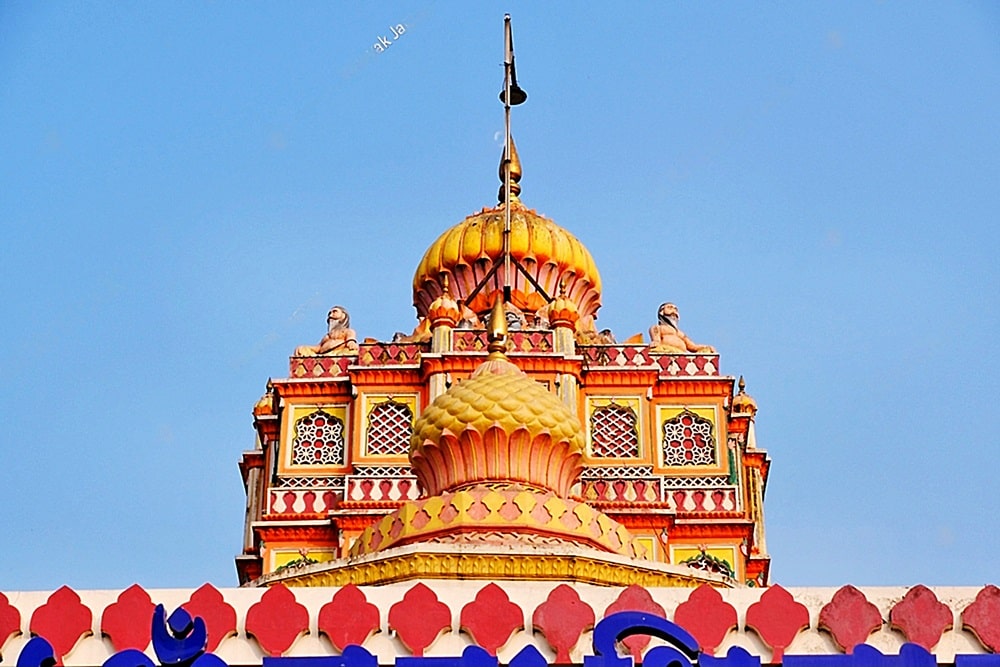
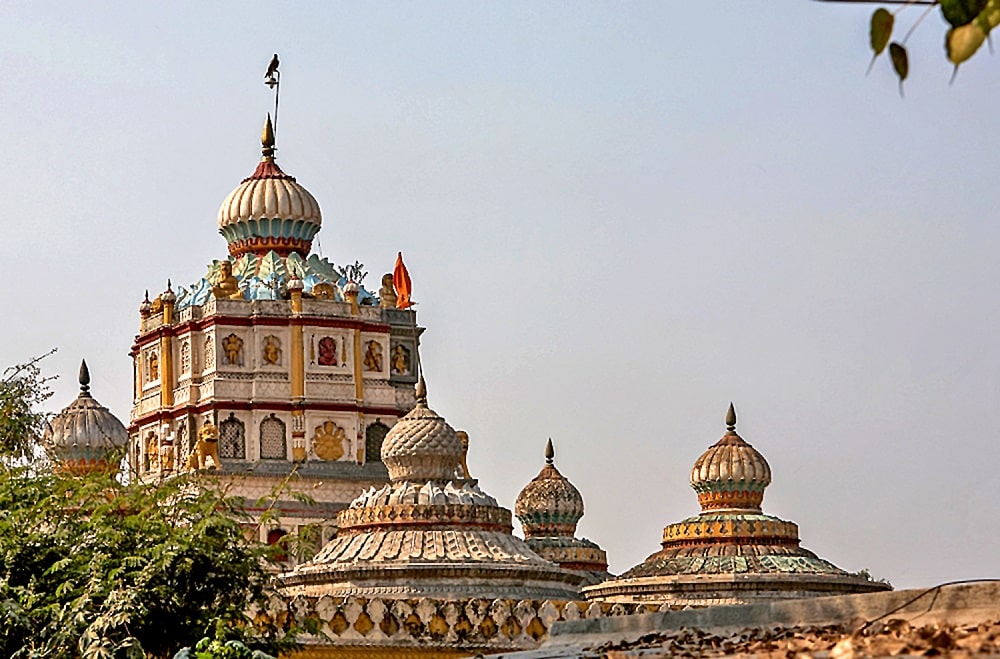
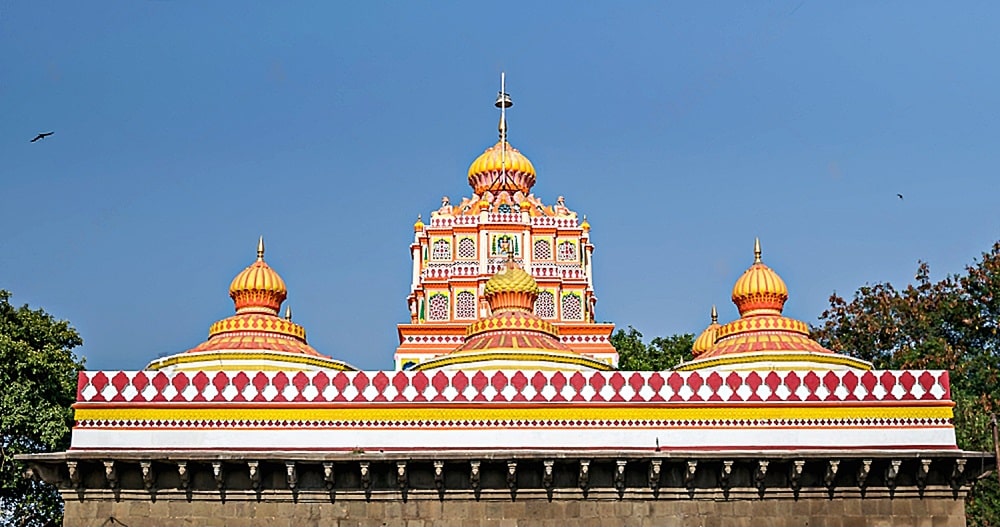
The roof of this temple features nine dome-shaped spires. They are systematically arranged with eight smaller spires surrounding the main central spire. The main spire, made of soft white crystalline stone, is five-tiered. On each level of this spire, rare sculptures of Vyasa Maharshi, Dattatreya, and a straight-trunked Ganesha are carved. The influence of Mughal architecture is evident in the style of the spires. In the niches of these spires, where sculptures of sages are carved at the corners, lamps were once lit on Mahashivratri to illuminate the entire temple.
Following the Peshwa-era traditions, the daily rituals and customs in the temple are still observed in a disciplined manner. Due to the thick black stone walls of the temple, the atmosphere remains cool in summer and warm in winter. Specific rules are followed to enter the sanctum sanctorum. It is mandatory for men to wear a dhoti-sadra and for women to wear a saree or a Punjabi dress with an odhni. Wearing revealing clothing is considered prohibited in the temple.
Throughout the year, various festivals and celebrations are observed in the temple with great enthusiasm. On Mahashivratri, a special Maharudra ritual is performed here. Every Monday during the holy month of Shravan, special decorations and bhajan-kirtan sessions are organized in the temple. In the month of Vaishakh, there is an ancient tradition of applying a sandalwood paste (Chandan-Uti Abhishek) to the deity to provide relief from the intense summer heat. On Gudi Padwa, Diwali, and Vasant Panchami, the deity is adorned with a historic mask and magnificent attire. The tradition of female priesthood, initiated by Anandibai Lonkar, is a modern hallmark of this temple. This tradition, observed during the Mahashivratri Homa-Havan, continues to this day. Devotees can visit the temple for darshan daily from 6:00 AM to 1:00 PM and from 5:00 PM to 10:00 PM.
This sacred temple stands as a testament to deep spiritual devotion, ancient architectural grandeur, and rich local cultural traditions.
The sanctum sanctorum houses the divine idol consecrated according to ancient Vedic traditions, surrounded by serene courtyards and traditional temple architecture.
Navratri, Maha Shivratri, Annual Temple Jatra & Deepotsav
Compare and book flights, secure top-rated local hotels near the temple, hire reliable guides, and rent cars instantly.
Extend your pilgrimage by visiting other highly sacred temples located nearby.

Add ₹999 more to unlock FREE SHIPPING!
Your sacred cart is currently empty.
Shop Photo FramesFill in your delivery details below to place your order.
Add comment