
Add ₹999 more to unlock FREE SHIPPING!
Your sacred cart is currently empty.
Shop Photo FramesIt is believed that Yamai Devi is a manifestation of Renuka Devi, the mother of Parashurama and the wife of Jamadagni. The original seat of Yamai Devi is at Aundh in Satara district, where the Goddess is known as Moolmaya. There are many temples of Yamai Devi across Maharashtra, Andhra Pradesh, and Karnataka. Among them, one famous temple is located in Chafeban, near Wadi Ratnagiri in Panhala taluka. Legend has it that the Goddess traveled from Aundh in Satara to Chafeban. It is said that the pilgrimage to the southern King Jotiba is considered incomplete without the darshan of this Goddess.
The legend regarding this seat of Yamai Devi is mentioned in the Marathi scripture ‘Kedarvijay’. ‘Kedarvijay’ was originally a Sanskrit text, which was brought into Marathi by Hari Angarpurkar in 1779. This text consists of 36 chapters, and the story of Yamai Devi is narrated in the 27th chapter. The legend states that Kedarnath accepted the task of re-establishing Lakshmi, who had been exiled from Karveer due to the havoc caused by Kolhasura. In that southern campaign, Yamai Devi was the assistant of Kedarnath. She slew the demon Aundhasura, a member of Kolhasura’s demonic army, which cleared the path for Kedarnath in the south. The place where this occurred came to be known as Aundh
. This village is in Satara district. Yamai Devi appeared on the Kanthagiri hill near Aundh to destroy Aundhasura. Since Yamai is the primordial Maya, Kanthagiri later came to be known as Moolgiri, which is the original seat of Yamai Devi.
After the successful completion of the southern campaign, at the request of Mahalakshmi, Kedarnath (Jotiba) began residing at Wadi Ratnagiri. Mahalakshmi established a throne on the Wadi Ratnagiri hill and performed his coronation. Mahalakshmi forgot to invite Yamai Devi to that ceremony, which caused Yamai Devi to become offended. Chopdai (Charpatamba) Devi brought this to the attention of Kedarnath. To appease her, Kedarnath set out for Aundh on the day of Chaitra Shuddha Ekadashi. He reached Aundh on Chaitra Shuddha Purnima. Upon seeing him, Yamai closed the doors. Seeing this, Kedarnath, along with all the gods, offered prayers to Yamai. For three years, he visited this place during the month of Chaitra. Thereafter, Yamai told him, “Do not take the trouble of coming to the original seat anymore; I shall come to you at Ratnagiri.” Accordingly, Yamai appeared in Chafeban on the northern side of the Ratnagiri hill.
The history of this temple is that Ranoji Shinde, a devotee of Jotiba from the Shinde dynasty of Gwalior, built the current temple in 1730 AD. The Shindes were a valiant dynasty of the Maratha Empire. The Shinde dynasty rose to prominence starting from Ranoji Shinde. He served in the infantry under Peshwa Balaji Vishwanath. Six years later, in 1722, the first Bajirao Peshwa made him a Bargir. Between 1728-29, Chimaji Appa, with the help of the Shindes, Holkars, and Pawars, conquered Malwa. At that time, they divided the conquered territory among these three commanders. Ranoji’s share included a region yielding 65.5 lakh out of the 1.5 crore revenue of Malwa. After this, the Shindes established themselves in Malwa and eventually founded their kingdom there. Immediately after taking charge of Malwa, Ranoji Shinde built the temple of his family deity, Jotiba. At the same time, he also built the temple of Yamai Devi.
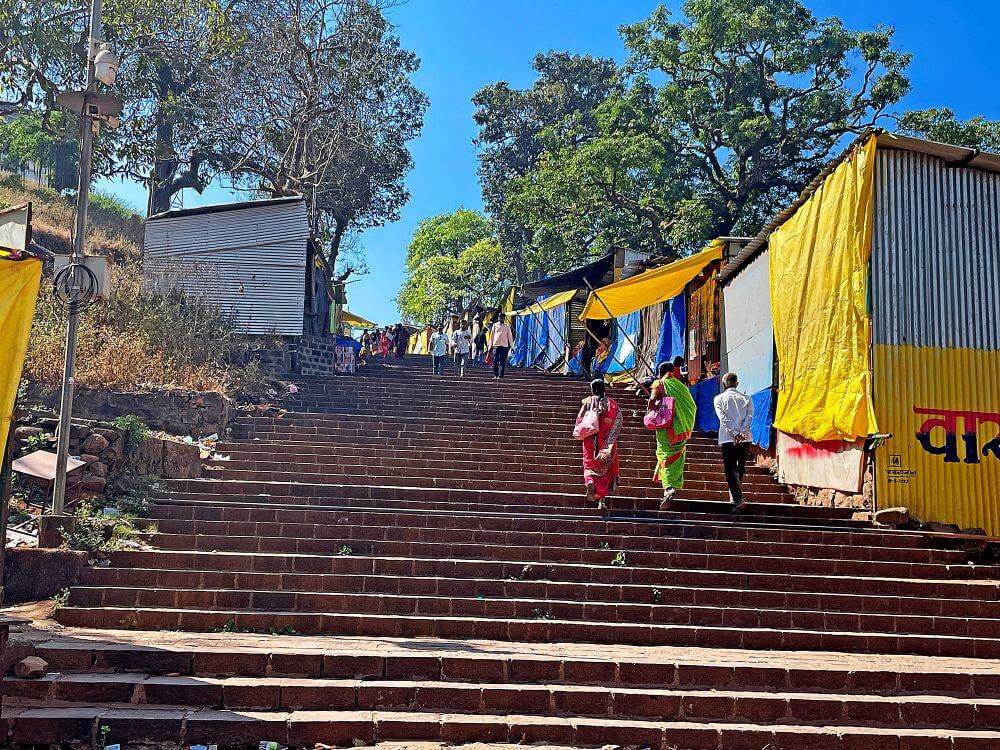
This east-facing temple is built of stone in the Hemadpanti architectural style. One enters the temple courtyard by descending about 50 steps from a spacious parking lot located at some distance from the temple. There are shops selling worship materials on both sides of this stairway. The temple structure consists of a Sabha Mandap (assembly hall) and a Garbhagriha (sanctum sanctorum). There are high platforms and sub-entrances on both sides of the main entrance of the temple. These sub-entrances are used for the darshan queue during crowded times.
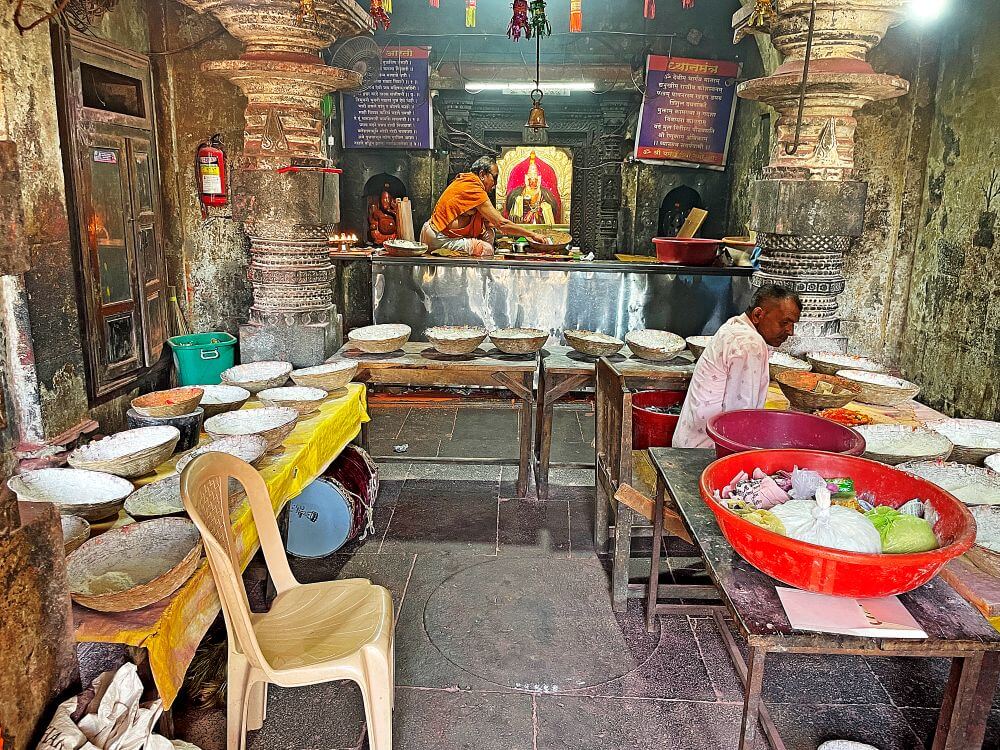
The door frames of the entrance are carved with floral and leaf patterns, and an ornate torana is carved on the horizontal beam of the pillars on the outer side. An idol of Ganesha is seated on the lintel. The Sabha Mandap has carved stone pillars. These pillars are wider and square at the base, while in the upper part, they are hexagonal, circular, octagonal, and dodecagonal in structure. The Sabha Mandap here is of a closed type (Gudhamandap). There are windows on the right and left walls for sufficient light and air. Benches are placed in this Sabha Mandap, on which many baskets are kept. After the fulfillment of vows, devotees offer flour and salt in these baskets.
In the Garbhagriha, there is a self-manifested (Swayambhu) stone idol of Yamai Devi on a Vajrapitha. The Goddess looks beautiful, adorned with a silver crown on her head, earrings, golden eyes, a nose ring, various ornaments, and a saree. Different decorations are made here on various occasions. There is a golden sheet decoration on the back slab of the idol. On it, there is a Kirtimukha and floral patterns at the top, and carvings of attendants at the bottom. A sword is kept beside the idol. There are niches on both sides of the Vajrapitha. In them, there is an idol of Ganesha on the right and a local deity on the left.
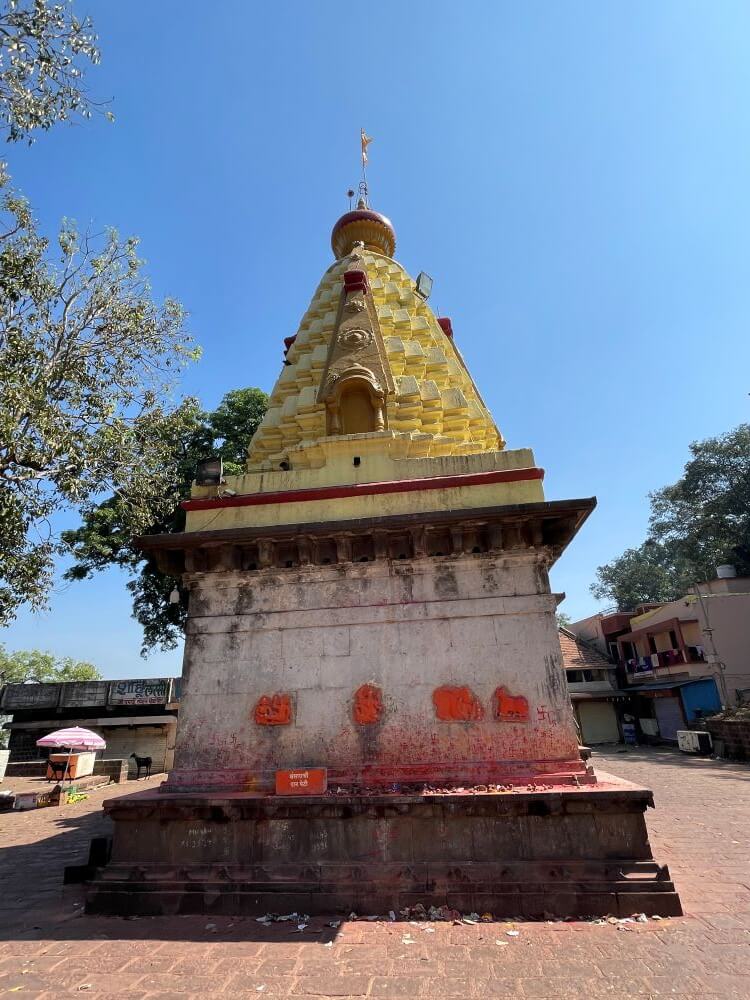
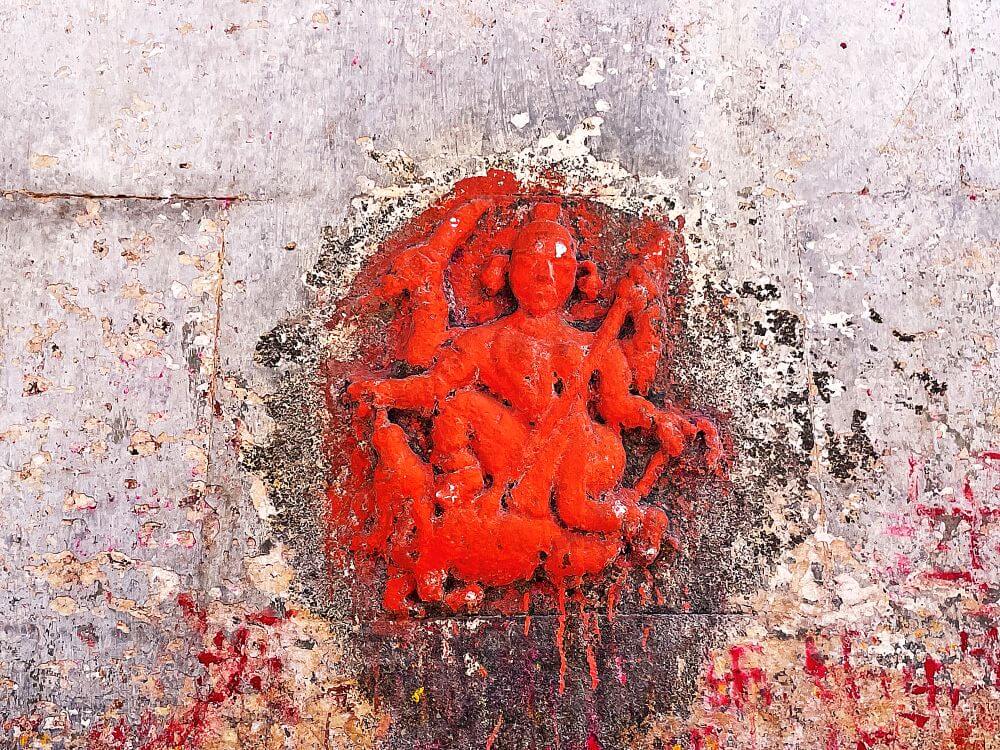
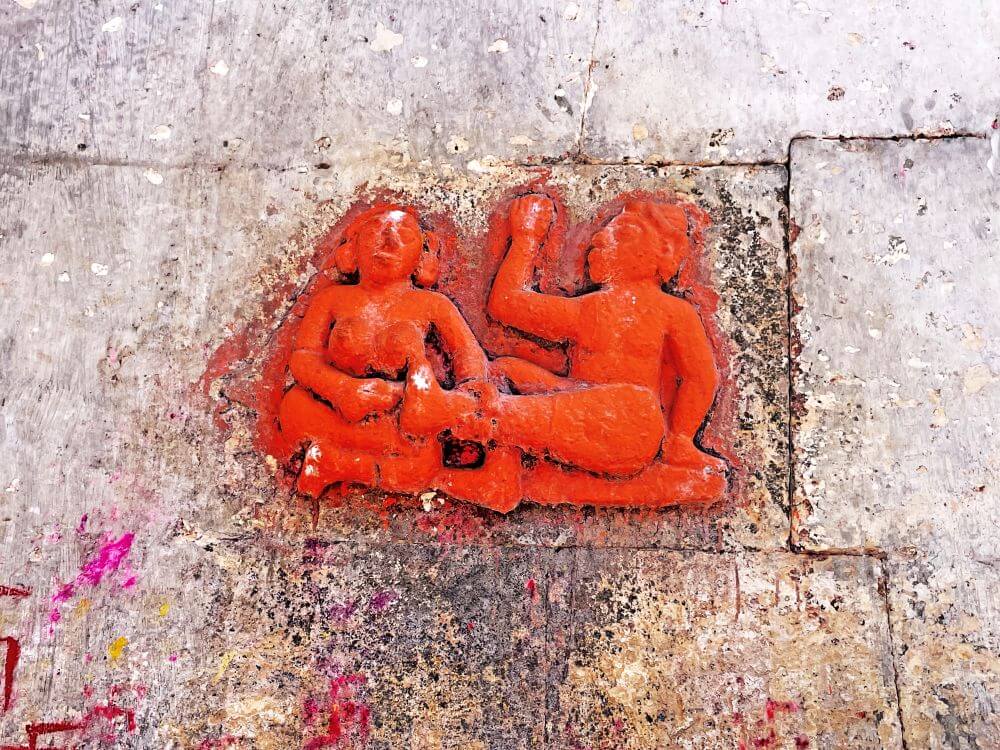
On the outer walls of the temple’s Garbhagriha, there are excellent examples of 18th-century Maharashtrian style relief sculptures. On the wall at the back of the Garbhagriha, there is a sculpture of a half-human, half-animal figure performing an abhishek on a Shiva Linga. This is a sculpture of Vyaghrapada Rishi, and in front of it is a Nandi sculpture. Beside this is a sculpture of Mahishasuramardini. According to some scholars, this Goddess is Yamai herself in the form of Aundhasurasuramardini. Similarly, there is also a sculpture of Anantashayana Vishnu here. However, according to local belief, this sculpture depicts a young woman removing worms from her brother’s feet. It is said that there is a story of sisterly love behind this sculpture. It is told that once a brother kicked his sister, which caused worms to grow in his feet. Seeing this, the sister felt sorrow and took her brother’s foot on her lap to remove the worms. That story is depicted in the sculpture here.
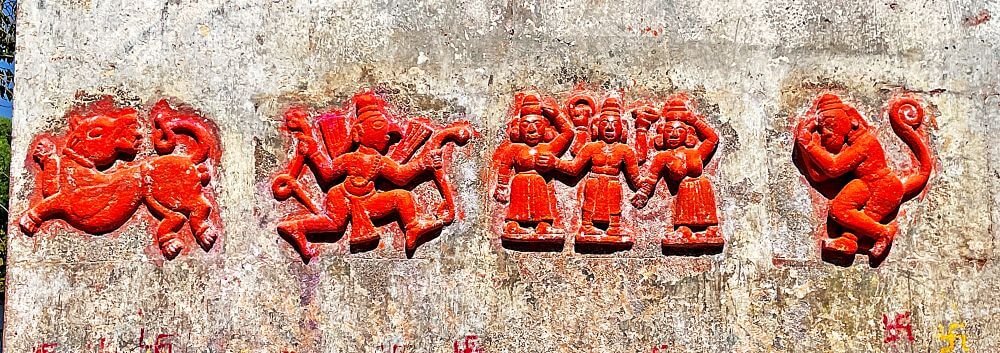
On the right-side wall, there are sculptures of a Vyala, Garuda holding a serpent in his hands, and Hanuman in a humble posture with his hand touching his forehead. Between the sculptures of Garuda and Hanuman, there is a sculpture of Krishna and the Gopis. Notably, the Krishna depicted here is four-armed, holding a Sudarshana Chakra and a Shankha in his two rear hands. With one of his front hands, he holds the hand of a Gopi, while his other hand is positioned near the Gopi’s waist. Both Gopis have pots of curd and milk on their heads, which they are holding with one hand. The influence of the eighteenth-century Gavalan poetic genre is clearly visible in this sculpture. On the outer left wall of the sanctum sanctorum, scenes from the Ramayana are carved. The sculptures of Hanuman and Shri Ram featured here are distinctive.
Below the sculptures on the rear wall of the sanctum sanctorum, many Swastika symbols can be seen drawn with vermilion. Similarly, many flat stones are seen scattered on the parapet wall there. Many newlywed women stack seven flat stones one on top of the other, like a game of Lagori. These stones are considered a representative form of the Saptapadi. It is the belief of the women that if seven stones are stacked one above the other here and the stack remains upright, their married life across all seven births will be happy. At this time, women draw the Swastika symbol, a sign of auspiciousness, on the temple walls with vermilion.
The Shikhara above the sanctum sanctorum of the Yamai temple is similar to the Shikhara of the Jotiba temple. Since many pillars are mounted on this Shikhara, which tapers towards the top on all four sides, it gives the impression of being constructed entirely of pillars. Likewise, decorated niches are visible on all four sides of the Shikhara, although they do not contain any deity idols. The Shikhara is topped by an Amalaka with lotus petals carved on its lower side, and a Kalasha above it. There are two temple tanks or Tirthas in the courtyard of the Yamai temple. One of these Tirthas was built by Jijabaisaheb in 1743, and the other, the ‘Jamadagnya Tirtha’, was built by Ranoji Shinde. It is the belief of devotees that bathing in the water of the Tirtha, which has stone steps and a parapet, cures skin diseases.
The five-day Chaitra Purnima Vasantotsav is the main annual festival of this temple. On the afternoon of Chaitra Purnima, the Palkhi of Lord Jotiba arrives from the Jotiba hill, accompanied by Sasanakathis and other royal entourages, to visit Goddess Yamai. In the January 1976 issue of ‘Navabharat’, sponsored by the ‘Pradnya Pathashala Mandal’ of Wai and the ‘State Literature and Culture Board’, the renowned researcher Ra. Chin. Dhere provided information about this festival as follows: ‘The main part of the Chaitri Purnima festival is Jotiba’s procession to Yamai for the wedding… The Palkhi arrives in front of the Yamai temple around 3 o’clock in the afternoon. Then, the Palkhi is placed on the platform in front of Yamai; but surprisingly, as soon as Yamai realizes that Jotiba has come to marry her, she immediately shuts her door… Then, the wedding ritual is performed by placing a dagger before the Goddess.’
According to the explanation in the ‘Kedarvijaya’ regarding this, Yamai was originally Renuka, the wife of Jamadagni. To destroy Aundhasura, Kedarnath called out to her saying ‘Ye Mai’ (Come, Mother). That is how she came to be named Yamai. When Kedarnath went to her original place in Aundh to appease her, she shut the temple door upon seeing him. Seeing this, everyone wondered why Yamai had shut the door when the Lord himself had arrived. However, Kedarnath then recounted the story of her previous birth. When Parashurama beheaded Renuka at the behest of Jamadagni, the sage Jamadagni had promised her that they would be reunited. Kedarnath’s sword contained a portion of Jamadagni’s wrath; in other words, it contained Jamadagni himself. Realizing that the time for the fulfillment of their promise to reunite had come, Kedarnath had Yamai married to his sword, which represented Jamadagni. The great scholar and researcher of deities and folk religion, Ra. Chin. Dhere, states in this regard: ‘Even though the mythological stories link this deity to Shiva, known as Kedarnath in the Himalayas, in reality, his worldly form remains intact. Like Khandoba, he is a deity of the pure Kshetrapal category. A folk goddess like Yamai is his wife.’ Thousands of devotees are present during this festival. Apart from this, annual festivals like Sharadiya Navaratrotsav, Shakambhari Navaratrotsav, Dussehra, and Diwali are also celebrated in the temple. There is a tradition of offering ‘Jogwa’ of salt and flour to the Goddess.
This sacred temple stands as a testament to deep spiritual devotion, ancient architectural grandeur, and rich local cultural traditions.
The sanctum sanctorum houses the divine idol consecrated according to ancient Vedic traditions, surrounded by serene courtyards and traditional temple architecture.
Navratri, Maha Shivratri, Annual Temple Jatra & Deepotsav
Compare and book flights, secure top-rated local hotels near the temple, hire reliable guides, and rent cars instantly.
Extend your pilgrimage by visiting other highly sacred temples located nearby.


Add ₹999 more to unlock FREE SHIPPING!
Your sacred cart is currently empty.
Shop Photo FramesFill in your delivery details below to place your order.
Add comment