
Add ₹999 more to unlock FREE SHIPPING!
Your sacred cart is currently empty.
Shop Photo FramesThe city of Miraj in the Sangli district, blessed with a rich historical, cultural, and spiritual heritage, possesses many unique characteristics. The most significant attraction here is the Talya-varil Ganpati Temple. This temple holds a history dating back to the princely state era. Since Lord Ganesha was the presiding deity of the Patwardhan dynasty, they established many Ganesha temples in Sangli and Miraj. One of them is the Talya-varil Ganesha Temple. It was named Talya-varil Ganesha Temple because it is situated in front of the Ganesha lake. Devotees believe that the Ganesha here, who is a center of faith for the devotees of Miraj, is spiritually awakened and grants the wishes of those who pray with sincerity.
Harbhat Balambhat, the progenitor of the Patwardhan dynasty that ruled the Sangli-Miraj state, originally hailed from the village of Kotawade in Ratnagiri. He held the hereditary position of Gramopadhye there. Due to poverty at home, Harbhat moved to Ganpatipule, where he worshipped Lord Ganesha for twelve years. Through his acquaintance with Naro Mahadev, a minister to the Kolhapur commander Santaji Ghorpade, he came to Kapshi in the Ghat region and began serving as the family priest for the Ghorpades. Among Harbhat’s seven sons, Trimbak Hari, Govind Hari, and Ramchandra Hari earned great renown for their valor during the Peshwa era. Of these, Govind Hari received the jagir of Miraj, along with Mangalwedha and Kurundwad, from Shrimant Nanasaheb Peshwa. It was Gangadharrao, the son of this Govind Hari, who constructed the Ganesh temple by the lake.
Chintamanrao Appasaheb Patwardhan, the founder of Sangli city and the princely state, was the nephew of Gangadharrao. When Chintamanrao was young, Gangadharrao managed all the affairs of the state. He was religious by nature. He built the ghat on the Krishna River in Miraj and the Markandeshwar temple, as well as the Madhavji (Vishnu) temple in the local fort. The temple was built. Since Ganesha was their presiding deity, they constructed this Ganesha temple in the year 1799. Later, to build other structures within the temple complex, stones were excavated from the ground in front, which gave the area the appearance of a pond. Because of this, the temple came to be known as the Talya-varil Ganpati Temple (Ganesha Temple by the Pond). This pond is known as the Ganesha Pond. They named the locality where this temple is situated as Ganesha Peth. Since a Tuesday market is currently held here, this locality is now also known as Mangalwar Peth. Gangadhar Patwardhan had granted the rights for the worship at this temple to Gopalbhat Raghunathbhat Acharya, who resided at Mauje Mopade, Tarf Pernem in the Kudal province. These rights were granted through a deed in 1801, which was two years after its establishment. The time of the temple’s establishment is recorded in this deed.
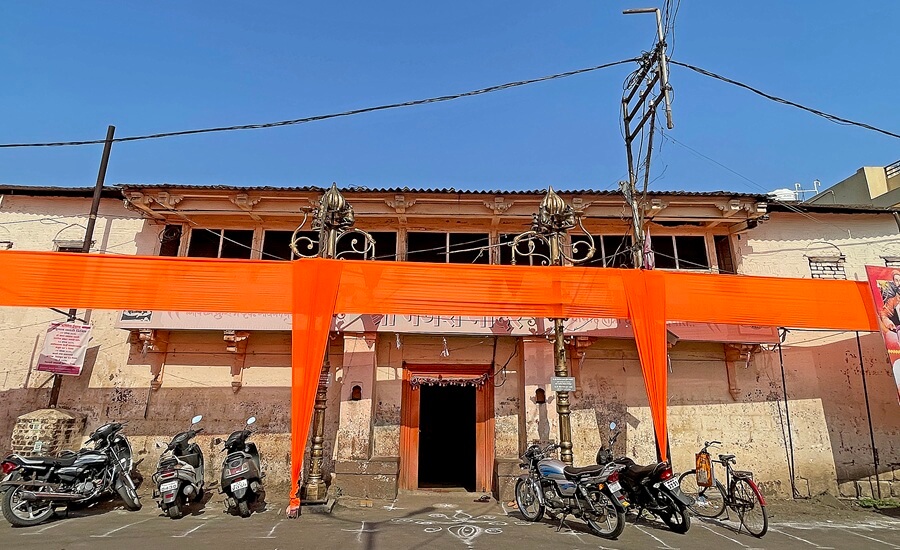
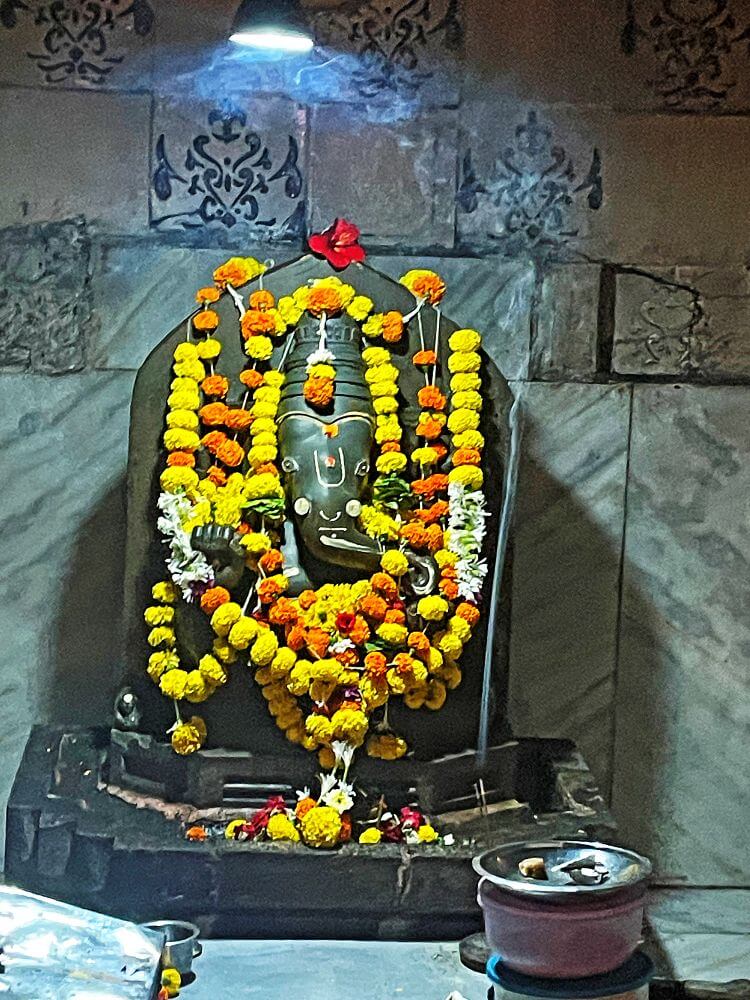
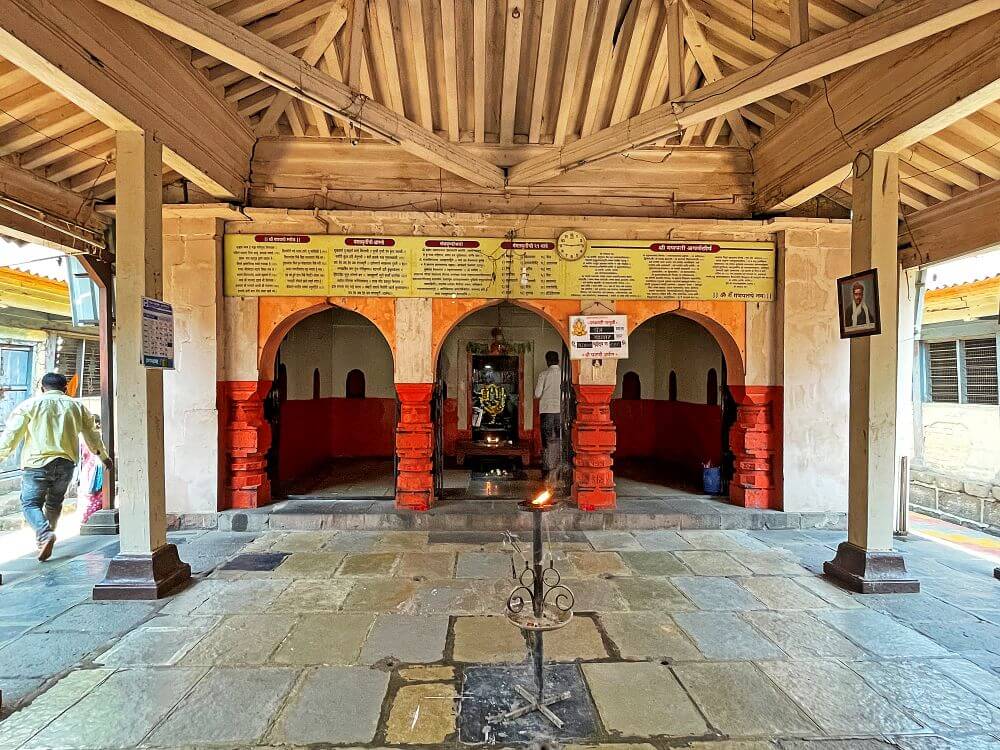
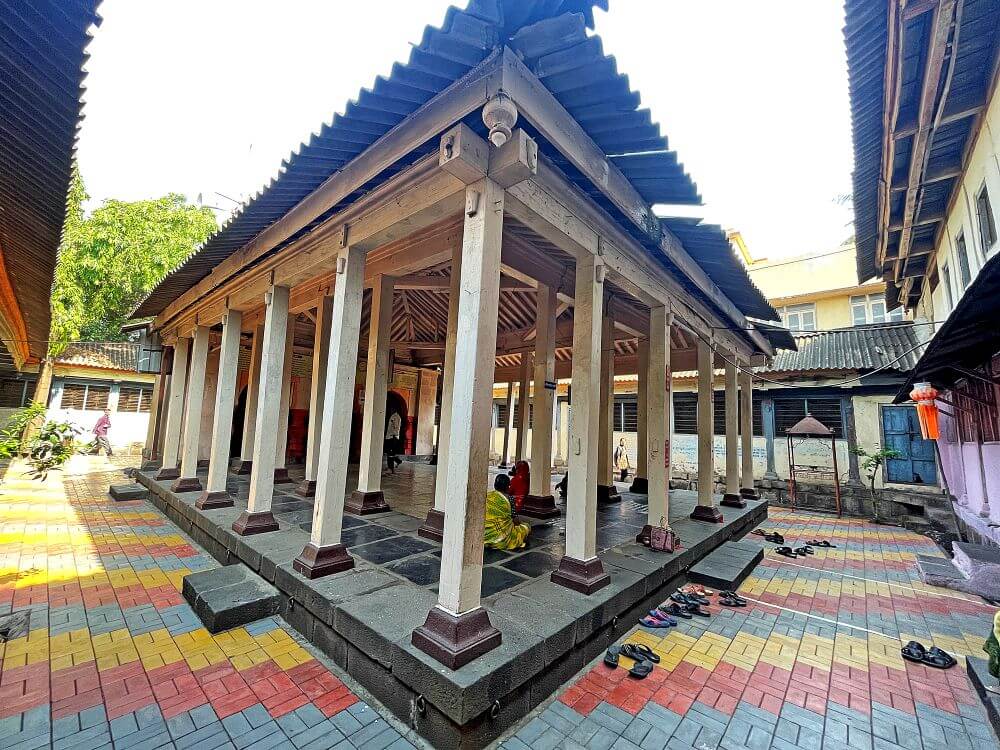
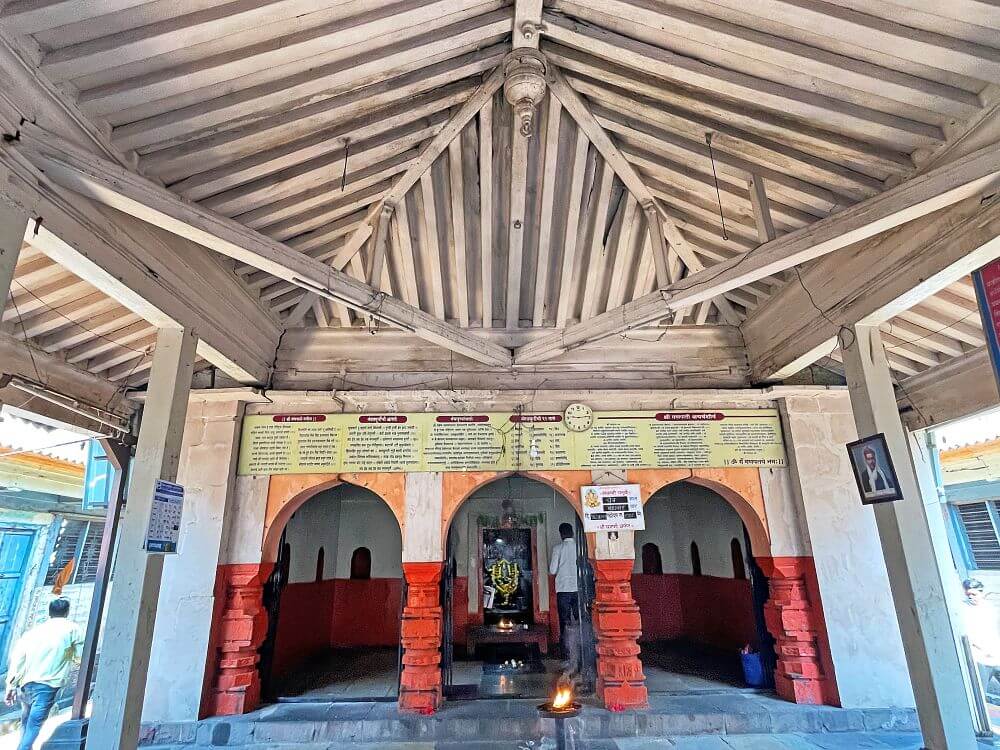
To enter the courtyard from the ground floor of this temple’s two-story fortification There is an entrance gate. There are lamp niches within the ornate pillars on both sides of the entrance. The front wall of the second floor features as many as 14 windows. The ornate door frames of the entrance are smeared with vermilion. From here, one enters the temple courtyard, which is paved with paver blocks. The temple is structured into a Sabhamandapa (assembly hall), Antarala (vestibule), and Garbhagriha (sanctum sanctorum). This open-style assembly hall consists of four rows of five square wooden pillars each, with four additional wooden pillars in the center. All the wooden pillars stand on square stone bases. Beyond the assembly hall lies the Antarala and Garbhagriha, built entirely of stone in the Hemadpanti architectural style. The entrance to the Antarala is characterized by four ornate pillars connected by three semicircular arches. There are lamp niches on both sides of the Garbhagriha entrance within the Antarala. An Utsava Murti (processional idol) of Lord Ganesha is placed on a table in the Antarala. From here, one must take the Darshan of the Ganesha idol located in the Garbhagriha. Further ahead is the entrance to the Garbhagriha. The door frames feature faint carvings, and there is an image of Lord Ganesha on the Lalatabimba (lintel). Inside the Garbhagriha, there is a four-armed idol of Lord Ganesha seated on a Vajrapitha (diamond-shaped pedestal). This idol, carved from black stone, is exceptionally well-defined. The idol has weapons in its two back hands. The right hand is in a gesture of blessing, while the left hand holds a modak. The ears of the idol are rectangular. The eyes are carved and prominent. Both tusks on the sides of the trunk are half-broken, and there is a serpent on the abdomen.
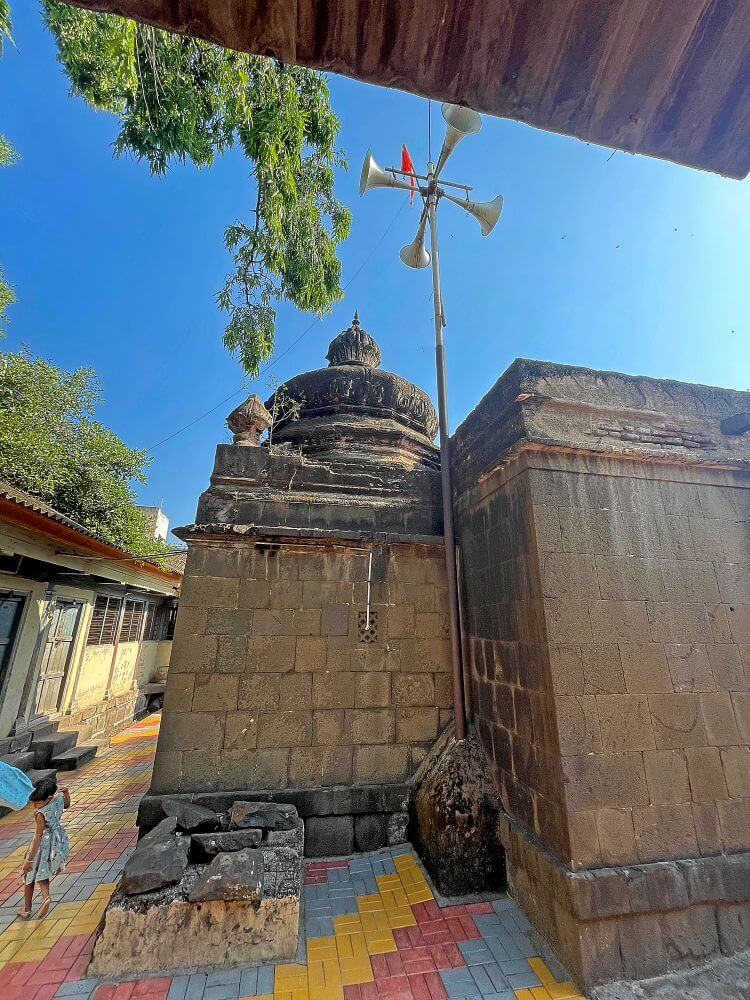
On the ceiling of the sanctum sanctorum, there are four dome-shaped miniature spires at the four corners, with the main spire in the center. The main spire is dodecagonal at the base and dome-shaped at the top. The dome is adorned with lotus flower carvings. At the apex of the spire sits the Amalaka, topped by the Kalasha and the temple flag. In the temple courtyard, there are residences for the priests and several other buildings.
In the temple, Ganesh Jayanti in the month of Magh and the five-day Ganeshotsav in Bhadrapada are celebrated with great enthusiasm. However, an earthen idol of Ganesha is not installed during the Bhadrapada Ganeshotsav. During the festivals, programs such as bhajans, kirtans, discourses, music, and dance are organized in the temple. The crowd of devotees increases in the temple during all annual festivals and on every Sankashti Chaturthi. On these occasions, thousands of devotees come here for the darshan of the deity.
This sacred temple stands as a testament to deep spiritual devotion, ancient architectural grandeur, and rich local cultural traditions.
The sanctum sanctorum houses the divine idol consecrated according to ancient Vedic traditions, surrounded by serene courtyards and traditional temple architecture.
Navratri, Maha Shivratri, Annual Temple Jatra & Deepotsav
Compare and book flights, secure top-rated local hotels near the temple, hire reliable guides, and rent cars instantly.
Extend your pilgrimage by visiting other highly sacred temples located nearby.


Add ₹999 more to unlock FREE SHIPPING!
Your sacred cart is currently empty.
Shop Photo FramesFill in your delivery details below to place your order.
Add comment