
Add ₹999 more to unlock FREE SHIPPING!
Your sacred cart is currently empty.
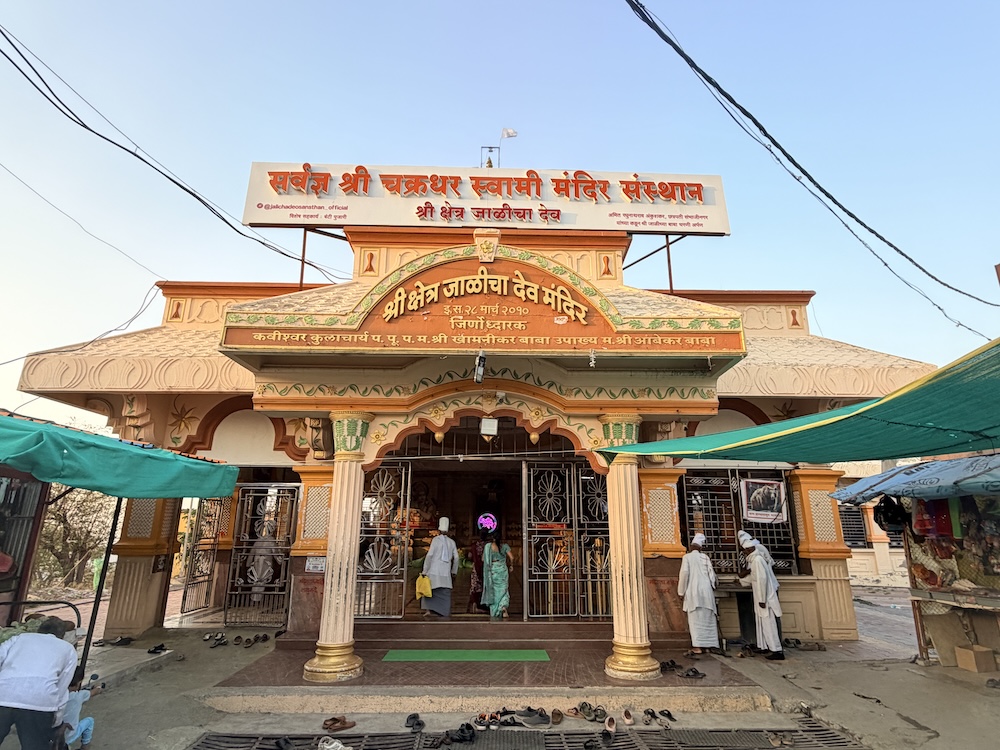
Shop Photo FramesSituated at Jaydevwadi in the Bhokardan taluka of Jalna district, the holy site of Jalicha Dev is an important pilgrimage center of the Mahanubhav Panth. This land gained spiritual and historical significance in the 12th century due to the presence of Sarvagnya Shri Chakradhar Swami. This temple is a symbol of that extraordinary incident where the Swami calmed a tigress. Nestled amidst mountain ranges and picturesque surroundings, devotees visit this temple with great reverence. Because this site is sanctified by the footprints of Shri Chakradhar Swami—one of the five avatars of the Mahanubhav Panth—it holds a place of honor on the religious map of Maharashtra. The Government of Maharashtra has granted this temple the status of a ‘B’ grade pilgrimage site.
In the religious history of Maharashtra, the 12th century proved to be a turning point for the Marathi language and culture. During this period, caste and gender discrimination were prevalent in society. In such times, Sarvagnya Shri Chakradhar Swami founded the Mahanubhav Panth and advocated for humanism. The story of Shri Chakradhar Swami’s incarnation is unique. In the city of Bharvas in Gujarat, Prince Haripaldev, son of King Vishaldev and Queen Malhaisa, died in his youth. As the entire city mourned and the prince’s body was being placed on the funeral pyre, an event occurred, and Haripaldev came back to life. It is believed that Changdev Raul of Dwaravati had entered the lifeless body of Haripaldev through his yogic powers and assumed a new avatar. After the revival of the body, the Swami felt no attachment to the comforts of the royal palace. Using a pilgrimage to Ram as a pretext, he left Bharvas and went directly to Riddhapur. There, he met Shri Govindprabhu Baba, who gave him the name ‘Chakradhar’ and bestowed knowledge upon him.
The Swami traveled across the country, spreading the message of equality and humanity. While moving through Maharashtra, he visited various villages such as Kanashi, Bhadgaon, Pachora, Shendurni, Changdev, Hartala, and Savaldabara. Around the year 1193 Shaka, on the day of Vaishakh Vadya Dashami, the Swami was traveling from Savaleshwar towards Valsavangi. While walking on this dense mountain ridge, he saw two tiger cubs playing in a thicket of Karvanda bushes. The Swami, filled with affection, took the cubs in his arms. Seeing this, the mother tigress rushed towards the Swami. However, as soon as the Swami looked at her, the tigress’s ferocity vanished. She began licking the Swami’s feet like a pet animal. The Swami returned the cubs to the tigress, said, “Mother, take care of your cubs,” and departed. It is because of this incident that this place came to be known as ‘Jalicha Dev’ (The God of the Thicket).
The history of the temple’s construction at this site is also inspiring. Around 1936, a gentleman named Laxmanrao Patil from Vaghoda in Jalgaon district was suffering from leprosy. To be cured of this disease, he began serving at Jalicha Dev. On the twenty-first day of his worship, he received a divine vision from the Lord, and subsequently, his disease was completely cured. Out of gratitude, he resolved to build a temple here. However, at that time, this region was under the control of the Nizam’s rule. To obtain permission for construction, Laxmanrao Patil had to go to the Nizam’s court in Hyderabad. Upon receiving permission, he accelerated the temple work, and the construction of the temple’s Sabha Mandap (assembly hall) was completed in 1942. As the temple deteriorated over time, it was renovated in 2010, giving this pilgrimage site a modern and grand appearance.
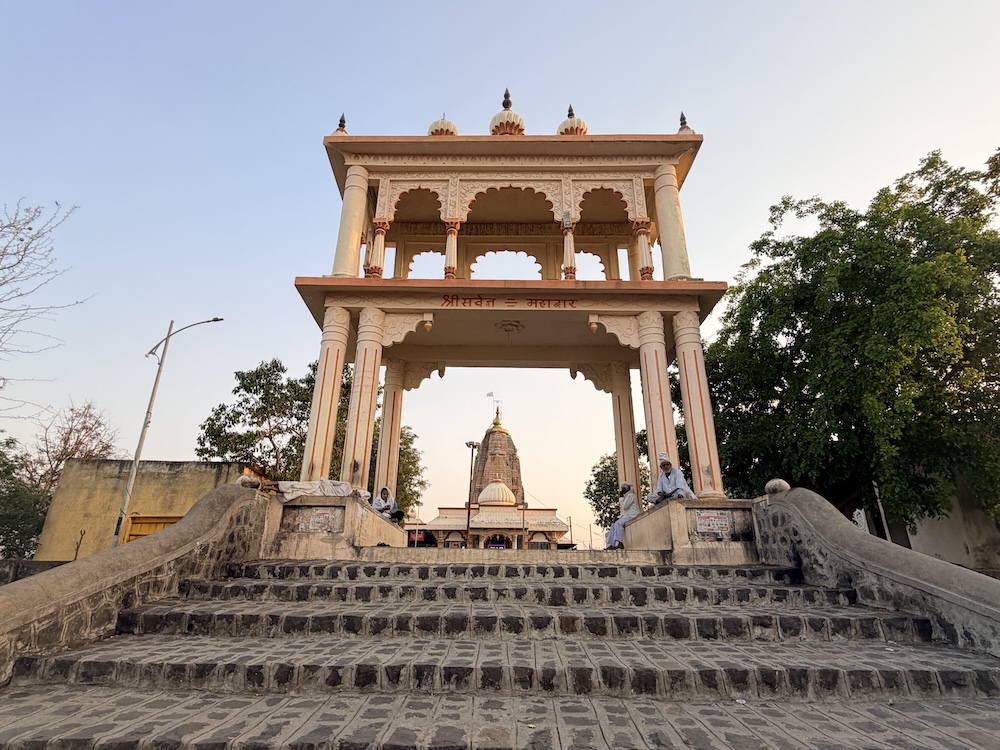
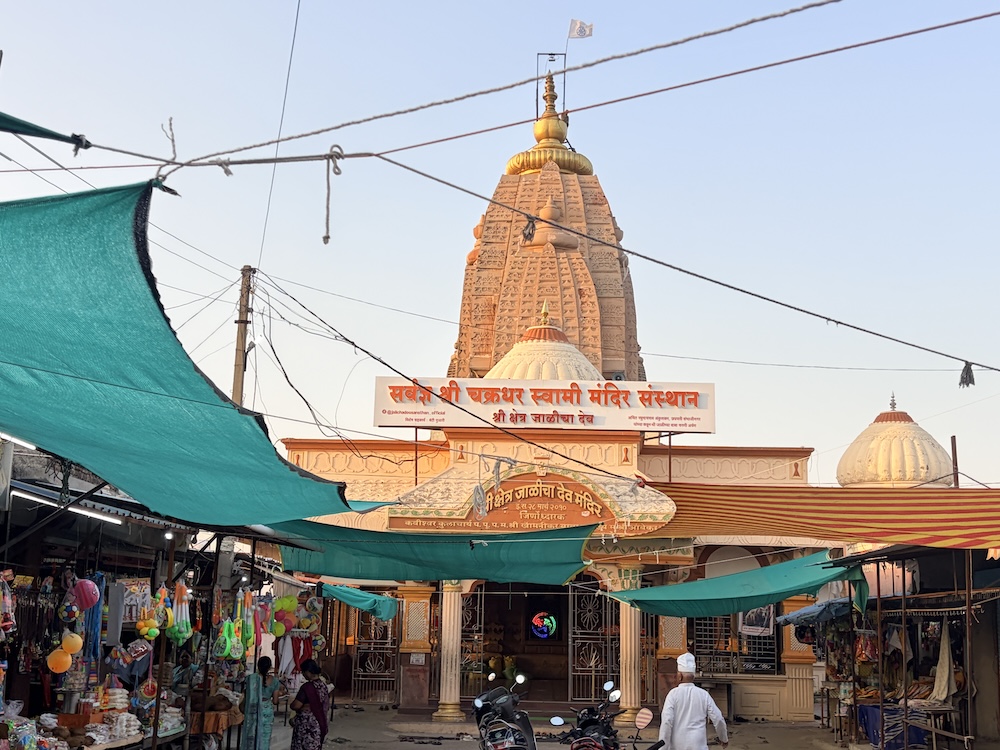
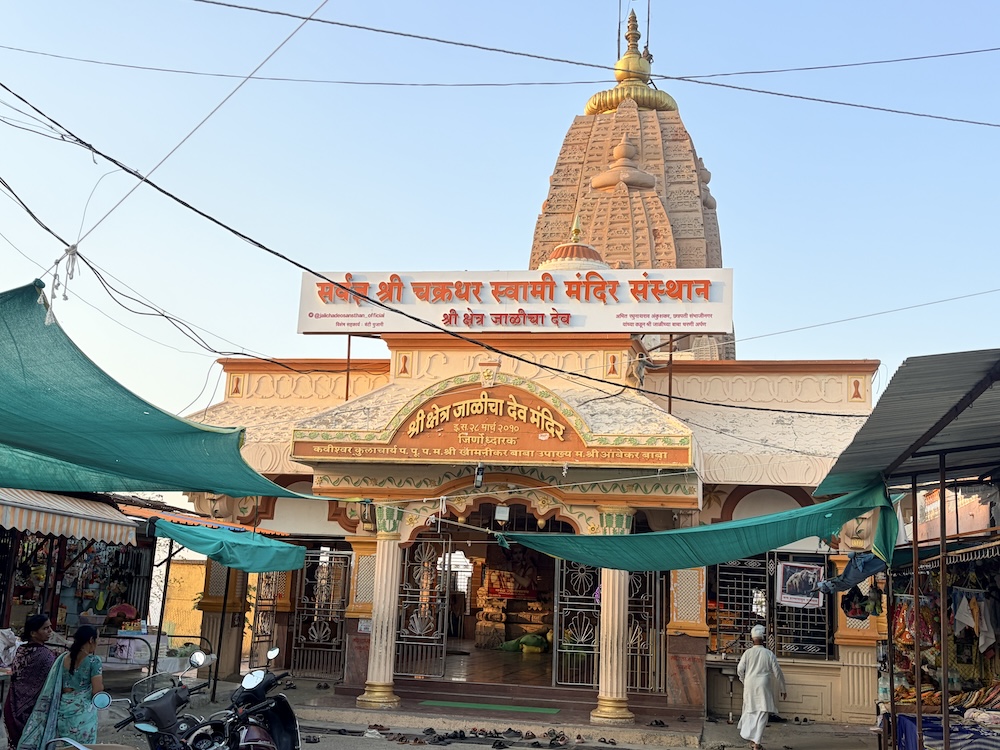
Regarding its geographical location, this place is situated on the border of Jalna and Buldhana districts. After turning towards Jaydevwadi from the main Buldhana-Ajanta road, one sees the first grand welcome arch of the temple. This arch features an idol of Shri Chakradhar Swami, with two tiger sculptures carved on either side. There are many shops selling worship materials and prasad on both sides of the road. Additionally, there is a beautiful stone-carved stairway leading from the foothills for those coming from the direction of Savaldabara village. These stairs have safety railings on both sides, and at the end of the path, there is a two-story welcome arch. The main courtyard of the temple is adorned with paver blocks. In the courtyard, there is an open hall and an Annachhatra (free food service) for devotees. A large pavilion has been built here for the devotees, where they tie coconuts as a vow to the pillars with great faith.
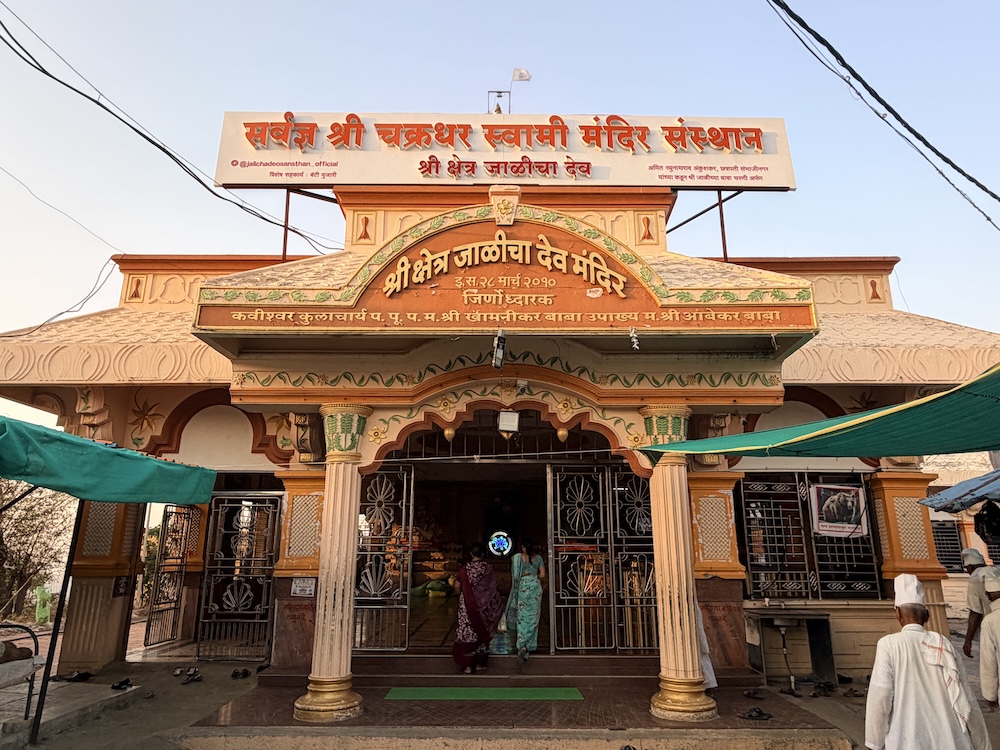
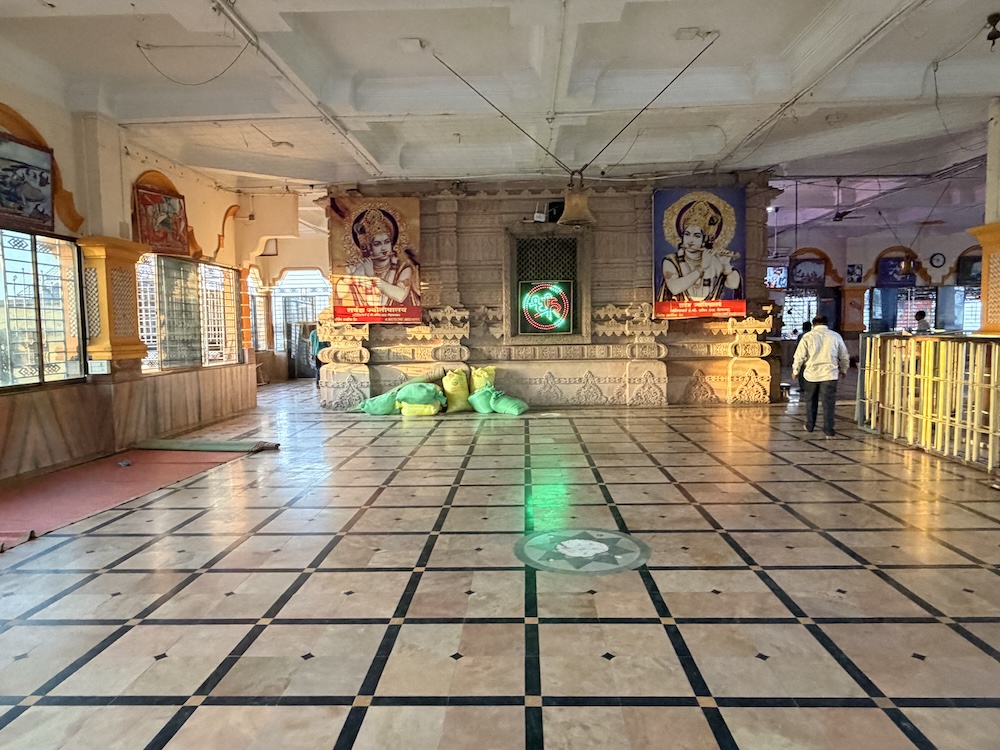
The architecture of the temple reflects a blend of traditional and modern styles. The main temple is divided into three parts: the Mukhamandap (entrance porch), the Sabhamandap (assembly hall), and the Garbhagriha (sanctum sanctorum). The roof of the Mukhamandap is supported by two circular pillars, and there are two square pillars at the entrance of the Sabhamandap. These pillars are connected by an arched torana, which features intricate carvings. The Sabhamandap has entrances on three sides. The entrance to the Garbhagriha has intricate carvings, and the door frames feature sculptures of Dwarapalas (gatekeepers), Dwarpalikas, and Lord Krishna. The lintel depicts the five avatars of Lord Krishna. These five avatars of Shri Krishna are considered extremely important in the Mahanubhav Panth.
In the center of the Garbhagriha, the sanctified footprints of Shri Chakradhar Swami are visible. This spot is on a raised platform, surrounded on all four sides by a gold-plated railing. On this platform stands a serene silver idol of Shri Chakradhar Swami, which is adorned with clothes, ornaments, and a golden crown. There are three niches in the back wall of the Garbhagriha. The central niche contains an image of the Swami with the cubs. The niches on the left and right sides preserve items used by the Swami. A circumambulation path (Pradakshina Marg) is available around the exterior of the Garbhagriha. The design of the temple spire is also unique. There is a circular dome-shaped spire over the Sabhamandap and a tall, square spire over the Garbhagriha. The spire is adorned with smaller spires (Angishikhare), an Amalaka, and a white-colored religious flag (Dharmadhwaja) on all four sides.
Various religious festivals and celebrations are observed here throughout the year. Magh Purnima, also known as Dandi Purnima, is the largest annual festival celebrated here. On this occasion, a seven-day yatra (pilgrimage) is held. Thousands of devotees from across the country arrive for darshan during this time. Throughout the festival, programs such as scripture reading, bhajans, kirtans, and discourses are organized at the temple. A large crowd of devotees gathers to witness and enjoy the Swami’s Palkhi procession. Apart from the main yatra, festivals like Shri Krishna Janmotsav, Shri Chakradhar Swami Jayanti, Govind Prabhu Jayanti, and Gudi Padwa are also celebrated with deep devotion. Mahaprasad is served to devotees daily from 12:00 PM to 2:30 PM and from 6:00 PM to 9:00 PM. Devotees can have darshan daily from 3:00 AM until 9:00 PM.
This sacred temple stands as a testament to deep spiritual devotion, ancient architectural grandeur, and rich local cultural traditions.
The sanctum sanctorum houses the divine idol consecrated according to ancient Vedic traditions, surrounded by serene courtyards and traditional temple architecture.
Navratri, Maha Shivratri, Annual Temple Jatra & Deepotsav
Compare and book flights, secure top-rated local hotels near the temple, hire reliable guides, and rent cars instantly.
Extend your pilgrimage by visiting other highly sacred temples located nearby.


Add ₹999 more to unlock FREE SHIPPING!
Your sacred cart is currently empty.
Shop Photo FramesFill in your delivery details below to place your order.
Add comment