
Add ₹999 more to unlock FREE SHIPPING!
Your sacred cart is currently empty.
Shop Photo FramesAt Shri Kshetra Nagzhari in Khamgaon taluka of Buldana district stands the magnificent Samadhi temple of Gomaji Maharaj, who was the Guru of Shri Gajanan Maharaj. Legend has it that the Payoshni (Purna) River appeared here due to the invocation of Swami Nrusimha Saraswati and the devotion of Gomaji Maharaj. Situated on the banks of the Man River, this sacred site is renowned for its three-and-a-half-century-old Samadhi temple, the Gomukh Kund, and five self-manifested (Swayambhu) Shivlingas known as ‘Panchling Mal’. During the Ashadhi Wari, the Palkhi (palanquin) of Gajanan Maharaj halts here. This pilgrimage site, built in the Hemadpanti architectural style amidst scenic surroundings, is a place of deep faith for thousands of devotees.
This site is situated on the banks of the Man River, a tributary of the Purna River. It is said that the village was named ‘Nagzhari’ due to the ancient Nageshwar Shiva temple located here and the natural springs (zhari) in the area. A detailed description of the origin of the Gomukh Kund is provided in the first chapter of the text ‘Shri Nagzhari Mahatmya’, written by Saint Dasganu Maharaj. According to this, Nrusimha Saraswati, along with his seven disciples, was traveling from Shri Kshetra Karanja to have Darshan of the Trimbakeshwar Jyotirlinga in Nashik. They intended to have Darshan of Trimbakeshwar on Mahashivratri. They arrived at the banks of the Man River on Magh Vadya Ekadashi. The disciples were worried about how they would reach Trimbakeshwar by Mahashivratri. When they expressed this concern to Nrusimha Saraswati, he replied, “By the power of Yoga, you can go to the banks of the Gautami (Godavari) for a bath.” The disciples replied, “We have no knowledge of Yoga Shastra, so that is not possible. Is there any other river in Vidarbha as sacred as the Godavari where we could bathe as if in the Godavari?” Upon this, Nrusimha Saraswati explained the greatness of the Man River to his disciples. He took them to the confluence of the Man and Bordi rivers and asked them to bathe there, considering it to be equivalent to Prayag. After everyone bathed at this confluence, Nrusimha Saraswati and his disciples came to the plateau here, sat facing north, and invoked the Godavari River. At that very moment, with a loud cracking sound, a large pit as deep as a man’s height appeared on the plateau. Believing this pit to be ‘Kushavarta’, they prayed to the Godavari to manifest there. Instantly, a stream of pure Godavari water began to flow from a Gomukh (cow-faced spout) formed in this pit. Everyone bathed in this Kund. Thereafter, Nrusimha Saraswati showed his disciples the five Swayambhu Shivlingas that had manifested there: Nageshwar, Trimbakeshwar, Someshwar, Vishweshwar, and Gupteshwar. It is believed that the Gupteshwar Shivling remains hidden within the Gomukh Kund and is visible only to fortunate devotees. Nrusimha Saraswati stayed here for seven days; this chapter also mentions that the plateau came to be known as ‘Panchling Mal’ due to these five Shivlingas. The confluence of the Man and Bordi rivers is just a few kilometers away.
Over time, Gomaji Maharaj arrived here. A staunch devotee of Shri Krishna, Gomaji Maharaj also had immense faith in Lord Vitthal of Pandharpur. He would stand in knee-deep water in the local Gomukh Kund to perform Bhajans and would meditate in a nearby cave. Another legend is famous regarding the Gomukh Kund. According to it, Gomaji Maharaj used to go to the Purna River daily for his bath. However, due to old age, it became impossible for him to go there every day. Yet, driven by his strong willpower, he would still go to the river. Pleased by his devotion, the Purna River blessed him, saying, “I will manifest in the Gomukh Kund.” As a sign, she asked Gomaji Maharaj to release his staff into the river’s current. While the veracity of this legend is beyond debate, devotees experience that whenever the Purna River floods, the water in the Gomukh Kund also rises rapidly.
Gajanan Maharaj considered Gomaji Maharaj as his Guru. Gajanan Maharaj used to go on the Pandharpur Wari every year. After leaving Shegaon for the Wari, he would come here to have Darshan of Gomaji Maharaj’s Samadhi. The ‘Gajanan Vijay’ text written by Saint Dasganu Maharaj describes the miracles of Gomaji Maharaj. His glory is also sung in the ‘Shri Nagzhari Mahatmya’.
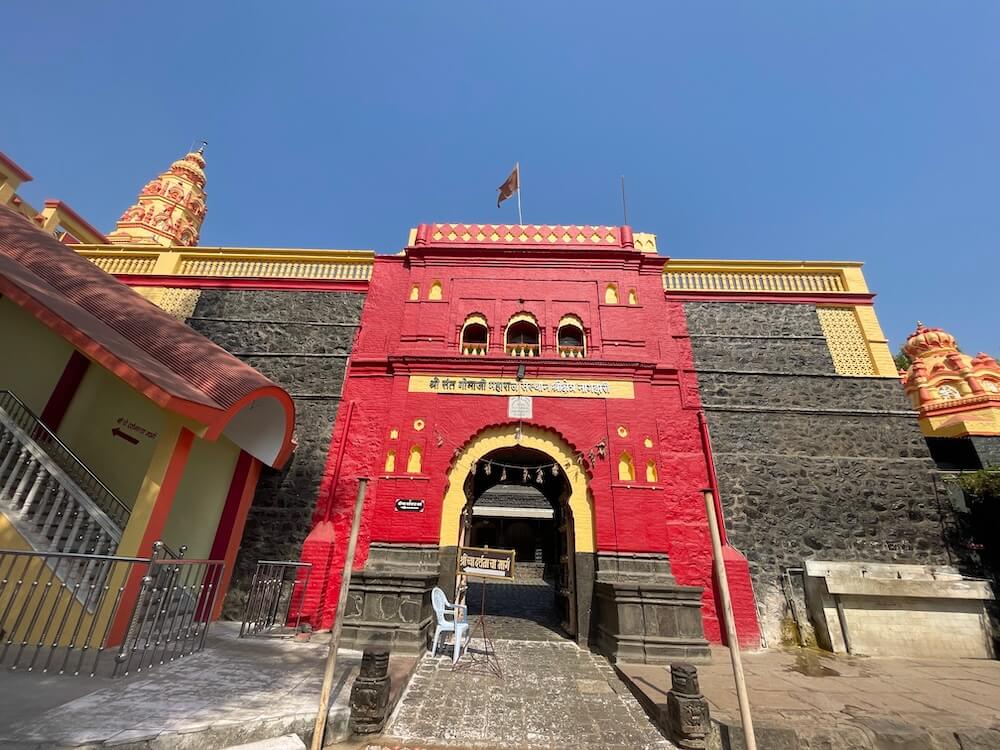
Gomaji Maharaj is also known as the Guru of the family of Karmayogi Shivshankarbhau Patil, under whose guidance the Shegaon Sansthan flourished. Tukaji Mahadji Patil Shegaonkar built the Samadhi temple of Gomaji Maharaj. It is mentioned on the temple entrance that the family of Shrihari Tukaji Patil renovated this temple in 1924.
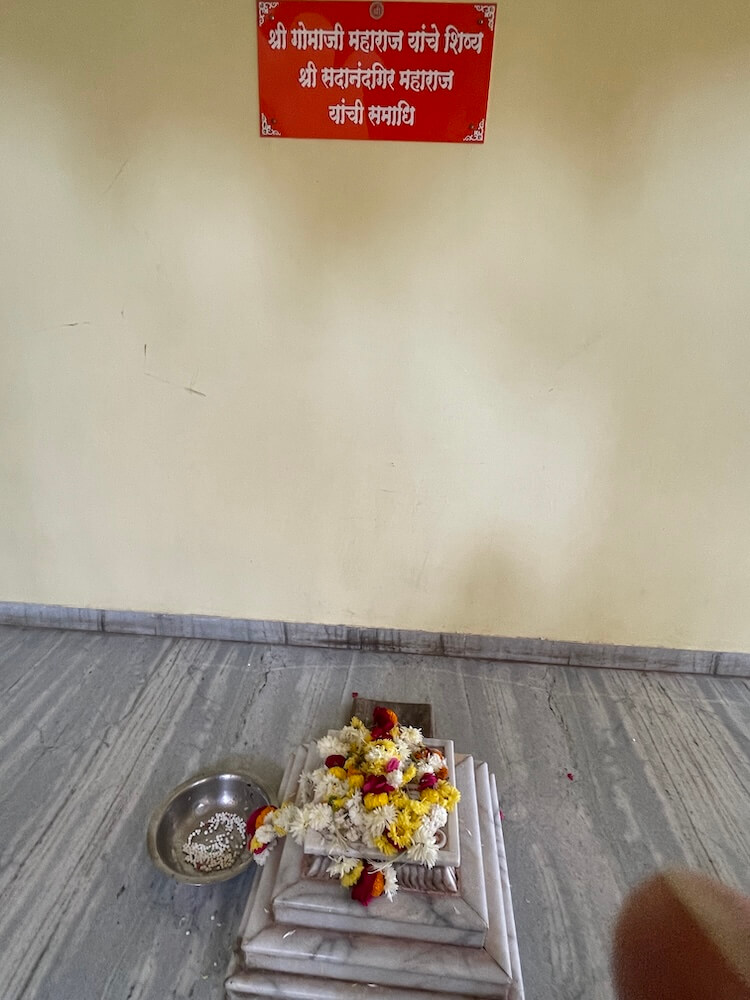
This Samadhi temple is located on the Panchling plateau at Nagzhari. To the north of the Samadhi is the Samadhi of Sadanandgir Maharaj, a disciple of Gomaji Maharaj. The old Nizam government had granted land as an Inam (gift) for this Samadhi temple. The ‘Central Provinces and Berar District Gazetteers – Akola District, Volume A’ (1910) mentions that this temple trust owns 415 acres of Inam land. The temple has attained its current magnificent form due to a recent renovation carried out a few years ago.
This temple is about seven kilometers from Shegaon. Rickshaws are available from the Bhaktiniwas in Shegaon to reach here. One can also arrive by private vehicle. There is also a railway station at Nagzhari. The temple is situated 1.6 kilometers from this station, which lies on the Mumbai-Kolkata route. The Man River flows a short distance from the temple. The Palkhi traveling from Shegaon Sansthan to Pandharpur passes through the road going through Nagzhari, which is why this route is also called the ‘Dindi Marg’. Shegaon Sansthan has built a small temple of Gajanan Maharaj on this route. The Sansthan provides free tea and refreshments for devotees visiting the Samadhi temple of Gomaji Maharaj for Darshan.
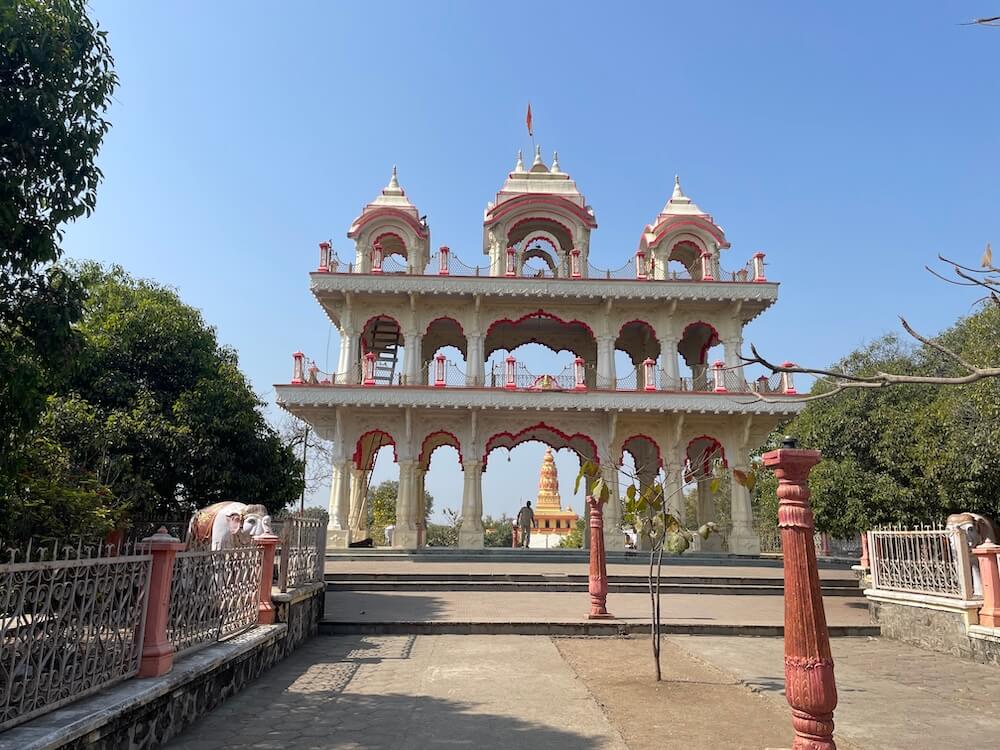
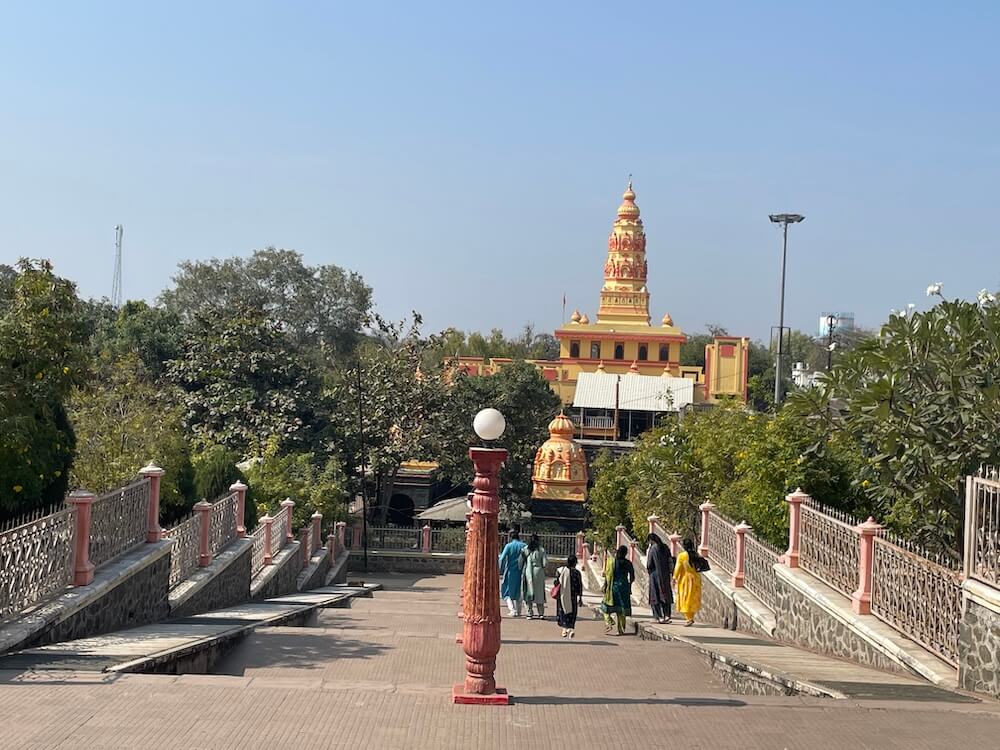
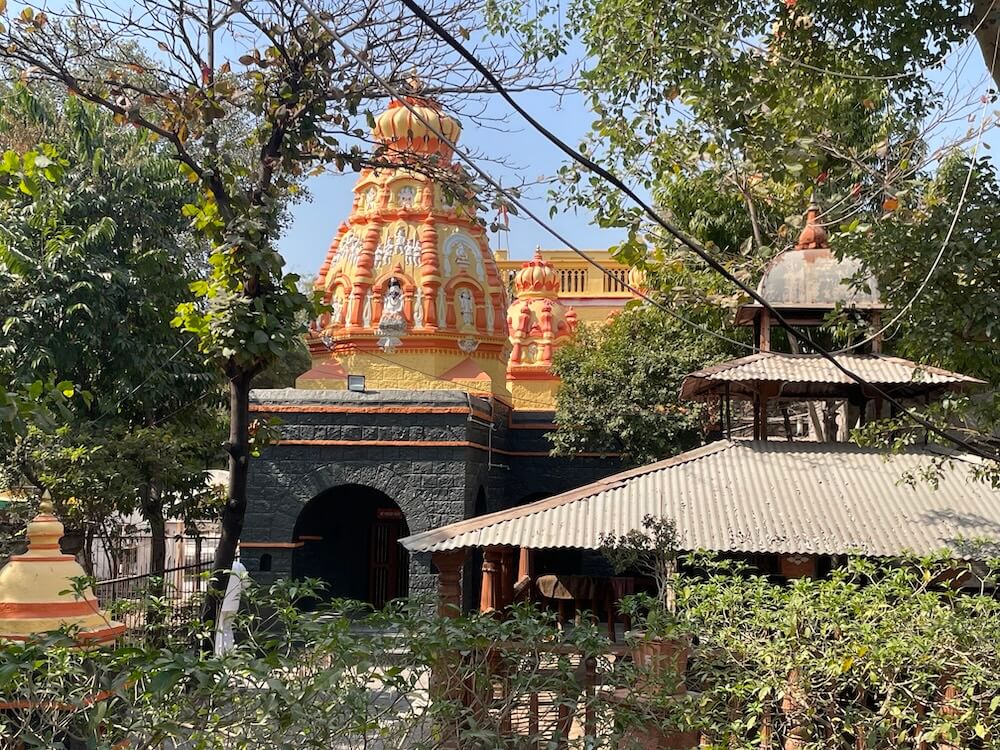
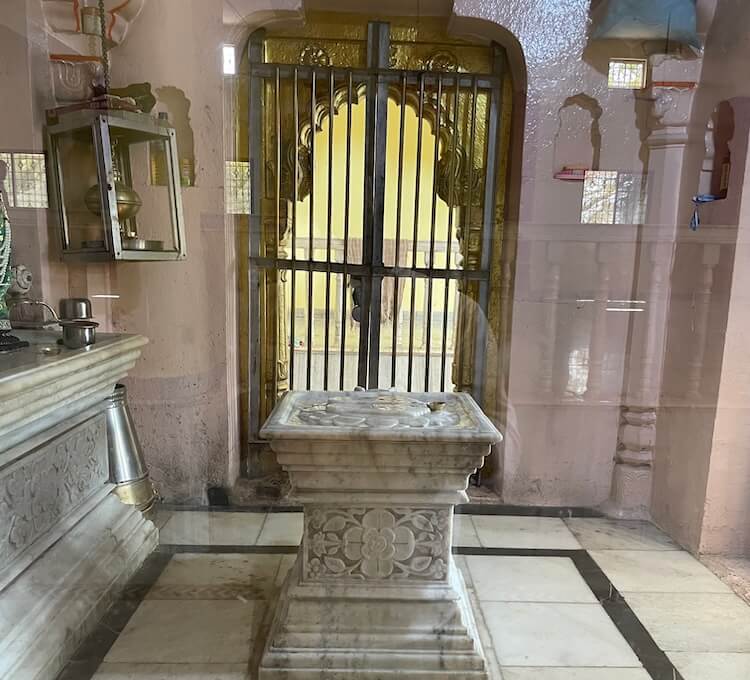
There is a parking facility near the temple entrance. Several small eateries are located nearby. The pathway leading to the temple entrance is lined with dense, shady trees on both sides. The beautiful entrance gate of the temple features a sculpture of Lord Ganesha. Upon entering through this gate, one must descend 35 steps. At the beginning, the sculptures of a cow and her calf on both sides immediately catch one’s attention. After descending the steps, one reaches an open area where shops selling worship materials and various items are located. To the right is the Gomukh Kund. Water flows continuously from the Gomukh here. Above the Gomukh is a small temple of Mother Godavari. There are separate arrangements for male and female devotees to bathe in this pond. Facilities for changing clothes are also available. Many devotees wash their feet in this pond before proceeding for the darshan of Gomaji Maharaj. A few steps from the pond is the entrance to the Samadhi temple. There is also a Nagarkhana here. The sturdy wooden door of this entrance is still in good condition today. To the left of the entrance, there are stairs leading to the Samadhi temple. This Samadhi is located in an underground chamber. The old tunnel leading to the Samadhi site is now closed. It is said that Gomaji Maharaj had dug this tunnel for meditation. The entrance to the stone-built Samadhi temple features an idol of Lord Ganesha. At the Samadhi site, there is a beautiful marble idol of Gomaji Maharaj, adorned with a colorful cloth turban. Behind the idol is a gold-plated, intricately carved prabhaval (halo). To the left of the idol is a staff, and in front are the padukas (footprints). After taking darshan and stepping outside, one enters a stone-paved courtyard. The sanctum sanctorum of the temple is crowned with a magnificent shikhara. There are spacious corridors (ovaris) on all four sides of the temple, and a tall flagstaff stands in the center of the courtyard. There are stairs on both sides to enter this three-story temple. Near the stairs on the left is the wooden chariot of Gomaji Maharaj, which houses the Maharaj’s image and padukas. This chariot is used for processions during festivals. In one of the corridors, there is a replica of the idol of Gomaji Maharaj. A short distance away are the Shiva temples housing the swayambhu (self-manifested) lingas of Nageshwar, Tryambakeshwar, Someshwar, and Vishweshwar Mahadev. These Shiva temples were renovated in the 1950s. In front of the Nageshwar temple, there is a yajna kund within a wooden assembly hall (sabhamandap). Here, one can have the darshan of a beautiful idol of Lord Shiva. Directly in front is a small temple of Nandi. Near a tree in the temple premises, there is also a temple of Mother Sita.
The Mohana River, which originates from one of the springs in the temple area, flows past the village. This east-flowing river receives many tributaries along its course. One of the ponds in its path is known as ‘Ramkund’. To the east, there is another pond called ‘Gopalkund’. The water flowing from the Gomukh Kund here joins the Mohana River, which then turns east and merges into the Bordi River.
Kakada Aarti and Haripath are performed daily at the temple of Gomaji Maharaj. Mahaprasad is distributed after the 11:00 AM Aarti. There is a large influx of devotees during auspicious occasions such as eclipses, Somvati Amavasya, and Adhik Maas. Various programs are organized on the occasion of the death anniversary (punyatithi) of Gomaji Maharaj on Magh Vadya Chaturthi. Additionally, festivals like Ram Navami and Hanuman Jayanti are celebrated with great enthusiasm. Well-equipped Bhakta Niwas (pilgrim accommodation) has been built in the area for the stay of devotees. During the Ashadhi Ekadashi Wari, the Palkhi (palanquin) of Gajanan Maharaj halts at this sacred site on its way to Pandharpur.
This sacred temple stands as a testament to deep spiritual devotion, ancient architectural grandeur, and rich local cultural traditions.
The sanctum sanctorum houses the divine idol consecrated according to ancient Vedic traditions, surrounded by serene courtyards and traditional temple architecture.
Navratri, Maha Shivratri, Annual Temple Jatra & Deepotsav
Compare and book flights, secure top-rated local hotels near the temple, hire reliable guides, and rent cars instantly.
Extend your pilgrimage by visiting other highly sacred temples located nearby.


Add ₹999 more to unlock FREE SHIPPING!
Your sacred cart is currently empty.
Shop Photo FramesFill in your delivery details below to place your order.
Add comment