
Add ₹999 more to unlock FREE SHIPPING!
Your sacred cart is currently empty.
Shop Photo FramesMany sects emerged within the Hindu religion. Each sect has its own distinct method of worship and philosophy, as well as its own deities and shrines. Sometimes, the same deity is worshipped under different names in different sects. One can identify which sect a deity or shrine belongs to by its name. Although the Nath Sampradaya in India is primarily Shaivite, it left a unique mark of its philosophy on the public consciousness. This is why the title ‘Nath’ was added before the names of many deities. One such ancient and famous Kalbhairavnath temple is located in the village of Sonari in Paranda Taluka.
This temple is about a thousand years old. However, history scholars believe that the various structures within the temple complex belong to different periods. The legend of this temple states that in ancient times, the village of Sonari was known as Suvarnapur. This city was ruled by the demon Suvarnasur, who had caused great suffering to the people. At that time, Kalbhairavnath killed Suvarnasur and other demons, liberating the people from their torment. Since then, by the command of Lord Shiva, Kalbhairavnath has resided in Suvarnapuri, also known as Sonari.
The temple is situated on the banks of the Sina River. The road leading to the temple is lined with shops selling worship materials on both sides. The temple has a sturdy fortification with a two-story entrance gate. There is a Nagarkhana (drum house) on the upper floor of the entrance. The roof of the Nagarkhana features an ornamental horizontal spire. There are stairs on both sides of the entrance to reach the Nagarkhana above. Inside the entrance, there are guard rooms on both sides. There is another gate in the fortification on the western side.
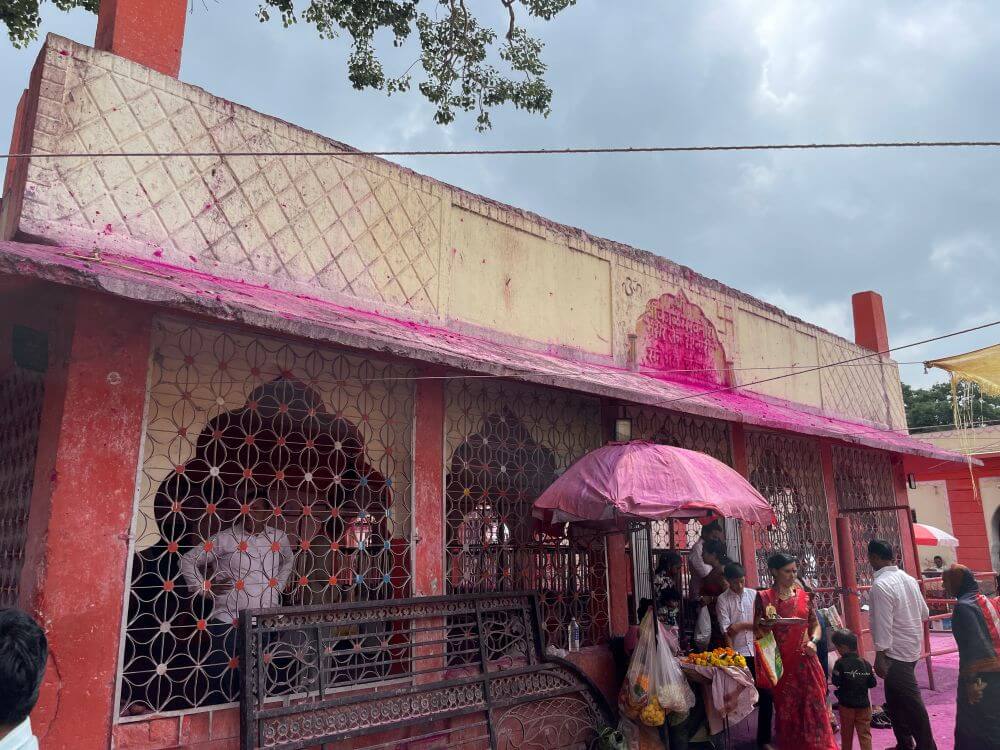
In the temple courtyard, adjacent to the entrance, is the chariot room. The ornate wooden chariot used during the deity’s wedding ceremony in the month of Chaitra is kept here. On both sides of the pathway in the courtyard, there are shops selling various items and worship materials, primarily dried coconut and gulal. A short distance from the temple in the courtyard is a water tank built of carved stone, known as Suvarnatirtha. There are steps to descend into the tank. On the left side of the stairway, there is a Deepmal (lamp pillar) on a platform. The stone walls of the tank contain niches with statues of various deities. The legend regarding this tank is that after killing the demon Suvarnasur, Kalbhairavnath became thirsty, and the Lord created this tank by striking the ground with his trident.
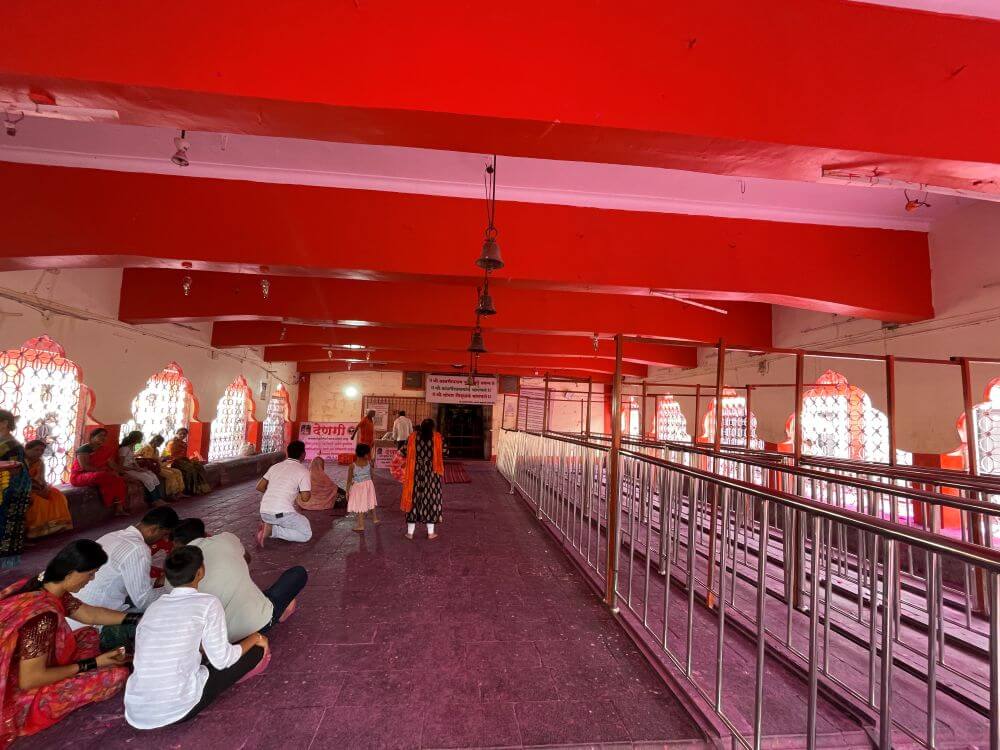
In the courtyard, there are ancient lamp pillars on both sides in front of the temple. The temple structure consists of a Sabha Mandap (assembly hall), Antarala (vestibule), and Garbhagriha (sanctum sanctorum). The Sabha Mandap here is a newer construction in front of the main temple. It is semi-open with a railing on the outer side and contains a total of 34 pillars. All pillars are connected by arched designs. Further ahead is the entrance to the Antarala, which has two additional doors on the left and right walls. The Antarala has four rows of four ornate pillars each. All pillars stand on square bases and are shaped in various geometric forms: square, hexagonal, octagonal, and circular. Four of these central pillars are covered with brass plating. On the left pillar near the entrance, there is a sculpture of Garuda, and on the right, a sculpture of Hanuman, with Kirtimukhas above them. On the right side of the Antarala, there is a small chariot with a brass horse statue. During the deity’s chariot procession, this horse is placed in front, and the deity’s chariot is pulled behind it.
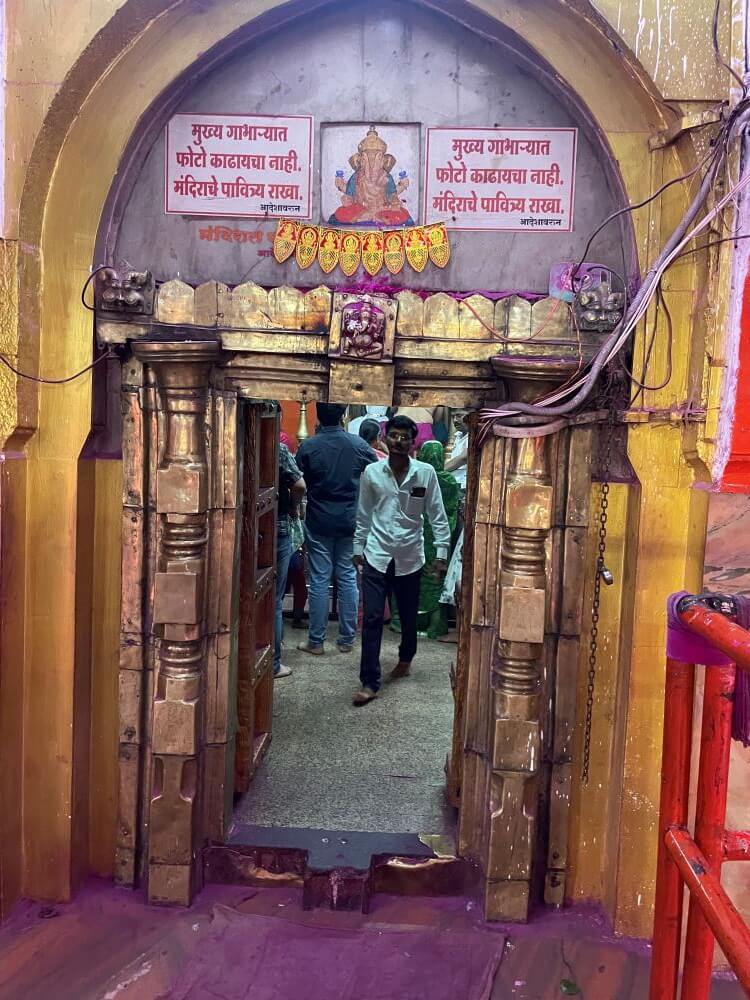
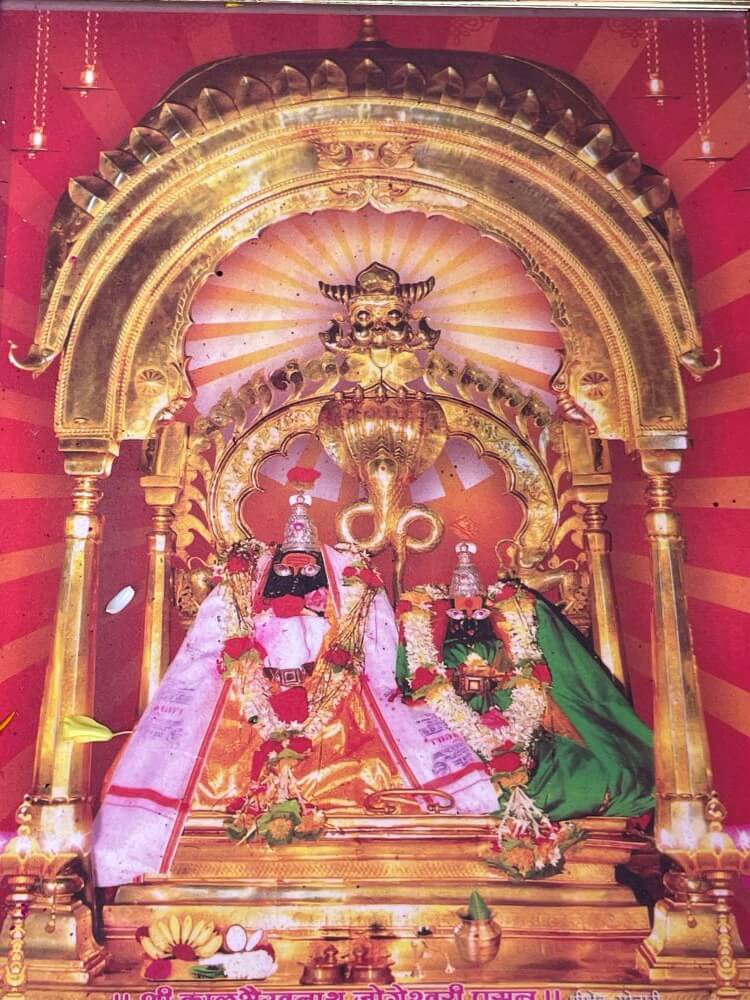
Further ahead is the entrance to the Garbhagriha. The door frames feature vertical carvings and a triangular arch at the top. The entrance has ornate wooden doors with brass plating. Inside the Garbhagriha, the idols of Kalbhairavnath and Jogeshwari Devi are placed in a brass shrine on a Vajrapitha. The Prabhavali (halo) behind the idols is decorated with leaf and flower motifs, with a Kirtimukha at the top center. On the right side of the Garbhagriha are the Utsava Murtis (processional idols) of the deity, which are taken out in processions during festivals in the chariot or palanquin. The ceiling of the Garbhagriha is octagonal and dome-shaped.
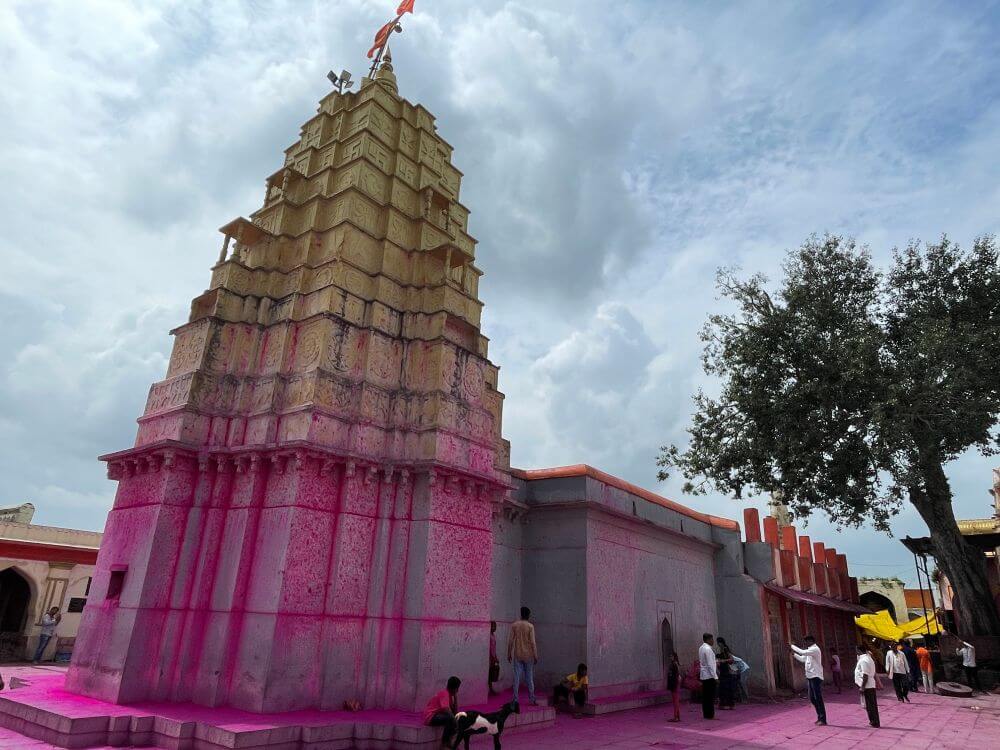
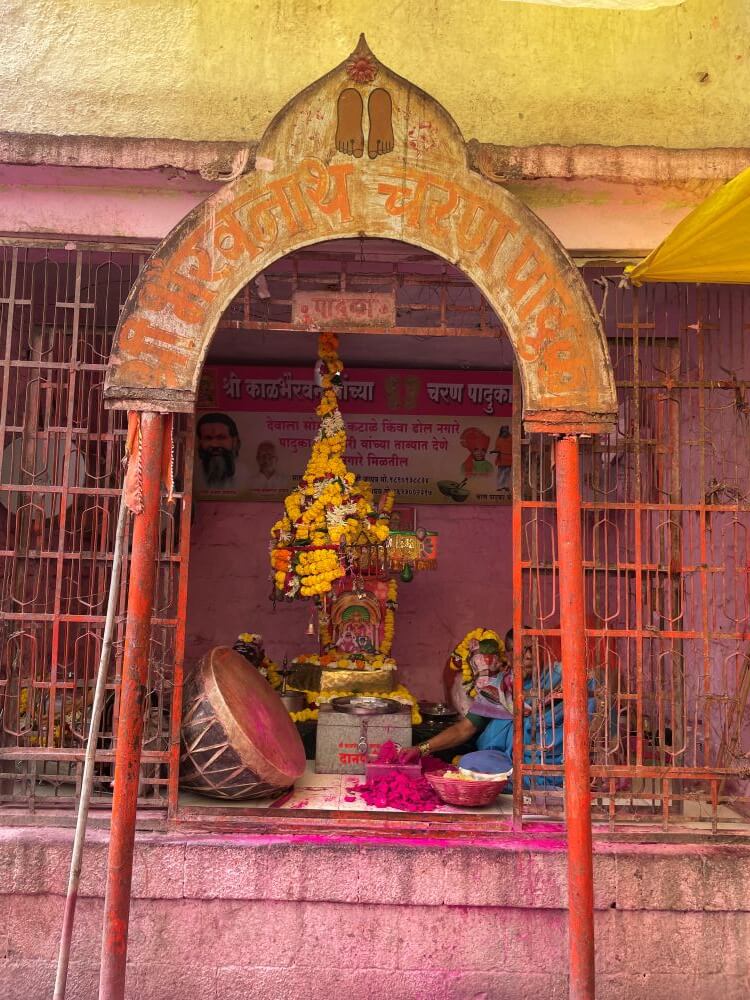
The roof of the temple has a safety railing on all sides. The roof of the Garbhagriha features a ten-tiered square spire (Shikhara). The spire is adorned with Chakra and other carvings on all sides. On the third, fifth, and seventh tiers on all four sides, there are niches for deities. At the top of the spire is a stupika, followed by a Kalash and a flag. In front of the temple, there is a small shrine containing the Padukas (footprints) of Lord Kalbhairavnath, along with two Nandi statues.
Next to the temple is a Nath-sect monastery (Math). It contains an underground cave with a temple of Bhadrakali Devi, where the goddess is represented by a stone (Tandala). The walls of the monastery contain stones from the original Bhairavnath temple, featuring Kirtimukhas carved on both sides. This monastery holds endowed lands. The Mahants here are selected once every twelve years at the Nashik Kumbh Mela. There are samadhis of six Mahants who passed away while serving as the head of the monastery. There is a Shiva Linga at the samadhi site. The monastery also houses a marble statue of Gorakshanath.
The wedding ceremony of Kalbhairavnath and Jogeshwari Devi is celebrated at midnight on Chaitra Vadya Ashtami. The annual fair is held from Chaitra Vadya Ekadashi to Trayodashi. On Chaitra Vadya Trayodashi, a chariot procession is taken out as the deity’s wedding procession (Varat). Thousands of devotees gather to pull the chariot. The deity’s birth anniversary is celebrated on Kartik Vadya Ashtami, during which cradles are hung and devotional songs are sung. On Paush Purnima, the palanquin procession is held, after which the deity goes on a Kashi Yatra. The deity returns from the Kashi Yatra on Magh Purnima, when another palanquin procession is celebrated. The deity performs the ‘Simollanghan’ (crossing the border) ritual on Dussehra via a palanquin procession. Other festivals throughout the year are also organized here. During all festivals, gulal and dried coconut are showered amidst the sound of drums and cymbals.
This sacred temple stands as a testament to deep spiritual devotion, ancient architectural grandeur, and rich local cultural traditions.
The sanctum sanctorum houses the divine idol consecrated according to ancient Vedic traditions, surrounded by serene courtyards and traditional temple architecture.
Navratri, Maha Shivratri, Annual Temple Jatra & Deepotsav
Compare and book flights, secure top-rated local hotels near the temple, hire reliable guides, and rent cars instantly.
Extend your pilgrimage by visiting other highly sacred temples located nearby.


Add ₹999 more to unlock FREE SHIPPING!
Your sacred cart is currently empty.
Shop Photo FramesFill in your delivery details below to place your order.
Add comment