
Add ₹999 more to unlock FREE SHIPPING!
Your sacred cart is currently empty.
Shop Photo Frames‘Vyaso-chhishtam jagat sarvam’ means that there is nothing in this world beyond the literature composed by Vyasa. It is in these words that the genius of Maharshi Vyasa is glorified, implying that everything that exists has been touched by his wisdom. According to traditional references, Vyasa is considered the author of texts such as the Brahma Sutras, Mahabharata, Puranas, Vyasa Bhashya, Bhagavata, and Veda Vyasa Smriti. The greatness of Vyasa is such that even today, wherever a discourse is delivered, the dais is revered as the ‘Vyasapeetha’. There are only a few temples of Maharshi Vyasa in the country. One of the ancient and famous temples among them is situated in Yawal.
According to the entries in the Marathi Vishwakosh, ‘The general meaning of the word Vyasa in Sanskrit is expansion or division. Later, the term Vyasa may have also come to refer to the authors who performed the ‘Vyasa’—that is, the detailed division and classification—of the knowledge gathered within various branches of learning. Mentions of twenty-eight such Vyasas having existed over time are found in the Puranas. Among such Vyasa-authors, Krishna Dwaipayana Vyasa, the creator of the Mahabharata, is considered the foremost, as stated in the Bhagavata.’ In traditional popular belief, Veda Vyasa and Krishna Dwaipayana Vyasa are considered to be one and the same. The distinctive birth story of Krishna Dwaipayana Vyasa is narrated in the 60th chapter of the Adi Parva of the Mahabharata. It states that Satyavati gave birth to a child by Sage Parashara while she was still a maiden at Yamunadwipa. That child was Krishna Dwaipayana.
The story behind this is that once, Sage Parashara boarded a boat to cross the River Yamuna. This boat was being rowed by the fisherwoman Satyavati. Sage Parashara became enchanted by her beauty. At that time, Satyavati laid a condition, saying, “My maidenhood must not be tainted.” Parashara accepted this and, through the power of his penance, He removed the fishy odor from her body and made her fragrant for a yojana, and also created a thick mist around the boat. From their union here, Krishna Dvaipayana Vyasa was later born. Because he was born on an island (dvipa) in the Yamuna, he was named Dvaipayana, and because of his dark complexion, he was called Krishna. At birth, he had increased the size of his body according to his own will. He possessed the knowledge of the Vedas and history from birth—knowledge that could not be attained through any Vedic study, vows, fasting, or sacrifices. (Yannaiti tapasa kaschinn vedadhyayanena cha. Na vratairnopavasaischa na prashantya na manyuna.. – Adi Parva, 60.4) This Vyasa was the grandfather of the Pandavas. He fathered Pandu, Dhritarashtra, and Vidura. There is also a mention that it was Vyasa who bestowed divine vision upon Sanjaya during the Mahabharata war.
Among the prominent temples of Maharishi Vyasa in the country are the Vyasa Gufa near Badrinath in Uttarakhand, the Vyasa Mandir at Ramnagar in Varanasi, and the Vyasa Gadi in Naimisharanya, Uttar Pradesh. Among them, One such temple is the Maharshi Vedvyas Temple in Yawal. The legend associated with this temple states that during the Mahabharata era, the dense forests of the Satpura range extended up to Yawal. The Harita and Sarita rivers of that time are known today as the Hadkai and Khadkai rivers. On the banks of the Suranadi, a southward-flowing river formed by their confluence, stood the ashram of Sage Lomesh. He once decided to perform a Yajna officiated by Maharshi Vyasa. During that same period, the Pandavas, while returning to Hastinapur during their exile, arrived at Sage Lomesh’s ashram. In their presence, the Yajna was conducted by Maharshi Vyasa. It is said that they resided here for some time, and it was at this very place that he composed some of the Parvas of the Mahabharata.
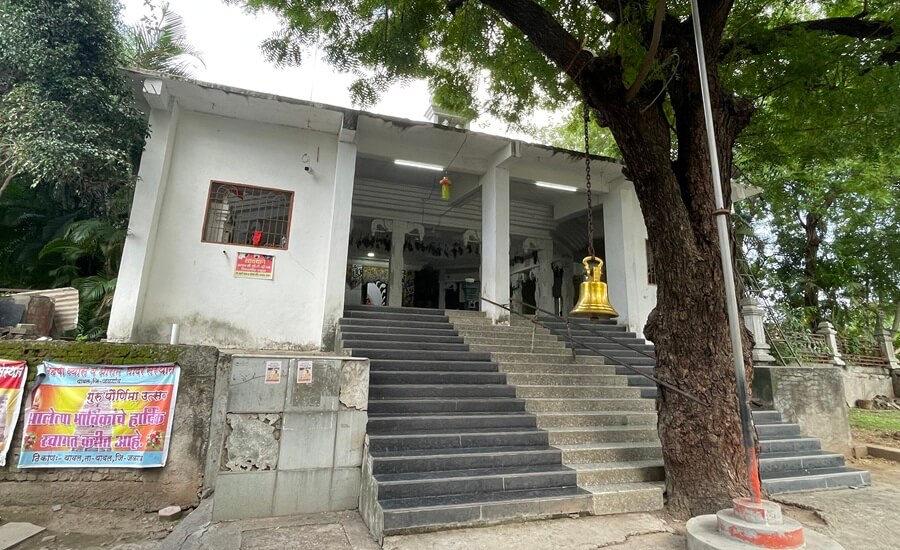
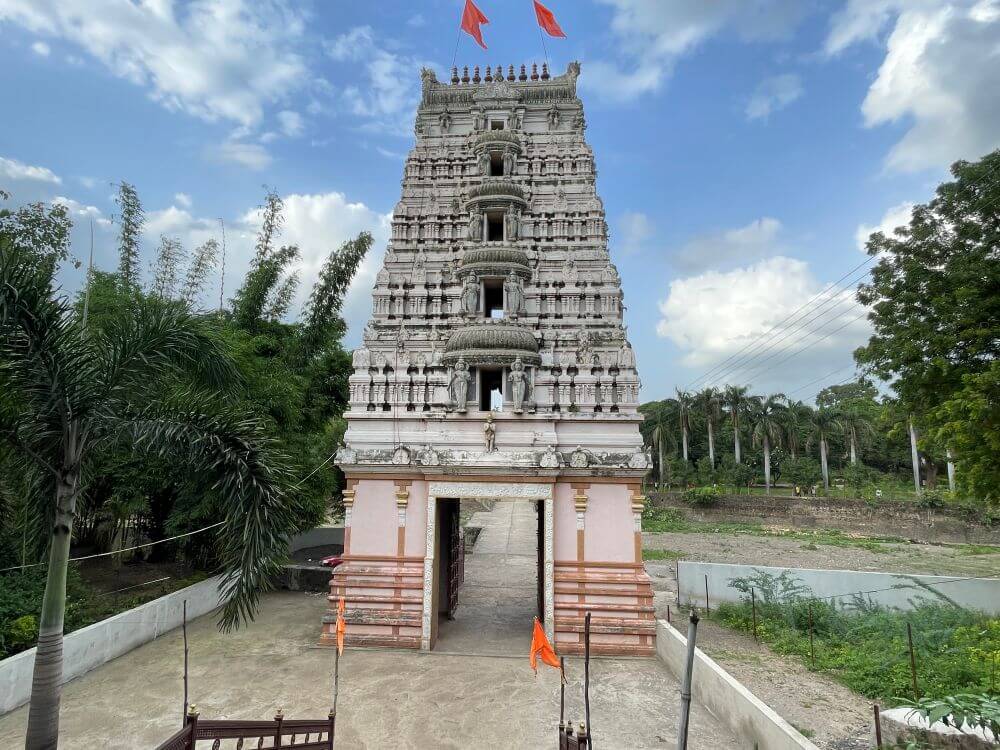
This temple of Vyasa is situated on the banks of the river on the outskirts of Yawal village. One enters the temple premises by crossing a small bridge. Right in front stands the magnificent Gopuram of the temple, built in the Dravidian style. On both sides of the main entrance of the Gopuram, there are two large elephant sculptures with mahouts mounted on them. Above the main entrance Above the temple nameplate in the area, there are idols of Lakshmi, Ganapati, and Saraswati. The five-tiered gopuram (tower) features various sculptures and intricate carvings. The grand wooden doors of the mahadwara (main entrance) are adorned with carvings of Maharishi Vyasa, Shri Rama, and Suryanarayana.
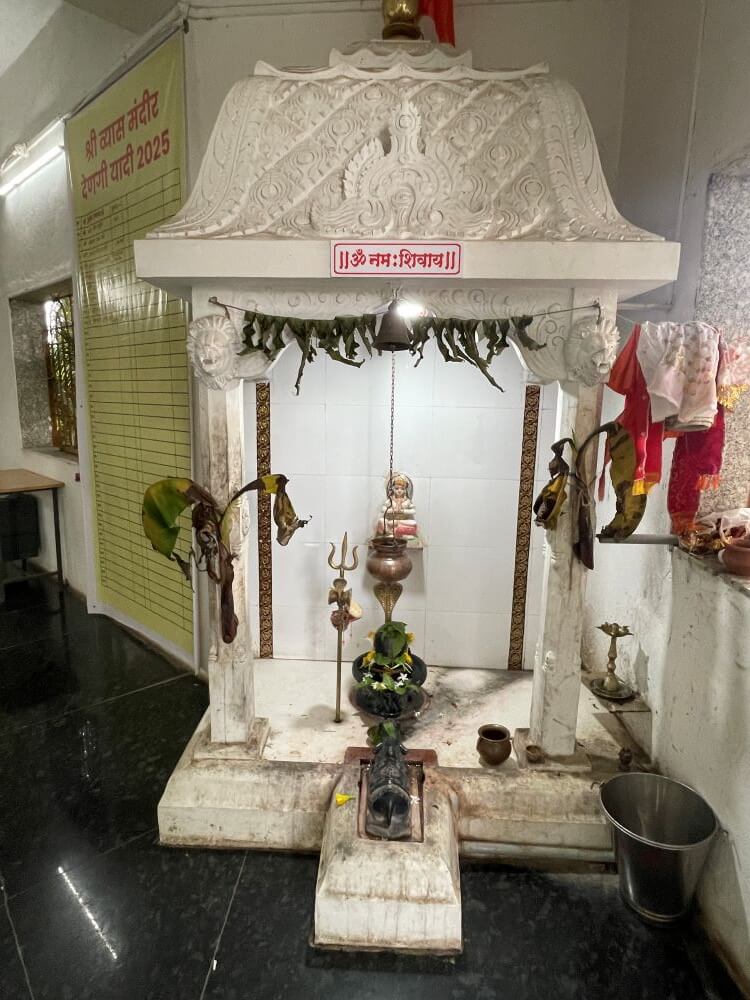
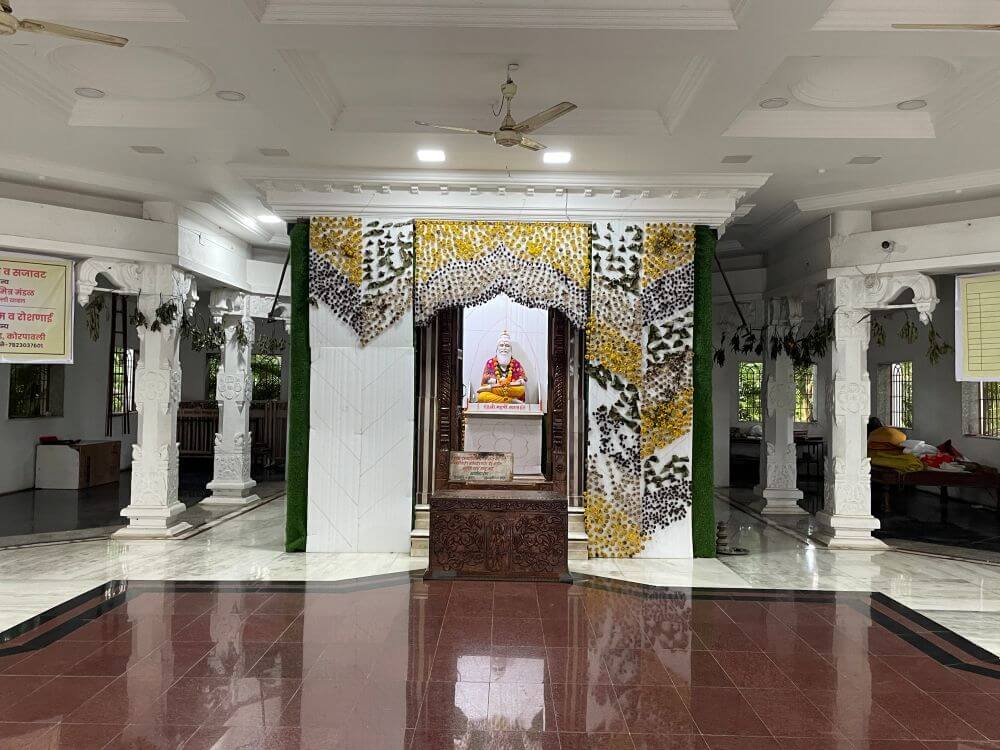
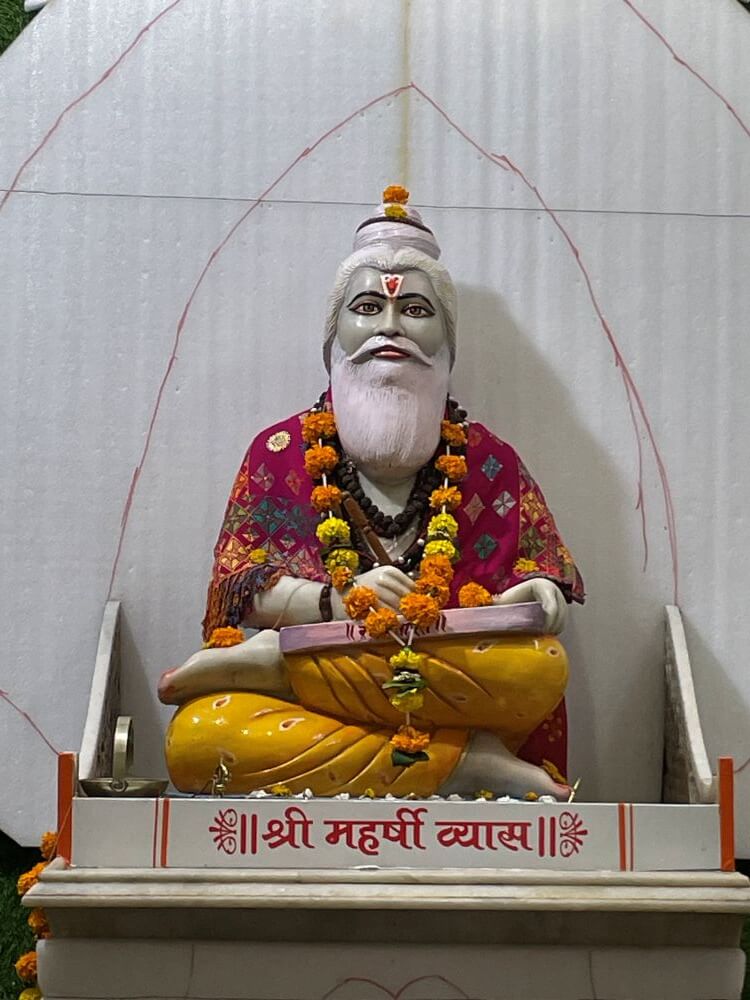
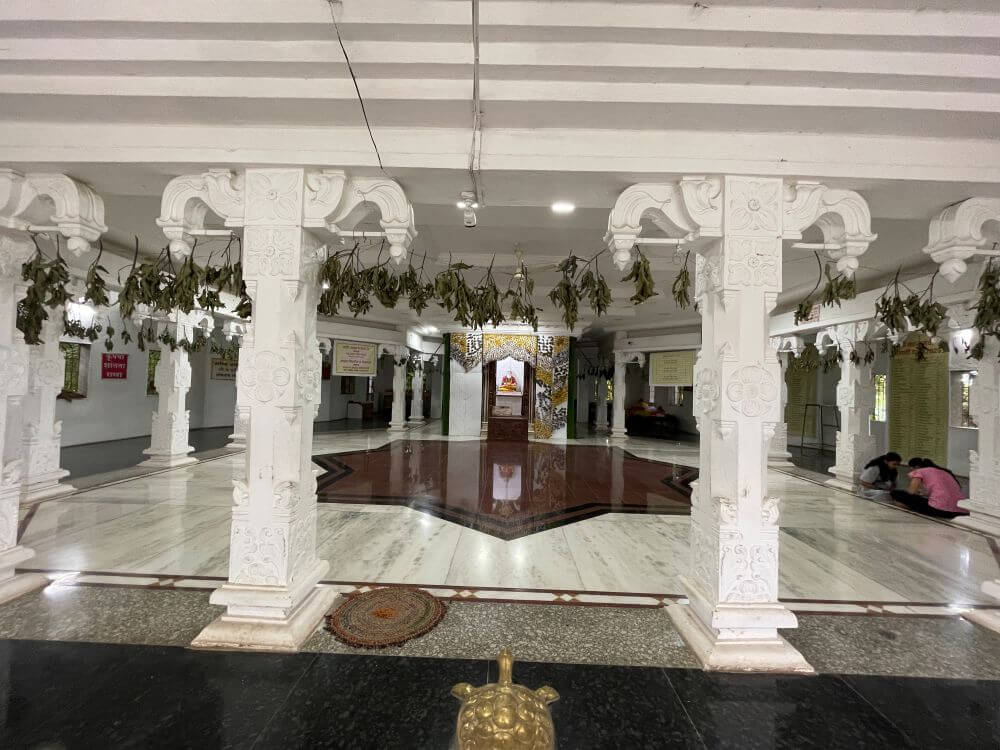
After climbing a few steps from here, one enters the picturesque courtyard of the temple. In the courtyard, the temple of Vyasa is situated on a high pedestal. One enters the main hall (mukhamandapa) of this temple by climbing 16 steps. Here, to the left in a niche is the shrine of Hanuman, and to the right is the shrine of Shankara. In the center, there is a large brass tortoise sculpture. Next to it, on a platform, is a cylindrical stone. This is known as the ‘Ishapurti-cha Gota’ (the stone of wish fulfillment). Devotees believe that if this stone rotates while being lifted and placed back using four fingers, that person’s wish is fulfilled. The main assembly hall (sabhamandapa) of the temple is spacious. In the assembly hall, there are 18 pristine white pillars with intricate carvings. These pillars are considered to be symbolic of the eighteen Puranas. There are two marble shrines in the assembly hall. In one shrine, Riddhi Ganesha with a trunk turned to the right is seated, and in the other shrine, Siddhi Ganesha with a trunk turned to the left is seated. In the sanctum sanctorum (garbhagriha), a marble idol of Maharishi Vyasa is seated on a white pedestal. Maharishi Vyasa, seated in a comfortable posture (sukhasana), holds the Mahabharata scripture in his hands. Above the sanctum sanctorum, there is a tall and distinctive spire (shikhara).
Opposite the Maharshi Vyasa temple stands the ancient temple of Shri Rama. The temple is simple and small. The structure of this temple consists of a sanctum sanctorum (Gabhara) in the center, surrounded by a pillared hall (Sabhamandapa). Small niches have been crafted into the interior walls using wood. This temple features traditional wooden windows, doors, and a ceiling. In the central sanctum, there are small yet exquisite idols of Shri Rama, Lakshmana, and Sita. Below the main idols, various deities cast in five metals (Panchadhatu) are placed. On the decorative arch (Makhar) behind the idols, there are intricate carvings of attendants dressed as Maratha warriors.
Aarti is performed every morning and evening at 7 o’clock in the temple of Maharshi Vyasa. The full moon day of the month of Ashadha is the birth anniversary of Maharshi Vyasa Rishi. This day is celebrated here on a grand scale as Vyasa Purnima or Guru Purnima. Jalgaon is known as the land of bananas. From here, bananas are exported in large quantities even to foreign countries. On the day of Guru Purnima, the sanctum sanctorum of the temple is decorated with bunches of bananas as a gesture of gratitude towards Vyasa Rishi. Thousands of devotees gather here to witness this. Various festivals and celebrations, including Ram Janma, are also celebrated with great enthusiasm at the Ram Mandir here.
This sacred temple stands as a testament to deep spiritual devotion, ancient architectural grandeur, and rich local cultural traditions.
The sanctum sanctorum houses the divine idol consecrated according to ancient Vedic traditions, surrounded by serene courtyards and traditional temple architecture.
Navratri, Maha Shivratri, Annual Temple Jatra & Deepotsav
Compare and book flights, secure top-rated local hotels near the temple, hire reliable guides, and rent cars instantly.
Extend your pilgrimage by visiting other highly sacred temples located nearby.

Add ₹999 more to unlock FREE SHIPPING!
Your sacred cart is currently empty.
Shop Photo FramesFill in your delivery details below to place your order.
Add comment