
Add ₹999 more to unlock FREE SHIPPING!
Your sacred cart is currently empty.
Shop Photo FramesOut of the one hundred and eight Shaktipeeths of the Primordial Mother Bhagwati, three and a half are located in Maharashtra. The Mahalakshmi of Kolhapur, Bhavani Mata of Tuljapur, and Mahakali (Renukadevi) of Mahur are considered the full Peeths, while the Saptashrungi Devi of Vani is considered the primordial and half-Peeth. The Goddess situated on the Saptashrungi fort is believed to be the trigunatmaka (three-fold) manifestation of Mahakali, Mahalakshmi, and Mahasaraswati. It is believed that before residing on the Saptashrungi fort, the Goddess dwelt on this hill at Shiragad. Therefore, even today, this place is referred to as the Goddess’s maternal home and the ‘Lahangad’ (Small Fort).
According to mythological legends, Goddess Sati was the daughter of King Daksha Prajapati and the wife of Mahadeva. Once, King Daksha organized a Yajna and invited all the gods except Mahadeva. Upon learning this, Sati went to her father to demand an explanation. At that time, Daksha insulted Mahadeva. Hearing those derogatory words about her husband, Sati became enraged, and in that fury, she sacrificed her life in the Yajna being performed there. When Shankar learned of this, He became extremely enraged. He arrived at the Yajna site and retrieved Sati’s lifeless body from the fire. Carrying it in His arms, He began to wander here and there in grief and anger. Assuming the Rudra avatar, Shankar began to perform the Tandava dance. All the gods became worried, fearing that this would lead to the destruction of the earth.
At that time, Lord Vishnu used His Sudarshan Chakra to dismember Sati’s body. The places where the parts of Sati’s body and her ornaments fell became Shaktipeeths. There are fifty-one such Shaktipeeths of the Goddess across India, Pakistan, Bangladesh, Nepal, and Tibet. According to mentions in the Devi Bhagavata Purana, there are one hundred and eight such Shaktipeeths.
The legend of the Saptashrungi temple at Shiragad states that in ancient times, sages were performing a great Yajna for the welfare of the world in the nearby Adgaon area. The demon Mahishasura was creating obstacles in it. At that time, many deities, along with the sages, requested the Primordial Mother to put an end to Mahishasura. Respecting everyone’s request, the Primordial Mother appeared at Adgaon and prepared to fight Mahishasura. The place where the Goddess fought Mahishasura is the hill where the temple is currently located at Shiragad. In this battle, Mahishasura could not withstand the Goddess. To save his life, Mahishasura fled from this place and went to hide on the Saptashrungi fort. However, the Goddess pursued him, reached there, and slew him. The Goddess then resided at the very place where Mahishasura was slain. The Goddess was named Saptashrungi as the resident of Saptashrungi. Since then, Saptashrungi has been famous as the ‘Motagad’ (Big Fort), and the awakened place of the Goddess at Shiragad is known as ‘Lahangad’.
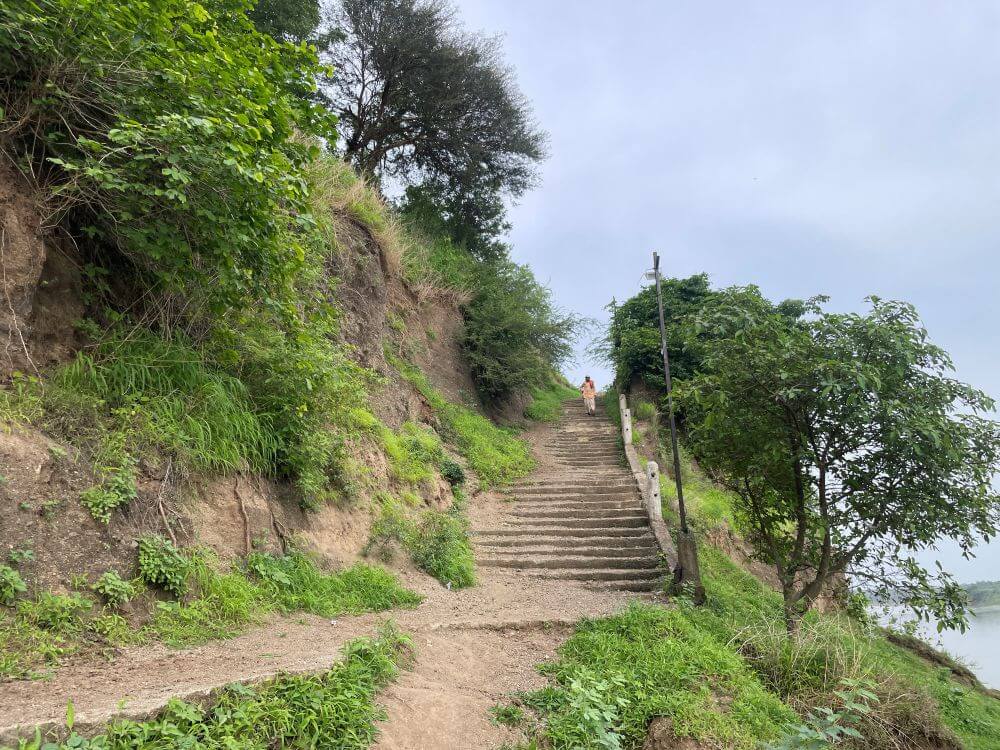
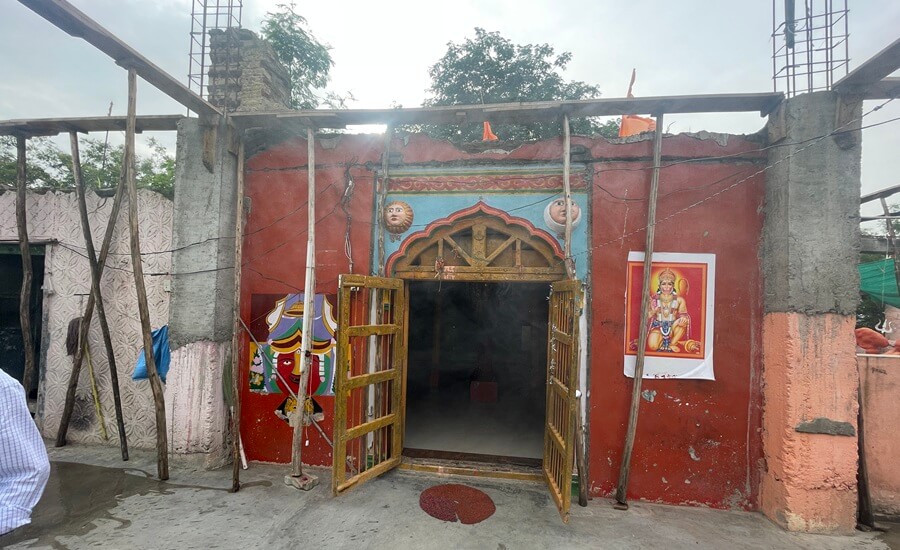
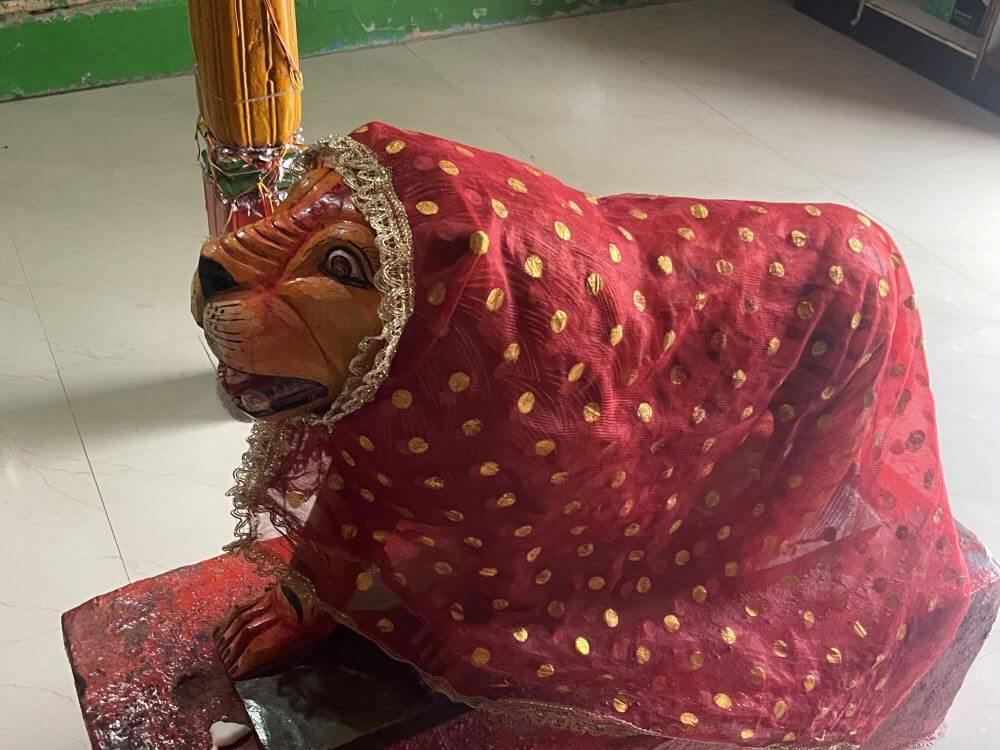
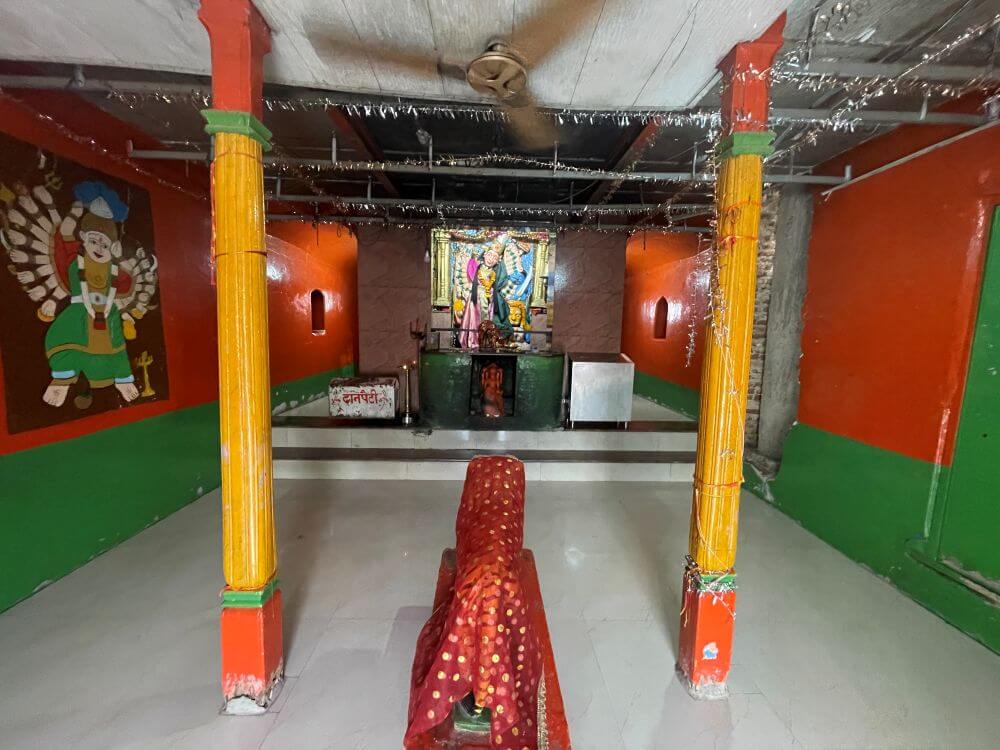
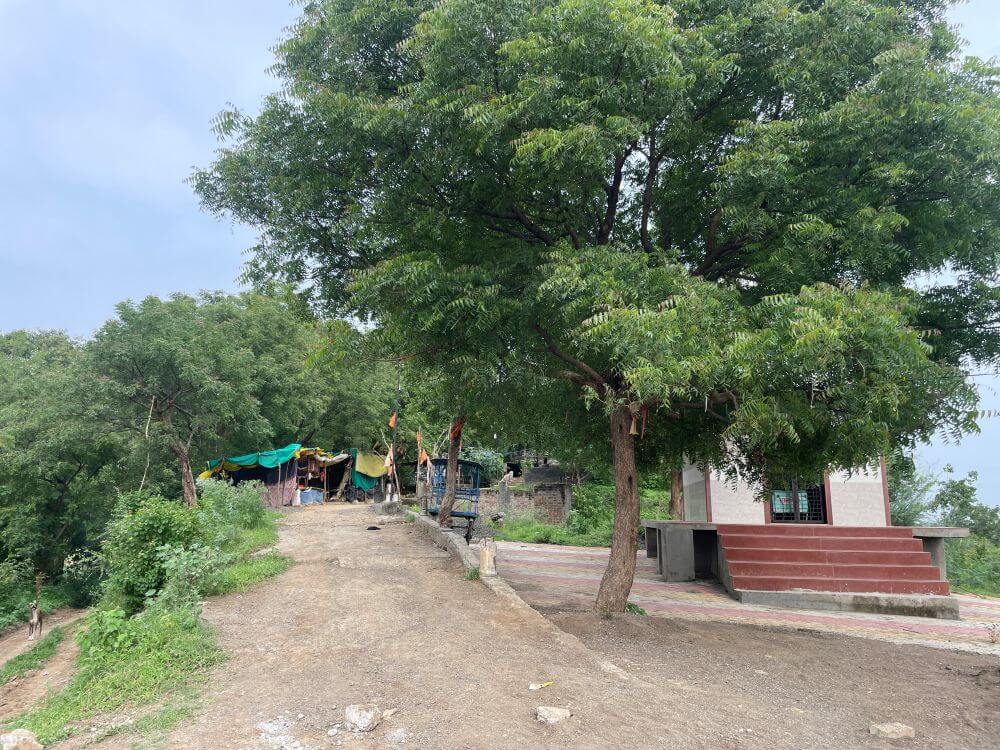
This awakened place of Saptashrungi Devi is located on the outskirts of Shiragad village, on the banks of the Tapi river. One has to reach this temple from Shiragad village by boat through the riverbed. After climbing about one hundred and fifty steps from the riverbank, one enters the temple courtyard. The temple is situated on a small hill plateau. In front of the temple here, there is a Homa-kunda (sacrificial fire pit) and a large Trishula. The structure of the temple consists of a Sabha-mandapa (assembly hall), a Pradakshina-marga (circumambulation path), and the Garbhagriha (sanctum sanctorum). There are images of the Sun and Moon above the entrance. In the center of the Sabha-mandapa, there is an idol of a tiger, the vehicle of the Goddess, and in front of it, a brass Kurma (tortoise) idol. The walls of the Sabha-mandapa are adorned with paintings of the various forms of the Goddess.
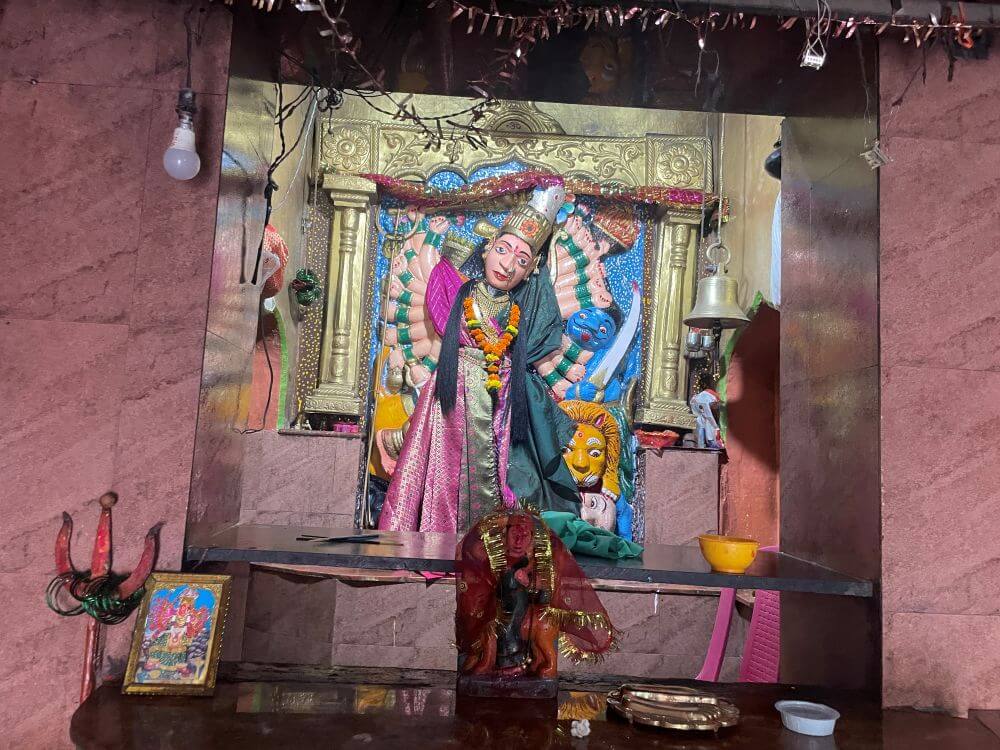
In the Garbhagriha, on a Vajra-pitha (diamond throne), inside a golden ornamental arch, stands a four-foot-tall stone idol of the Goddess. The form of the Goddess, mounted on a lion, appears gentle. The Goddess has various weapons in her eighteen hands. Therefore, this Goddess is also called ‘Ashtadasha Devi’. The Goddess’s left hand is behind her ear, and her neck is tilted. She is adorned with ornaments such as a crown on her head, earrings, a nose ring, a Mangalsutra, a necklace of gold coins, green bangles on her hands, a waistband, and anklets. In front of this idol is a small vermilion-smeared stone idol of the Goddess riding a tiger. In a small niche in front of the Vajra-pitha, an idol of Ganesha smeared with vermilion is seated.
In the temple premises, there is a large, ancient idol of Hanuman. It is a vermilion-smeared stone idol holding the Dronagiri mountain in one hand and a mace in the other. Behind the main temple of the Goddess, a large idol of Saptashrungi Devi is also enshrined in a small temple. Festivals such as Sharadiya Navaratri, Chaitra Navaratri, Kojagiri Purnima, Gudi Padwa, Gokulashtami, and Lakshmi Pujan are celebrated in this temple. During these celebrations, many devotees come to seek the blessings of the Goddess. Due to the thousands of devotees arriving during Navaratri, the area takes on the atmosphere of a pilgrimage.
This sacred temple stands as a testament to deep spiritual devotion, ancient architectural grandeur, and rich local cultural traditions.
The sanctum sanctorum houses the divine idol consecrated according to ancient Vedic traditions, surrounded by serene courtyards and traditional temple architecture.
Navratri, Maha Shivratri, Annual Temple Jatra & Deepotsav
Compare and book flights, secure top-rated local hotels near the temple, hire reliable guides, and rent cars instantly.
Extend your pilgrimage by visiting other highly sacred temples located nearby.


Add ₹999 more to unlock FREE SHIPPING!
Your sacred cart is currently empty.
Shop Photo FramesFill in your delivery details below to place your order.
Add comment