
Add ₹999 more to unlock FREE SHIPPING!
Your sacred cart is currently empty.
Shop Photo FramesKolhapur is the original seat of the primordial nature, Adimaya Mahalakshmi-Ambabai. Among the three and a half Shaktipeethas, Kolhapur is considered a complete Peetha. In this ‘Dakshin Kashi’, which has a history spanning many centuries and is considered ‘Yavadhik’ (slightly more) than Kashi, there are many ancient temples of the Goddess. One such temple is the Pratyangira Devi Temple located in Shivaji Peth here. This Goddess is also known as Phirangai Devi. Devotees believe that this Goddess is a healer of diseases and a remover of mental distress. Therefore, many devotees who come for the darshan of Ambabai make it a point to visit Pratyangira Devi.
The story of the origin of this Goddess is given in the ‘Naradiya Brahmanda Purana’. It is said that a fallen man, consumed by repentance, went to Sage Angiras for guidance with the intention of turning to the right path and living a good life. At that time, the sage was sitting in a temple in deep meditation (Samadhi). A long time passed, but the sage did not come out of his meditation. Finally, intending to announce his arrival, the man rang the temple bell loudly. With that, the sage’s meditation was broken. As soon as he opened his eyes, he saw the man in front of him. Realizing that he had broken his meditation, Sage Angiras cursed him, saying, “You shall become a black stone.” The fallen man pleaded profusely. Finally, moved by compassion, the sage granted him a counter-curse: “At the end of the Kalpa, your form will change. Your body structure will alter, and you will be worshipped as a deity in a female form.” This is the very same Pratyangira Devi.
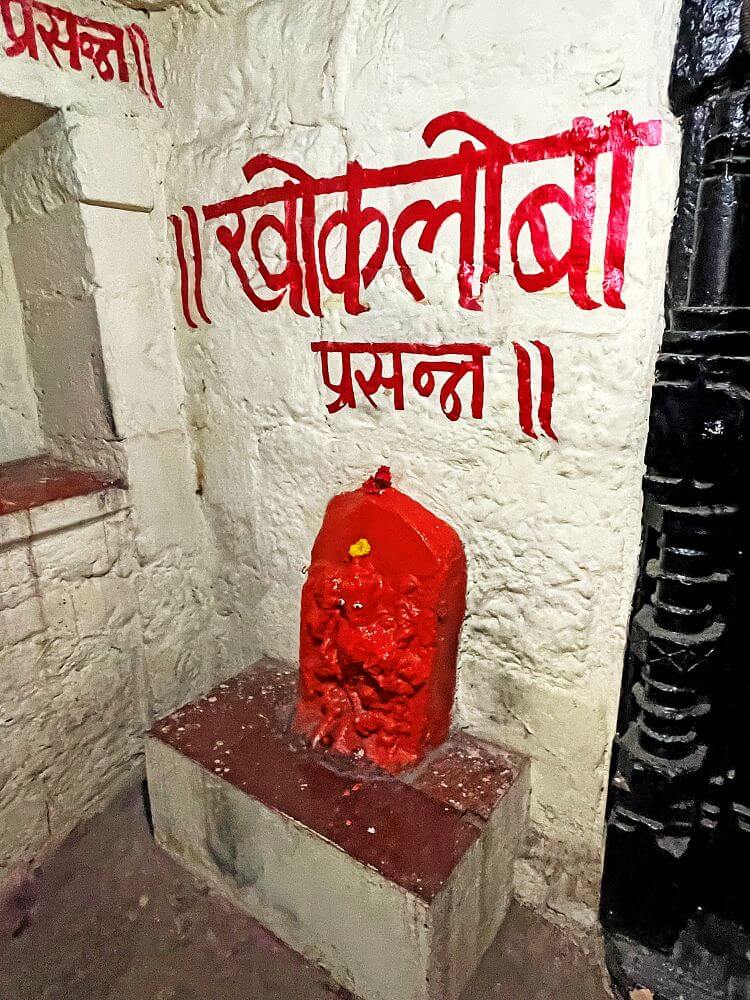
Since she was created through the action of Sage Angiras, she received the name Pratyangira (meaning ‘from Angiras’). She is also known by names such as Priyangi and Phirangai. It is said that the original seat of this Goddess is in Balochistan. Regarding the Goddess’s presence here, a legend states that in ancient times, Kolhasura wreaked havoc in the Karveer region. Because of this, all the gods were distressed. Then, all the gods sought refuge with Mahalakshmi-Ambabai. The Goddess rushed to defeat Kolhasura and his army of demons. At that time, among the many deities who came to the Goddess’s aid, Pratyangira Devi was also present. In the research book ‘Hindu Mythology – Vedic and Puranic’ written by American researcher W. J. Wilkins in the year 1900, there is information about Pratyangira Devi stating that Pratyangira is a form of Goddess Durga. However, an idol of this form is not typically crafted. This Goddess is also worshipped with the intention of destroying enemies. At such times, the priest of the Goddess wears red-colored garments at night. He offers red flowers, liquor, and meat as Naivedya to the Goddess. During this ritual, pieces of animal meat are dipped in liquor and burned. Devotees believe that as the pieces of meat swell in the fire, the fat in the enemy’s body also begins to swell, leading to their death. This information is also cited in the second volume of ‘Devikosha’ published by Pralhad Krishna Prabhudesai in 1968. From this, it appears that Pratyangira Devi is originally a folk deity and was associated with occult rituals. The word ‘Pratyang’ in the name Pratyangira means a secondary part of the body. The term ‘Anga-Pratyanga’ is in common usage. This is the meaning of ‘Pratyang’ here. Scholars believe that this Goddess must be related to certain organs of the body and their ailments. This is because even today, the family deities Kanoba and Khokoloba are present in this temple, and they are associated with the ears and the throat, respectively. Similarly, there used to be a pond next to the Goddess’s temple here. Devotees believed that bathing in its water would cure skin diseases. Over time, that pond has disappeared.
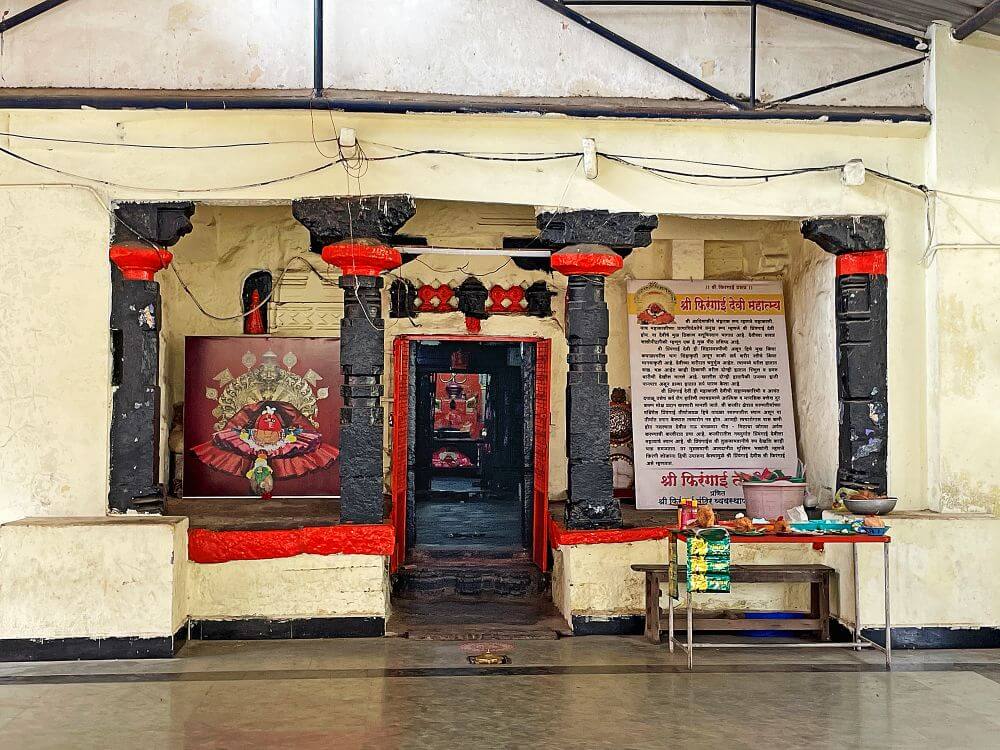
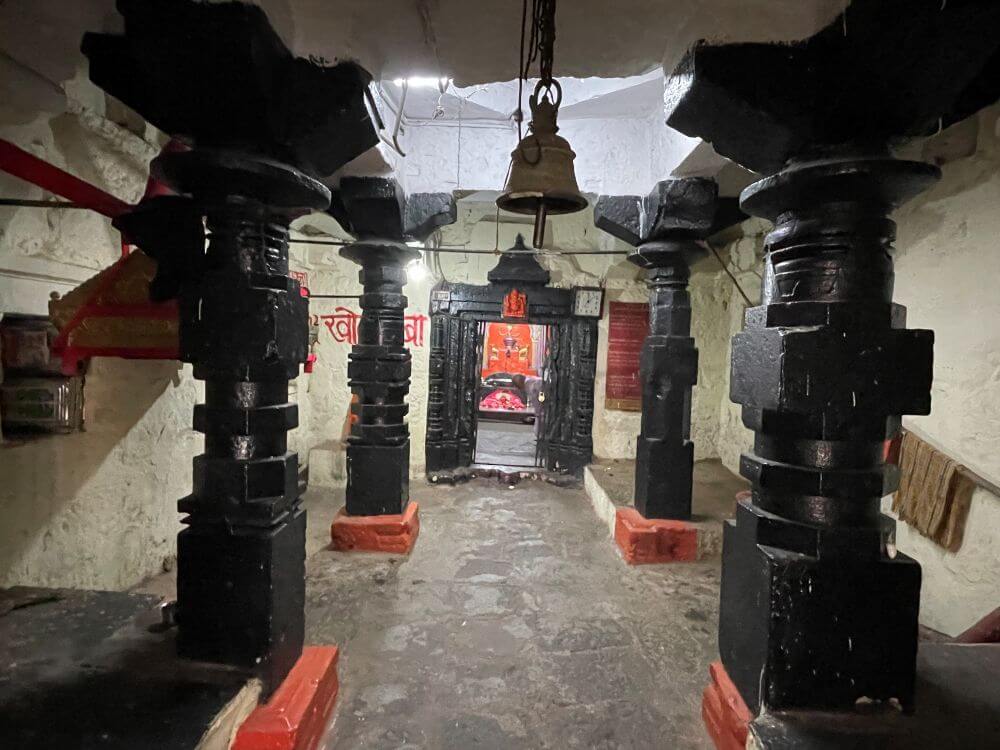
The original temple of Pratyangira, or Phirangai Devi, is ancient. A few years ago, a large Sabha Mandap (assembly hall) was built in front of this ancient temple. One enters this assembly hall by climbing six steps from the busy road of Shivaji Peth. The assembly hall is spacious. After entering, the main temple is to the right. The temple is structured with a Mukhamandap (entrance hall), Gudhamandap (inner hall), Antarala (vestibule), and Garbhagriha (sanctum sanctorum). The temple is constructed of stone. Its carved pillars indicate its antiquity.
In front of the Mukhamandap, there is a brass tortoise. At some distance in the entrance path, there are two relief sculptures on the floor. These are sculptures of female devotees going to worship the Goddess. There are stone benches on both sides of the Mukhamandap for devotees to sit. In the center is the entrance, which has a stone door frame. On the architrave of the entrance, there are carved semi-circular stones. Previously, silver or gold coins were embedded in this threshold. Now, only small pits where they were placed are visible. On the lintel of the door frame, there is a carved idol of Ganesha. Above it, there are carved idols of three deities. Due to the paint applied and the wear and tear over time, these idols are unclear. Here, on both sides above the frame, horse faces can be seen.
The original assembly hall of this temple is enclosed. Therefore, it is called the Gudhamandap. It has two stone pillars on each side. The Goddess’s palanquin is kept in this Gudhamandap. There is also a stone tortoise here. The ceiling of the assembly hall is also made of stone. On the front side, in a niche, there is an idol of Kanoba smeared with vermilion. On a platform nearby, there is an idol of Khokoloba. Devotees believe that offering a Naivedya of flour, salt, and curd-rice to Khokoloba cures a cough, while worshipping Kanoba and applying his holy ash (Angara) and drinking his holy water (Teertha) destroys ear ailments. According to iconographic scholars, the idol of Khokoloba here is originally that of Mahishasuramardini, while the idol of Kanoba is originally that of Saraswati. They have been given the form of disease-curing folk deities here.
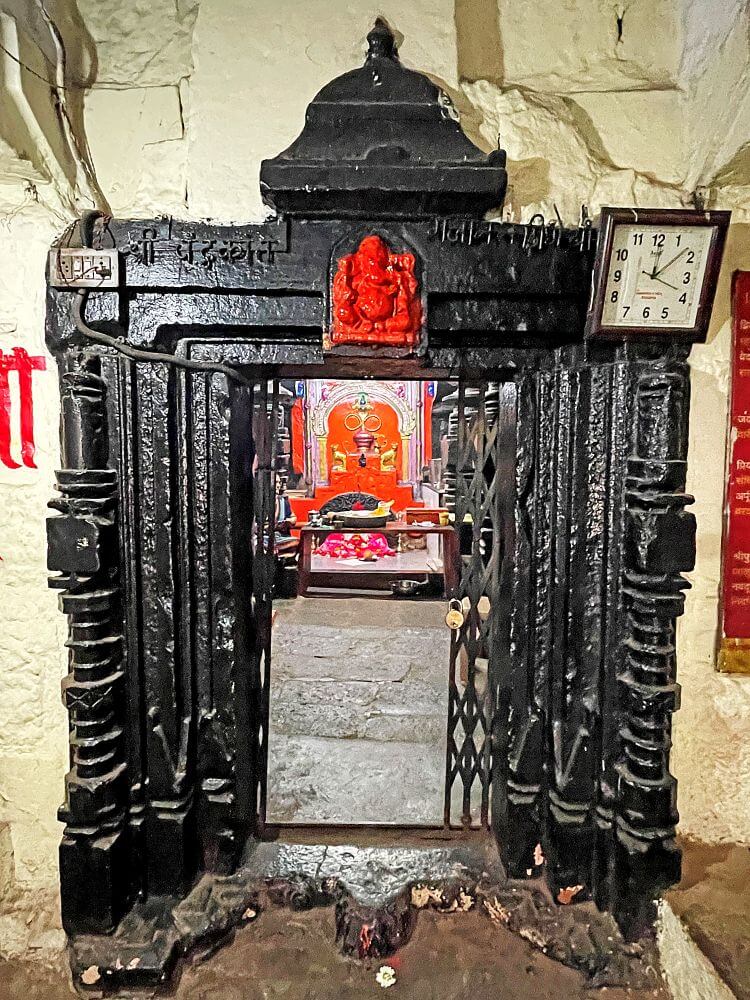
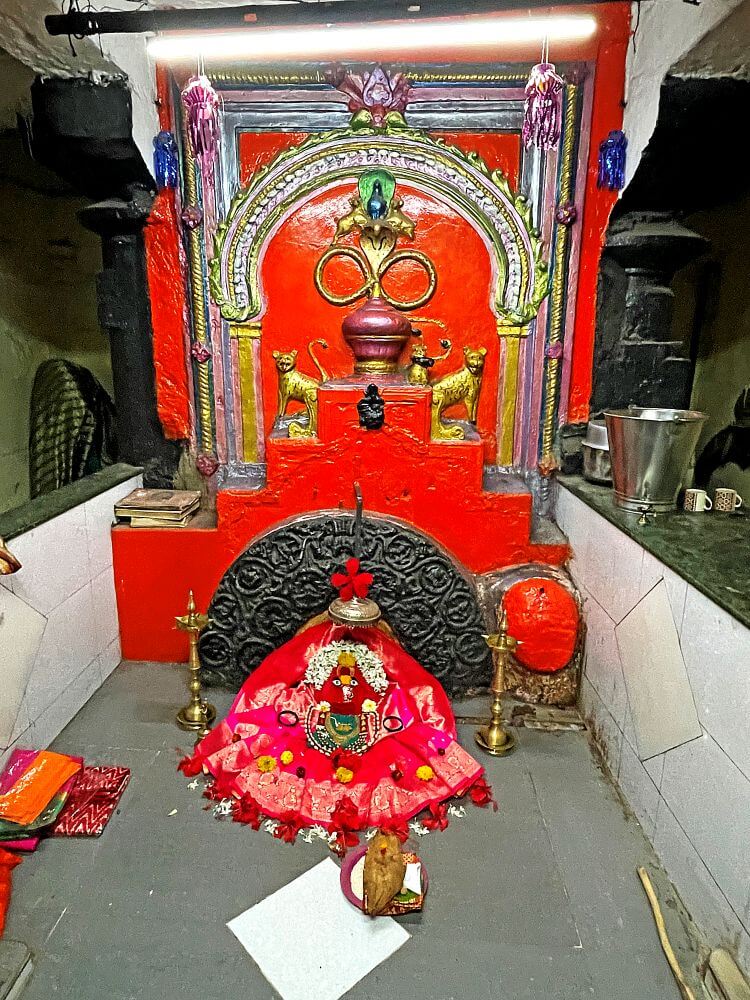
The entrance to the Antarala is made of stone and is tripartite. Its door pillars have carvings. On the upper side, there is a spire-like shape and a carved idol of Ganesha on the lintel. In the Garbhagriha, on a high Vajrapitha, the Goddess’s idol in the form of a ‘Tandala’ (aniconic stone) is seated, adorned with clothes and ornaments. Eyes, lips, and a nose are carved onto it. Above it is a small silver canopy. Behind this idol, there is a stepped back-slab. In the center of it, there is a black-painted, carved crescent moon. A kalasha shape is carved at the top, and there are tiger sculptures on both sides of it.
On the day dedicated to the worship of the Goddess, which is Tuesday, a long queue of devotees forms for darshan from the early hours of the morning at this temple. There is a tradition of offering ‘Peeth-Mitha cha Jogwa’ (flour and salt) to the Goddess for nine consecutive Tuesdays if one is suffering from persistent skin ailments. The Sharadiya Navratri festival is celebrated here on a grand scale. Notably, on the seventh day of the Sharadiya Navratri festival, the deity Karveer-Nivasini Mahalaxmi-Ambabai is adorned in the form of Pratyangira Devi.
This sacred temple stands as a testament to deep spiritual devotion, ancient architectural grandeur, and rich local cultural traditions.
The sanctum sanctorum houses the divine idol consecrated according to ancient Vedic traditions, surrounded by serene courtyards and traditional temple architecture.

Navratri, Maha Shivratri, Annual Temple Jatra & Deepotsav
Compare and book flights, secure top-rated local hotels near the temple, hire reliable guides, and rent cars instantly.
Extend your pilgrimage by visiting other highly sacred temples located nearby.


Add ₹999 more to unlock FREE SHIPPING!
Your sacred cart is currently empty.
Shop Photo FramesFill in your delivery details below to place your order.
Add comment