
Add ₹999 more to unlock FREE SHIPPING!
Your sacred cart is currently empty.
Shop Photo FramesMachanur is believed to have been a land of penance since ancient times. Located on the banks of the Bhima River, this sacred site is where Gorakshanath performed penance for 21 days. Consequently, Machanur, known as the ‘Abode of the Naths’, houses the ancient Siddheshwar Mahadev temple, a magnificent example of the Hemadpanti architectural style from the Yadava era. It is said that Swami Samarth of Akkalkot and Shankar Maharaj of Dhankawadi resided in this temple for some time. As a place of faith for millions of devotees, this temple attracts a large number of pilgrims from states such as Karnataka, Andhra Pradesh, and Goa.
Machnur, a village considered significant from mythological, religious, and historical perspectives, is situated adjacent to Brahmapuri. For a period, Brahmapuri served as a center of Mughal power. Emperor Aurangzeb, who had descended into the Deccan to overthrow the Maratha power, established a vast encampment for his army at Brahmapuri from 21 May 1695 to 16 October 1699. He renamed this village Islampuri. He administered his empire from the land fort located here. Many of his commanders had established their mansions near Machnur. Aurangzeb had initiated the Rudrabhishek in the Siddheshwar temple at Machnur during the holy month of Shravan. During this month, Brahmins would reside here, and they received financial support from Aurangzeb’s treasury for performing worship and rituals.
The legend regarding this is that Aurangzeb had attempted to destroy the Siddheshwar temple here, but he did not succeed. He then tried to desecrate the sanctity of Siddheshwar by offering beef as an offering. However, as soon as the cloth covering the plate was removed inside the temple, white flowers were seen there. At that moment, beetles and honeybees suddenly appeared, and they They taught Aurangzeb’s army a lesson, forcing them to flee in disarray. Following this, Aurangzeb initiated an annual grant for the temple. It is said that at that time, the annual grant for the temple was six rupees. In this temple, the honor of playing the nagara rests with the Muslim community of Machnur, and the responsibility for worship and rituals lies with the Gurav community of Brahmapuri. Previously, the temple possessed fifty-two acres of land as an endowment. Due to twenty-two acres being submerged in the Ujjani Dam, the temple now holds thirty acres of land.
Saint Babamaharaj Arvikar, who resided here, described the legend regarding the site of Siddheshwar in one of his poems. It is said that when unrighteousness increased in the Kali Yuga and there was no one left to protect the people on Earth, the incarnation of Siddharam took place here. While in the forest here, he once caught sight of a Shiva Linga. It had been recently worshipped by someone. Astonished by this, Siddharam began searching for the devotee. He then saw Goddess Ambika herself worshipping the Shiva Linga. He They performed the worship of Mother Ambika. At that time, Ambika told them that once, when Vamadeva, who is the embodiment of Shiva, came here, he saw this Shiva Linga floating on the water. He took it out of the water and installed it here in the presence of many sages and seers. Today, the ancient temple of Siddheshwara stands at that very same spot.
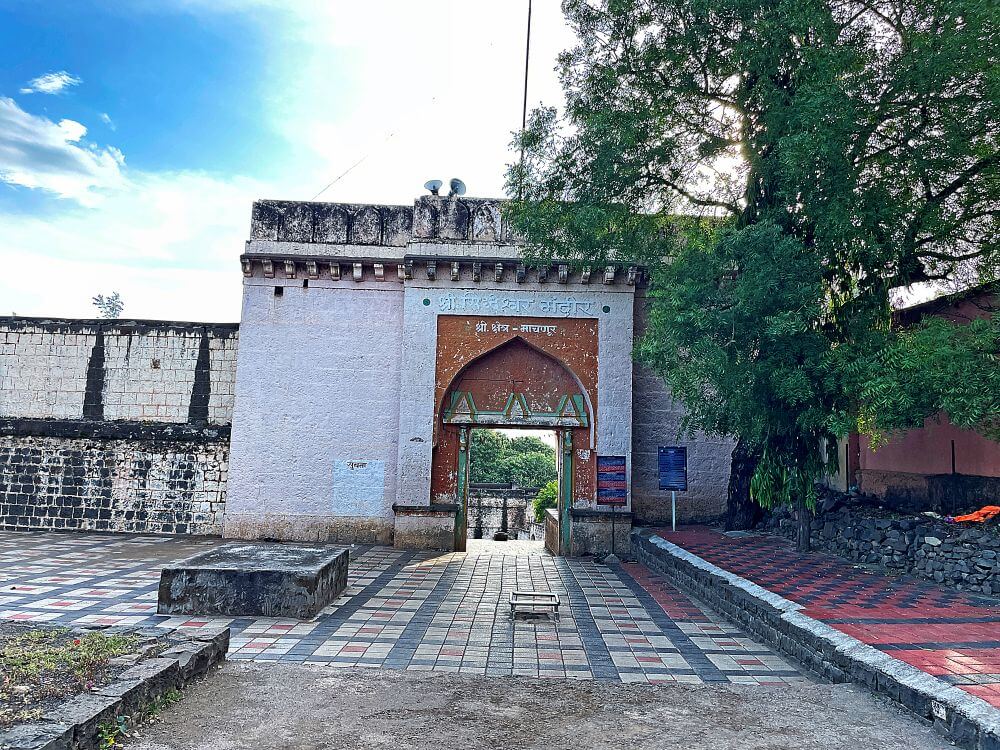
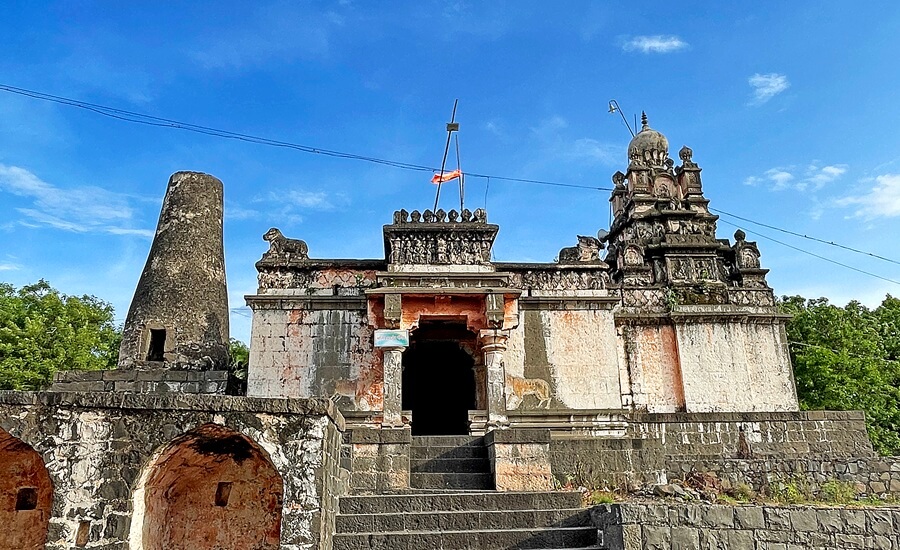
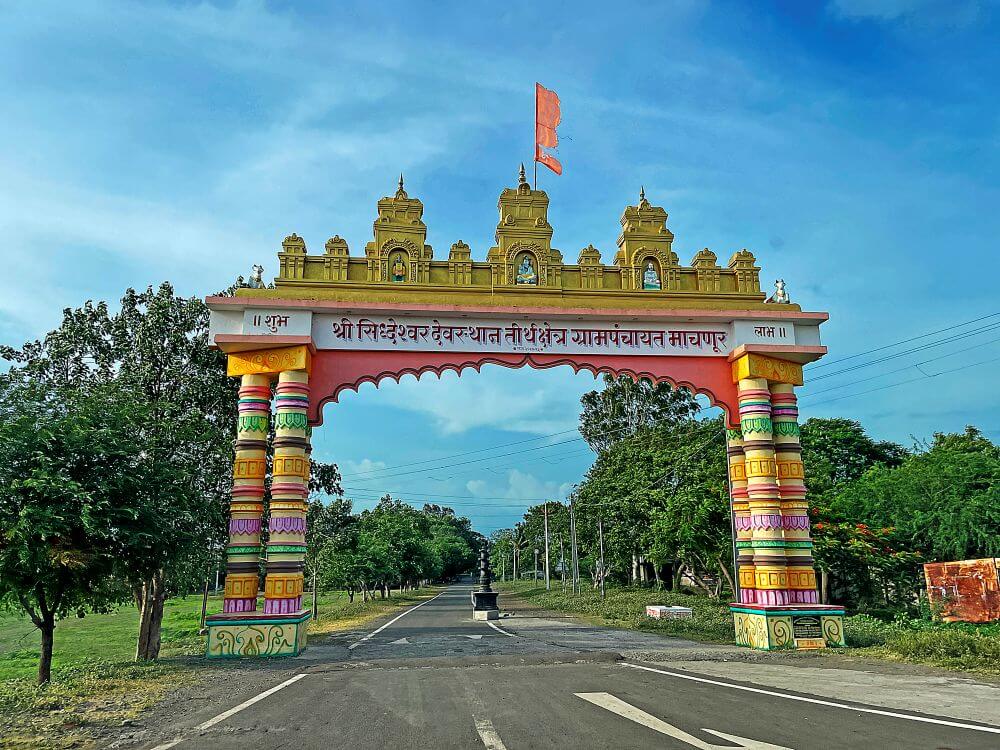
At the entrance of Machnur village, located near Mangalvedha, stands a large temple arch. A short distance from here, one encounters the first stone fortification of the temple, which resembles a fortress. After passing through the gateway of this fortification, one must descend about fifty steps to reach the Siddheshwar Temple. Along this stairway, the first structure encountered is the ancient Mallikarjun Temple. In front of this temple stands a large lamp pillar. The temple is structured with a main assembly hall, an intermediate chamber, and the inner sanctum. In the assembly hall of this temple, there is a carved idol of Nandi fashioned from a single monolithic stone. Beyond this, the uniqueness of this place In this assembly hall, there are stone seats along the lower portion of all four walls. In the sanctum sanctorum here, there is a Shiva Linga carved from a single, unbroken stone.
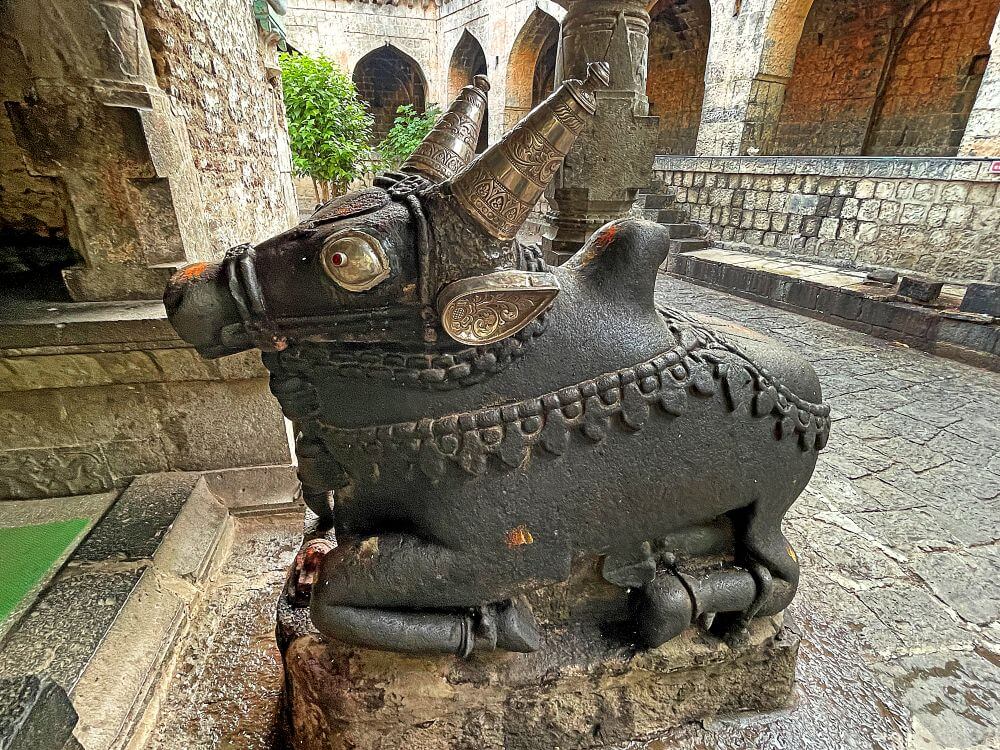
After descending a few steps from this temple, the second fortification wall of the temple becomes visible. One enters the temple courtyard through the gateway in this fortification. There are many alcoves along the inner side of the fortification wall that surrounds the temple on all four sides. Near the entrance in the courtyard, there are four lamp pillars. There are also many ancient Peepal trees in this courtyard. The structure of the Siddheshwar temple consists of a front porch, a main hall, an intermediate chamber, and the sanctum sanctorum. In the front porch, there is a three-foot-tall idol of Nandi carved from a single piece of black stone. The eyes, ears, and horns of this Nandi are covered with metal sheets. From here, one enters the main hall. In this semi-open main hall, there are stone seats for devotees to sit. On the beams above the pillars in the main hall, images of Yakshas and Nagas are carved. Notably, all these images are distinct. are of the shape.
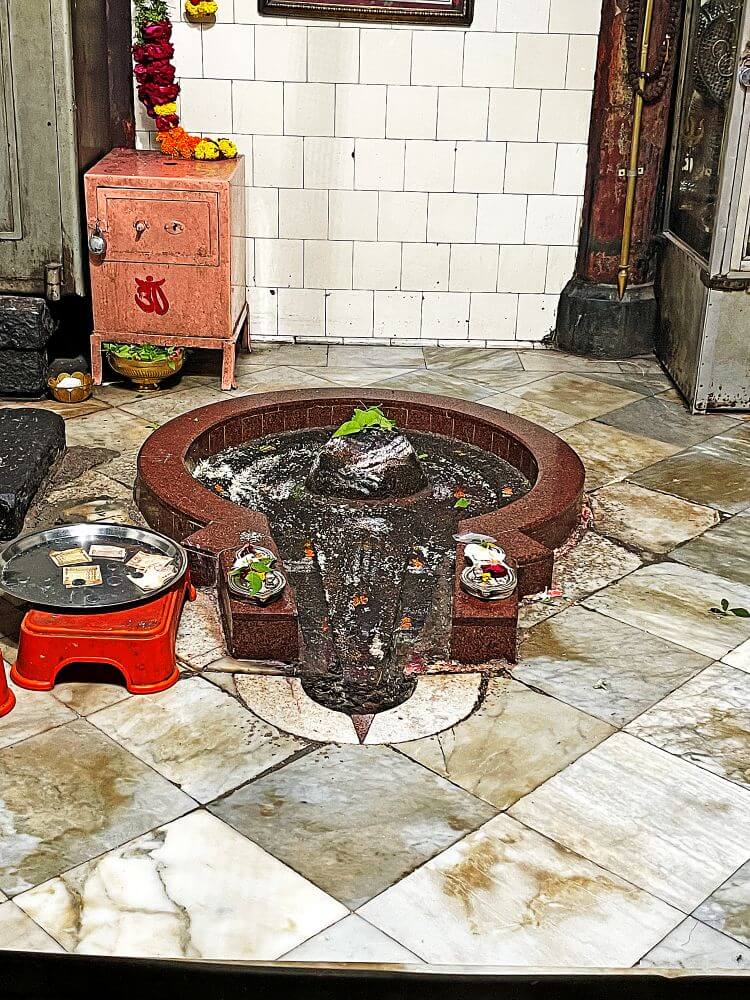
The door frame and pillars at the entrance of the antarala (vestibule) are covered with brass sheets. On the lalata-bimba (lintel) is an idol of Ganesha, and on both sides below are armed dwarapalas (gatekeepers). Devotees must have darshan of the swayambhu (self-manifested) pindi of Siddheshwara, located in the garbhagriha (sanctum sanctorum), from this antarala itself. The nose, ears, and eyes are depicted on this pindi. A unique feature here is that the nani (the outlet for the abhisheka water) of this pindi faces the entrance. During festival periods, a brass mask is placed over this pindi.
On the exterior of all the temple walls, there are relief sculptures depicting various mythological episodes. These include the Dashavatara of Vishnu, scenes from the Ramayana and Mahabharata, Vitthal-Rukmini, Shri Krishna with the five Pandavas and Kunti, the Kaliyamardana episode, the meeting of Sita and Hanuman in the Ashok Vatika, and Shiva-Parvati mounted on Nandi with the three-legged sage Bhringi standing before them. Above these relief sculptures are carvings of Nandi. On the pinnacle of the sanctum sanctorum Images of snakes are carved here. At the pinnacle of the spire, there is an amalaka resting within a lotus flower, topped by a kalasha. Around the spire, there are small minarets that resemble those of a mosque. This temple does not have a gomukha drain on the exterior; therefore, it is believed that one may perform a full circumambulation, even though this is a temple dedicated to Lord Shankara.
Daily worship is performed at the temple. There is a constant crowd of devotees and tourists here. Throughout the month of Shravan, a large number of devotees visit this place. A grand fair is held here on Mahashivratri. Thousands of devotees participate in this five-day-long festival. The sacred ash (Bhasma) required for the worship of Mahadeva in this temple is brought from the mountains of Uchethan. The Badves of Pandharpur come to the temple in Machnur for a specific period during Shravan to perform worship.
Adjacent to the fortification of this temple, there is a large ghat on the Bhima River. By descending about 50 steps from this ghat, one can reach the Jatashankar Temple situated in the riverbed. Near this temple is the Samadhi shrine of Saint Baba Maharaj Arvikar.
This sacred temple stands as a testament to deep spiritual devotion, ancient architectural grandeur, and rich local cultural traditions.
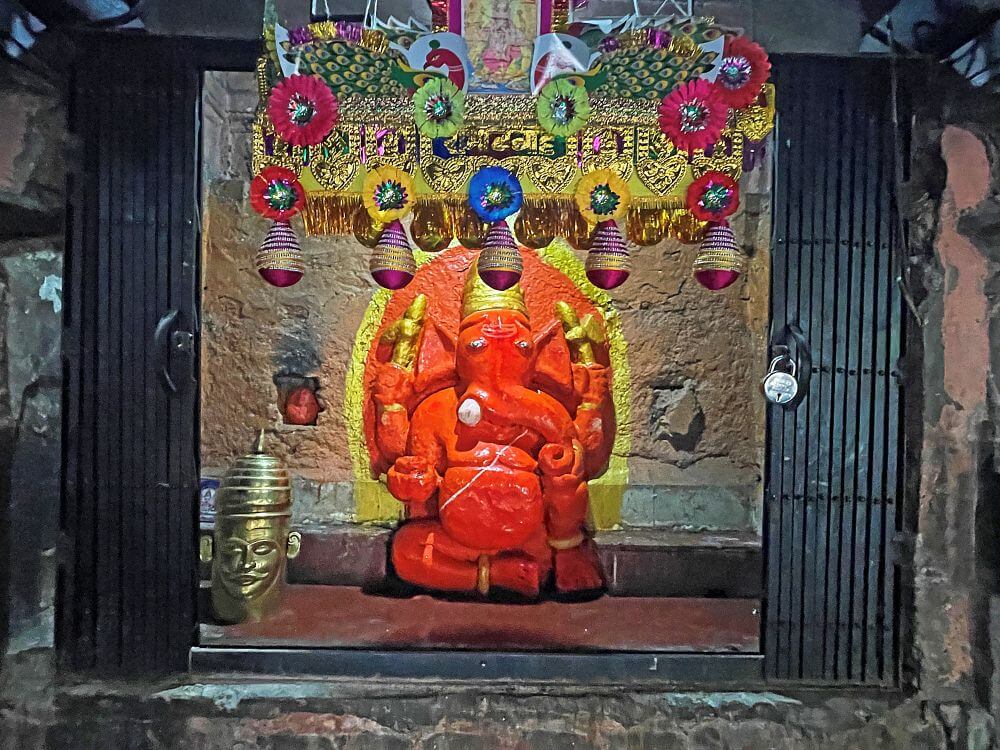
The sanctum sanctorum houses the divine idol consecrated according to ancient Vedic traditions, surrounded by serene courtyards and traditional temple architecture.
Navratri, Maha Shivratri, Annual Temple Jatra & Deepotsav
Compare and book flights, secure top-rated local hotels near the temple, hire reliable guides, and rent cars instantly.
Extend your pilgrimage by visiting other highly sacred temples located nearby.


Add ₹999 more to unlock FREE SHIPPING!
Your sacred cart is currently empty.
Shop Photo FramesFill in your delivery details below to place your order.
Add comment