
Add ₹999 more to unlock FREE SHIPPING!
Your sacred cart is currently empty.
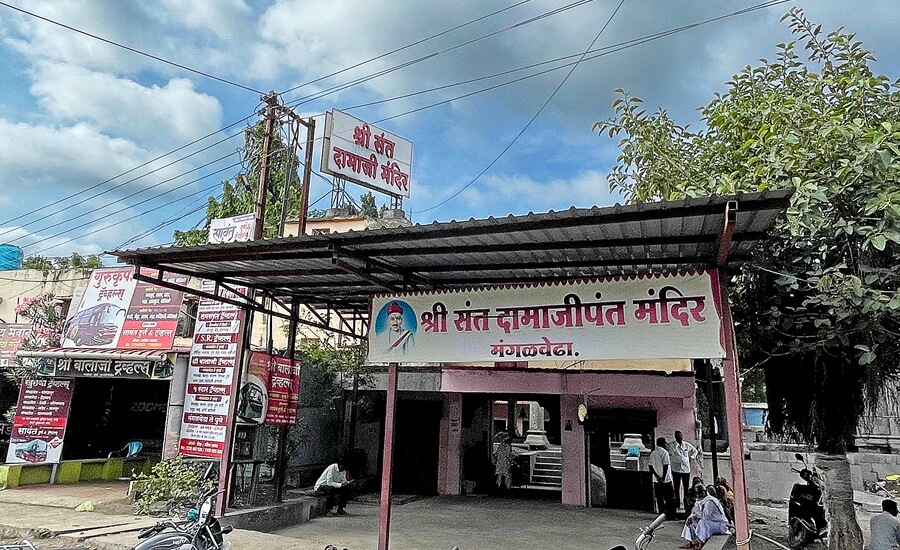
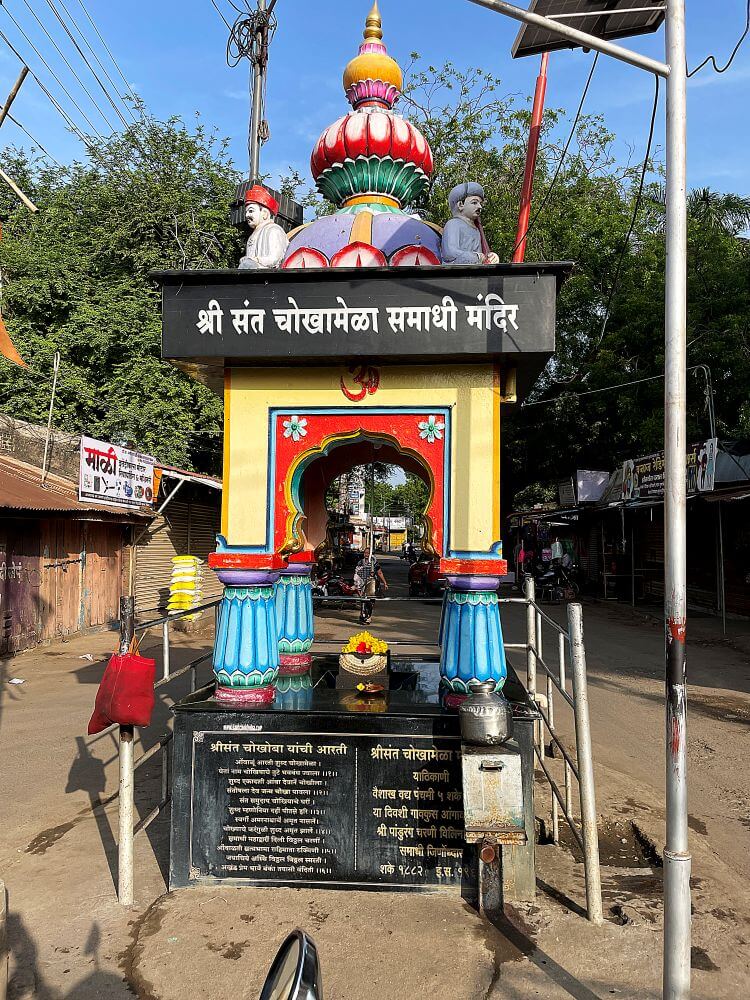
Shop Photo FramesKnown in ancient times by names such as Mahamandaleshwar and Mangalveshtak, Mangalwedha is a town of great religious and historical significance. Once the capital of Kalachuri Bijjala, this town holds a sacred and revered place in the Warkari Sampradaya. Sanctified by the holy presence of great saints like Sant Chokhamela and Sant Kanhopatra, this sacred ‘Land of Saints’ houses the Samadhi Temple of Sant Damajipant, an ardent devotee of Lord Vitthal. In Mangalwedha, Sant Damajipant is venerated as the Gramdaivat (presiding deity of the town). Damajipant’s Wada (mansion) here serves as a sanctuary for Warkaris. Pilgrim processions (Dindis) and Bhajan troupes stay at Mangalwedha, seek the divine darshan at Damajipant’s Samadhi, and only then proceed towards Pandharpur.
It is a rare and extraordinary example for a government official to be elevated to the status of a saint, to have a temple erected in his honor, and to be revered as the Gramdaivat of an entire taluka. Sant Damajipant attained immortality through his noble deeds and selfless divine devotion. Mangalwedha was his birthplace. He served as the *Kamavisdar* (revenue collection officer) of Mangalwedha under the Bahmani Sultans, whose capital was Bidar . Shortly after Sultan Alauddin Shah Bahmani ascended the throne, a severe famine struck the entire southern region in 1460 CE. The legendary account of Damajipant’s heroic compassion during this crisis is chronicled in the sacred text ‘Bhakta Vijaya’. Composed just four years after the passing of Chhatrapati Shivaji Maharaj, this revered work was authored by the eminent saint-poet Mahipati Kamble, also known as Mahipati Taharabadkar.
According to the narrative of Damajipant in the 40th chapter of Bhakta Vijaya, the famine was catastrophic—so severe that “all living creatures were dying of extreme hunger and starvation.” People could find no food, and many chose to end their lives by swallowing gold coins (*hons*). (“Placing gold coins in their mouths, beings departed for the abode of death.”) During this dire period, two royal granaries belonging to the Sultan were under Damajipant’s authority. He knew that if he unlocked them to distribute grain to the starving masses and the Sultan found out, the ruler would take his life in anger. (“If the King learns of this, he will angrily take my life.”) Yet, he contemplated, “Even if one life is sacrificed, the Brahmins and people of this holy land will survive”—reasoning that even if his own life were lost, the inhabitants of sacred places like Mangalwedha and Pandharpur would be saved. With this sublime devotion, he opened both granaries, first for the Brahmins and subsequently for people of all communities.
According to Mahipati’s account, a Kannada Brahmin who served as a *Mujumdar* (accountant) in Mangalwedha reported this act to the Sultan. Enraged, the Sultan dispatched royal guards to arrest Damajipant. Realizing his end was near, Damajipant went to Pandharpur to seek the holy darshan of Lord Vitthal. At that moment, Lord Vitthal assumed the form of ‘Vithu Mahar’ and presented Himself at the Sultan’s court in Bidar, claiming that the grain had not been given away by Damajipant, but sold. Thereupon the Sultan declared that the grain was valued at “one lakh sixty-eight thousand gold coins” (1,68,000 *hons*). Lord Vitthal, in the guise of Vithu Mahar, immediately paid the exact amount to the Sultan, thus miraculously dissolving the grave crisis that threatened Damajipant.
Later, when the Sultan’s guards brought Damajipant to the royal court, the Sultan astonished him by revealing that Vithu Mahar had already settled the full payment. Damajipant realized with overwhelming reverence that Lord Panduranga of Pandharpur Himself had assumed the form of Vithu Mahar to shower grace upon him. Filled with gratitude, he resigned from the Sultan’s service and dedicated the rest of his life entirely to the service of Lord Panduranga. Today, Mangalwedha Taluka is also affectionately revered as ‘Damajipantanchi Nagari’ (The City of Damajipant).
Following Sant Damajipant’s passing, a modest Samadhi was built in Mangalwedha. Later, Chhatrapati Rajaram Maharaj, son of Chhatrapati Shivaji Maharaj, constructed a small temple at the site and consecrated the sacred idols of Sant Damajipant and Lord Vitthal-Rakhumai. In 1944, a trust was established in Mangalwedha in the name of Sant Damajipant. Through donations raised by the trust, the construction of the grand Samadhi Temple commenced, progressing continuously as devotee contributions poured in.
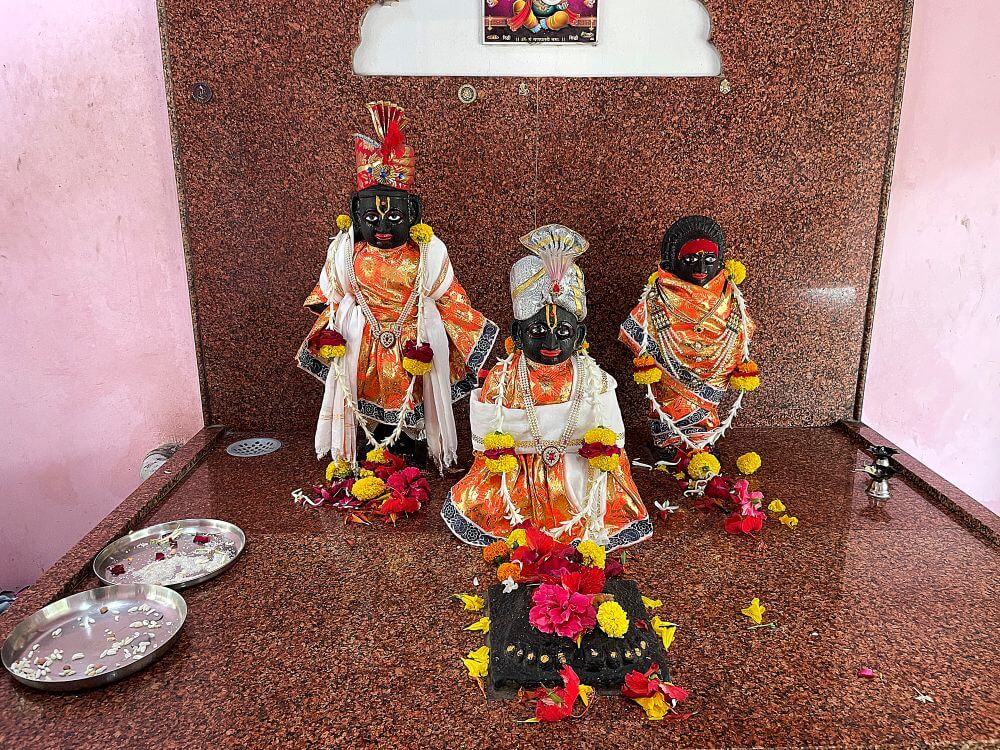
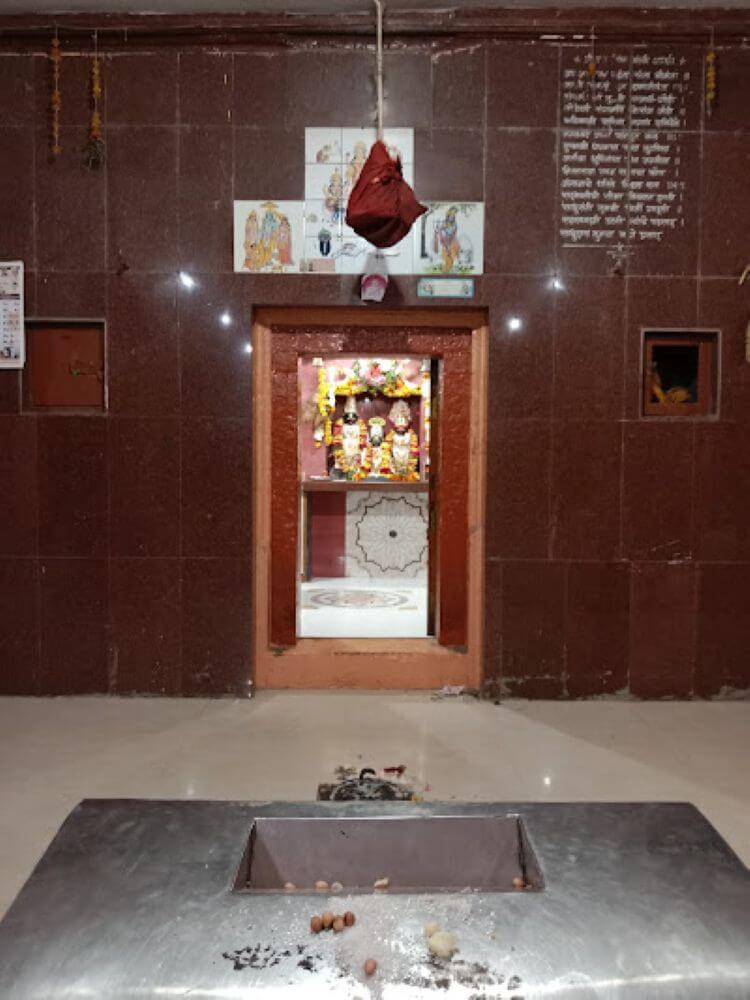
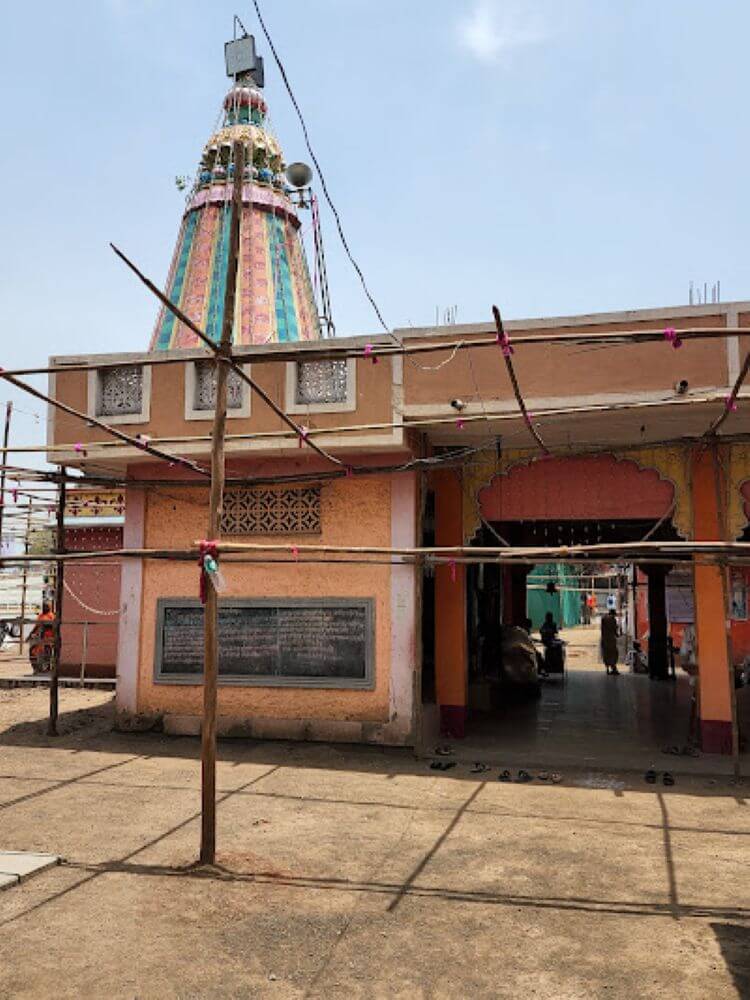
The Damajipant Samadhi Temple is situated along the Mangalwedha-Pandharpur road. The temple complex comprises an open assembly hall (*Sabhamandap*), an antechamber (*Antarala*), and a sanctum sanctorum (*Garbhagriha*). The open Sabhamandap in front of the main shrine appears to have been added in later years. Inside the sanctum sanctorum of the original temple, resting upon a *Vajrapitha* (sacred pedestal), are the holy *Padukas* (footprints) of Sant Damajipant, behind which stands his idol carved from black stone. Situated behind his idol are the divine deities of Lord Vitthal and Goddess Rukmini.
Uninterrupted Veena playing (*Akhand Vinavadan*) echoes within the temple, and a perpetual sacred flame (*Nandadeep*) glows endlessly. This temple is among the rare few shrines in the state that maintain the tradition of continuous Veena rendition. Furthermore, daily rituals include early morning *Kakad Aarti*, recitation of *Damaji Akhyan*, evening *Dhuparti*, Thursday *Bhajans*, and *Gita Parayan* with *Hari Jagar* on Ekadashi days. Auspicious festivals such as Gudi Padwa, Gokulashtami, Rama Navami, Hanuman Jayanti, Gita Jayanti, Tukaram Beej, and Eknath Shashti are celebrated here with immense devotion.
A *Bhakta Niwas* (pilgrim rest house) has been constructed within the temple premises by the temple trust for the comfort of visiting devotees. Additionally, *Mahaprasad* is served daily to all pilgrims by the temple trust.
This sacred temple stands as a testament to deep spiritual devotion, ancient architectural grandeur, and rich local cultural traditions.
The sanctum sanctorum houses the divine idol consecrated according to ancient Vedic traditions, surrounded by serene courtyards and traditional temple architecture.
Navratri, Maha Shivratri, Annual Temple Jatra & Deepotsav
Compare and book flights, secure top-rated local hotels near the temple, hire reliable guides, and rent cars instantly.
Extend your pilgrimage by visiting other highly sacred temples located nearby.


Add ₹999 more to unlock FREE SHIPPING!
Your sacred cart is currently empty.
Shop Photo FramesFill in your delivery details below to place your order.
Add comment