
Add ₹999 more to unlock FREE SHIPPING!
Your sacred cart is currently empty.
Shop Photo FramesThe village of Apegav is situated on the banks of the Godavari River in the Ambad Taluka of Jalna district. This village houses the ancient and historical temple of Vignaneshwar Mahadev. The temple was established in the twelfth century during the reign of King Vikramaditya VI of the Chalukya dynasty. As this temple was built by a scholar named Vignaneshwar, who was in the court of the Chalukya King, it is known as the Vignaneshwar Mahadev Temple. Devotees believe that the Mahadev here fulfills their prayers.
The history of the construction of this temple and the literary works of Vignaneshwar is significant. During the reign of King Vikramaditya VI (years १०७६ to ११२६), Pandit Vignaneshwar, son of Padmanabha Bhattopadhyaya of the Bharadwaj Gotra, served in the royal court. Vignaneshwar was a scholar of ethics and law. In the twelfth century, he composed the famous treatise titled ‘Mitakshara’. In this work, he granted women the right to property. It is believed that modern Hindu law is based on the principles laid down in this Mitakshara treatise. In his work, Vignaneshwar primarily referenced six earlier commentators: Asahaya, Vishwarupa, Medhatithi, Srikar, Bharuchi, and Bhojadeva. The Mitakshara is referenced in the ‘Smritichandrika’, a work written by Devannabhatta after the twelfth century. Based on this, scholars estimate the composition period of the Mitakshara to be between the years ११०० and ११२०. In this work, Vignaneshwar refers to himself as ‘Vijnanayogin’ and ‘Paramahamsa’. From this, it is speculated that he may have taken Sannyasa in the later stages of his life. It is said that he established this Mahadev temple at Apegav during this same period.
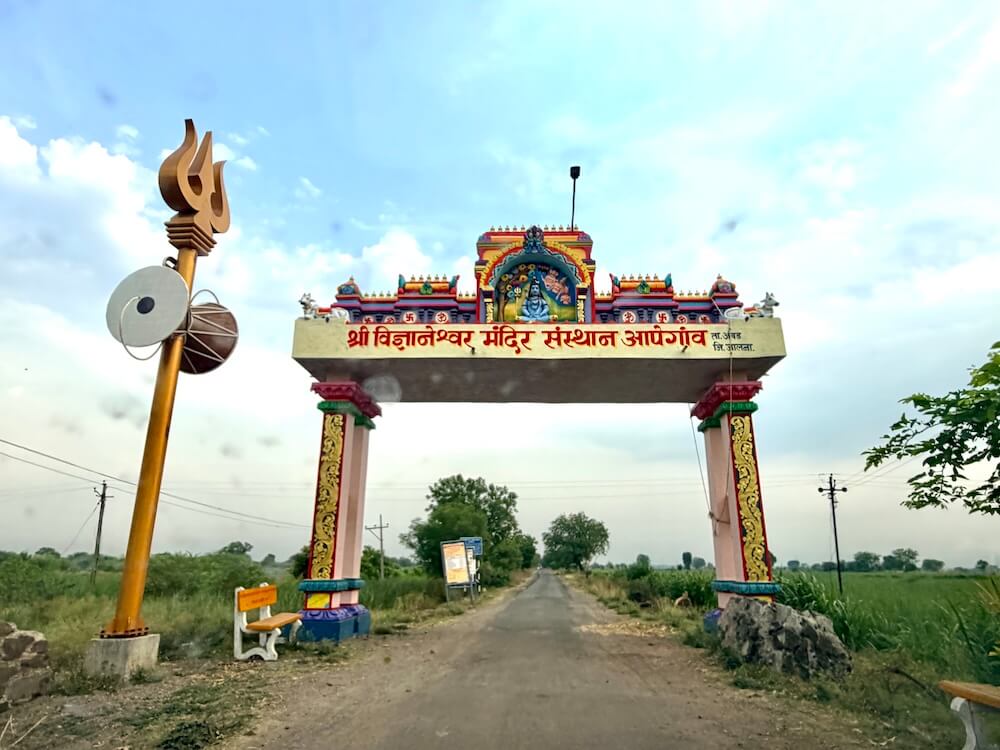
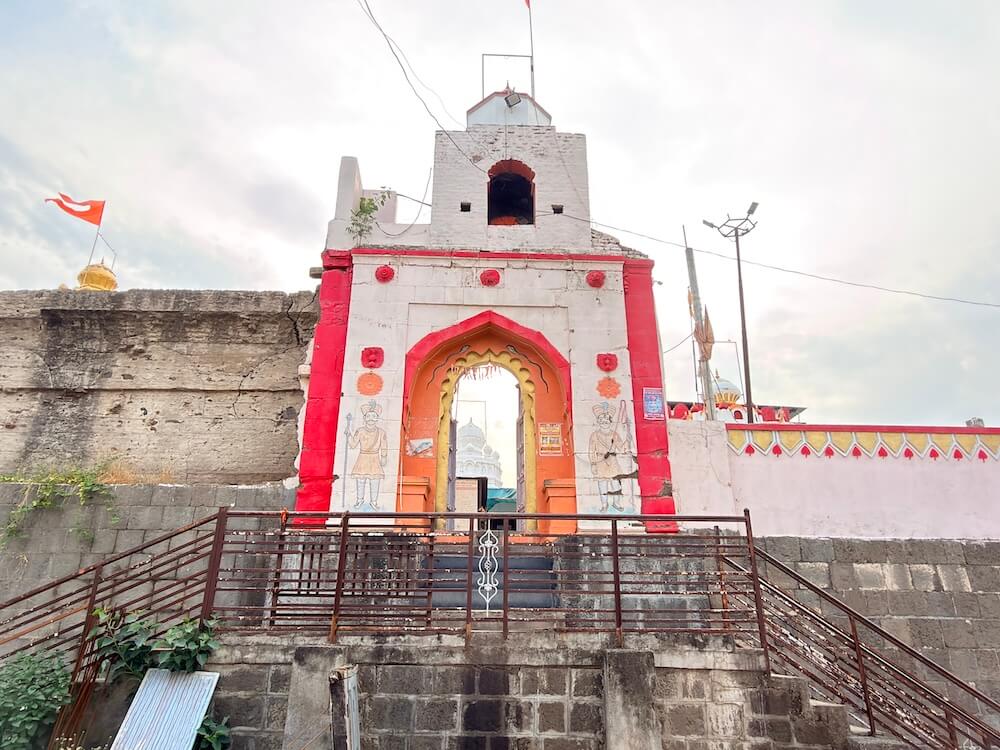
Previously, this temple was located at some distance from the village on the banks of the Godavari River, but due to the expansion of the village over time, it is now adjacent to the village. The first welcoming arch of the temple is erected at the junction of the road leading into the village from the main road. There is a parking area for vehicles right in front of the temple. A stone fortification about ३० feet high is built around the main temple premises. In this fortification, there is a two-story entrance gate situated about १५ feet higher than the main road. A platform about १० feet high is built in front of this entrance. To access this platform, there are २० steps each on the left and right sides along the fortification. Iron railings are installed for safety between and outside the steps. The main entrance is another ५ feet higher than the platform, and ५ steps have been built to reach it. Seats for guards have been prepared on the left and right sides of the entrance. The entrance is fitted with ornate stone and wooden door frames. An image of Ganapati is carved on its lintel, while a Kirtimukha is on the architrave. Paintings of gatekeepers are depicted on the front walls on both sides of the entrance. There is a Nagarkhana (drum house) on the floor above this entrance. The temple courtyard is spread out at the same level as the entrance. Separate steps have been arranged to reach the Nagarkhana from the courtyard.
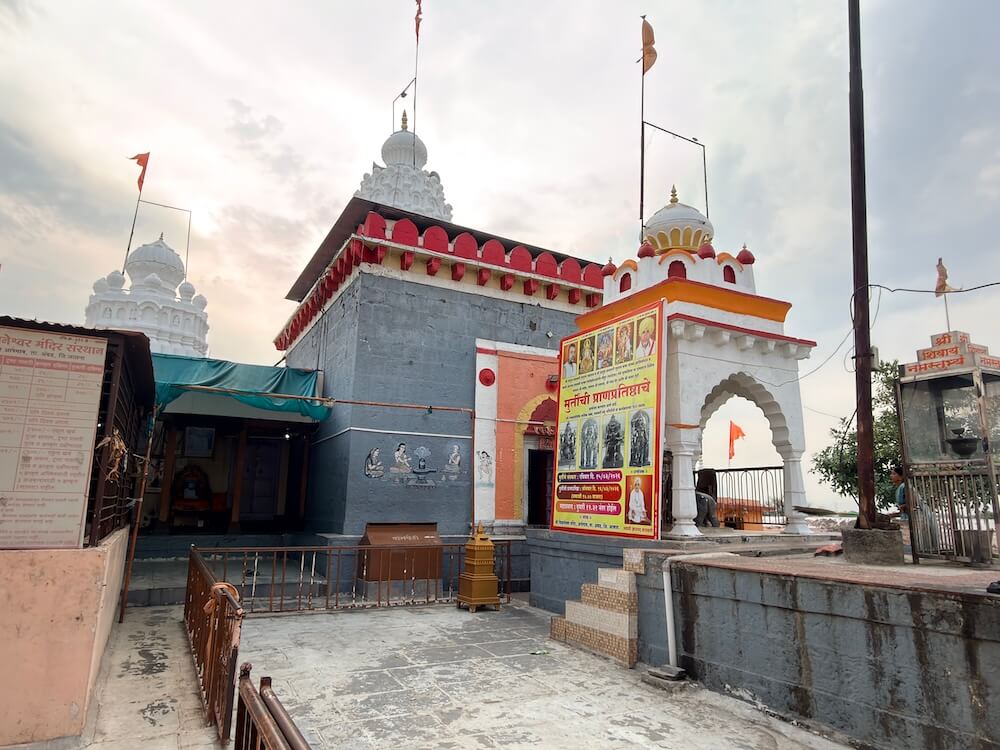
The main temple of Vignaneshwar Mahadev stands in the center of the courtyard. Directly in front of the temple, on a platform about ४ feet high, is the Nandi Mandapa. On the four corners of the Nandi Mandapa platform are four ornate pillars connected by arched beams. The roof of the Nandi Mandapa has a two-tiered spire. The lower octagonal tier of the spire has carved niches for deities, while the upper tier is dome-shaped. A finial and a Kalash are placed on the top of this spire. Steps have been built on the side to climb onto the Nandi Mandapa platform. A black stone idol of Nandi is consecrated inside the Nandi Mandapa. In front of this Nandi is an idol of Sage Pushpadanta. It is believed that this Sage Pushpadanta composed the famous ‘Shivamahimna Stotra’.
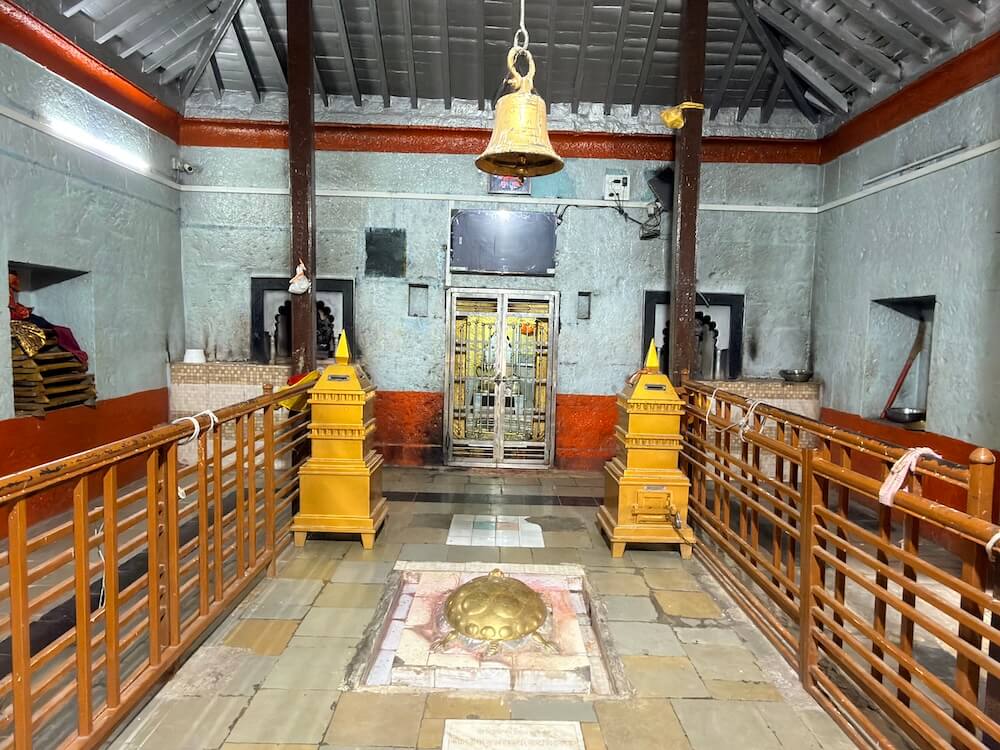
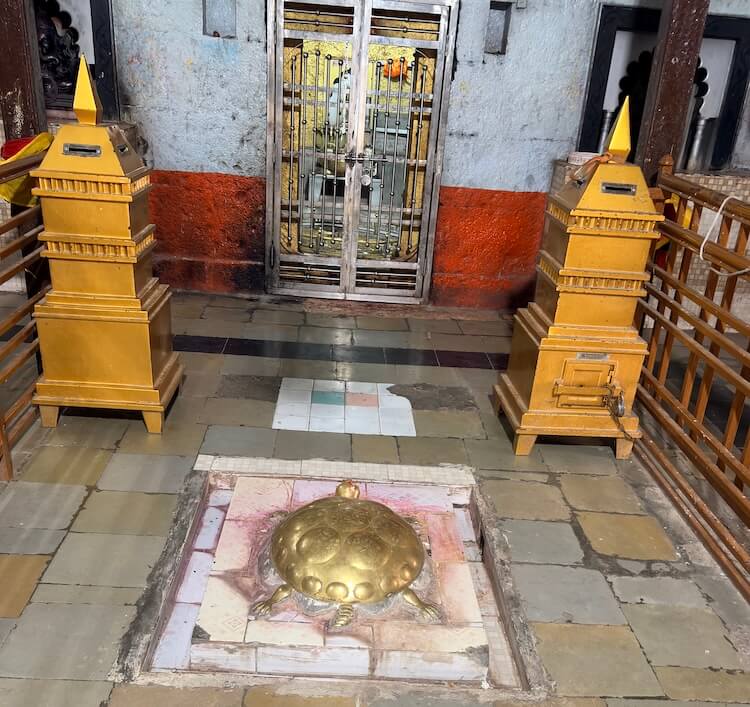
The main temple is divided into a Sabha Mandapa (assembly hall) and a Garbhagriha (sanctum sanctorum). This temple stands on a foundation about ३ feet high. The main entrance of the Sabha Mandapa is higher than the courtyard. On its lintel is a sculpture of Ganapati with Riddhi and Siddhi, while a Kirtimukha is carved on the architrave. This entrance has sturdy wooden shutters. Inside the Sabha Mandapa, there are ३ wooden pillars each in vertical rows on the left and right sides. These pillars are connected to each other by a ३-foot-high wooden railing. Wooden ceiling work has been done on the beams above the pillars. A stone tortoise sculpture is carved in the center of the Sabha Mandapa floor. This Sabha Mandapa is enclosed. It has two additional entrances on the left and right sides. Inside the Sabha Mandapa, on the front wall of the Garbhagriha, there are two niches on the left and right sides of the entrance. One of these niches contains an idol of Ganapati and the other an idol of a Yaksha.
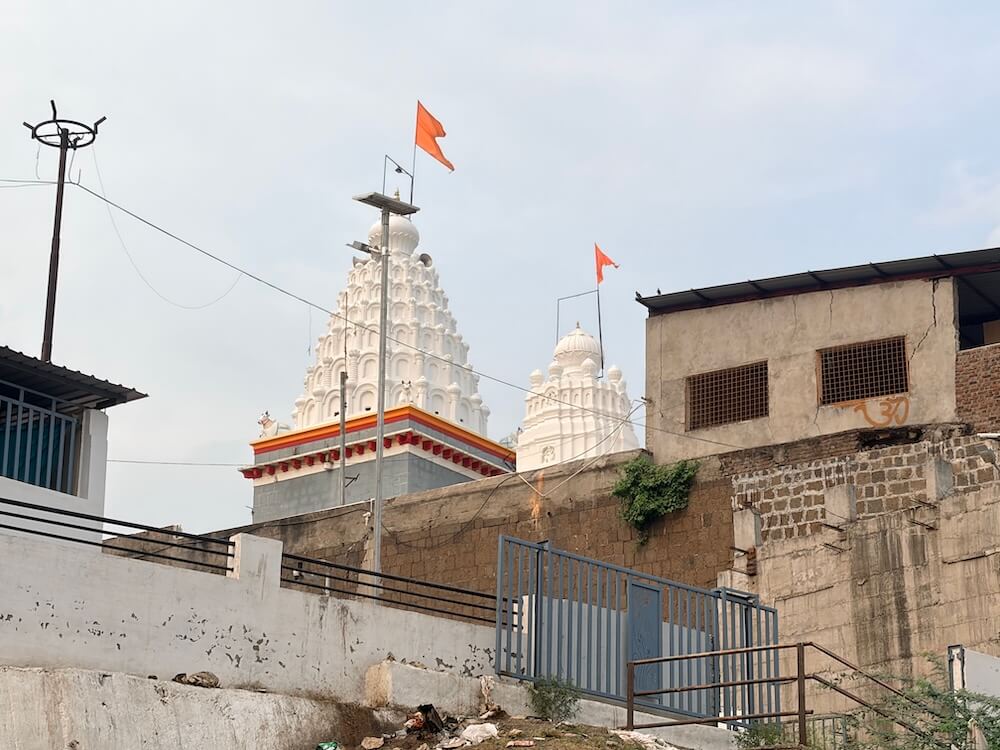
After crossing the Sabha Mandapa, one reaches the main entrance of the Garbhagriha. Ornate pillar branches are carved on this entrance. There is a sculpture of Ganapati on the lintel, and a Kirtimukha on the architrave. This door is also fitted with wooden shutters. The main Garbhagriha is slightly deeper than the level of the entrance. There are steps to descend into it. On this step, a Yaksha sculpture is carved as the royal seal or mark of the Chalukya Empire. An ancient inscription testifying to the history that Pandit Vignaneshwar was in the court of Chalukya Emperor Vikramaditya VI can be seen at this very spot. A Swayambhu Shivling is consecrated in the center of the Garbhagriha floor. A brass cover is placed over this Shivling. A brass Abhishek vessel is hung from the ceiling to hold a continuous stream of water over the Linga, and a brass Trishul is kept on the side. There are niches in the walls of the Garbhagriha; the niche in the back wall contains a brass idol of Goddess Parvati. Also, brass masks of Vignaneshwar Mahadev are kept on the floor. On the roof of the Garbhagriha, a spire in the Chalukya-Nagara style is erected on the exterior. This main spire has many smaller spires of the Urushringa type. There is an Amalaka at the top of the spire. A golden Kalash and a Dharmadhwaja are placed on this Amalaka.
At a short distance from the main temple, a Yajna Mandap (sacrificial pavilion) is constructed within the courtyard. In the center of this pavilion lies the Yajna Kund. Directly behind the temple is the residence of Swami Anand Saraswati. A short distance from this residence, his Samadhi is situated. This Mahant carried out the renovation work of this temple and also initiated the Annachhatra (free food distribution) in the temple. Adjacent to the Maharaja’s residence are the Someshwar Mahadev and Nilkantheshwar temples. In front of the entrance of this temple, on a Vajrapitha (stone pedestal) in the courtyard, stands a black stone idol of Nandi. This temple is structured with a shared wooden Sabha Mandap (assembly hall) and two Garbhagrihas (sanctum sanctorum). In the Garbhagriha on the right side of the temple, the Swayambhu (self-manifested) Shiva Linga of Someshwar Mahadev is consecrated on the ground, while the Shiva Linga of Nilkantheshwar Mahadev is in the left Garbhagriha. On a Vajrapitha against the back wall of this left Garbhagriha, a vermilion-anointed stone idol of Lord Kalbhairav is installed.
Behind the main temple is an ancient Dattatreya temple. It is said that Lord Dattatreya gave his darshan to Vigyaneshwar at this very spot. The architecture of this temple also consists of a Sabha Mandap and a Garbhagriha. The entrance side of the enclosed Sabha Mandap is completely open. There are four pillars connected to each other by semi-circular arches. Inside the Sabha Mandap, two separate rooms are built on the right and left sides. Further ahead is the narrow entrance of the Garbhagriha; a sculpture of Lord Ganesha is carved on its lintel, and there is a Chandrashila (moonstone) on the threshold. This entrance is fitted with wooden shutters. Inside the Garbhagriha, on a Vajrapitha against the left wall, is a black stone idol of the one-faced and four-armed Shri Dattatreya. On the Vajrapitha against the wall facing the Garbhagriha are idols of Garuda and Goddess Lakshmi, while Khamblingeshwar is consecrated against the right wall. The roof of this temple features a three-tiered circular Shikhara (spire). In the upper tier of the Shikhara, there are eight small Urushringa-style spires. At the pinnacle of the Shikhara is the Amalaka, topped with a Kalasha. The riverbed of the Godavari flows right behind the temple. A Ghat has been constructed on the riverbank. On this very Ghat, about one lakh lamps are lit every year during the Deepotsav celebrated on Diwali.
Various religious festivals and celebrations are held in this temple throughout the year. Mahashivratri and Shravani Mondays are the main festivals here. On these occasions, thousands of devotees from many parts of the district come here for the darshan of Mahadev. A large fair is held here on Mahashivratri. On the occasion of Shri Ram Janmotsav, a festival is celebrated for seven consecutive days from Ram Navami to Purnima. During this period, an unbroken Yajna is organized in the temple. Every year, a Dindi (procession) of devotees departs from this temple for Pandharpur and Alandi on Ashadhi and Kartiki Ekadashi. Apart from this, festivals like Dussehra, Diwali, Nag Panchami, Kartik Purnima, and Hanuman Jayanti are celebrated in the temple in a traditional manner. Throughout the year, spiritual programs like Harinam Saptah, Ram Katha, and Shivastotrayag are organized in the temple. On the occasion of all these festivals, programs like continuous Bhajan, Kirtan, and Pravachan (discourses) take place in the temple. Every Monday, a special floral decoration is offered to the Vigyaneshwar Shiva Linga. There is a large crowd of devotees for darshan in this temple every day.
This sacred temple stands as a testament to deep spiritual devotion, ancient architectural grandeur, and rich local cultural traditions.
The sanctum sanctorum houses the divine idol consecrated according to ancient Vedic traditions, surrounded by serene courtyards and traditional temple architecture.
Navratri, Maha Shivratri, Annual Temple Jatra & Deepotsav
Compare and book flights, secure top-rated local hotels near the temple, hire reliable guides, and rent cars instantly.
Extend your pilgrimage by visiting other highly sacred temples located nearby.


Add ₹999 more to unlock FREE SHIPPING!
Your sacred cart is currently empty.
Shop Photo FramesFill in your delivery details below to place your order.
Add comment