
Add ₹999 more to unlock FREE SHIPPING!
Your sacred cart is currently empty.
Shop Photo FramesDharashiv city, which was part of the Rashtrakuta and Chalukya dynasties in ancient times, was later ruled by the Mughals of Delhi and the Nizam of Hyderabad. Inscriptions from the 7th and 8th centuries AD mention the city’s name as Dharashiv. At the beginning of the 20th century, during the reign of Mir Osman Ali Khan, the 7th Nizam of Hyderabad (1911 to 1948), the city was named Osmanabad. In the year 2023, the government decided to rename the city and district to Dharashiv. The ancient and famous temple of Goddess Dharashiv, after whom the city gets its name, is located in the Anand Nagar area of the city. Devotees firmly believe that the *Jagrut* (responsive) Goddess here fulfills all vows and prayers.
This temple is around one thousand to twelve hundred years old. The temple attained its current form through restoration carried out with public participation. It is said that this temple finds mention in the Skanda Purana. According to legend, the demon Dharasur received a boon from Lord Mahadev, making him arrogant and causing him to torment the people. To be saved from Dharasur’s tyranny, the people prayed fervently to Goddess Bhagavati. Taking the form of Mahishasura Mardini, the Goddess vanquished Dharasur. Exhausted after slaying him, the Goddess sat at this sacred spot to rest and became consecrated here. Having slain the demon Dharasur, the Goddess came to be known as Dharasur Mardini.
There is a parking facility near the temple and a spacious paver-blocked courtyard in front. In the courtyard, on both sides in front of the temple, there are platforms with octagonal *Deepmalas* (lamp towers). The temple architecture consists of a *Mukhamandapa* (front porch), *Sabhamandapa* (assembly hall), *Antarala* (vestibule), and *Garbhagriha* (sanctum sanctorum). The *Mukhamandapa* features four square pillars connected at the front by arched niches. On the front side of each pillar, there are eight lamp niches (*Deepakoshtakas*). Beams rest upon the pillars, supporting the roof. The rear side of the *Mukhamandapa’s* roof rests on the wall of the *Sabhamandapa*.
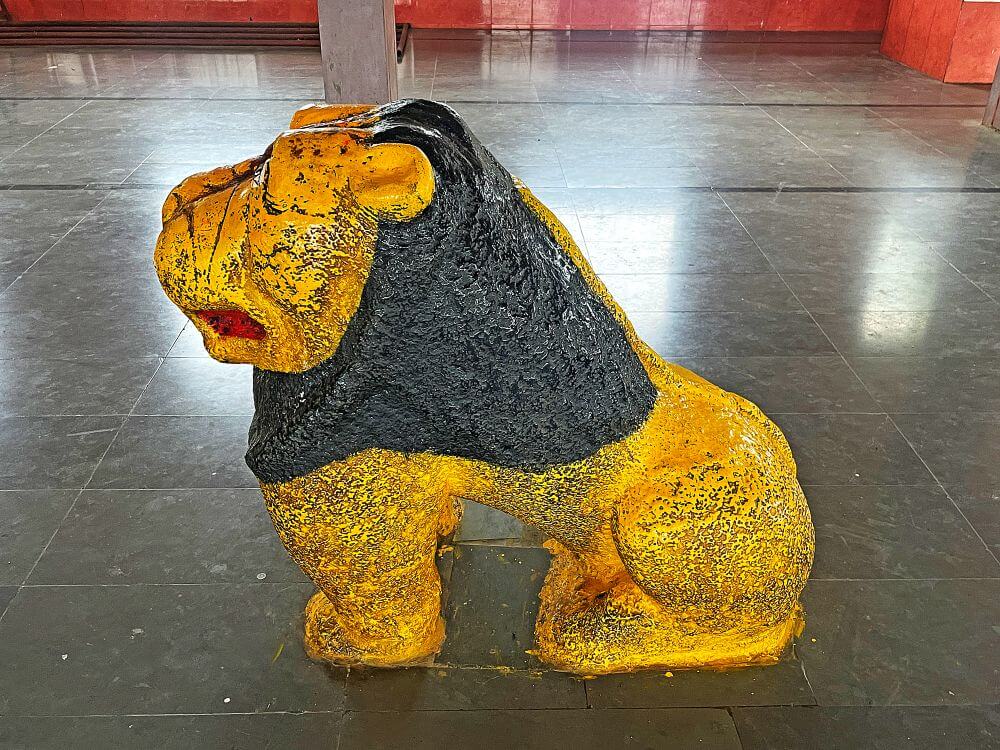
In the center of the *Mukhamandapa’s* roof, there is a square replica of a temple, adorned with an *Amalaka* and a *Kalash* on its spire. Lion sculptures flank both sides of this temple replica. Beyond the *Mukhamandapa* lies the entrance to the *Sabhamandapa*. The entrance to the *Sabhamandapa*, which is elevated higher than the *Mukhamandapa*, has three steps. Inside the *Sabhamandapa*, directly facing the entrance, is a *Yagnakunda* on the floor, followed by a lion sculpture and a brass tortoise. The *Sabhamandapa* features four rows of eight square pillars each. The outer pillars are embedded in the walls. Beams rest upon the pillars, supporting the ceiling. Windows (*vatayanas*) are provided for light and ventilation in this enclosed *Sabhamandapa*. There are two additional doors on the right and left sides of the *Sabhamandapa*.
The *Antarala* has three doors at the front. The central entrance is flanked by square pillars and windows on either side. Circular carvings adorn the top of all three doors and windows. Inside the *Antarala*, facing the entrance of the sanctum sanctorum, is a lion sculpture on the floor, followed by a brass tortoise, and beyond that, sacred *Padukas* (footprints) carved on a square stone upon a raised platform. On the right side of the *Antarala* rests the Goddess’s *Palkhi* (palanquin) used during festival occasions. Traditional baskets (*Pardya*) for *Jogwa* are kept near the *Palkhi*. Devotees coming for *darshan* offer flour, salt, food grains, and other sacred offerings into these baskets. There are two side doors on the left and right to exit from the *Antarala*.
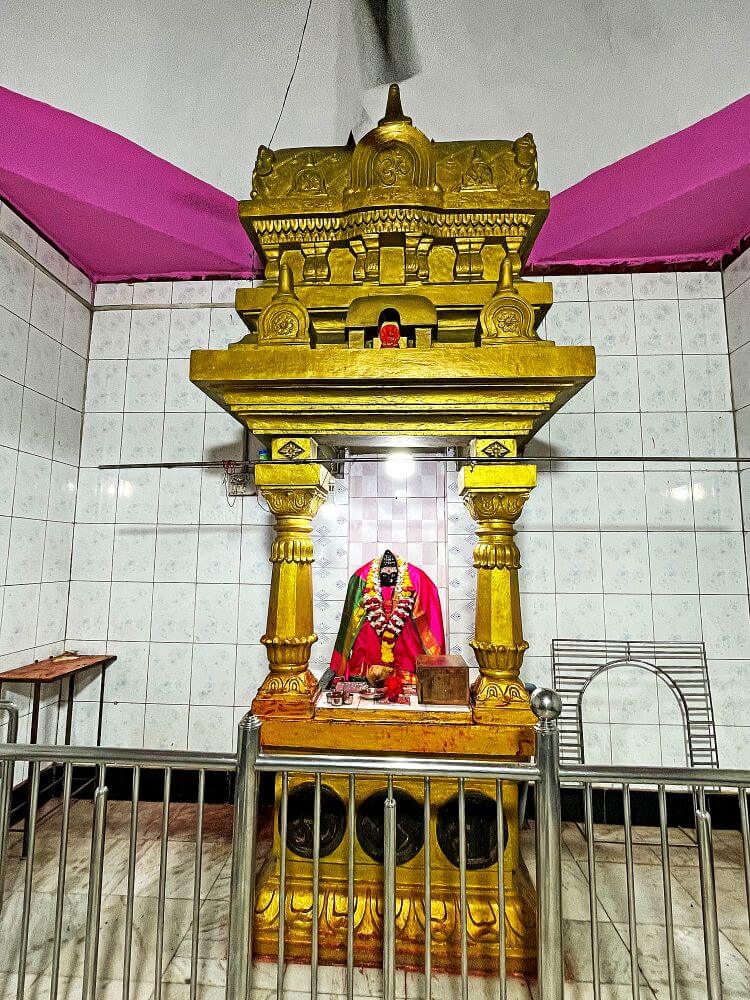
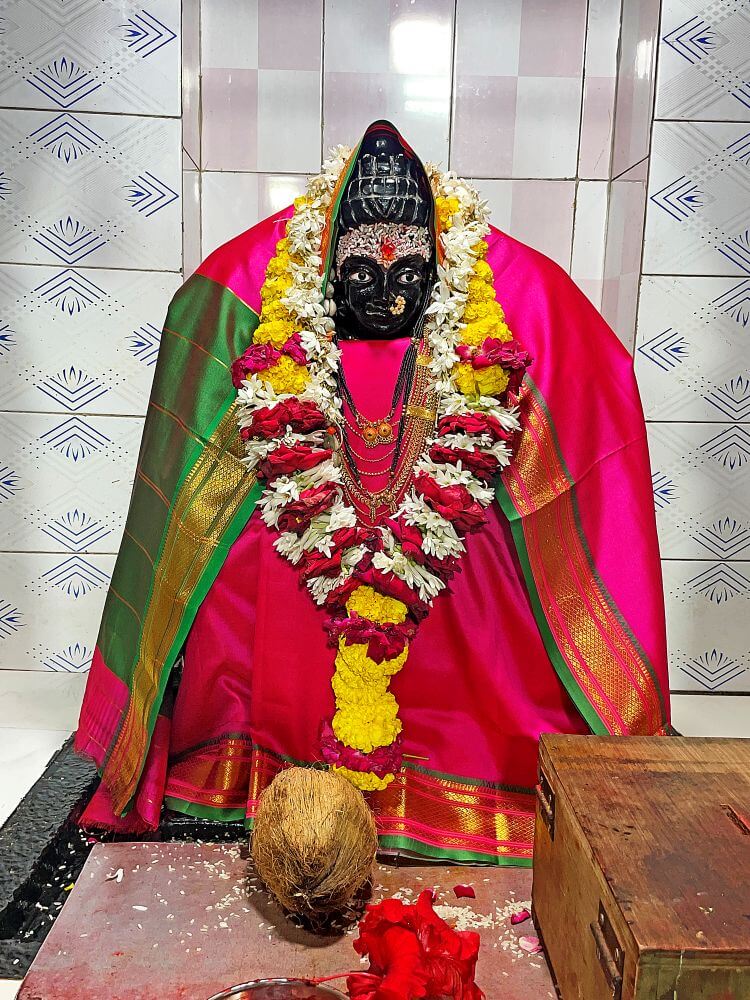
Further ahead is the entrance to the *Garbhagriha* (sanctum sanctorum). Since the sanctum is higher than the *Antarala*, there is a step at the entrance. An idol of Lord Ganesha graces the lintel center (*Lalatabimba*), and peacock carvings adorn the door beam (*Lalatapatti*). Inside the *Garbhagriha*, atop a *Vajrapitha*, stands an ornate shrine (*Makhar*) supported by two carved pillars, topped with a spire and *Kalash*. Seated within this *Makhar* is the idol of Goddess Dharasur in the form of Mahishasura Mardini, mounted on a lion. Silver feet (*Paduka*) are placed in front of the idol. In the right corner of the sanctum is an ancient stone lamp (*Malta*), considered rare today.
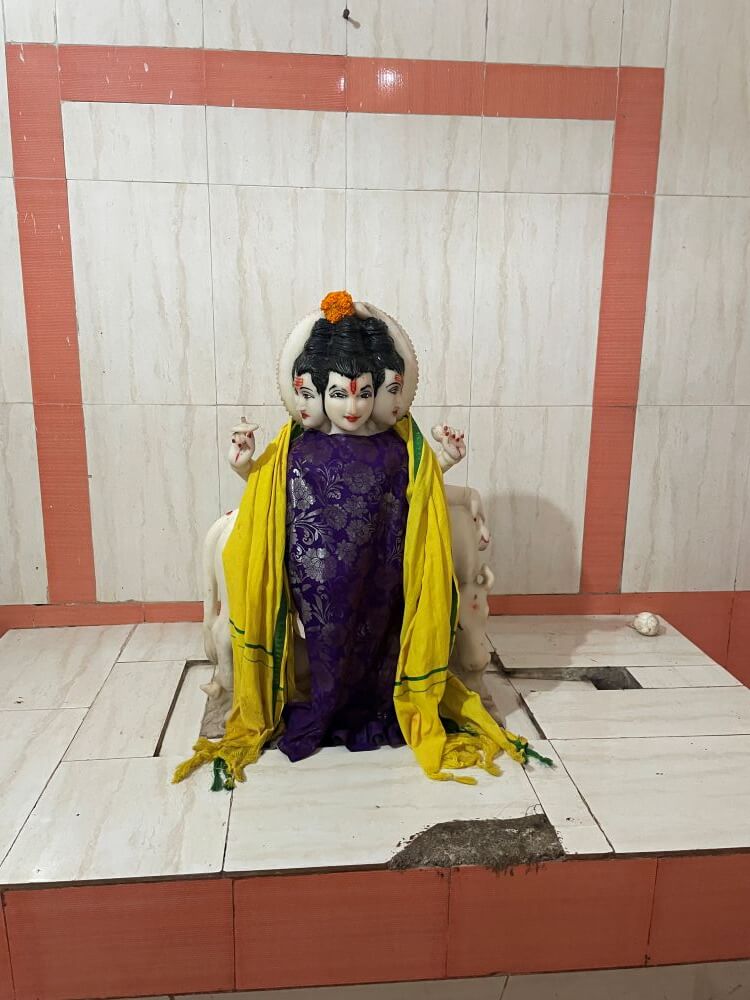
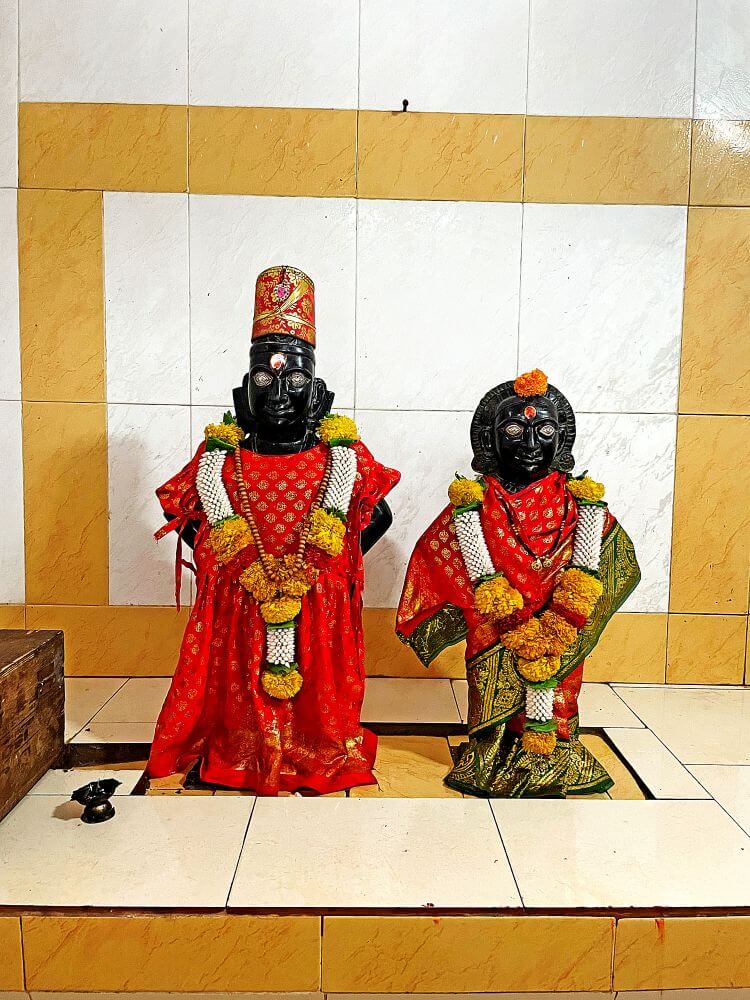
Around the outer side of the *Garbhagriha* is the *Pradakshina* (circumambulation) path. To the left and right of the main sanctum, there are two sub-sanctums on each side. The first sub-sanctum on the left houses a *Shivlinga* and Nandi, while the second enshrines the idols of Vitthal and Rakhumai. In the first sub-sanctum on the right is the Goddess’s bed, where She rests during Navratri. The second sub-sanctum on the right houses a marble idol of Lord Dattatreya, along with ceremonial umbrellas used during festivals.
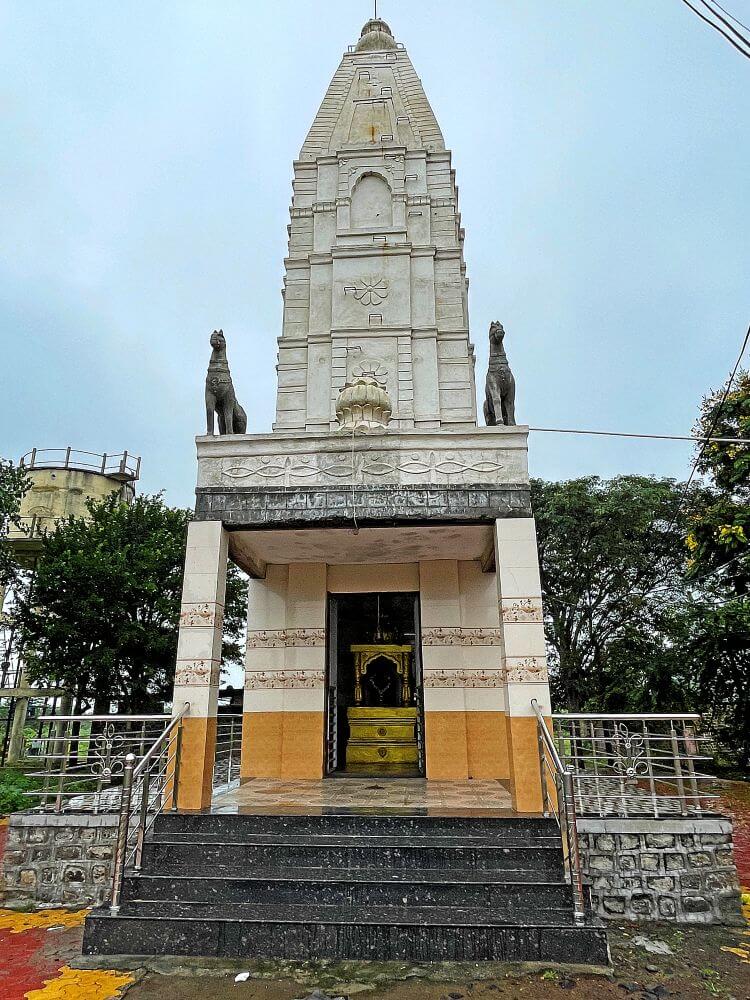
A protective parapet wall runs along all sides of the temple roof, and above the sanctum roof rises a two-tiered square *Shikhara* (spire). Each tier of the spire features niches for deities (*Devakoshtakas*) on all four sides, topped with an *Amalaka*, a *Kalash*, and a ceremonial flag (*Dhvajapataka*). In the courtyard, a Maruti (Hanuman) temple stands to the right of the main temple, and a Khandoba temple to the left. Both temples are built of traditional stone masonry.
Vaishakh Purnima is the Goddess’s main annual fair and festival, celebrated with immense enthusiasm. On this day, amidst the grand beats of *dhol-tasha* and showering of *gulal* (vermilion powder), the Goddess’s *Palkhi* is taken out in a grand procession around the city. Chaitra Navratri and Sharad Navratrotsav are also celebrated with devotion at the temple. During all festivals, thousands of devotees gather for the Goddess’s *darshan*, to fulfill their vows, and to participate in the *Palkhi* procession. On every *Purnima* (full moon day), the *Palkhi* circumambulates around the temple. The temple witnesses a heavy rush of devotees particularly on Tuesdays, Fridays, *Purnima*, and *Amavasya*.
This sacred temple stands as a testament to deep spiritual devotion, ancient architectural grandeur, and rich local cultural traditions.
The sanctum sanctorum houses the divine idol consecrated according to ancient Vedic traditions, surrounded by serene courtyards and traditional temple architecture.
Navratri, Maha Shivratri, Annual Temple Jatra & Deepotsav
Compare and book flights, secure top-rated local hotels near the temple, hire reliable guides, and rent cars instantly.
Extend your pilgrimage by visiting other highly sacred temples located nearby.


Add ₹999 more to unlock FREE SHIPPING!
Your sacred cart is currently empty.
Shop Photo FramesFill in your delivery details below to place your order.
Add comment