
Add ₹999 more to unlock FREE SHIPPING!
Your sacred cart is currently empty.
Shop Photo FramesSituated on the holy banks of the Indrayani River in the Khed taluka of Pune district, the pilgrimage site of Alandi holds a deeply significant place in the spiritual and cultural tradition of Maharashtra. This sacred land attained extraordinary importance as Sant Shri Dnyaneshwar Maharaj, the progenitor of the Warkari Sampradaya and author of the revered scripture *Dnyaneshwari*, took Sanjeevan Samadhi here at the tender age of twenty-one. Known as Maharashtra’s *Matru-Pitrutirth* (sacred pilgrimage of parents), lakhs of devotees bow down at this holy place every year and offer their heartfelt devotion at the feet of Dnyanobaraya.
Sant Dnyaneshwar Maharaj, the pioneer of the spiritual revolution and the great philosopher who laid the foundation of the Warkari Sampradaya, was born in Apegaon to the devout couple Vitthalpant and Rukminibai. Vitthalpant had taken initiation into Sannyasa (asceticism) after marriage, but returned to the householder life (*Grihasthashrama*) to obey the command of his Guru. Due to this event, the orthodox society of Alandi at that time imposed a severe social boycott on the entire family. Society constantly humiliated Vitthalpant for renouncing Sannyasa and returning to worldly life, denying even the basic right to live with dignity to all four of his children. During this time, Vitthalpant and Rukminibai were forbidden from residing in the main settlement of Alandi. Consequently, they lived a life of extreme hardship in a small hut outside the village.
The four siblings—Nivruttinath, Dnyandev, Sopandev, and Muktabai—faced humiliating and disgraceful treatment from society at every step during their childhood. The dominant leaders of society refused to perform the sacred thread ceremony (*Munj*) for these children and banned them from drawing water from the village well. For every single morsel of food, these siblings had to beg for alms door to door in the scorching sun, and people often turned them away empty-handed, considering them ill-omened. To purify their children and grant them an honorable place in society, Vitthalpant and Rukminibai took the extremely agonizing decision to undergo *Dehanta Prayashchitta* (atonement by giving up life). By offering their lives at the Triveni Sangam in Prayag, these parents made the supreme sacrifice for the bright future of their children.
Left orphaned without the loving shelter of their parents, the four siblings went to the learned scholars of Paithan to earn a living and obtain a certificate of purification (*Shuddhipatra*). Although these children displayed their profound wisdom before the religious council of Paithan, the scholars initially refused to accept them with respect. Dnyaneshwar Maharaj proved his spiritual power by performing the extraordinary miracle of making a male buffalo recite the Vedas, after which the siblings returned to their city of Alandi. Even upon returning to Alandi, society’s opposition had not entirely faded, and they had to face many difficult situations with courage once again. On one occasion, when the village refused to give even a simple earthen pan (*Khapar*) to bake *Mande* (a traditional sweet bread), Dnyaneshwar demonstrated his divine power through his yogic strength by heating his own back red-hot to bake the *Mande*.
Despite enduring immense harassment and neglect from society, no feeling of hatred ever arose in Dnyaneshwar’s heart toward society. On the contrary, he composed the *Pasayadan*, offering a heartfelt prayer for the well-being of the entire world and the transformation of the minds of the wicked. At the young age of just sixteen, he created the monumental scripture *Dnyaneshwari*, elevating the Marathi language to the pinnacle of glory. Through this scripture, he showed the common man a simple path of devotion to God in their own language and dismantled harmful social dogmas and traditions. At the end of his earthly journey, he sanctified this land forever by taking Sanjeevan Samadhi beneath the Ajhan tree (*Ajanvruksha*) right here in Alandi.
The history of the holy city of Alandi is ancient. A clear mention of this village is found in the copper plate inscription of Krishna I of the Rashtrakuta dynasty at Talegaon dating back to 768 AD, proving the historical significance of this region. During the medieval period, this village emerged as an important cultural center. This place received royal patronage under various dynasties. In the 64th chapter of the Sahyadri Khanda of the Skanda Purana, this land is described by names such as Varuna, Alka, Karnika, Anandavan, and Siddhashetra. According to historical documents, Chhatrapati Shivaji Maharaj also issued a charter (*Sanad*) granting one *Khandi* and two *Maunds* of grain from a farm for the maintenance of this temple, a record that sheds light on its connection with the Shiv era. The greatness of this pilgrimage place spread far and wide as this region was repeatedly referred to as Alankapuri or Alkapuri in numerous abhangas of Sant Namdev and Sant Tukaram Maharaj.
From a religious and spiritual perspective, Alandi is considered a divine land (*Devabhumi*). Many mythological stories are associated with this place. This pilgrimage site is situated on the banks of the Indrayani River. According to popular belief, the river was named Indrayani because Devraj Indra freed himself from a curse by performing intense penance at this place. It is believed that before taking Sanjeevan Samadhi in 1296 AD, Sant Dnyaneshwar Maharaj planted his walking stick here, which sprouted leaves and grew into the majestic Ajhan tree (*Ajanvruksha*) seen today. A legend is told regarding the roots of this tree. In the sixteenth century, Sant Eknath Maharaj received a divine vision in a dream. Realizing that a root of the Ajhan tree was touching Dnyaneshwar’s neck and causing him distress, Eknath Maharaj came from Paithan to Alandi, descended into the Samadhi cave, and removed the root. He has mentioned this incident in his abhangas. He also emphasized that performing spiritual practice (*Anushthan*) while consuming the leaves of the Ajhan tree bestows divine knowledge.
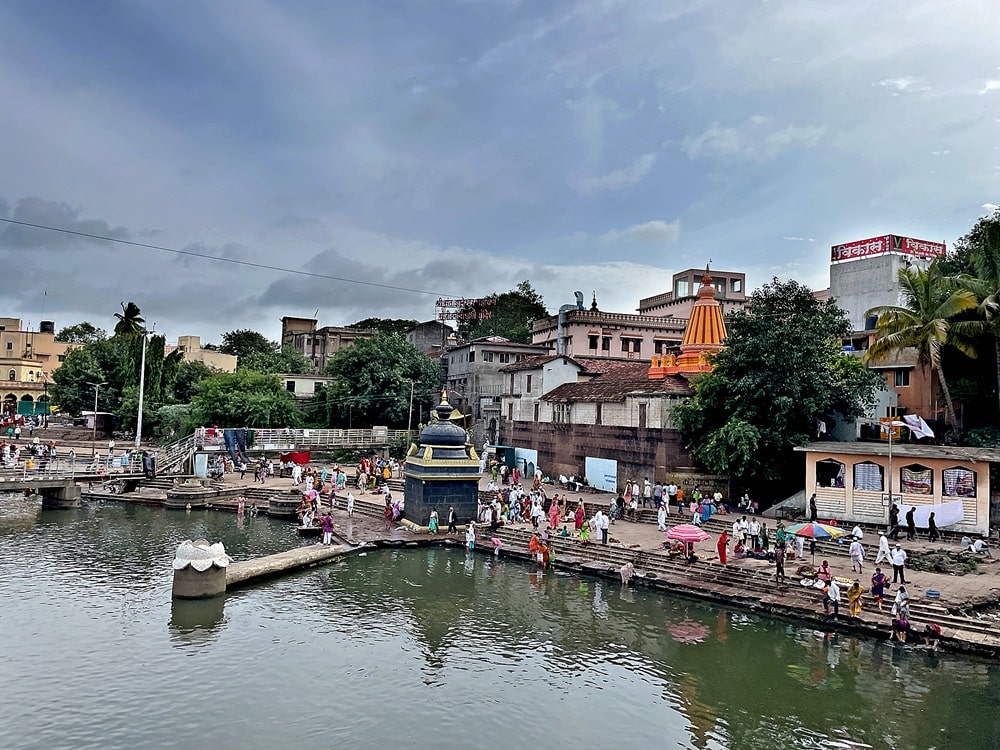
The Sant Dnyaneshwar Maharaj Samadhi Temple is situated on the banks of the Indrayani River. Approaching the temple from the main road, one comes across the river ghat. There are several small and large temples as well as samadhi shrines on the ghat. Devotees come for the darshan of the Samadhi after taking a holy dip (*Tirthasnan*) in the river or purifying themselves. The Vishwashanti Stambha (World Peace Pillar) is located on the ghat. Moving from the river toward the temple, there are shops on both sides of the road selling worship materials, religious books, utensils, clothes, and other items.
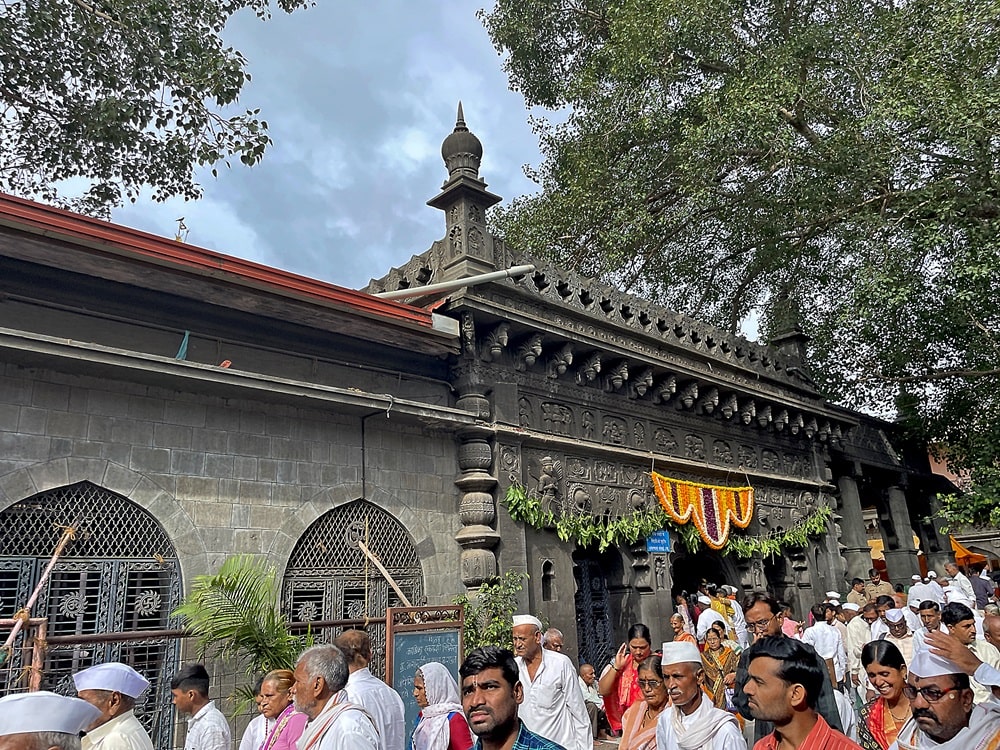
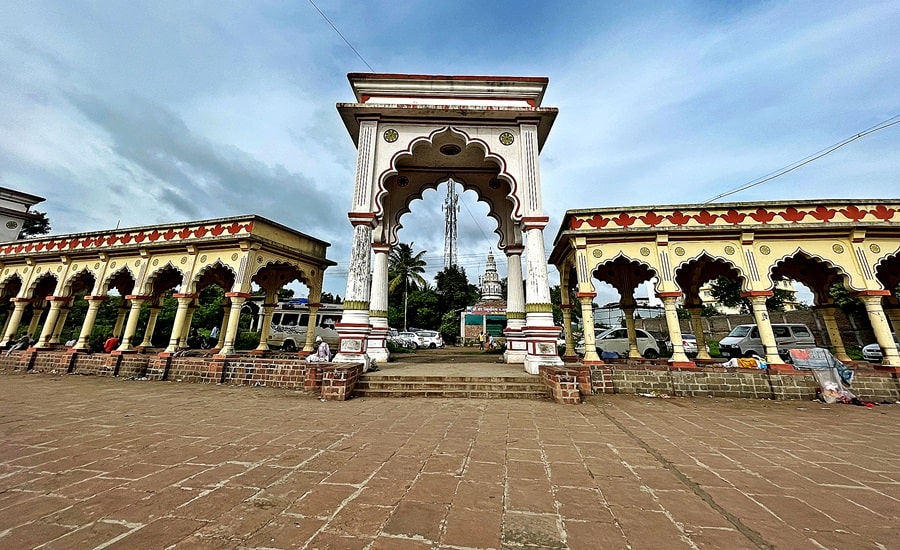
Mauli’s Samadhi is situated within the Deulwada (temple complex). The Deulwada is enclosed by strong ramparts, and on the northern side of these ramparts stands a two-storeyed main entrance gate. On both sides of the entrance gate, there are sculptures of four-armed Dwarapalas (gatekeepers). In their rear two hands, the Dwarapalas hold the Shankha (conch) and Chakra (discus), while their front two hands hold Dandas (maces). At the entrance lies the sacred step dedicated to Haibatrao Baba, a devout disciple of Mauli. Devotees enter the Deulwada after bowing their heads at this step. A Nagarkhana (drum house) is located on the upper floor above the entrance gate. Beside this entrance gate is the temple of Sant Mahadev Kasar.
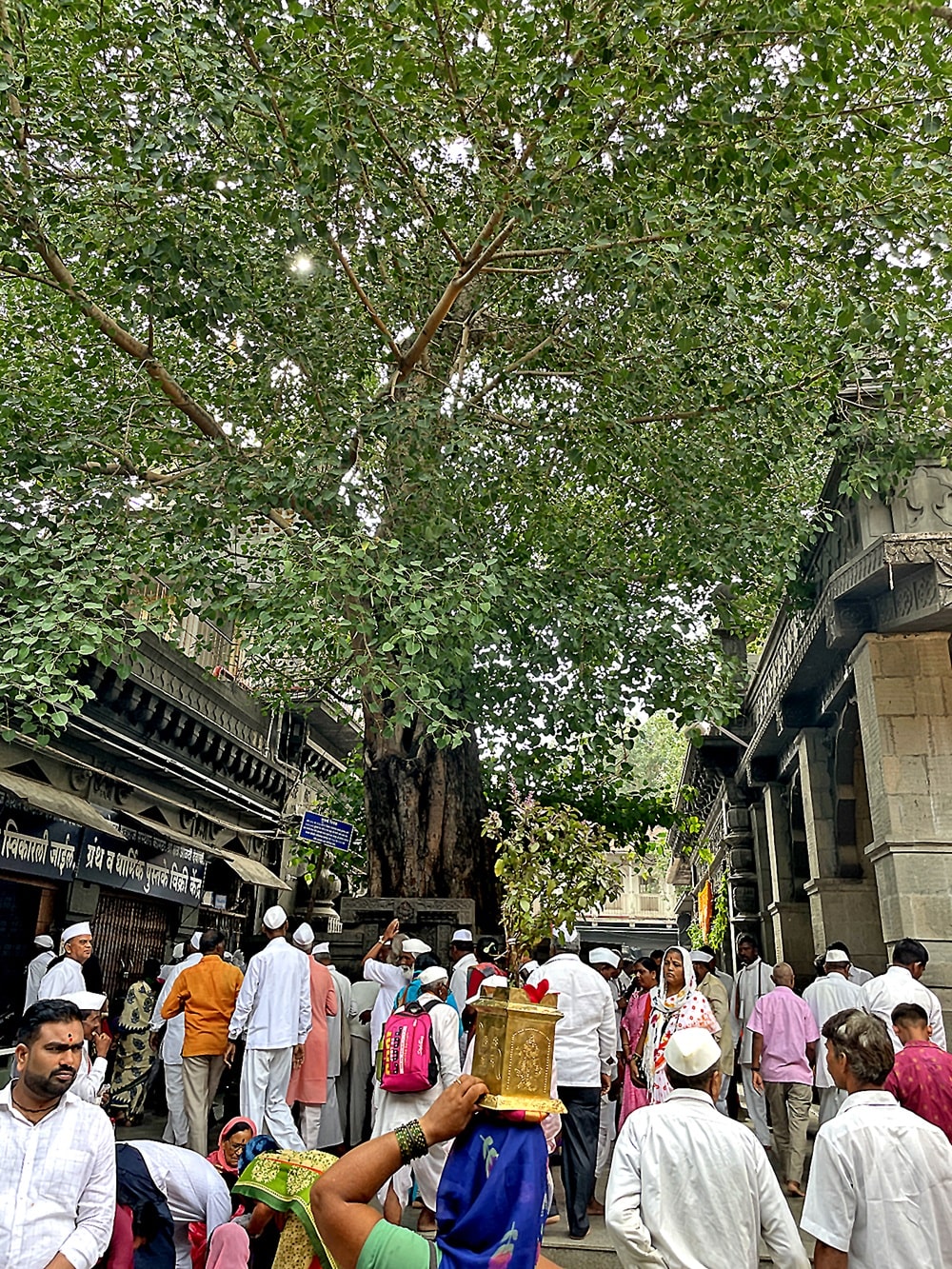
Upon entering the courtyard, there are small shrines housing the idols of Lord Hanuman on the right side and Lord Garuda on the left side of the temple. Moving forward from here is the Haibat Baba Paduka Sthan Temple. The temple houses the Padukas (sacred footprints) and idol of Haibat Baba. Behind them, on a Vajrapitha (raised stone pedestal), stand the idols of Lord Vitthal and Goddess Rakhumai. Adjacent to this temple is the sacred spot of Sant Eknath Maharaj. On the platform (Paar) surrounding a Peepal tree, a small shrine enshrines a brass idol of Sant Eknath Maharaj seated in a yogic posture along with his Padukas. Beside the Peepal tree are the Samadhi temples of Lakshminath and Kesarinath. Nearby stands the Samadhi temple of Sant Bhojling Kaka. It was this very Bhojling Kaka who took care of Sant Dnyaneshwar and his siblings after the passing of their parents. The courtyard also houses the Darshan Bari (queue complex) building and a wooden bridge.
Further ahead is the main Samadhi Temple of Sant Dnyaneshwar Maharaj. The architecture of the Samadhi temple comprises a Sabhamandap (assembly hall), Antarala (vestibule), and Garbhagriha (sanctum sanctorum). The entrance to the Sabhamandap features intricately carved doorframes. On the front wall near the entrance, carvings of Lord Garuda, Lord Hanuman, and other decorative motifs are rendered. On the floor of the Sabhamandap lies a sacred sculpture of a tortoise (Kasav). Beyond this lies the Antarala, followed by the doorway to the Garbhagriha. The doorway is adorned with ornate carved pillars. A sculpture of Lord Ganesha graces the Lalatabimba (center of the lintel), and the entire doorway is plated with silver.
In the center of the Garbhagriha floor rests the platform (Chauthara) of Sant Dnyaneshwar Maharaj’s Samadhi. A silver mask (Mukhavata) of Mauli is placed on this platform. It was at this spot, in the cellar beneath, that Maharaj attained Sanjeevan Samadhi in his bodily form. In the niche (Devakoshtaka) on the rear wall of the Garbhagriha, the idols of Lord Vithoba and Goddess Rakhumai are enshrined. A twelve-hooded silver serpent behind the idols forms a protective canopy over them. The niche is adorned with silver plating. On the roof of the Samadhi temple, at all four corners, stand four minaret-like miniature spires (Laghu-Shikharas).
Adjoining the Samadhi temple is the Siddheshwar Mahadev Temple. This temple is structured with a Sabhamandap and a Garbhagriha. In the Nandi Mandap within the assembly hall, a black stone idol of Nandi is consecrated on a Vajrapitha. Beneath the Nandi lies a subterranean tunnel, through which Dnyaneshwar Maharaj descended into the underground vault to take Samadhi. It is said that Sant Eknath Maharaj entered the Samadhi cellar via this very path to remove a root of the Ajaan tree that had entwined around Dnyaneshwar Maharaj’s neck. The semi-open Sabhamandap is supported by numerous pillars. The entrance to the Garbhagriha features beautifully carved doorjambs and an image of Lord Ganesha on the lintel. The Garbhagriha is set lower than the Sabhamandap, with four steps leading down into it. On the floor of the Garbhagriha lies a Swayambhu (self-manifested) Shivlinga. A copper serpent canopy hovers over the Shivlinga, along with an Abhishek Patra for the sacred water stream. Above the Nandi Mandap in the Sabhamandap rises a circular, tall, and tapering Shikhara (spire). At the pinnacle of this spire, two Amalakas are stacked one above the other, surmounted by a Kalasha (finial). Over the Garbhagriha, the roof features a four-tiered spire. The lowest tier of the spire is square-shaped, containing five niches on each of its four sides. On all four sides here, sculptures of various animals and birds are carved. The upper three tiers of the spire are circular, with around sixteen niches in each tier. These niches are adorned with Amalakas and Kalashas. At the summit of the main spire, two Amalakas rest one above the other, topped with a Kalasha.
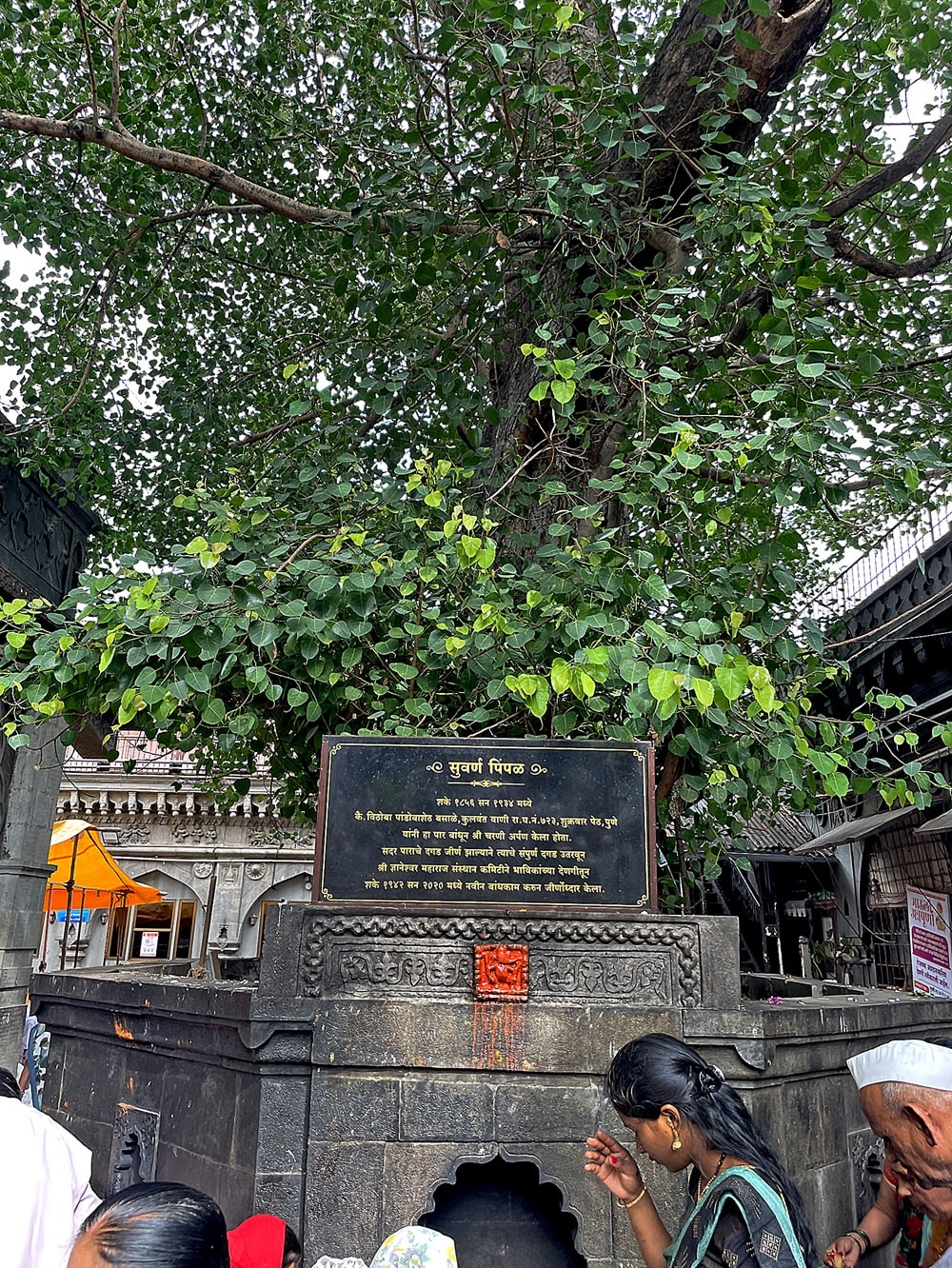
Along the Pradakshina (circumambulation) path of the Samadhi temple stands the Sant Muktabai Temple. A few steps further from here is the Ajaanbagh (garden of the Ajaan tree). It is said that the roots of this sacred Ajaan tree had reached Sant Dnyaneshwar’s neck. Devotees firmly believe that reading holy scriptures while sitting under this tree ensures that the wisdom stays permanently in one’s memory, . A short distance ahead lies the sacred Suvarna Peepal tree. This ancient tree, around a thousand years old, is surrounded by a carved stone platform (Paar), near which a Shivlinga and an idol of Nandi facing it are installed.
In the town of Alandi, a short distance from the Samadhi temple, stands the historic Wall of Sant Dnyaneshwar (Dnyaneshwaranchi Bhint). When the proud Yogi Changdev came to meet Dnyaneshwar riding on a tiger, Sant Dnyaneshwar made a lifeless wall move forward to greet him. To protect this wall, the temple trust constructed a stone platform around it. On this platform, inside a glass-enclosed chamber, stands a sculpture depicting the divine meeting between Changdev and Sant Dnyaneshwar. Further ahead lies the residence (Nivassthan) of Sant Dnyaneshwar Maharaj.
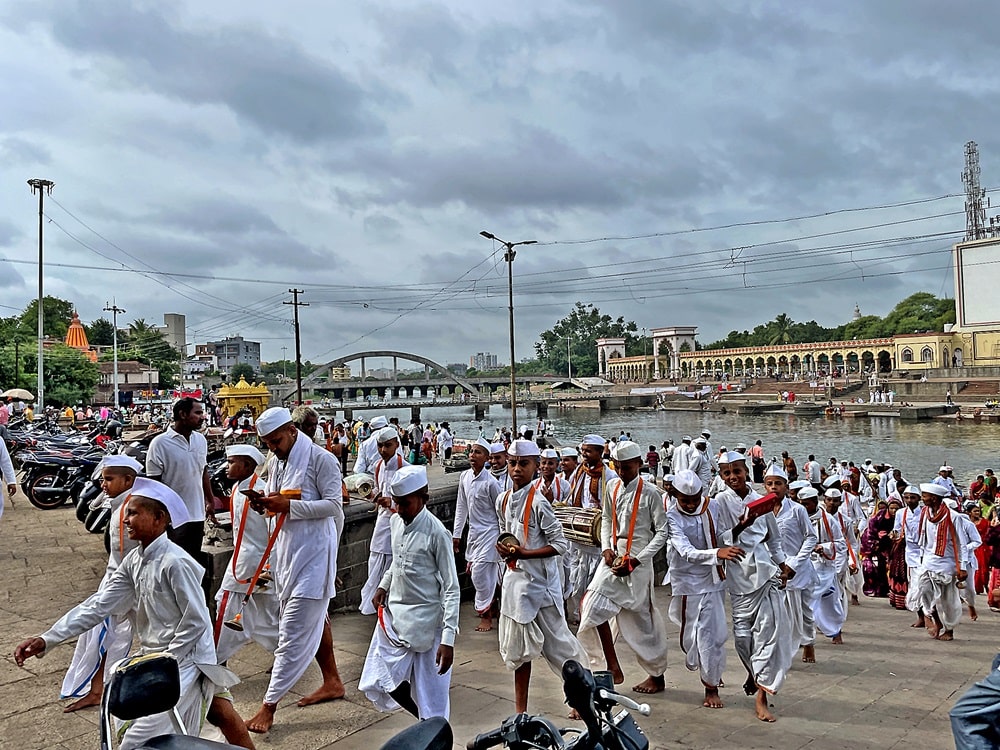
Among the festivals in Alandi, the Palkhi Prasthan Sohala (palanquin departure ceremony) of Dnyaneshwar Maharaj, held on Jyeshtha Vadya Ashtami, is considered the grandest and most devotional event. Hundreds of thousands of Varkaris gather for this procession as the Palkhi departs for Pandharpur for the Ashadhi Wari. During this time, the entire holy town of Alandi resonates with joyful chants of ‘Dnyanoba-Tukaram’. Devotees firmly believe that the Kalasha (spire finial) of the temple tilts slightly at the moment of the Palkhi’s departure, and large crowds gather to witness this miracle. The Sanjeevan Samadhi Sohala, celebrated on Kartik Vadya Trayodashi, is another major festival. On this day too, an immense surge of devotees flocks here. Additionally, during Navratri in the month of Ashwin, Mauli’s Palkhi travels to Vishrantwad, where the festival is celebrated with great fervor and enthusiasm.
This sacred temple stands as a testament to deep spiritual devotion, ancient architectural grandeur, and rich local cultural traditions.
The sanctum sanctorum houses the divine idol consecrated according to ancient Vedic traditions, surrounded by serene courtyards and traditional temple architecture.
Navratri, Maha Shivratri, Annual Temple Jatra & Deepotsav
Compare and book flights, secure top-rated local hotels near the temple, hire reliable guides, and rent cars instantly.
Extend your pilgrimage by visiting other highly sacred temples located nearby.


Add ₹999 more to unlock FREE SHIPPING!
Your sacred cart is currently empty.
Shop Photo FramesFill in your delivery details below to place your order.
Add comment