
Add ₹999 more to unlock FREE SHIPPING!
Your sacred cart is currently empty.
Shop Photo FramesThe ancient and famous temple of Goddess Govardhani is situated at the medieval fort of Belapur in Navi Mumbai. It is considered the only temple in Navi Mumbai whose consecration (Pranapratishthapana) took place during the Peshwa era. A unique feature of this place is that the Navratri festival has been celebrated here continuously since 1860. The Goddess is renowned for being one who grants wishes and responds to the calls of her devotees. This Goddess is the family deity (Kuldevata) of many Agri, Koli, Sonar, and Brahmin families from Navi Mumbai, as well as the Thane and Raigad districts. The temple is also known for its beautiful architecture.
In the planned city of Navi Mumbai, known as the ‘city of the twenty-first century’, there were once many villages and hamlets. Belapur was one of the most important among them. Situated at the mouth of the Panvel Creek, this fort was built on a hill in this village by the Siddi of Janjira between 1560 and 1570 AD. Later, it was captured by the Portuguese. At that time, Belapur was known as Shahbaz. In Portuguese documents, the fort here is It is mentioned as ‘Sabajo’. This fort was conquered by the Marathas from the Portuguese during the Vasai campaign, which was conducted between March 1737 and May 1739 under the leadership of Anant Balaji, also known as Chimaji Appa, the brother of Shrimant Thorle Bajirao Peshwa.
According to historical records, the fort had five bastions and eleven cannons at that time. Additionally, there were nine cannons for the protection of the port. Under the leadership of Narayan Joshi, brother of the Subhedar of Kalyan, Vasudev Joshi (Murudkar), about four thousand Maratha soldiers laid siege to this fort. This siege lasted for about a month. Regarding this, it is recorded that Narayan Joshi and his men “fought with utmost valour.” On 26 April 1737, they hoisted the Maratha Jaripatka (flag) atop this fort. The fort remained under Maratha control until 23 June 1817. Thereafter, Captain Charles Gray of the British East India Company took possession of it. At that time, the British caused extensive damage to the fort. The temple of Goddess Govardhani is situated within this Belapur fort settlement.
The legend of this temple states that about two hundred years ago, while fishing at Retibandar in this area, a local villager named Rama Chimaji Bhagat found a stone idol of the Goddess in the waters of the creek. Subsequently, the Goddess appeared to Bhagat in a vision and instructed him to install the idol at the fort in Belapur Killa Gavthan. Following this, he built a small temple at this site and consecrated the idol of the Goddess within it. This old temple was constructed of stone. Villagers used to bring their cows to graze on this hill. Because of this, the villagers believed that the Goddess was one who protected and nurtured their cattle and brought happiness and prosperity to the farmers. It is for this reason that the Goddess came to be known as Govardhani Mata.
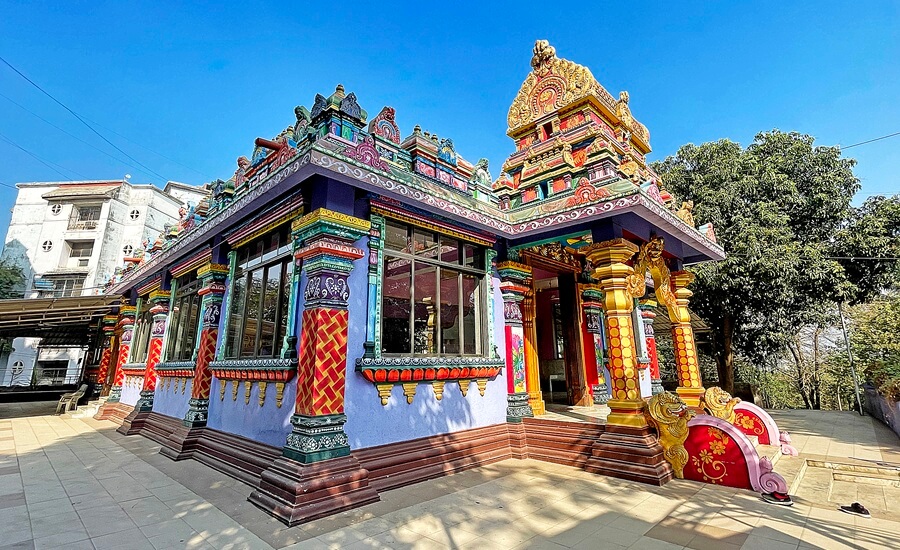
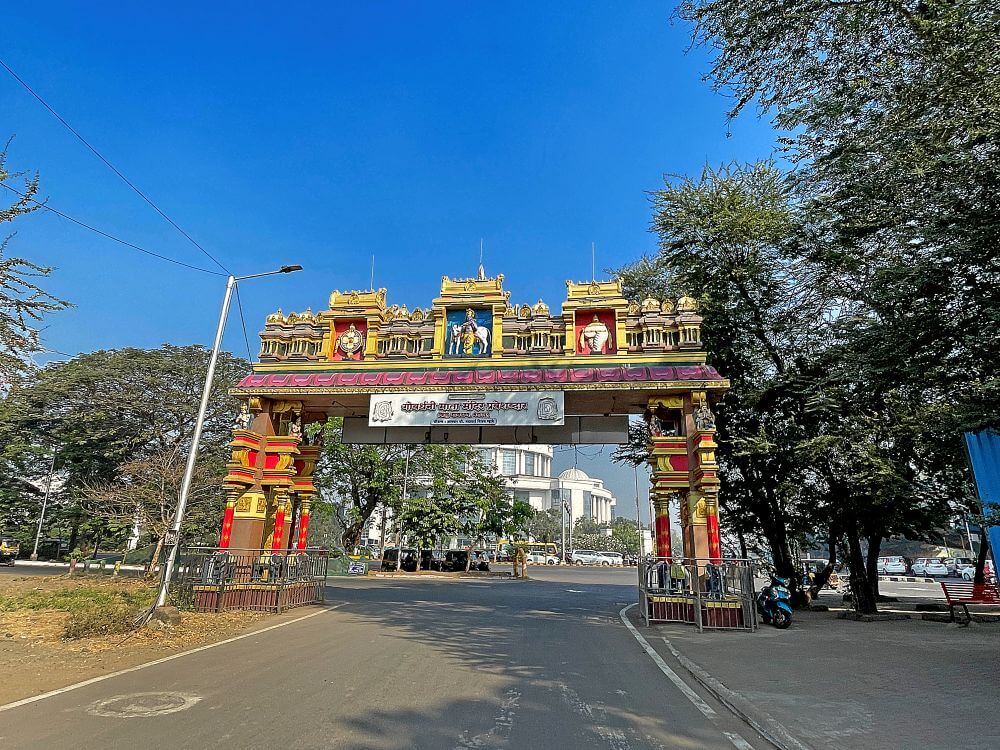
The temple of Mother Govardhani is situated in a nature-rich area on a medium-sized hill along the vast banks of the creek. This entire area is adorned with lush greenery. After the renovation carried out in 2008, the temple attained its current spacious and has attained a beautiful form. The distinctive entrance gate of Mother Govardhani is located one kilometer away from the temple. Situated near the Navi Mumbai Municipal Corporation building, this entrance is built in the Dravidian, or South Indian, architectural style. The pillars of the entrance feature sculptures of gatekeepers (pratiharis) in a posture of salutation (namaskar mudra). The roof of the entrance is adorned with a row of miniature temple replicas. In the central niche, there is a relief sculpture of Muralidhar Krishna with a cow behind Him. To His left, the niche contains a floral wreath, and to the right, a conch shell sculpture. The intricate craftsmanship and color scheme make this entrance truly captivating.
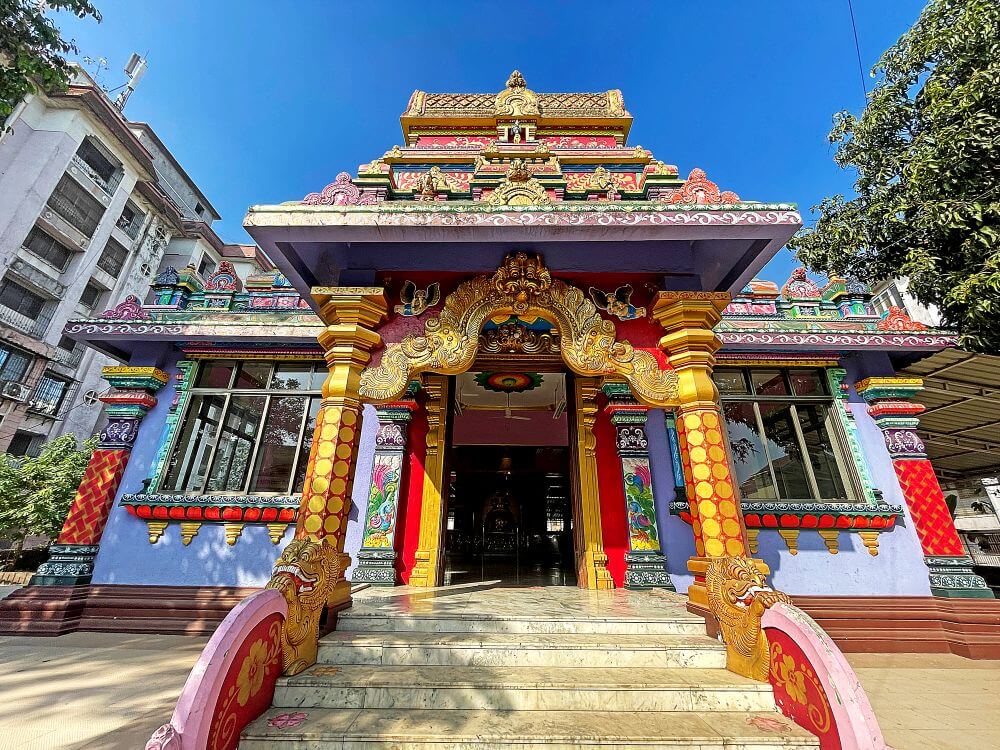
There are about 50 steps to reach the temple from the foothills. Additionally, there is a direct motorable road behind the temple. The architecture of the Govardhani Mata temple bears a strong influence of the Dravidian style. The temple structure consists of a Mukhamandapa (entrance porch), a Sabhamandapa (main hall), and a Garbhagriha (sanctum sanctorum). There are five steps to enter the Mukhamandapa. On the balustrades of these steps are sculptures of Vyala (mythical beasts) with their front two legs raised. The Mukhamandapa of the temple resembles a Gopuram. In the Dravidian style, a Gopuram is a towering, distinctively structured entrance gate located in the prakara (outer wall) of the temple. The roof of the Govardhani Mata temple’s Mukhamandapa reflects this Gopuram style. Between the two pillars in front of the Mukhamandapa, there is an ornate torana (archway) with a large Kirtimukha at its center. On the walls of this archway, there are relief sculptures of celestial beings (devadutas) on both sides. The ceiling features a highly ornate, three-tiered rectangular structure. The lower tier houses idols of Ganesha and Krishna, while the middle tier features an enshrined idol of Muralidhara Krishna.
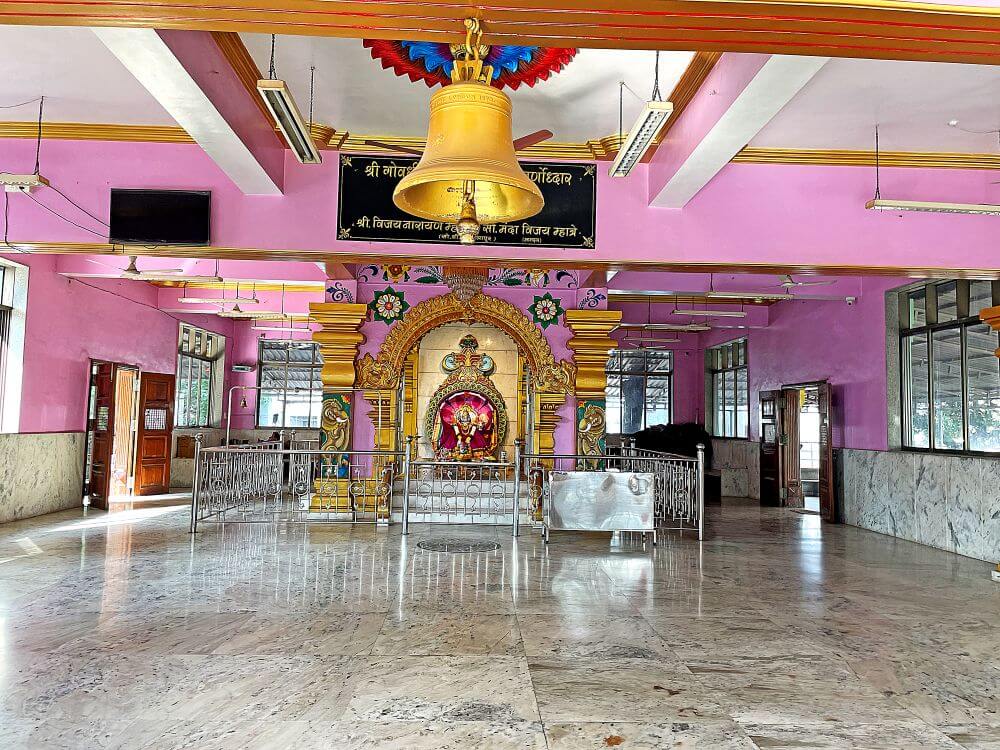
From this Mukhamandapa (entrance porch), one enters the spacious Sabhamandapa (main assembly hall) of the temple. This Sabhamandapa Although it is enclosed, there is ample light and ventilation due to the many large windows on the sides. The polished marble flooring in the sabhamandapa (main hall) further enhances the beauty of this temple. A large brass bell is hung at the entrance of the sabhamandapa, on which ‘Warner & Sons London 1832’ is inscribed in English. There are two doors on the left and right sides of this sabhamandapa for devotees to exit. Beyond the sabhamandapa, leaving space for the pradakshina marg (circumambulation path), is the garbhagriha (sanctum sanctorum) of the Goddess. Outside the garbhagriha, there is a silver utsavamurti (processional deity) of the Goddess.
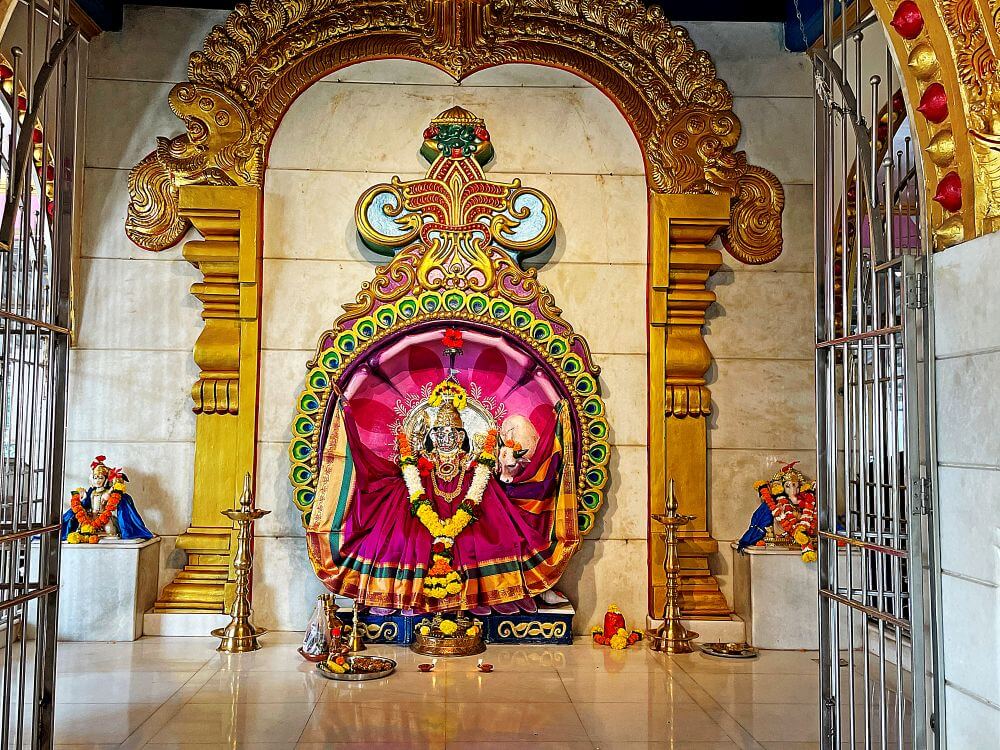
The sanctum sanctorum (Garbhagriha) is like a vast shrine. On both sides of the wall in front of it, there are square-shaped pillars painted in gold. Images of Gajavyala are depicted upon them. Inside, there is an arched doorway leading to the sanctum. This arch is adorned with intricate carvings on semi-pillars. The arch, as well as the pillars, are embellished with a golden hue.
In the center of the sanctum sanctorum, on a high marble Vajrapitha, the idol of Mother Govardhani is consecrated within a shrine adorned with peacock feather motifs. Above this shrine is a Kirtimukha. Facing east, Mother Govardhani wears a silver mask and a golden crown on her head. In the Goddess’s right hands, she holds the weapons of a shield and a trident. Beside her is the idol of a cow. Draped in various ornaments and a saree, the form of the Goddess appears beautiful. To the right of the Goddess, on a small Vajrapitha, is the idol of Hanuman, and to the left is the idol of Ganapati.
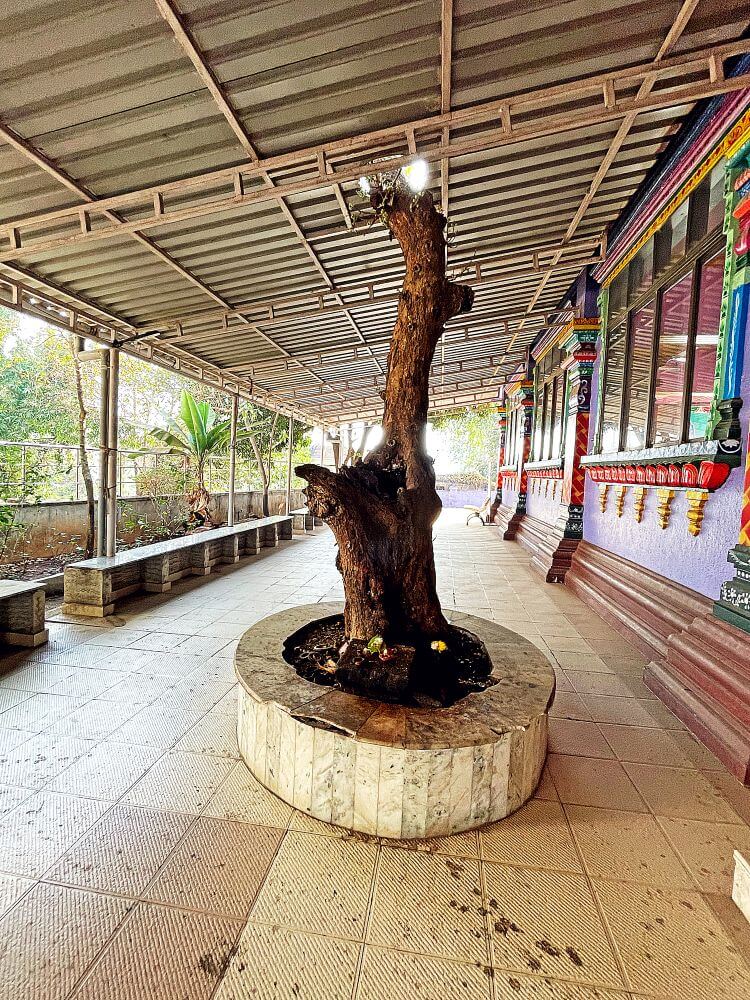
The outer walls of the temple and the ceiling of the assembly hall (Sabhamandapa) are adorned with intricate carvings and an attractive color scheme. The ceiling features gopura-style niches on all four sides. The courtyard outside the temple is paved with paver blocks, which makes the area look beautiful. In this courtyard, near the entrance to the left of the Sabhamandapa, stands an ancient Umbar (Cluster Fig) tree. Many devotees make it a point to pay their respects to this tree after having the darshan of the Goddess. From this courtyard, one can enjoy a panoramic view of a large part of the surrounding area.
Known as a ‘Jagrut Devasthan’ (an awakened or spiritually vibrant abode of the Divine), the Navaratri festival is celebrated on a grand scale at the Govardhani Mata Temple. During these nine days, the premises take on the atmosphere of a pilgrimage site. Thousands of devotees offer sarees, blouses, and green bangles to the Goddess in fulfillment of their vows. Various programs are held during this time, including Haldi-Kumkum ceremonies for women, traditional dress competitions, and cultural events. The Gokulashtami festival is also celebrated here. Every day at 7:00 AM, Abhishek and the Aarti of the Goddess are performed.
This sacred temple stands as a testament to deep spiritual devotion, ancient architectural grandeur, and rich local cultural traditions.
The sanctum sanctorum houses the divine idol consecrated according to ancient Vedic traditions, surrounded by serene courtyards and traditional temple architecture.
Navratri, Maha Shivratri, Annual Temple Jatra & Deepotsav
Compare and book flights, secure top-rated local hotels near the temple, hire reliable guides, and rent cars instantly.
Extend your pilgrimage by visiting other highly sacred temples located nearby.


Add ₹999 more to unlock FREE SHIPPING!
Your sacred cart is currently empty.
Shop Photo FramesFill in your delivery details below to place your order.
Add comment