
Add ₹999 more to unlock FREE SHIPPING!
Your sacred cart is currently empty.
Shop Photo FramesThe ancient temple of Nagadevi Mata is situated in Karave village, located in the Nerul area of Navi Mumbai. Although this city is modern, the Agri and Koli communities of this village have preserved their cultural traditions intact. In the folk culture of Konkan, nature worship holds extraordinary importance, which is why the serpent deity is worshipped in this region. This part of the Konkan coastline was once covered with vast marshes and forests. Serpents, which protected crops and grain stores from rodents, are considered ‘Kshetrapal’ or guardians of the land here. It was out of this sense of gratitude that the tradition of worshipping Nagadevi began in Karave village. The villagers firmly believe that this Goddess protects the entire village from natural disasters and epidemics.
The mention of Nagadevi Mata is found in various Puranic texts. Nagadevi is considered a form of Adishakti and is worshipped as the guardian deity of the Naga lineage. References to Nagatirtha and the worship of the serpent deity are found in the ‘Nagar Khand’ and ‘Tapi Khand’ of the Skanda Purana. According to these texts, the worship of the power in the form of serpents is essential for the balance of the Earth and for protection against natural disasters. The Mahabharata era also contains special mentions of the Naga lineage and the worship of their family deities. Spiritually, Nagadevi is considered a symbol of the Kundalini Shakti within the human body. In Yoga Shastra, Kundalini is envisioned as a serpent coiled three and a half times, which, upon awakening, leads the seeker to a higher spiritual state. Therefore, the worship of Nagadevi is directly related to the awakening of the inherent energy and consciousness within the human body. According to historical contexts, this deity was the presiding deity of the Naga tribes. According to religious texts, the worship of serpents is essentially the worship of the natural forces provided by the universe. In the worship of this deity, a sattvic (pure) sentiment is given more importance than any kind of difficult ritual.
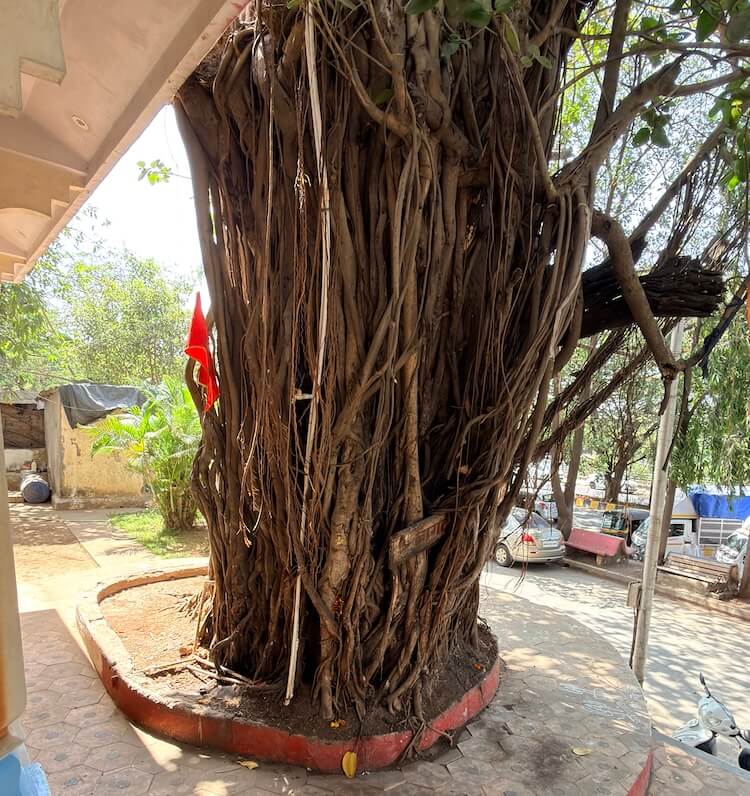
The history of this temple in Karave is that, in the past, the Goddess was worshipped in the form of a stone under the shade of an ancient banyan tree. This is considered a ‘Swayambhu’ (self-manifested) site of the Goddess. Farmers and fishermen of the village begin any auspicious work only after seeking the Goddess’s blessings. As Navi Mumbai expanded, Karave village also underwent a transformation. During this time, the villagers came together and decided to renovate this old shrine through public contributions. Today, a spacious temple made of cement, concrete, and marble stands in this place.
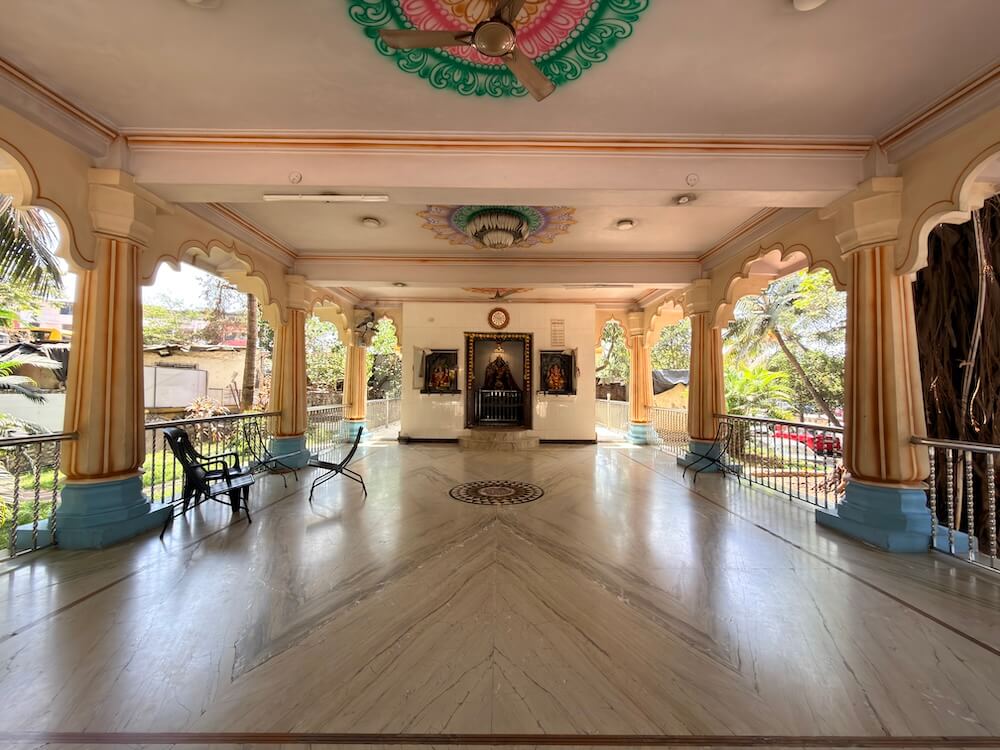
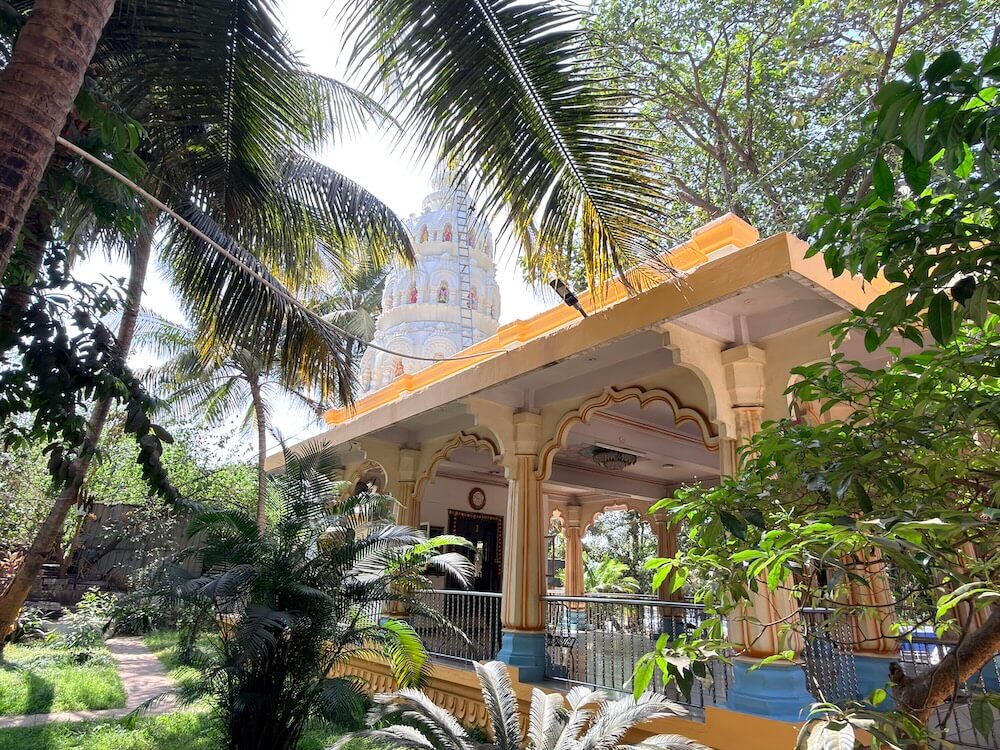
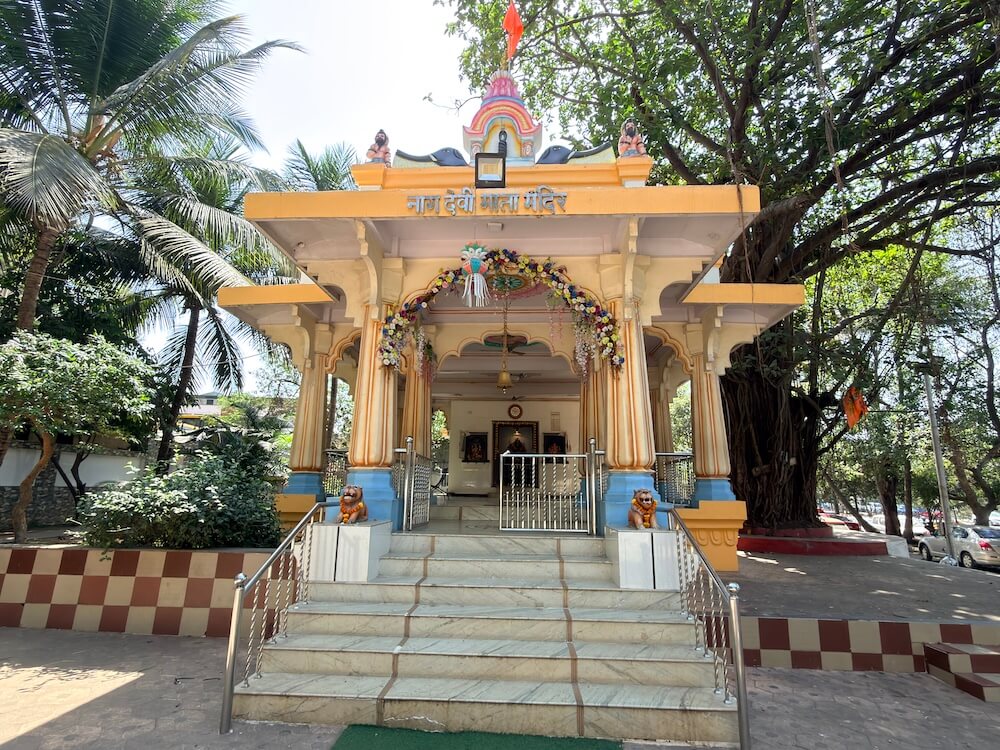
This temple of Nagadevi Mata is located in the central part of Karave village in Nerul, next to an ancient banyan tree. The courtyard in front of the temple is paved with paver blocks. One enters the Mukhamandapa (front hall) of the temple, which is situated on a high plinth, by climbing six steps from the courtyard. The structure of the temple consists of a Mukhamandapa, a Sabhamandapa (main hall), and the Garbhagriha (sanctum sanctorum) beyond it. On both sides of the entrance are sculptures of lions, the vehicle of the Goddess. On the ceiling of the Mukhamandapa, there are sculptures of two sages and royal elephants on both sides. In a niche located in the area between them, there is an idol of Nagamata. Above this niche is a lotus-shaped finial, topped with an Amalaka and a Shikhara (spire). The Mukhamandapa and Sabhamandapa here are semi-open in nature. All the pillars within them are connected to each other by arched gateways.
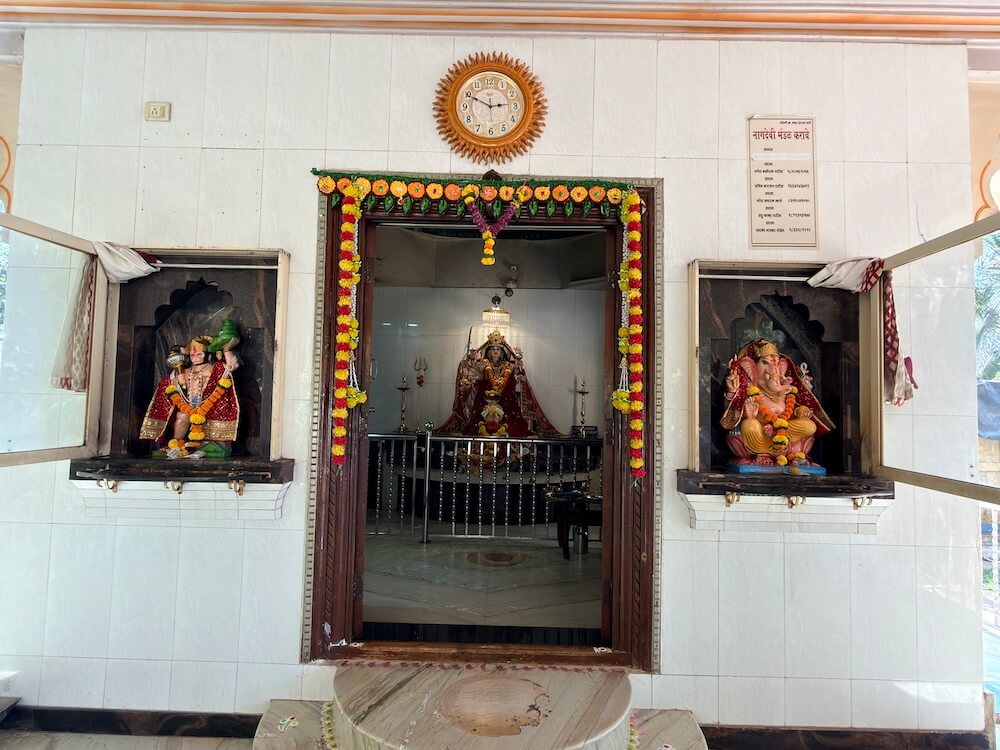
The Sabhamandapa has marble flooring, and beyond it, leaving space for the circumambulation path, is the structure of the Garbhagriha. On the front wall of the Garbhagriha, in the niches on both sides of the entrance, are idols of Ganpati and Hanuman. The Garbhagriha here is slightly higher than the Sabhamandapa. In the center of the Garbhagriha, on a high marble pedestal, the stone idol of Nagadevi Mata in the form of a ‘Tandala’ (aniconic stone) is enshrined. Adorned with various garments and ornaments, the idol has a beautifully carved crown and silver eyes. A metal serpent holds a canopy over the idol. Behind this idol is a beautiful idol of the eight-armed Goddess riding a lion. In the right hands of this idol are a sword (khadga), a trident, the third hand is in a gesture of blessing, and the lowest hand holds a lotus flower. In the left hands, the upper hand holds a conch, the second hand a mace, the third hand an arrow, and the lowest hand a bow. This idol is extremely beautiful and radiant. Wearing an artistic crown, the Goddess is adorned with many ornaments. These include necklaces, earrings, armlets, bangles, and a waist belt. There is a three-tiered Shikhara over the Garbhagriha of this temple. Each of these layers has a unique design of niches. Beautiful idols of various gods and goddesses are placed in these niches, which are topped with Amalakas and Shikharas. At the top of the Shikhara are two Amalakas and a golden finial above them. A beautiful garden has been developed in the temple premises, which contains many ornamental and flowering plants.
Various religious programs are held in this temple throughout the year. Among them, Nag Panchami is considered the biggest festival. On this day, Dugdhabhishek (milk offering) and Panchamrit Abhishek are performed for the Goddess. During the festival, devotees from Karave village as well as the Navi Mumbai area gather here in large numbers for darshan. At this time, a procession of the Goddess is taken out through the entire village in a palanquin, and Mahaprasad is distributed.
Navratri festivals in the months of Chaitra and Ashvin are also celebrated with great enthusiasm here. For nine days, Ghatasthapana, Bhajans, and Kirtans are organized in the temple. On Ashtami and Navami, Homa-Havan and Yajna are performed in the temple.
The daily routine of the temple begins with the Kakad Aarti at 5:00 AM. The Dhup Aarti is at 9:00 AM, and the Sandhya Aarti is performed after sunset. Devotees can have darshan of Nagadevi Mata in this temple every day from 5:00 AM to 10:00 PM.
This sacred temple stands as a testament to deep spiritual devotion, ancient architectural grandeur, and rich local cultural traditions.
The sanctum sanctorum houses the divine idol consecrated according to ancient Vedic traditions, surrounded by serene courtyards and traditional temple architecture.
Navratri, Maha Shivratri, Annual Temple Jatra & Deepotsav
Compare and book flights, secure top-rated local hotels near the temple, hire reliable guides, and rent cars instantly.
Extend your pilgrimage by visiting other highly sacred temples located nearby.


Add ₹999 more to unlock FREE SHIPPING!
Your sacred cart is currently empty.
Shop Photo FramesFill in your delivery details below to place your order.
Add comment