
Add ₹999 more to unlock FREE SHIPPING!
Your sacred cart is currently empty.
Shop Photo FramesDhargal in Pernem Taluka is considered a village of great religious and cultural significance. The Kalbhairav and Saptakoteshwar temples situated here are excellent examples of Goan architectural style. Kalbhairav is considered a fierce form of Lord Shiva. He is the symbol of the concept where ‘Kaal’ means ‘Time’ and ‘Bhairav’ means ‘The Terrible Protector’. Thousands of devotees visit this temple of Kalbhairav, the village guardian deity, every year. The festival of Kalbhairav Jayanti is celebrated with great enthusiasm here on Kartik Vadya Ashtami. Many scholars also visit this temple to study the Kavi-style paintings.
Kalbhairav is also known as the ‘Kotwal of Kashi’. Paapbhakshan, Amardak, and Kaalraj are his other names. According to mythology, Kalbhairav originated from the anger of Lord Shiva on Margashirsha Krishna Ashtami. Once, Lord Brahma insulted Shiva, which enraged him. From that fire of anger, the dark-complexioned Bhairav was born, who severed the head of Brahma that had insulted Shiva. However, he incurred the sin of Brahma-hatya (killing a creator). Despite visiting all the holy places, he could not be absolved of his sin. Finally, he attained liberation from the sin in Kashi and placed Brahma’s head there. The place where Kalbhairav placed Brahma’s head is known as Kapalmochan Tirtha. The Kalika Purana narrates that Mahakal, a Gana of Shiva, was born as Bhairav due to a curse by Goddess Parvati.
This temple in Dhargal is about five hundred years old, dating back to the period between 1560 and 1567, and it is said that the idol of Kalbhairav here is even older. During the Portuguese rule in Goa, many temples were in danger, leading to the relocation of their idols. It is said that this Kalbhairav temple is one of them. Previously, this idol was in the Kondavali region of Goa and was brought here in the latter half of the sixteenth century. Even today, when offering prayers or seeking divine guidance (Kaul) from Bhairavnath, he is invoked as ‘Kondavali-cha Bhairavnath’.
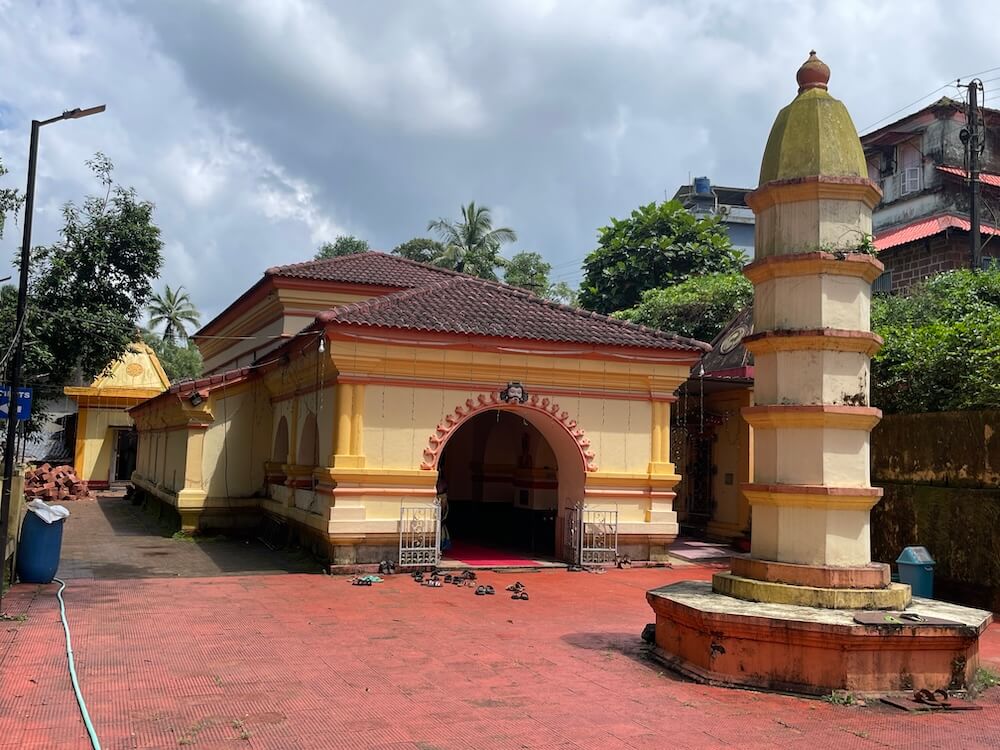
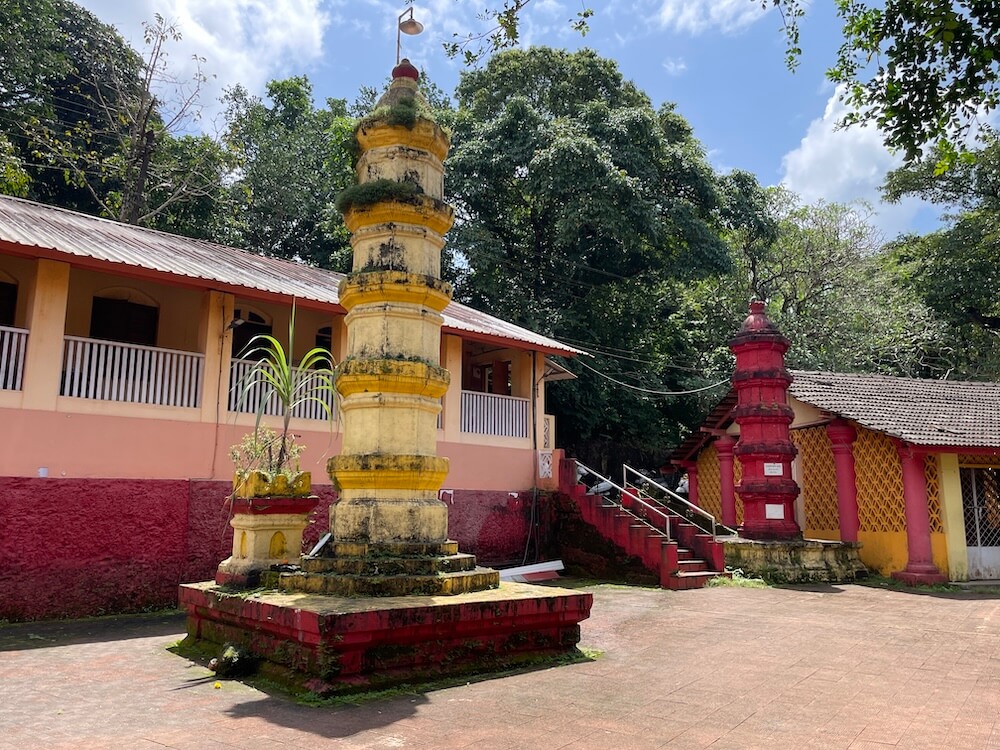
There is an archway at the entrance of the village. There is a spacious parking area in front of the temple. One enters the temple courtyard through a gate in the surrounding wall. There is a well in the paver-block-covered courtyard. Platforms have been built around the trees in the courtyard. There are a total of five temples in the courtyard, and in front of almost every temple, there is a raised platform (chautara) with a five-tiered Deepmala (lamp tower) on top. There is a Tulsi Vrindavan in front of the Kalbhairav temple.
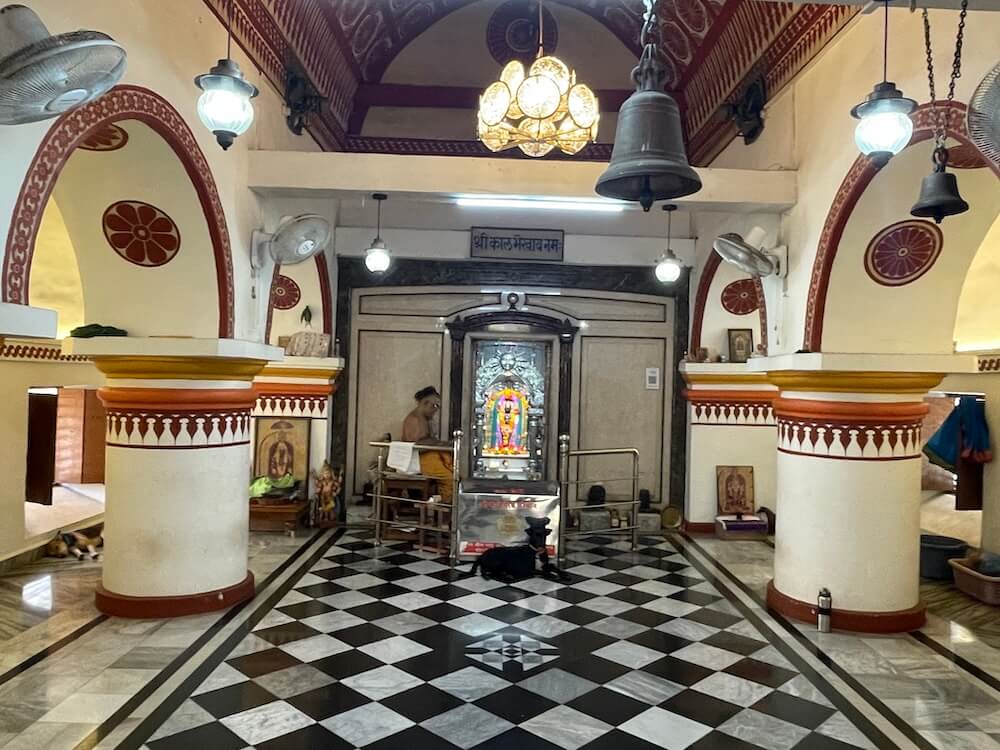
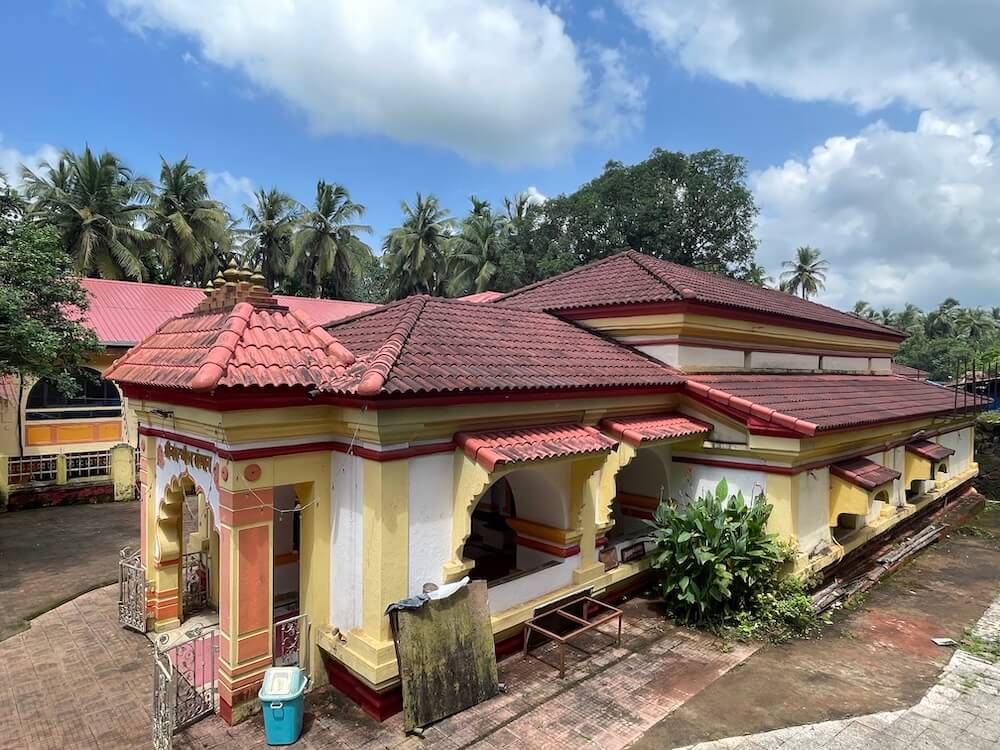
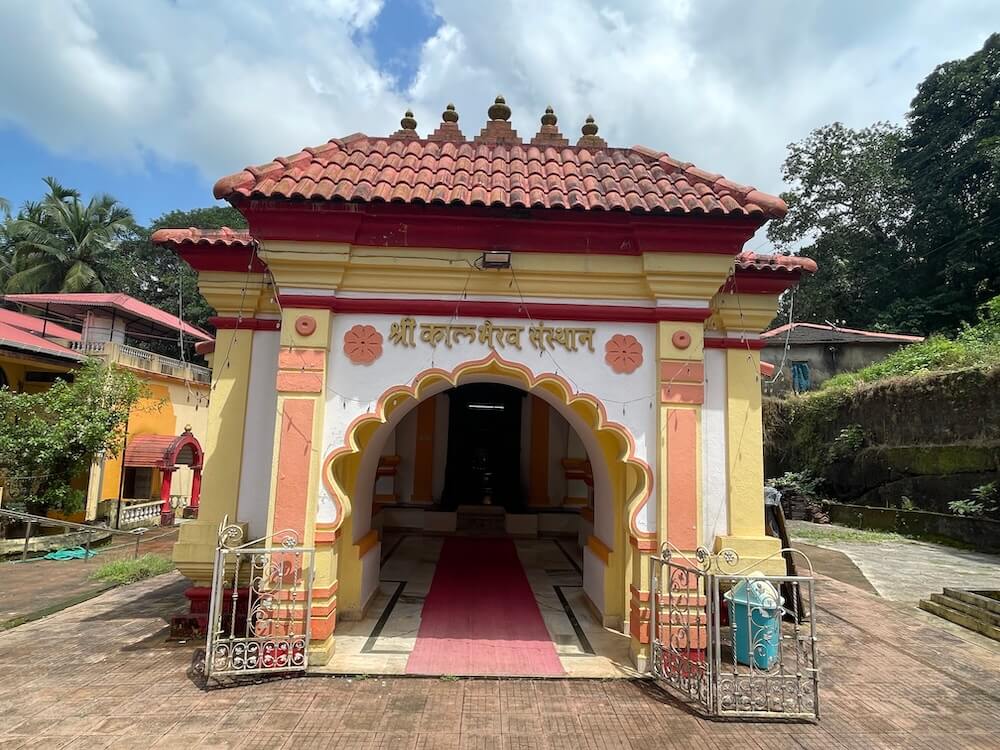
The structure of the Kalbhairav temple consists of a Mukhamandapa (front hall), Sabhamandapa (assembly hall), main Sabhamandapa, Antarala (vestibule), and Garbhagriha (sanctum sanctorum). The entrance of the enclosed Mukhamandapa features an arched gateway and iron-grille shutters. Inside the Mukhamandapa, there are pillars on the left and right sides, and stone benches along the walls for devotees to sit. The wooden door frame of the Sabhamandapa is adorned with floral carvings. The enclosed Sabhamandapa has two rows of square pillars. Some pillars have divine sculptures carved near them. The pillars in each row are connected by semi-circular arches. Above the arches are beams and a roof shaped like the back of an elephant (Gajaprishtha). The pillars and ceilings are decorated with paintings in the Kavi style. Further ahead, a stainless steel safety railing marks the Antarala, which is a few inches higher than the Sabhamandapa. The Antarala houses stones representing local deities. The door frame of the Garbhagriha is also adorned with floral carvings.
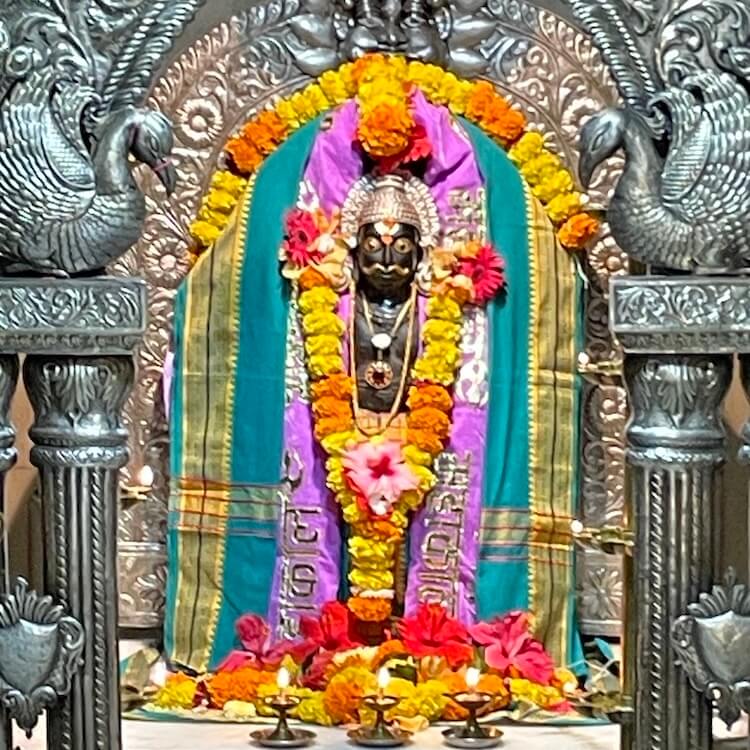
In the Garbhagriha, there is a four-armed standing idol of Lord Kalbhairav on a Vajrapitha (diamond pedestal). The deity holds a Damaru, Trishul, lotus, and a Somapatra (vessel). There are Shakti sculptures at the feet of the deity. The back slab of the idol features lotus carvings on both sides and a Kirtimukh at the top. The deity wears a silver crown, and there is a silver Prabhavali (halo) behind the idol. This halo features a Kirtimukh in the center and floral carvings on both sides. There is a circumambulation path (Pradakshina marg) around the exterior of the Garbhagriha. The temple has a tiled roof. There are five finials (kalash) in a horizontal row on the roof of the Mukhamandapa. A similar arrangement of finials is found on the roof of the Garbhagriha.
Besides this temple, there are a total of six temples in the courtyard: Saptakoteshwar, Sateri Devi, Purvadevi, Mahalaxmi, and Ravalnath. Almost all temples feature Kavi-style paintings on their walls and pillars. Except for the Sateri Devi temple, all temples here have idols of deities made of black stone. In the Sateri Devi temple, the Goddess is worshipped in the form of an anthill. There is a spacious hall for functions in the courtyard.
The festival of Kalbhairav Jayanti is celebrated with great enthusiasm on Kartik Vadya Ashtami. Kalbhairav Jayanti, Dussehra, and Phalguna Purnima are the main days for the deity’s Palkhi (palanquin) procession. Apart from these, other festivals like Sharadiya Navratri, Chaitra Padwa, Dussehra, Diwali, Kartik Purnima, and Kojagiri Purnima are also celebrated. During all these festivals, many devotees from the surrounding areas visit for Darshan and to fulfill their vows. During the Palkhi procession, the deity is placed in a palanquin and taken around the village amidst the sound of drums and the throwing of Gulal. Along with the deity’s palanquin, the Tarangs (divine symbols) of other deities are also carried in the procession.
The number of devotees visiting the temple is high on Sundays, Tuesdays, Fridays, Purnima, Amavasya, and Ashtami. Many scholars visit the temple to see the Kavi-style paintings.
This sacred temple stands as a testament to deep spiritual devotion, ancient architectural grandeur, and rich local cultural traditions.
The sanctum sanctorum houses the divine idol consecrated according to ancient Vedic traditions, surrounded by serene courtyards and traditional temple architecture.
Navratri, Maha Shivratri, Annual Temple Jatra & Deepotsav
Compare and book flights, secure top-rated local hotels near the temple, hire reliable guides, and rent cars instantly.
Extend your pilgrimage by visiting other highly sacred temples located nearby.


Add ₹999 more to unlock FREE SHIPPING!
Your sacred cart is currently empty.
Shop Photo FramesFill in your delivery details below to place your order.
Add comment