
Add ₹999 more to unlock FREE SHIPPING!
Your sacred cart is currently empty.
Shop Photo FramesThe most significant identity of the Shri Ram Mandir in Bhamberi is that it was built on a site suggested by Saint Gajanan Maharaj of Shegaon. Bhausaheb Maharaj, also known as Dev Master, who was revered as the presiding deity of this village, constructed this temple seventy-seven years ago under the command of Gajanan Maharaj. Adjacent to this temple is the Samadhi Mandir of Bhausaheb Maharaj. Countless people from the surrounding region have immense faith in Bhausaheb Maharaj. Many devotees who revere him begin their daily routine only after having darshan at his Samadhi Mandir. Consequently, this temple remains bustling with activity every day.
According to the legend regarding the temple, a noble soul named Guruvarya Ramchandra Purushottam Dev, alias Bhausaheb Maharaj, lived in Bhamberi. His date of birth was २९ March १८७३. He was a teacher, and for this reason, he was known as ‘Dev Master’ in the surrounding area. Bhausaheb Maharaj, who worked for the enlightenment of society, established the Warkari Sampradaya here and led many onto the path of righteousness. He was also a staunch devotee of Mahadev. Once, while he was walking through the village, Gajanan Maharaj, who had arrived there suddenly, snatched a bundle of raw mangoes from him and began eating them. Thereafter, pointing to a specific spot, he commanded Bhausaheb to build a Shri Ram Mandir there. Accepting this as a divine command, Bhausaheb Maharaj began the work of constructing the temple.
Since Bhausaheb’s financial situation was modest, he decided to build the temple through public donations. A few thousand rupees were collected for this purpose. However, the person to whom he had entrusted the money for safekeeping embezzled it. This caused profound grief to the virtuous Bhausaheb Maharaj. He became extremely detached from worldly life, left the village, and set out for the Himalayas for penance. Many noble people in the village were deeply saddened by the mental agony Bhausaheb had to endure. Eventually, some of them went to the Himalayas and pleaded with the Maharaj to return to the village. Finally, Bhausaheb returned. The villagers raised funds for the temple again, and through this, the temple was built on १९ April १९४८. One year after the command given by Gajanan Maharaj for the construction of the temple was fulfilled, exactly ३८ years after his own Mahasamadhi, Bhausaheb renounced his mortal frame. His passing occurred on ६ May १९४९.
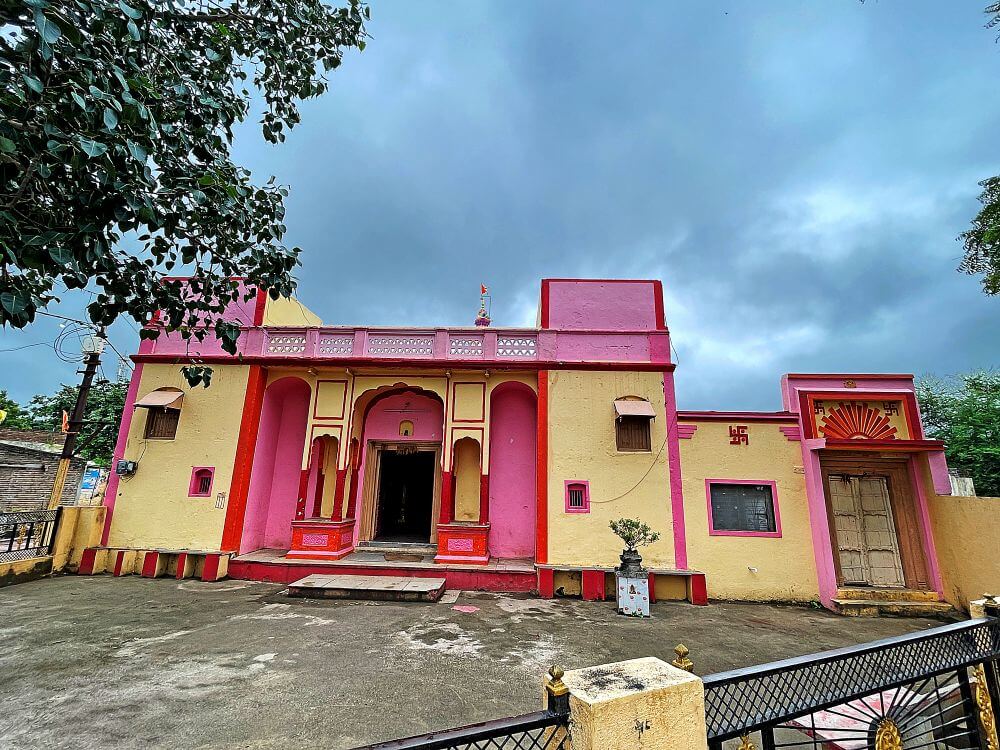
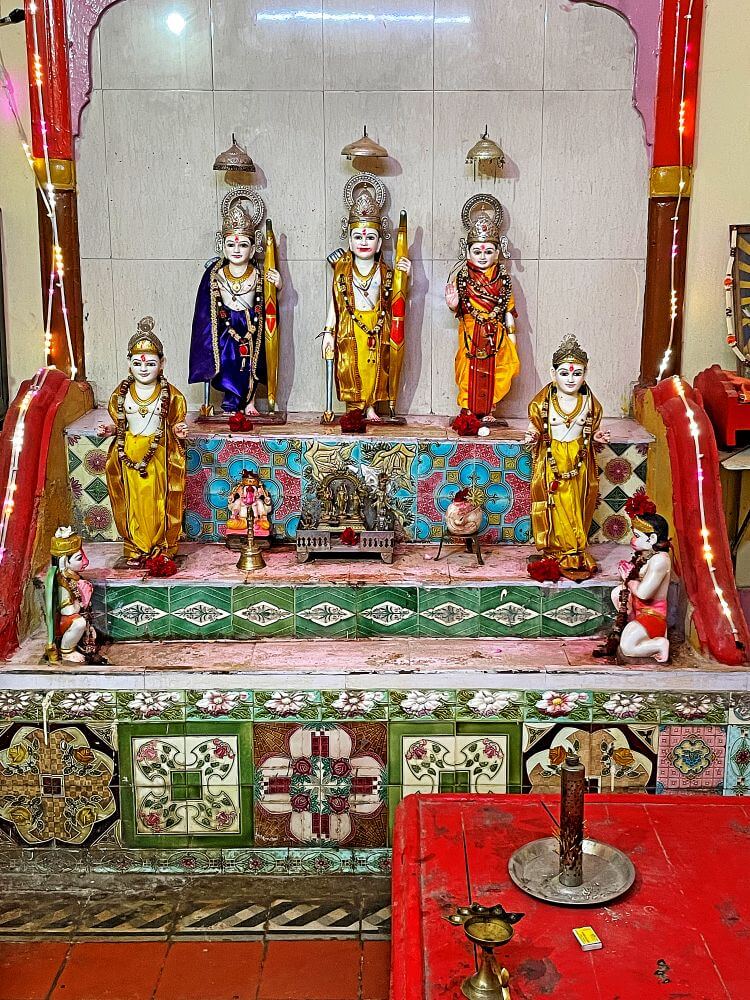
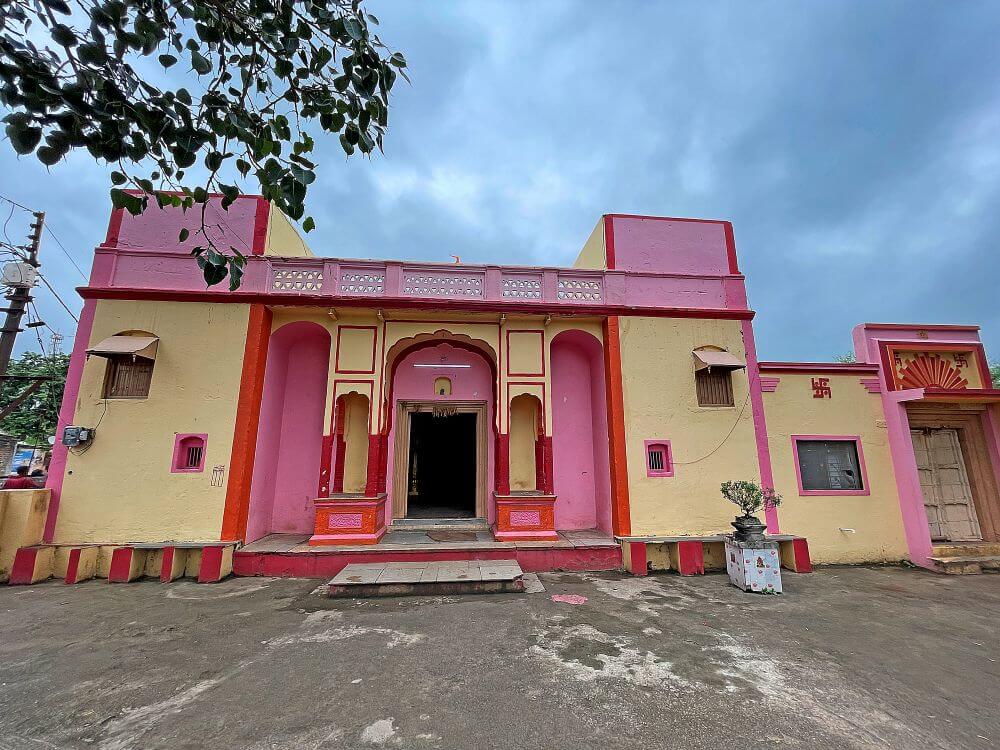
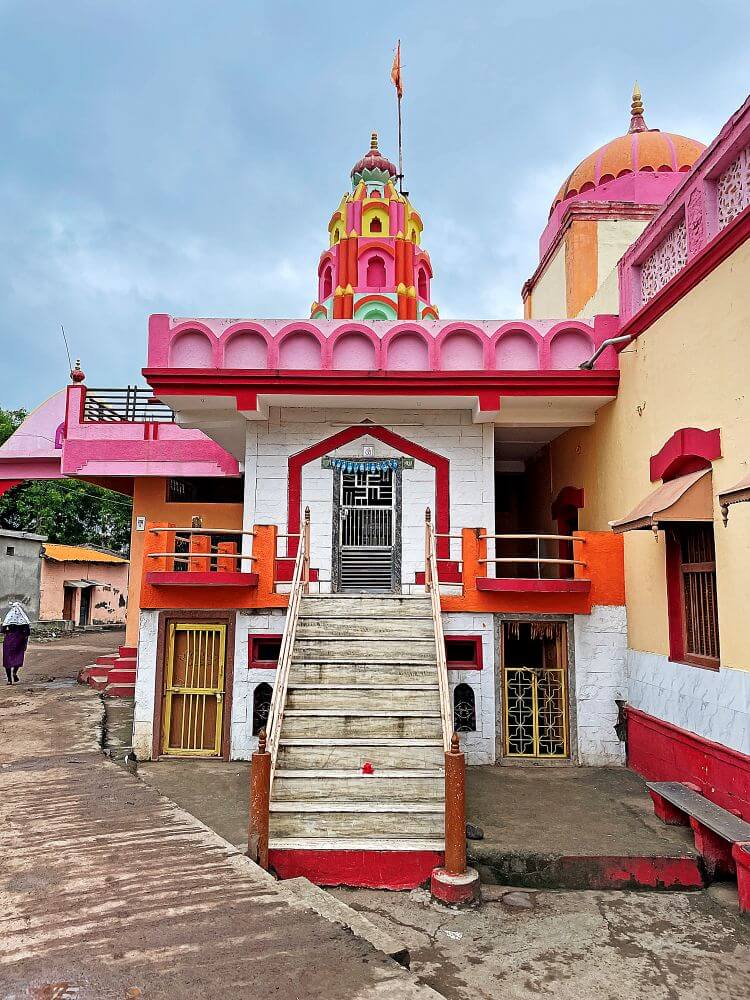
The temple is located in the central part of Bhamberi village, right by the road. The architecture of this temple resembles an old mansion. The structure consists of a spacious Sabha Mandap and three Garbhagrihas. All the pillars in the enclosed Sabha Mandap are connected to each other by arched gateways. On the walls of the Sabha Mandap, there are many images based on the life story of Bhausaheb Maharaj. In front of the Sabha Mandap is a wooden railing, and beyond that are the three Garbhagrihas. In the central main Garbhagriha, on a three-tiered Vajrapitha, are the white marble idols of Shri Ram, Lakshman, and Sita. Shri Ram and Lakshman hold bows and arrows in their hands, and all the idols are adorned with crowns and umbrellas above them. On the middle tier of the Vajrapitha are the marble idols of Bharat and Shatrughna. Between these two idols are the brass Utsav Murti of Shri Ram, Lakshman, and Sita. On the lower tier of the Vajrapitha are the marble idols of Hanuman and Garuda. In the Garbhagriha to the left are the marble idols of Radha-Krishna, and in the Garbhagriha to the right is a Chaturmukhi Shivling with Nandi seated in front of it. Near the wall behind the Shivling, in a niche, is the place of Mother Parvati. To the left of this niche is an idol of Ganesha, and to the right is an idol of Veerabhadra.
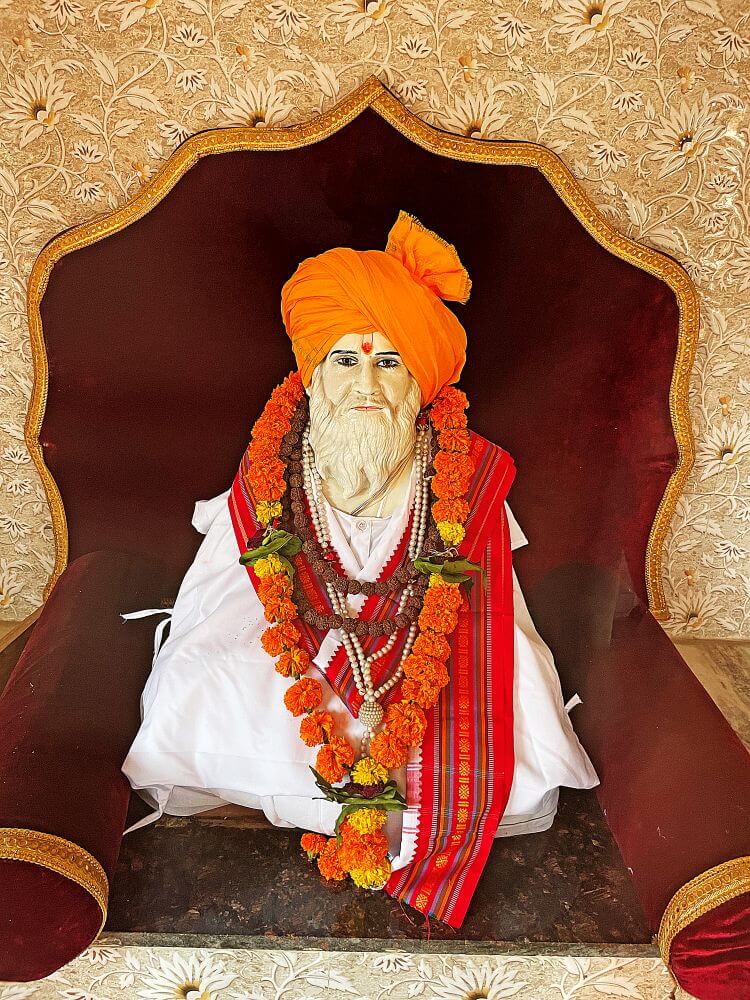
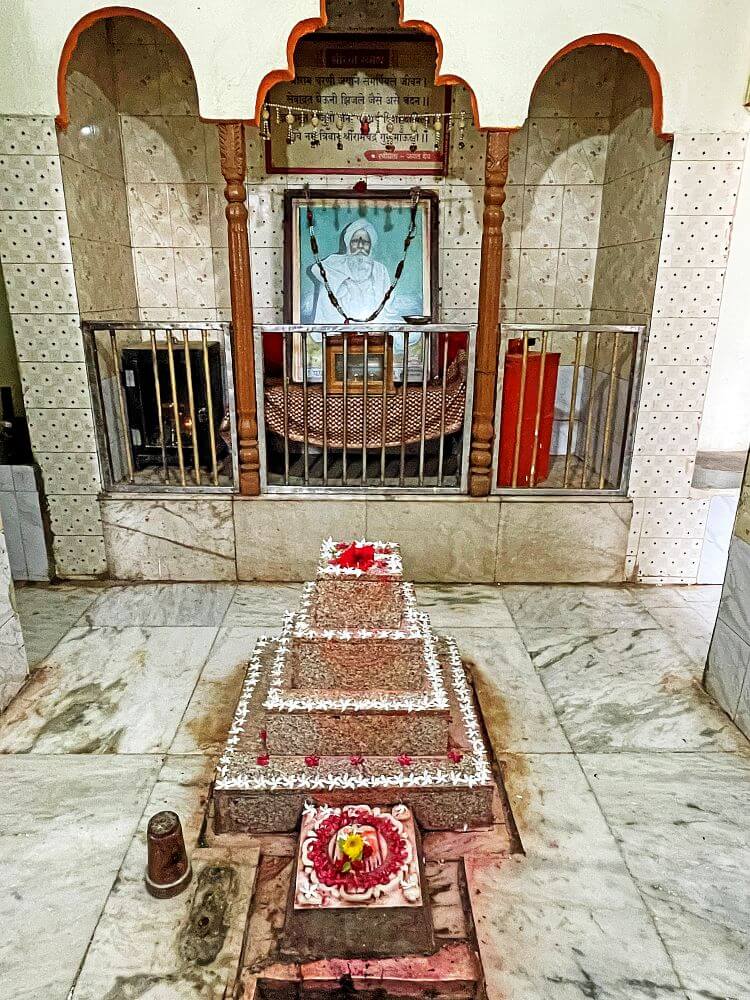
Adjacent to this temple is the Samadhi Mandir of Bhausaheb Maharaj. To reach it, one must descend a few steps from the entrance of the temple. In the Samadhi Mandir, the image and Paduka of Bhausaheb Maharaj have been placed. Here, there are also images of the village’s ancient Mahadev temple and the Hanuman temple. Bhausaheb Maharaj used to regularly visit that ancient Mahadev temple for darshan. In a room within the temple premises, there is a beautiful sculpture of Bhausaheb Maharaj in a shrine.
Aarti is performed in this temple every morning and evening. Every day, Puran Poli is offered as Naivedya to Lord Ramchandra. Haripath is recited every evening. Every Friday and on Purnima, a procession of Bhausaheb Maharaj’s Palkhi is taken out in the village. On those occasions, Mahaprasad is also distributed. Jagran is observed here every Ekadashi. Every month on Shivratri, Abhishek is performed on the Shivling in the temple. Festivals and celebrations such as Gudi Padwa, Ram Navami, Gokulashtami, Navratri, Kojagiri Purnima, Gita Jayanti, Makar Sankranti, and Guru Purnima are celebrated here with great enthusiasm. Similarly, the Bhausaheb Maharaj Prakat Din Mahotsav and Mahaprasad on Phalguna Vadya Panchami, as well as the temple foundation anniversary and Bhausaheb Maharaj Punyatithi Saptah on Vaishakha Shuddha Panchami, are celebrated here. Devotees can have darshan of the deity in this temple daily from early morning until late at night.
This sacred temple stands as a testament to deep spiritual devotion, ancient architectural grandeur, and rich local cultural traditions.
The sanctum sanctorum houses the divine idol consecrated according to ancient Vedic traditions, surrounded by serene courtyards and traditional temple architecture.
Navratri, Maha Shivratri, Annual Temple Jatra & Deepotsav
Compare and book flights, secure top-rated local hotels near the temple, hire reliable guides, and rent cars instantly.
Extend your pilgrimage by visiting other highly sacred temples located nearby.


Add ₹999 more to unlock FREE SHIPPING!
Your sacred cart is currently empty.
Shop Photo FramesFill in your delivery details below to place your order.
Add comment