
Add ₹999 more to unlock FREE SHIPPING!
Your sacred cart is currently empty.
Shop Photo Frames. At the Gajanan Maharaj Paduka Sansthan in Mundgaon, a place of both mythological and historical significance, one can have the darshan of the two original pairs of Padukas (sacred sandals) of Gajanan Maharaj of Shegaon. One of these blessed Padukas was given by Maharaj in 1906 to his ardent devotee Pundlik Bhokare through another devotee named Jhamsingh (Jhyamsing), while the second pair was given to Jhamsingh himself in 1908. At the insistence of Jhamsingh, Gajanan Maharaj visited Mundgaon in 1908, and a procession was held with him in a chariot. The remains of that chariot can still be seen at this temple.
According to the legend in the ‘Shri Gajanan Vijay Granth’, Pundlik Bhokare, an ardent devotee of Gajanan Maharaj, used to visit Shegaon regularly. In 1906, a woman from the village named Bhagabai told him, “Do not follow the path of Gajanan Maharaj. Instead, come with me to Anjangaon. Let us accept Kashinath, a disciple of Kejaji, as our Guru.” This caused a storm of thoughts in Pundlik’s mind. That night, Gajanan Maharaj appeared to him in a vision. Telling him, “Do not get caught up in hypocrisy,” Gajanan Maharaj gave him the mantra ‘Gan Gan Ganaat Bothe’. When Pundlik asked if there was anything else he desired, he requested the Padukas for his daily worship. To this, Maharaj replied, “Start worshipping the Padukas from tomorrow.”
Around the same time, Jhamsingh Dongarsingh Shekhawat (Rajput), a resident of Mundgaon, had gone to Shegaon for the darshan of Gajanan Maharaj. Jhamsingh, known as Dadaji, was an elderly and wealthy farmer of the region. As he was preparing to return to his village, Maharaj entrusted his blessed Padukas to him, instructing him to give them to Pundlik. Jhamsingh met Pundlik at the outskirts of Mundgaon. When Pundlik asked, “Has Gajanan Maharaj sent any Prasad for me?”, a surprised Jhamsingh asked, “How did you know?” Pundlik then told him about the vision he had received from Gajanan Maharaj. These are the same Padukas that are still in Mundgaon today.
Following this event, on January 16, 1908, Jhamsingh invited Gajanan Maharaj to Mundgaon. Accordingly, Gajanan Maharaj came to Mundgaon. Legend has it that since January 17 was a ‘Rikta Tithi’ (Chaturdashi), Maharaj warned the villagers not to hold a ‘Bhandara’ (community feast) on that day. Despite this, the villagers organized the Bhandara and also took Maharaj out in a chariot procession. However, a sudden storm arose, and the food prepared for the feast was covered in dust. Realizing their mistake, the villagers apologized to Maharaj, and the sky cleared again. The next day, on Paush Purnima, the Bhandara was organized again at the behest of Maharaj. Since then, a large fair is held here on this day. It was during this visit to Mundgaon that Gajanan Maharaj gave his wooden Padukas to Jhamsingh.
After this, Jhamsingh Rajput proposed to Pundlik Bhokare, “Gajanan Maharaj has given me his Padukas as well. Your house is made of mud and thatch. To ensure the divine Padukas of Gajanan Maharaj remain safe, let us install both pairs in my mansion (wada). For this, I will donate my mansion as well as my farmland. The honor of carrying the Palkhi (palanquin) of the Padukas will be yours.” After Pundlik accepted this proposal, both pairs of Padukas were installed in Jhamsingh’s mansion, which was spread over 5,500 square feet. Recently, this structure has been renovated. The state government has granted this Sansthan the status of a ‘B’ grade pilgrimage site.
Mundgaon, located 45 km from Shegaon, also holds mythological significance. During the Mahabharata era, Shri Krishna abducted Rukmini, the daughter of the Vidarbha King Bhishmaka, from her Swayamvara at Kaundinyapur. At that time, Rukmini’s brother Rukmi pursued them. In the fierce battle that followed, Rukmi was defeated. However, at Rukmini’s request, Shri Krishna did not behead Rukmi but instead shaved his head. Legend has it that this is how the region got the name ‘Mundgaon’. It is said that the Lakshminarayan temple, built in the Hemadpanti architectural style, may have been constructed in memory of this event. This temple is located a short distance from the Paduka Sansthan. It is said that Gajanan Maharaj also used to visit this temple for darshan. In Shake 1825 (1960 AD), Ganesh Vasudevrao Thokal renovated this temple. Currently, the Lakshminarayan Sansthan is under the jurisdiction of the Paduka Sansthan and is managed by it.
Just like Pundlik Bhokare and Jhamsingh Rajput, a saint named Baijabai also lived in this village. Her mention is also found in the ‘Gajanan Vijay Granth’. Additionally, Kashinathpant Kulkarni of this village was also an ardent devotee of Gajanan Maharaj. It is said that Gajanan Maharaj had called him to Shegaon to listen to his Bhajans. Rashtrasant Tukdoji Maharaj and Sant Gadge Baba also visited this village. Because of this, the village is also referred to as ‘Santnagari Mundgaon’.
Gajanan Maharaj stayed at Jhamsingh’s mansion. At that time, he gave his ‘Chilim’ (clay pipe) as Prasad to Vishnupant Govind Pathak, who was absorbed in his service. This six-and-a-half-inch long Chilim is encased in an eight-metal (Ashtadhatu) covering and features intricate, colorful wire inlay work. Before his death, Pathak entrusted the Chilim to his trusted associate Tryambakrao Vadalkar. The Chilim is still preserved in Vadalkar’s house in Akot. A silver badge indicating that Vadalkar was a servant of Gajanan Maharaj, as well as the silver Padukas that Tryambakrao’s mother had touched to Gajanan Maharaj’s feet, are also preserved in a glass case in this house.
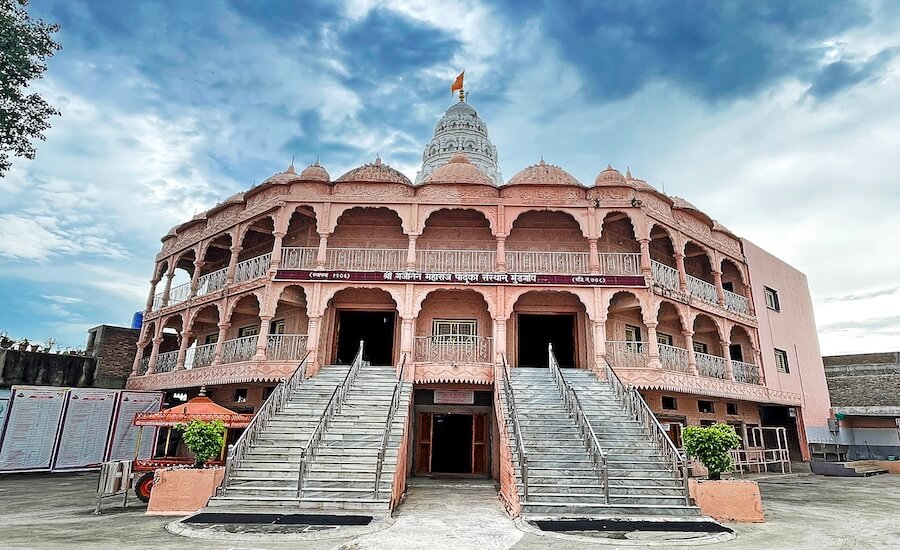
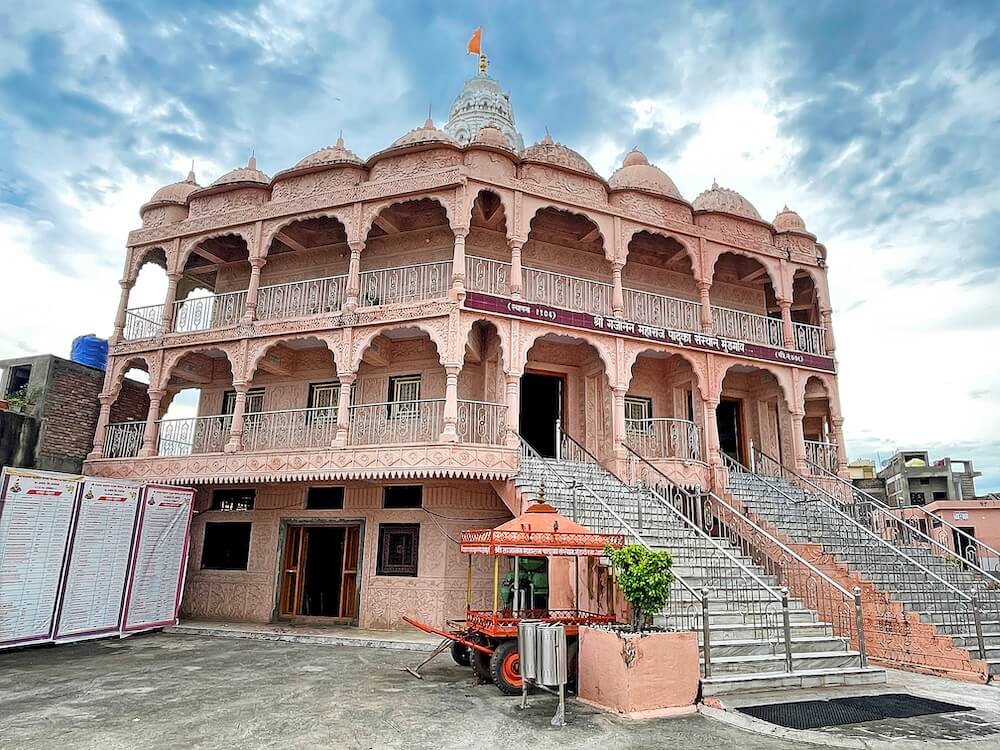
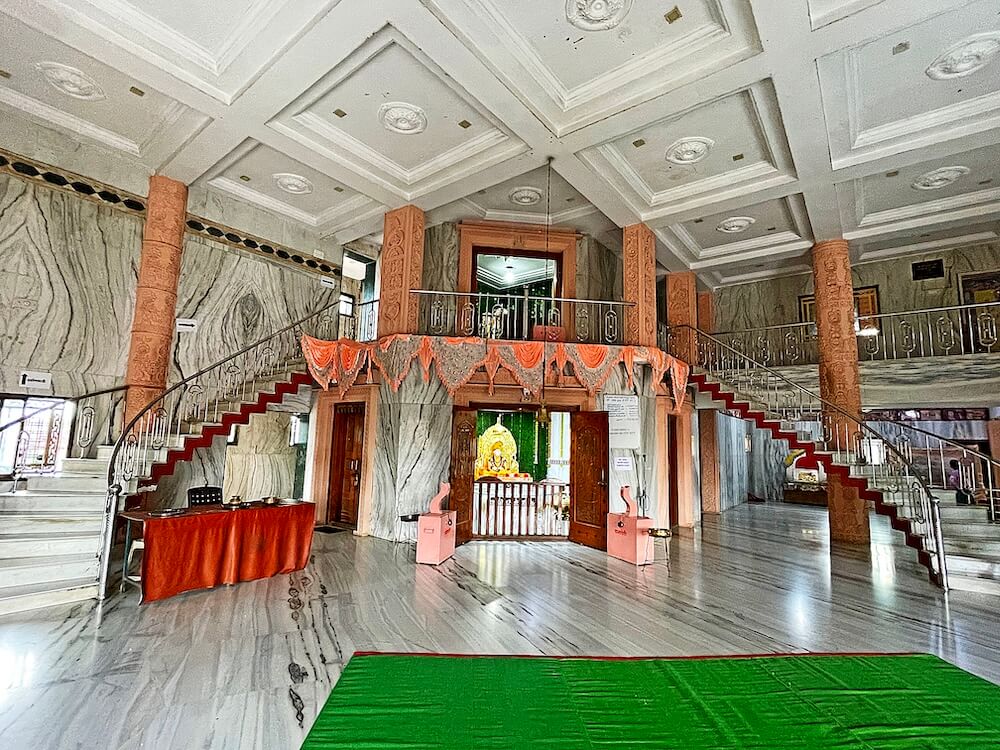
In the courtyard of the Paduka Sansthan, near a Peepal tree, there is a Shiva Linga and a statue of Nandi. The two-story temple located in the center of the courtyard is constructed using Rajasthani Dholpur stone and marble, making the temple’s structure resemble a palace. On the ground floor of this temple, in one room, is the ‘Gadi’ (seat) of Gajanan Maharaj. Here, one can find the Padukas given by Maharaj to Jhamsingh Rajput, as well as the old cot used by Maharaj for resting. Behind it is the statue of Gajanan Maharaj, and to the left is a small statue of Balakrishna. Images of Saint Baijabai and Pundlik Bhokare are also present here. Nearby are the original photographs of Gajanan Maharaj, Bhaskar Maharaj (Adgaon Budruk), and Jhamsing Shekhawat. At the insistence of Jhamsing Rajput, Gajanan Maharaj visited Mundgaon in 1908, where a procession was held for him in a chariot. A remnant of that chariot can be seen on the ground floor, which also houses an image of Gajanan Maharaj.
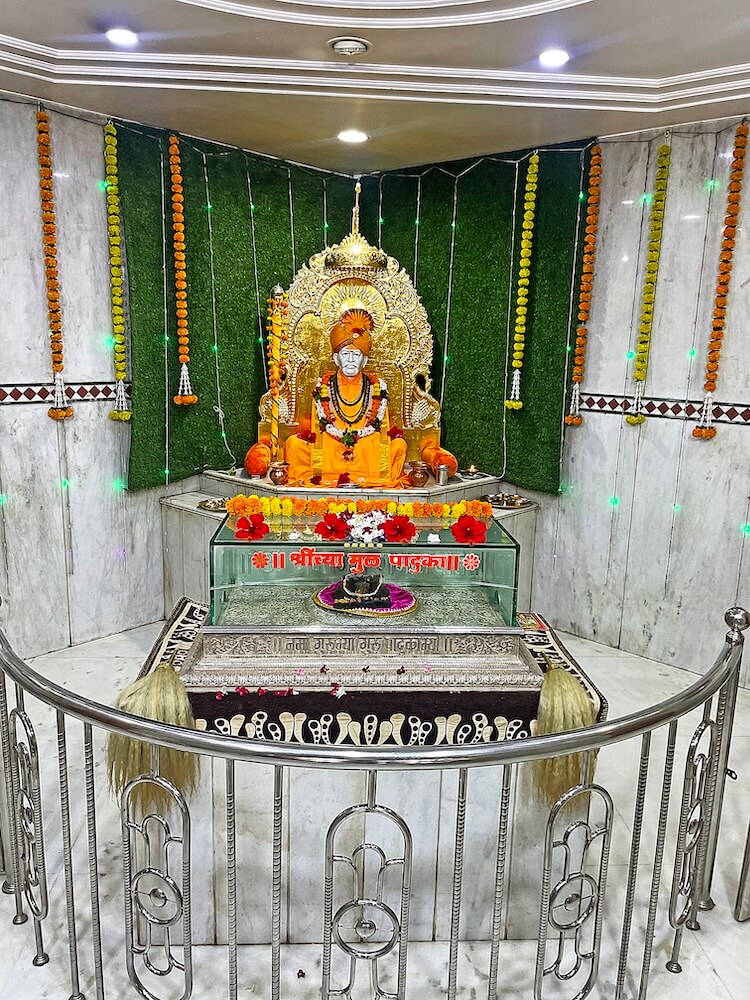
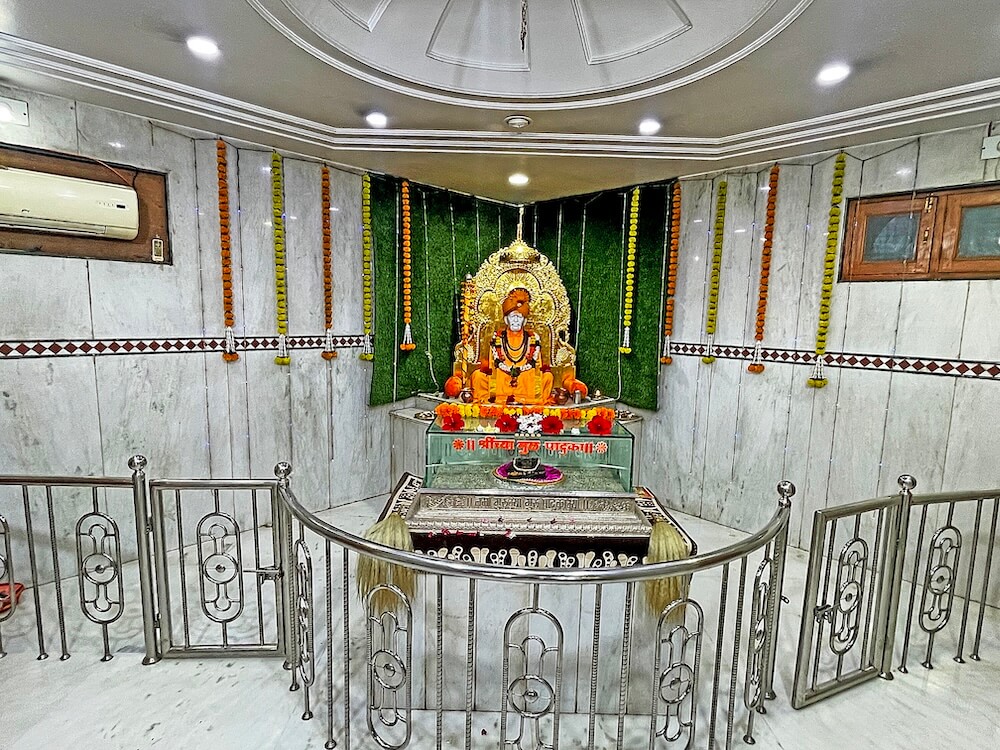
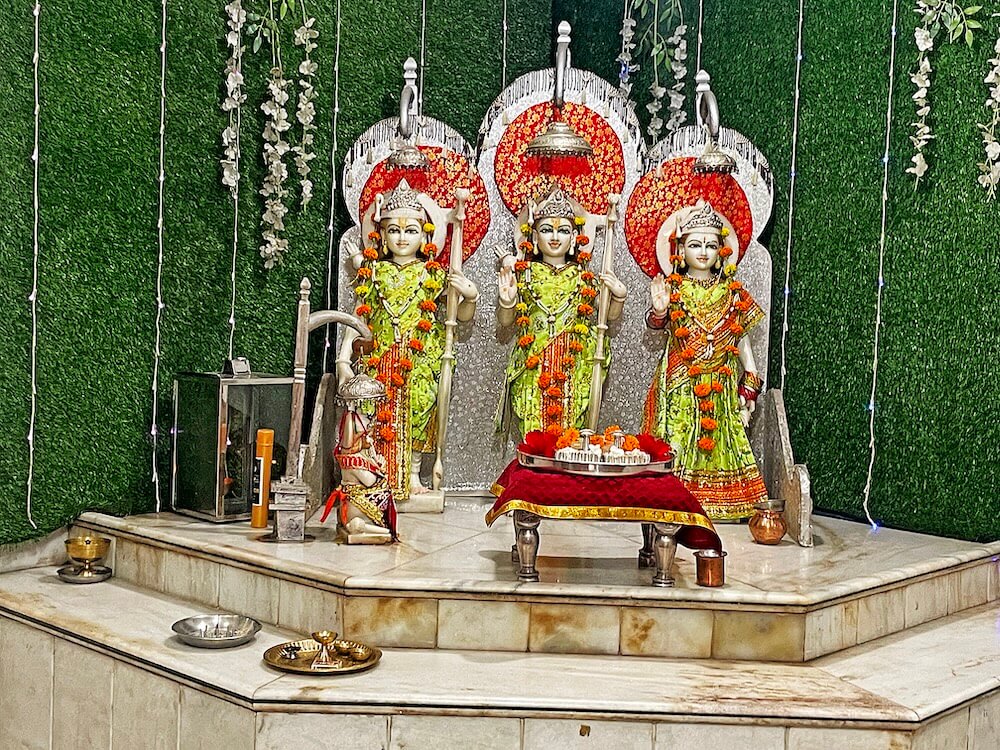
There are two staircases with about 25 steps each to reach the temple on the second floor. The balcony at the front of the temple features intricately carved pillars, followed by the Sabhamandap (assembly hall) and the Garbhagriha (sanctum sanctorum). In the spacious Sabhamandap, the Garbhagriha houses a white marble seated idol of Gajanan Maharaj on a high pedestal. The golden, ornate Prabhavali (halo) behind the idol is carved with peacock and sun motifs. In front of the idol, the Padukas (footwear) given by Gajanan Maharaj to Pundalik Bhokare are kept in a glass case. On both sides of this sanctum, there are two staircases with about 20 steps each leading to the third floor. Climbing these stairs leads to the third floor, where the Garbhagriha contains idols of Shri Ram, Sita, Lakshman, and Hanuman. The Parayan hall on this floor houses Gajanan Maharaj’s old cot and an image of the Maharaj.
In the courtyard near the temple is an ancient well known as ‘Amruttirth’. Adjacent to it, on the eastern side, is the Dhuni (sacred fire) of Gajanan Maharaj. It is said that when Gajanan Maharaj visited Jhamsing’s mansion in 1908, he lit this Dhuni here. Jhamsing Sadan is located in front of the temple. Hundreds of devotees and tourists visit this temple every day. Every Thursday, Mahaprasad is distributed to the devotees, and snacks are distributed on Ekadashi. Festivals such as Ram Navami, Ashadhi Ekadashi, Guru Purnima, Gokulashtami, Gajanan Maharaj Pragat Din, and Samadhi Sohala (Rishi Panchami) are celebrated here. A Yatra Mahotsav is held on Paush Purnima. The temple trust also carries out various social activities in the area. Devotees can visit the temple daily from 5:00 AM to 10:00 PM.
This sacred temple stands as a testament to deep spiritual devotion, ancient architectural grandeur, and rich local cultural traditions.
The sanctum sanctorum houses the divine idol consecrated according to ancient Vedic traditions, surrounded by serene courtyards and traditional temple architecture.
Navratri, Maha Shivratri, Annual Temple Jatra & Deepotsav
Compare and book flights, secure top-rated local hotels near the temple, hire reliable guides, and rent cars instantly.
Extend your pilgrimage by visiting other highly sacred temples located nearby.


Add ₹999 more to unlock FREE SHIPPING!
Your sacred cart is currently empty.
Shop Photo FramesFill in your delivery details below to place your order.
Add comment