
Add ₹999 more to unlock FREE SHIPPING!
Your sacred cart is currently empty.
Shop Photo FramesThe Vincharana River, which originates in the hilly region of Patoda Taluka in Beed District, cascades down a mountain cliff at Sautada from a height of about two hundred feet, forming a picturesque waterfall. This is famous as the Sautada Waterfall, and the surrounding area is home to diverse flora, fauna, and insects. This natural biodiversity and scenic beauty captivate nature lovers. In the vicinity of this waterfall lies the famous and ancient Rameshwar Shiva Temple of Beed District. This temple is a major center of faith for many devotees from Patoda Taluka and the entire district.
Historians believe that this temple, built of stone in the Hemadpanti architectural style, dates back about one thousand years, to the Chalukya period. A legend associated with this temple states that while Ravana was abducting Sita and taking her to Lanka via the sky, Sita dropped her ornaments. Rama found them here, and he subsequently consecrated a sandy Shiva Linga at this spot. This Shiva Linga, established by Shri Rama, came to be known as ‘Shri Rameshwar’. At this same location, a Shiva Linga brought by Maruti from Kashi has also been installed.
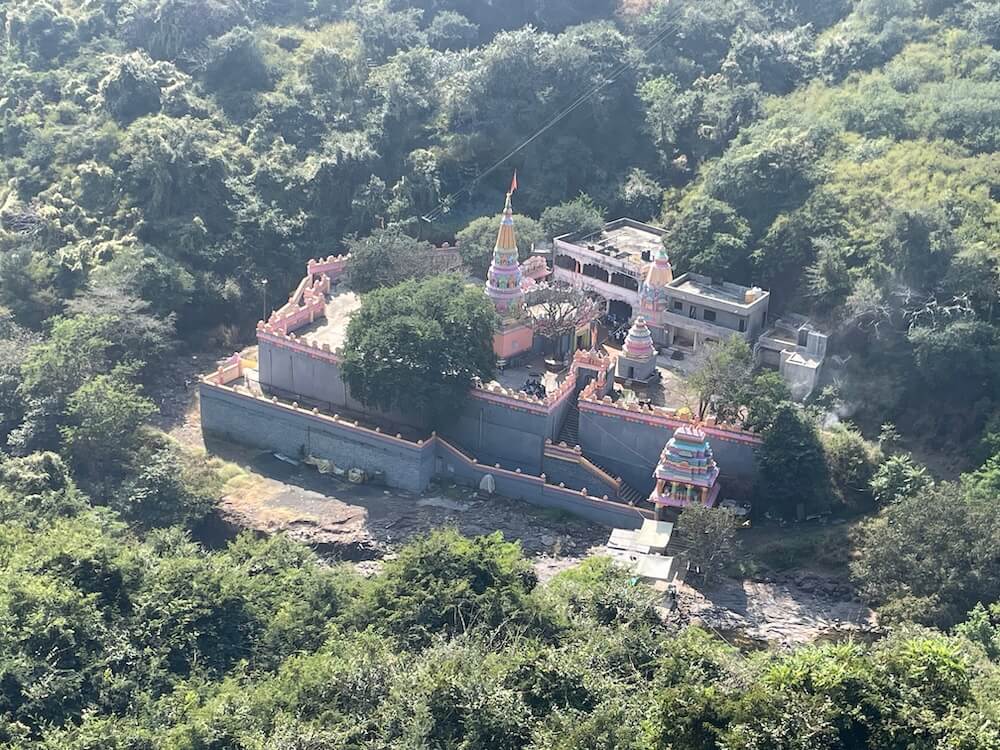
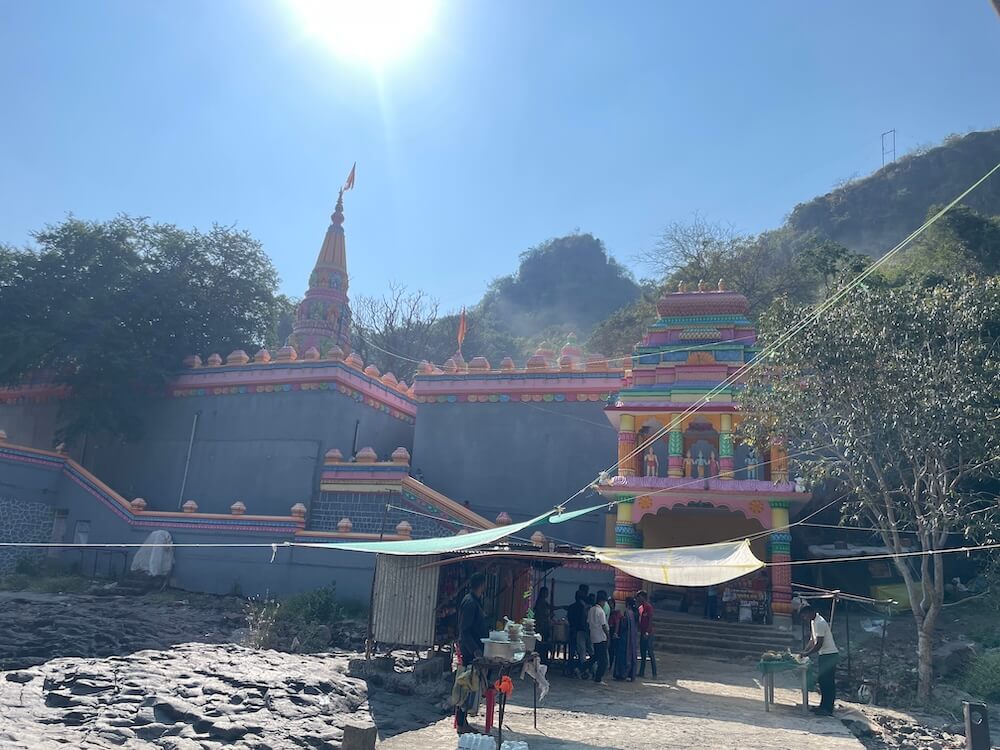
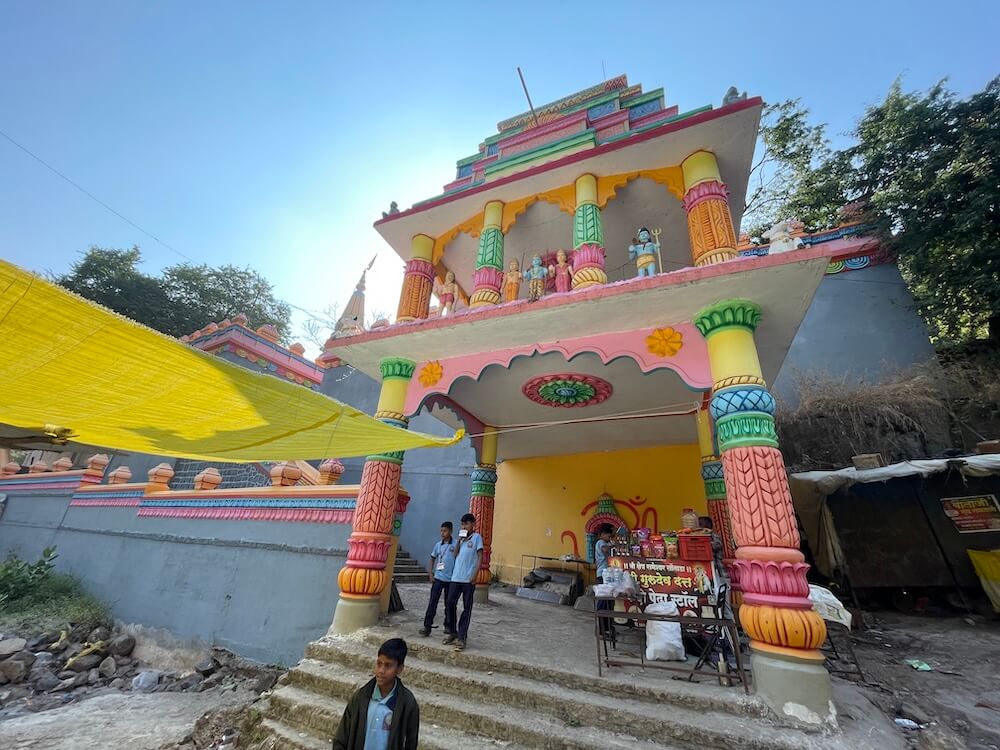
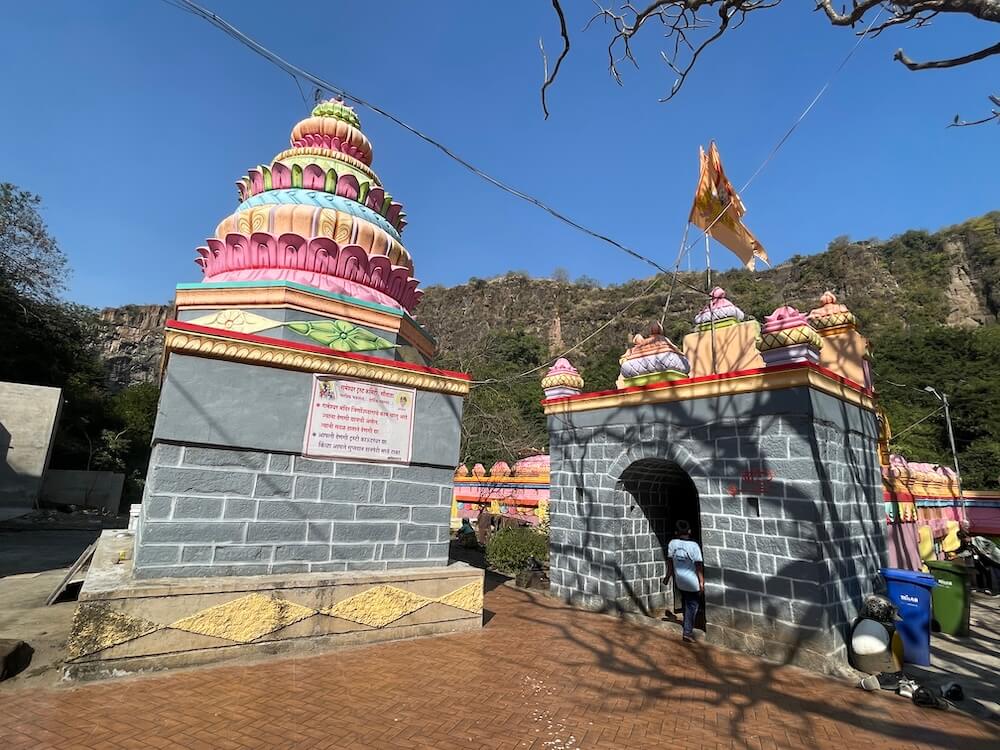
The temple is nestled in the lap of a hill about two kilometers away from Sautada village. There is an excellent road from the village leading to the temple’s parking area. Near the parking lot in this lush green area, there are shops selling food items and worship materials. From there, one must descend about ۳۵۰ steps carved into the stone to reach the temple. On one side of the stairway is the cliff face, and on the other is a stone safety railing. While walking down the steps towards the temple, one gets a beautiful view of the Sautada Waterfall on the left. Upon reaching the bottom of the steps, one crosses a stone bridge built over the Vincharana River to proceed to the temple. The temple has a sturdy, double-layered fortification. The first fortification features a two-story entrance gate. This elevated gate has five steps. It consists of four ornate circular pillars connected by an arched lintel, topped by a roof. The ceiling is carved with a circular motif, and there is a second floor above. On the upper floor, facing the front, are the idols of Rama, Lakshmana, and Sita. Additionally, there is an idol of Maruti on the left and Mahadeva on the right. The second floor has eight circular ornate pillars. The roof of the second floor features a pyramid-like stepped shikhara topped with a kalasha. From this entrance, one climbs about fifty steps to reach the entrance of the second fortification. Along the stairway adjacent to the fortification, there is a stone safety railing decorated with amalakas at specific intervals. Similar decorations can be seen on the walls of both fortifications.
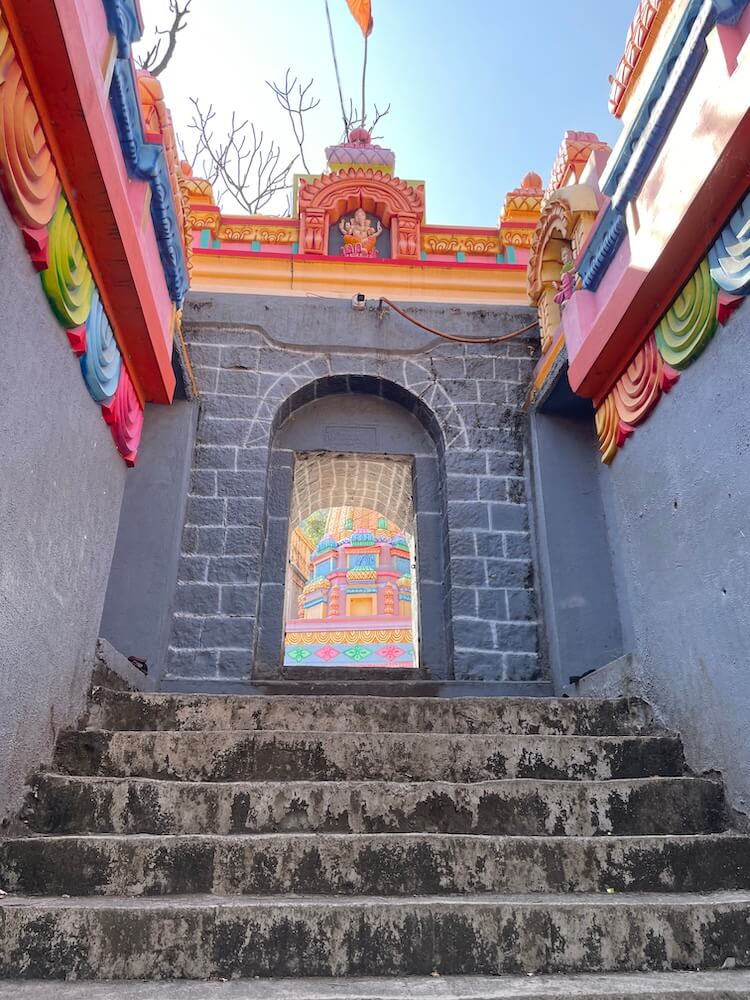
The second entrance is enclosed and features a semi-circular arch. There is a parapet on the roof of the entrance, and a sculpture of Ganapati is placed in a niche on the front side. The four corners of the parapet have small square shikharas topped with kalashas. In the center of the roof, there is a square shikhara with a kalasha. Inside the entrance, there are guard rooms on both sides. From here, one enters the temple courtyard. In the courtyard, on the right side, is the third fortification. On the outer side of this fortification, on a pedestal, is a horse sculpture known as the ‘Devghoda’. The fortification has a welcome arch, and within the arch, on both sides, are two ornate square pillars topped by a balcony (sajja). There are five shikharas in a row on the balcony. The shikhara in the center has a Ganapati idol in its niche. From here, one descends two steps to reach the courtyard of the Rameshwar Temple.
In front of the temple is a two-story building, with a hall for cultural programs on the upper floor. Wedding ceremonies are also organized here. The ground floor of this building serves as a queue pavilion for darshan. This pavilion is used during festivals when long queues of devotees form. The walls of the darshan pavilion are painted with scenes from the Ramayana, and stainless steel railings are installed to manage the queues. There is an open space of about ten feet between the darshan pavilion and the Rameshwar Temple. The structure of the Rameshwar Temple consists of a sabhamandapa (assembly hall), antarala (vestibule), and garbhagriha (sanctum sanctorum).
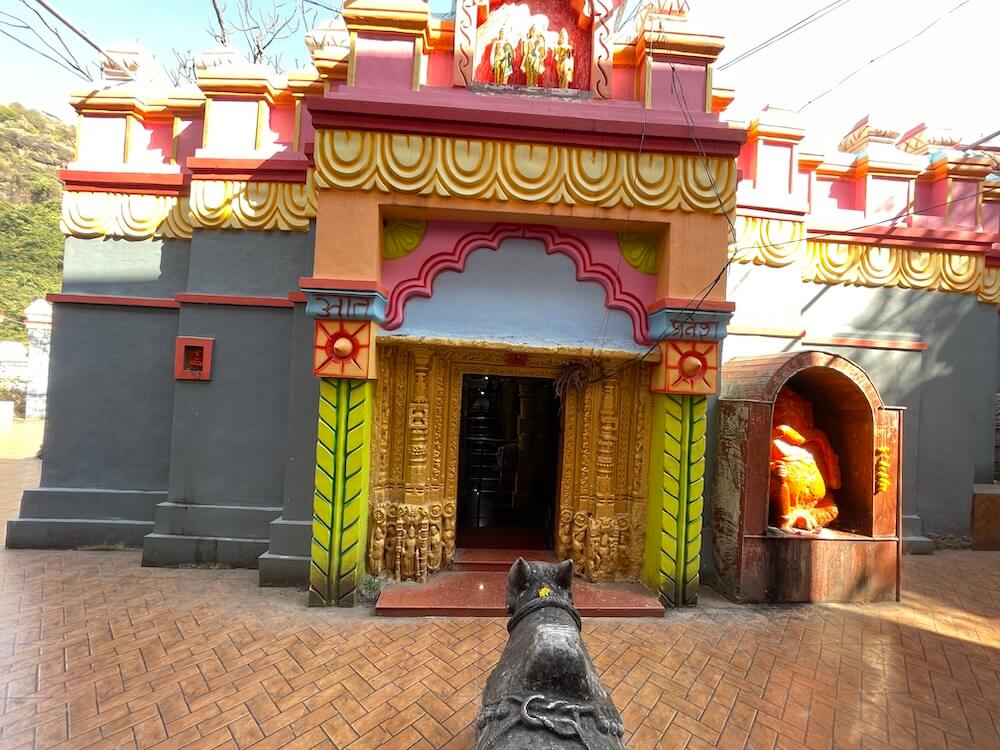
In front of the entrance to the sabhamandapa, there is a black stone idol of Nandi. To the right of the sabhamandapa entrance, there is a vermilion-smeared stone idol of Shri Ganesha housed in a meghadambari (canopy). To the right of the canopy is an ancient idol of Shri Rama. This is said to be the original idol of the temple, and it was placed near the entrance after new idols were installed in the temple. The entrance to the sabhamandapa is five-fold (panchashakhiya). The door jambs feature sculptures of door guardians (dwarapala and dwarapalika) at the bottom, while the upper sections feature carvings of humans, vines, foliage, flowers, and pillars. The lalata-bimba (lintel center) features a Ganapati sculpture, and the lintel is carved with floral motifs. The sabhamandapa has another entrance on the left, and there is also a Nandi sculpture in front of this entrance. This entrance has three door jambs. The door jambs feature sculptures of door guardians at the bottom. The jambs are carved with leaves, flowers, and pillars. The lalata-bimba features a Ganapati sculpture, and the lintel has composite carvings.
The sabhamandapa contains about ۲۱ ornate pillars, all standing on square bases. The shafts of the pillars feature various geometric shapes such as squares, hexagons, octagons, and circles. The ceiling is carved with circular motifs. In the center of the six middle pillars of the sabhamandapa is a square platform, and to the left on the floor is the Kashi Vishwanath Shiva Linga. It is said that this Shiva Linga was brought from Kashi and installed here by Hanuman. Behind this Shiva Linga, in a wall niche, is an idol of the four-armed Vishnu.
From here, one proceeds to the antarala and then to the entrance of the garbhagriha, which has seven door jambs. The door jambs feature sculptures of door guardians, Ganga, and Yamuna at the bottom, and carvings of humans, mythical beasts (vyala), foliage, flowers, and pillars at the top. The lalata-bimba features a Ganapati sculpture, and the lintel is carved with leaves and flowers. In the center of the garbhagriha floor is the Shiva Linga. A brass cobra shades the Shiva Linga. It is said that this sandy Shiva Linga was consecrated by Shri Rama. Near the back wall of the garbhagriha, on a vajrapitha (throne), are marble idols of Shri Rama, Lakshmana, and Sita.
There is a parapet on all sides of the temple roof, and in the niche above the entrance of the main assembly hall, there are idols of Shri Ram, Lakshman, and Sita. Above the entrance on the left side, there is a four-armed idol of Shri Vishnu in a niche. There are small spires at every corner of the parapet. The roof of the sanctum sanctorum has a four-tiered spire. The first three tiers are octagonal, each containing eight niches. The fourth tier is circular and features pillar carvings. At the top of the spire, there are three amalakas placed one above the other, topped by a kalash.
In the temple courtyard, on the right side, is the Gupteshwar Mahadev Temple. Inside the temple, in the center on the floor, is the Gupteshwar Mahadev Pindi, and near the back wall on a pedestal is an ancient idol of Gauri-Har. Behind the Gupteshwar Temple is the Shri Krishna Temple. In this temple, near the back wall on a pedestal, is an idol of Shri Krishna playing the flute while leaning against a cow. In the courtyard, there is the samadhi site of the temple’s late priest, Devraj Daji Bhalerao, and some ancient stone sculptures. The temple premises also house the residences of the priests and other structures. A short distance from the temple are the Sautada Waterfall and Sitakund.
Mahashivratri, Ram Navami, and the month of Shravan are the main annual festivals celebrated here. During all festivals, programs such as bhajan, kirtan, pravachan, music, and Mahaprasad are organized in the temple. Many devotees come for the darshan of the deity during these festivals. There is a large crowd of devotees at the temple during festivals like Chaitra Padwa, Dussehra, and Diwali.
This sacred temple stands as a testament to deep spiritual devotion, ancient architectural grandeur, and rich local cultural traditions.
The sanctum sanctorum houses the divine idol consecrated according to ancient Vedic traditions, surrounded by serene courtyards and traditional temple architecture.
Navratri, Maha Shivratri, Annual Temple Jatra & Deepotsav
Compare and book flights, secure top-rated local hotels near the temple, hire reliable guides, and rent cars instantly.
Extend your pilgrimage by visiting other highly sacred temples located nearby.


Add ₹999 more to unlock FREE SHIPPING!
Your sacred cart is currently empty.
Shop Photo FramesFill in your delivery details below to place your order.
Add comment