
Add ₹999 more to unlock FREE SHIPPING!
Your sacred cart is currently empty.
Shop Photo FramesIn the picturesque Konkan region, at Bharne in Khed taluka of Ratnagiri district, lies the sacred and vibrant abode of Kalkai Devi. Renowned as a deity who wards off misfortune and fulfills the vows of her devotees, she is believed by the faithful to be a constant protector of the women who were born in this village (Maherwashini). During the Navratri festival, devotees from Mumbai, Pune, Kolhapur, and various parts of the state arrive to seek the Goddess’s blessings. A unique feature of this temple is that the Goddess’s palanquin, which sets out during Navratri and Shimga (Holi) festivals, is first offered a formal salute by the police force before it proceeds on its journey.
The legend of the temple states that the village of Bharne was once covered in dense forest. Many cowherds from nearby villages would bring their cows to graze in these woods. One day, a cow belonging to the Shinde family, unbeknownst to the cowherd, would daily shed milk over a small stone under a tree. When the cowherd noticed this, he informed the villagers, who became convinced that this was a divine site. Since then, the stone began to be worshipped. It is said that once, an epidemic suddenly spread through the village. At that time, the Goddess manifested from this very stone and fought against ‘Kaal’ (death/misfortune), driving it out beyond the village boundaries. That night, the Goddess appeared in the priest’s dream and said, “I fought against the misfortune that had come upon the village. I am exhausted from driving it away. While fighting, the edge of my sari got caught in a bamboo thicket and tore.” When the priest and some villagers searched the bamboo thicket, they found a piece of the Goddess’s torn zari sari border. From then on, she became famous as ‘Kalkai Devi’, the Goddess who removes misfortune.
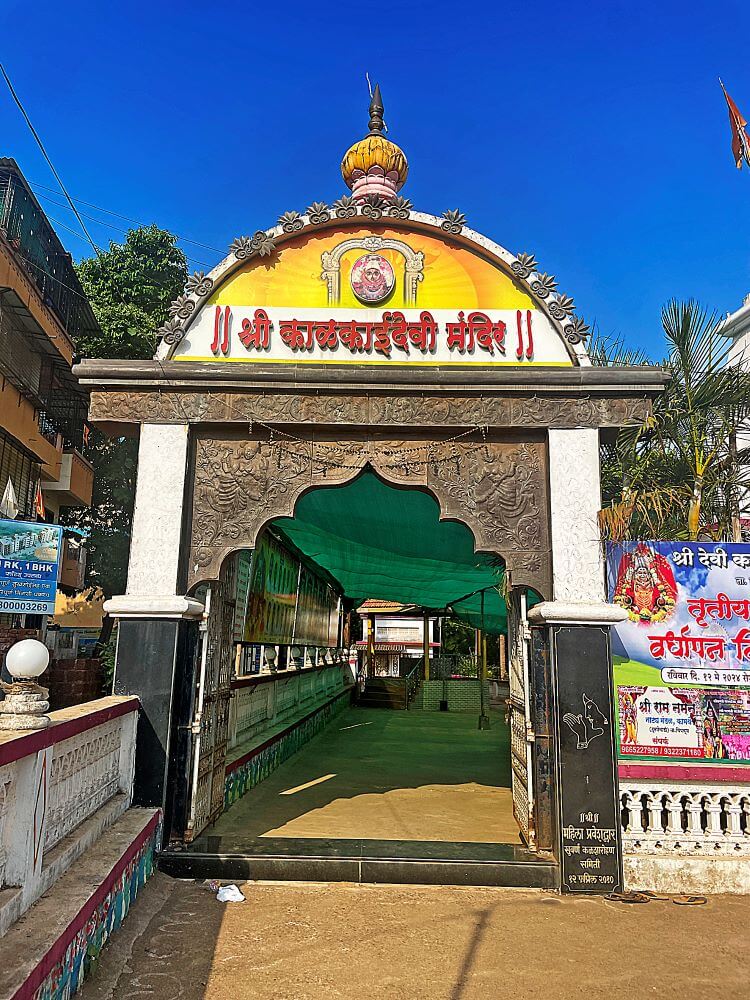
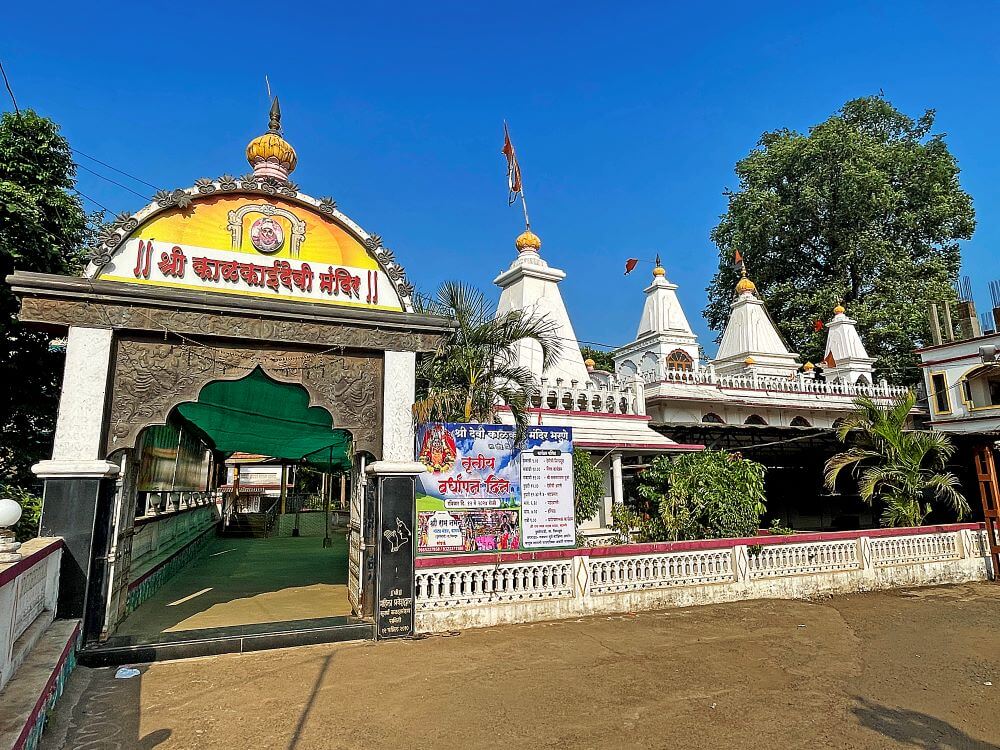
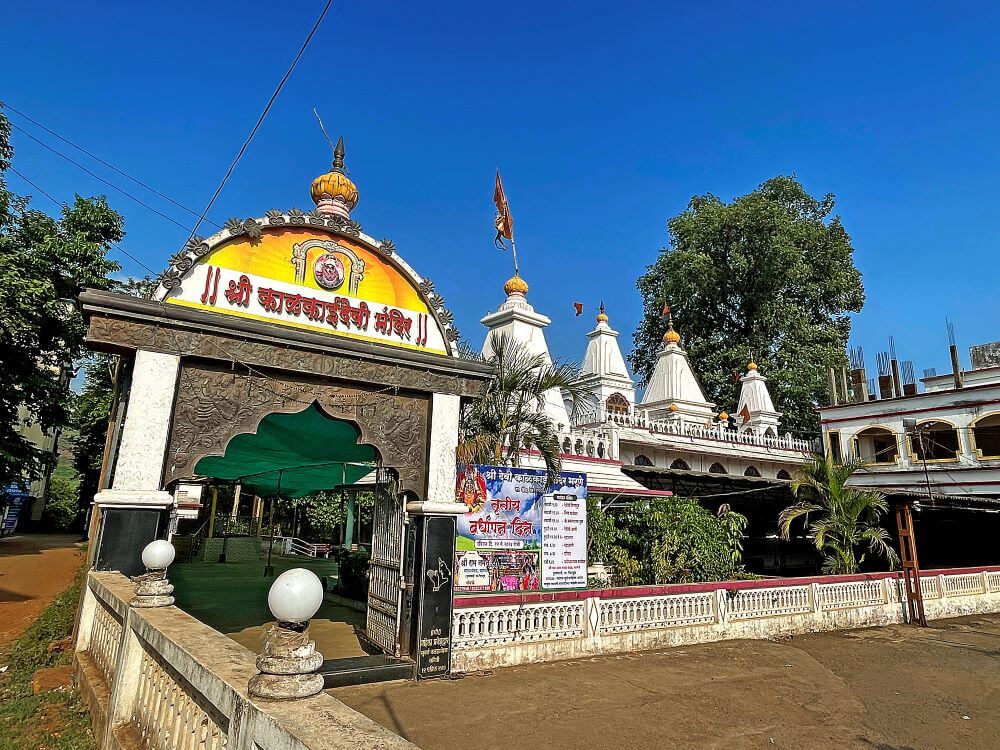
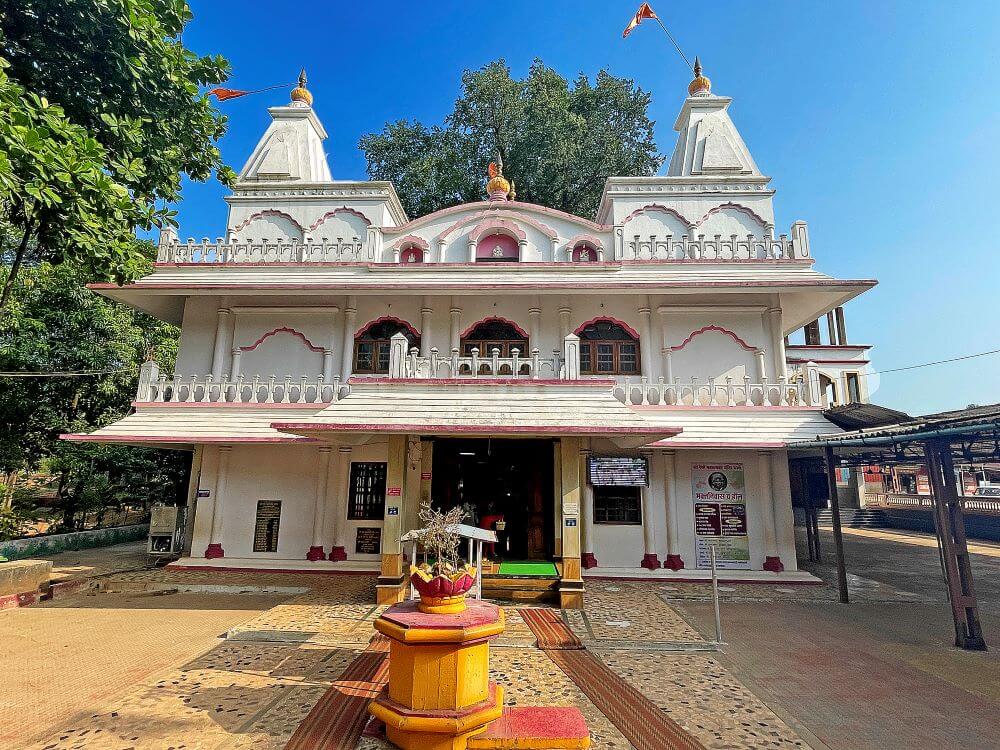
This spacious and beautiful temple is located near Bharne Naka on the Mumbai-Goa National Highway. One can walk to the temple from Bharne Naka. There are many shops selling worship materials along the path to the temple. The temple is surrounded by a fortification, and one enters the courtyard through an arched gateway located within it. On the semi-circular arch above the entrance is an idol of Kalkai Devi, topped by a small spire. In the paved courtyard, to the left of the main temple, is the temple of Mirashi Baba (the guardian). Next to it is a large stage where programs are held during festivals.
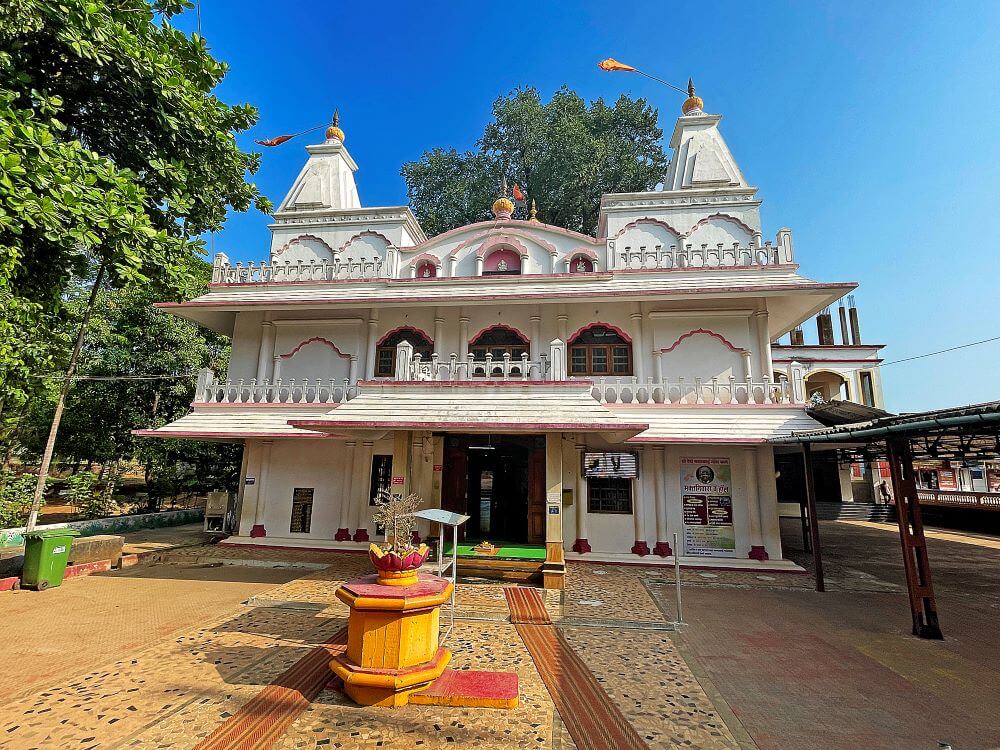
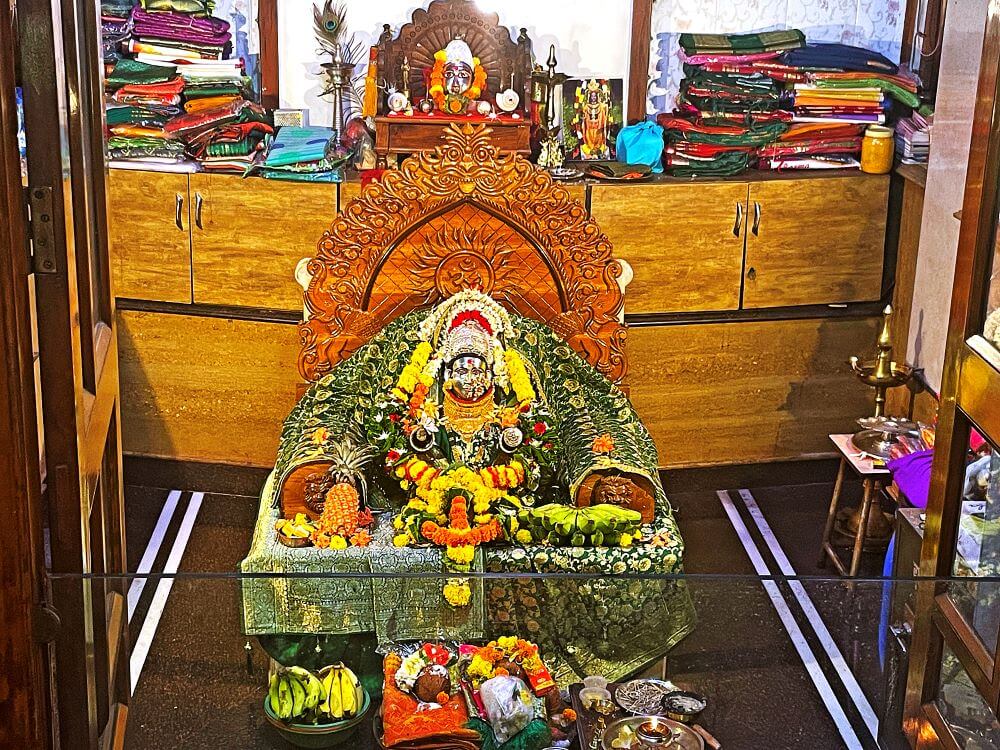
The main temple is a two-story structure painted in white. In front of the main entrance is a Tulsi Vrindavan, and the temple layout consists of a Darshan Mandap, Sabha Mandap, and Garbhagriha (sanctum sanctorum). Upon entering the Sabha Mandap from the Darshan Mandap, one can see the Garbhagriha, constructed in the center using wood and glass. On the lintel above the entrance to the Garbhagriha is an idol of Lord Ganesha. Inside, on a pedestal in the center, sits the serene idol of the Goddess within a beautiful wooden shrine (Makhar). The Goddess wears a silver mask and is adorned with various ornaments and garments. The Prabhaval (halo) behind her is also made of wood with intricate carvings. Behind this idol, on a square platform, the Goddess’s original silver mask is kept.
Near the tree behind the Garbhagriha is a sculpture of a cow shedding milk. Below it is a Shiva Linga, sheltered by a serpent’s hood. In front of the Pindi is a small idol of Nandi. It is said that the Goddess’s original site was under this very tree; however, in later times, the tree was preserved, and the temple was built in front of it. The temple attained its current form after a renovation in 2002. The temple has a total of five spires—two each in the front and back of the Sabha Mandap, and one over the Garbhagriha. On May 4, 2010, a golden pinnacle (Kalash) was installed on the spire of the Garbhagriha.
With devotees visiting throughout the year, Navratri and Shimga festivals are celebrated here with great enthusiasm. During the nine days of Shimga, programs such as Kirtan, Bhajan, and Haripath are held. For all nine days, crowds of devotees gather from dawn until late at night for the Goddess’s Darshan. Thousands of women, for whom this village is their maternal home, make it a point to visit during this festival to offer ‘Oti’ (a ritual offering of a sari piece, coconut, and rice) to the Goddess, who is known to protect them. Thousands of devotees from Mumbai, Pune, and the Ghat regions also arrive during this time to make or fulfill vows. During the Shimga festival, the Goddess’s palanquin is carried through the village with music and fanfare. It then visits the deities Khedjai, Redjai, Pathrajai, and Ramvardayini in Khed before returning to the temple. These five are believed to be sisters. Apart from these major festivals, the temple’s anniversary is celebrated every year on May 12th. On this day, a procession of the Goddess is taken out in the morning. Mahaprasad is served to the visiting devotees in the morning and evening. Behind the temple, the Devasthan Trust has built a well-equipped Bhakta Niwas (pilgrim accommodation) for devotees. Additionally, the trust provides ambulance services for the local residents. (Contact: Mahesh Jagdale, President, Mob: 9850376472; Alpesh Fage, Clerk, Mob: 8263037750)
This sacred temple stands as a testament to deep spiritual devotion, ancient architectural grandeur, and rich local cultural traditions.
The sanctum sanctorum houses the divine idol consecrated according to ancient Vedic traditions, surrounded by serene courtyards and traditional temple architecture.
Navratri, Maha Shivratri, Annual Temple Jatra & Deepotsav
Compare and book flights, secure top-rated local hotels near the temple, hire reliable guides, and rent cars instantly.
Extend your pilgrimage by visiting other highly sacred temples located nearby.


Add ₹999 more to unlock FREE SHIPPING!
Your sacred cart is currently empty.
Shop Photo FramesFill in your delivery details below to place your order.
Add comment