
Add ₹999 more to unlock FREE SHIPPING!
Your sacred cart is currently empty.
Shop Photo FramesOn the Alibaug-Murud road, two kilometers before reaching Murud, stands the temple of Koteshwari Devi, an embodiment of Tulja Bhavani. The temple is situated in a naturally rich landscape, with the Padmadurg Fort on one side, the sea in the middle, and a hill covered in dense forest on the other. To maintain control over the sea, the Marathas built the Kasa or Padmadurg Fort near Murud. It is said that the original temple of the Goddess was located within this very fort, surrounded by the sea. The Goddess moved from there to Murud and has resided here ever since. The Koteshwari Devi temple is a place of deep faith for many devotees from Murud as well as the Alibaug taluka.
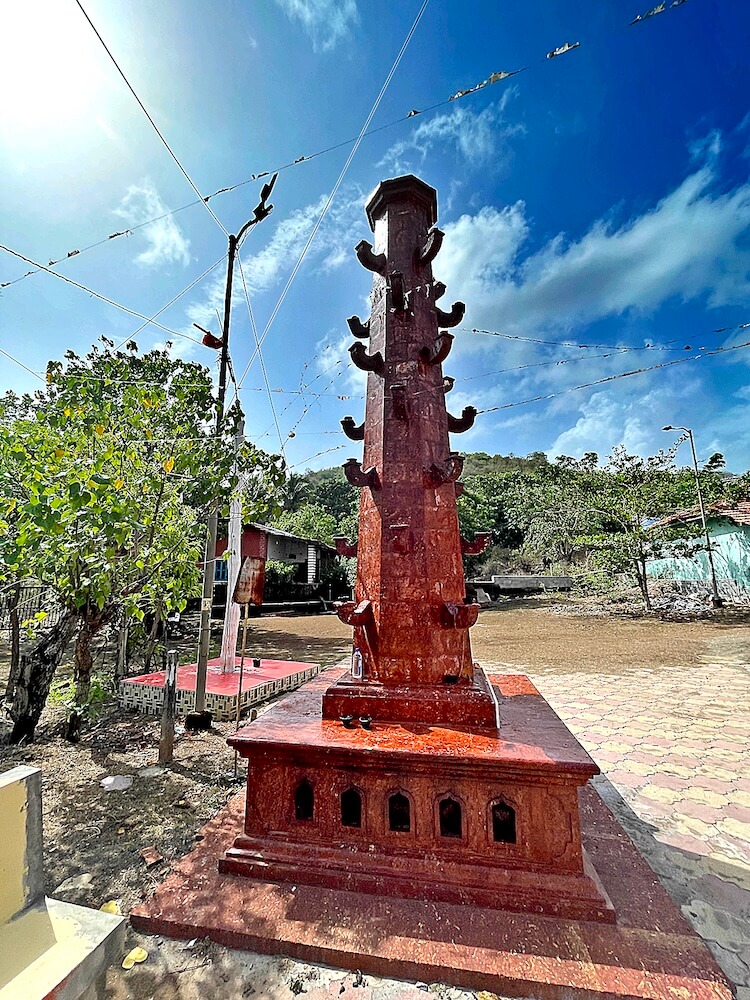
A legend regarding the temple states that the original abode of the Goddess was in the nearby Padmadurg Fort, located in the sea. Because it was near the ‘Kota’ (fortification), she was called Koteshwari Devi. She had manifested from a stone. One day, a pillar near the original site broke and fell into the sea. It drifted with the currents and washed ashore at the spot where the Koteshwari Devi temple stands today. Surprisingly, along with the pillar that drifted through the turbulent sea, the mask of the Goddess from the original site was also present. The villagers saw the pillar and the mask that had arrived with the waves, and realizing that it was the Goddess’s wish to be established here, they built a temple on this spot. They also erected the pillar that had come with the waves nearby (it is called the ‘Latecha Khamb’ or ‘Wave Pillar’ because it arrived with the waves). That pillar, which broke away from Padmadurg Fort, still stands in front of the temple today like an ascetic. Despite enduring many summers and monsoons, the pillar remains unaffected. A part of this broken pillar still remains in Padmadurg Fort, and a photograph of it can be seen in the temple.
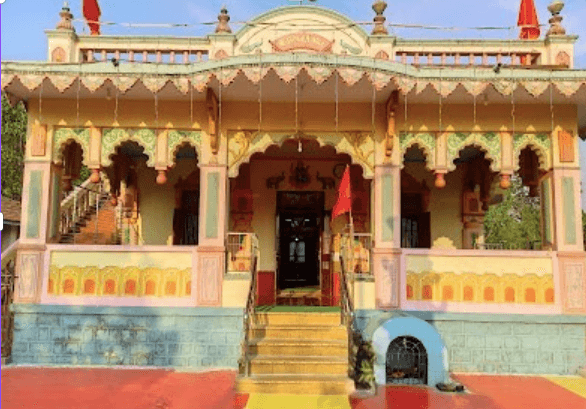
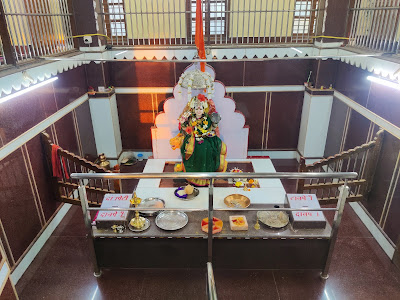
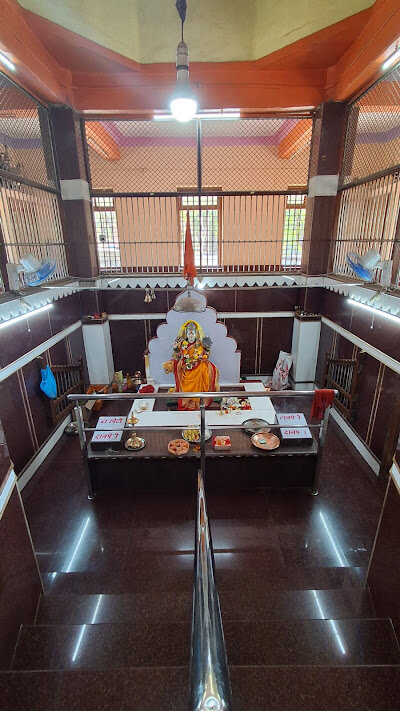
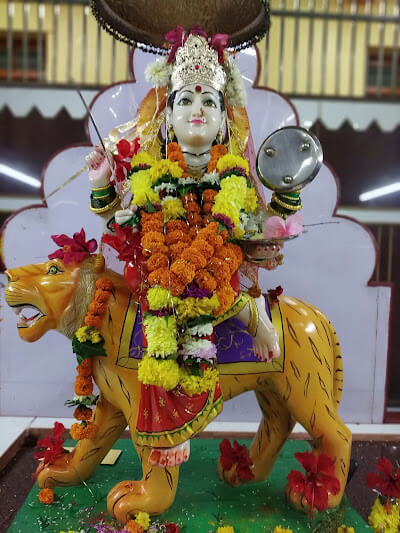
Although the temple is located along the main road, its entrance faces the opposite direction, towards the sea. One enters the temple courtyard through this entrance. In front of the temple stands a large Deepmal (lamp tower). Next to it, on a platform, is a wooden pillar. This is the pillar from the Goddess’s original site in the fort. From the courtyard, one climbs five steps to enter the mandap of the temple, which is situated on a high plinth. From this semi-open mandap, one enters the Sabha Mandap. In the compact Sabha Mandap, the Goddess’s sanctum is located in a slightly recessed area in the center. Here, there is a beautiful idol of the Goddess mounted on a tiger. Although she holds a trident and other weapons in her hands, her face radiates a loving expression. There is a circumambulation path (pradakshina marg) around the sanctum from the Sabha Mandap.
The Navratri festival begins on Ashwin Shuddha Pratipada. During this time, the Goddess is adorned with a mask, a prabhaval (halo), a shield and sword, a trident, a waistband, anklets, and various garments. On the day before the fair, which takes place on Chaitra Shuddha Chaturdashi, the Goddess’s palanquin procession is held. At that time, devotees go to the temple in Padmadurg Fort to break coconuts. Before launching their boats after the monsoon, the Koli community from across the district unfailingly visits this temple to seek the Goddess’s blessings and fulfill their vows. Along with the Koli community, the Marwari community and many other devotees from the district come to the temple for the Goddess’s darshan.
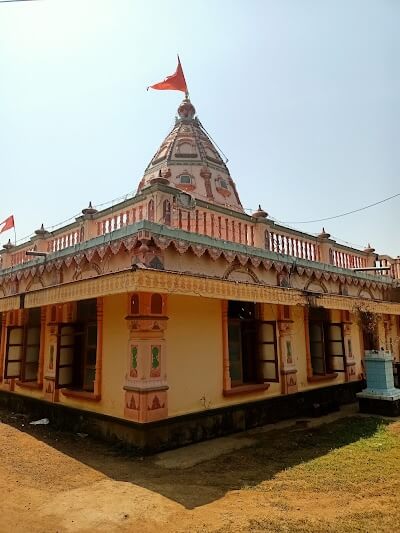
It is said that the Koteshwari Devi temple was built between 1760 and 1770. Even though the Janjira state was under the rule of a Muslim Nawab, historical documents mention that a ‘dhupada’ (grant for incense/worship) was provided for the maintenance of this temple. Initially, this temple was very small. Recently, in 1970, the temple was renovated, and this beautiful structure was built. Since the time of the Nawab, expenses for the temple’s lamps were provided, and the government still continues that tradition today.
This sacred temple stands as a testament to deep spiritual devotion, ancient architectural grandeur, and rich local cultural traditions.
The sanctum sanctorum houses the divine idol consecrated according to ancient Vedic traditions, surrounded by serene courtyards and traditional temple architecture.
Navratri, Maha Shivratri, Annual Temple Jatra & Deepotsav
Compare and book flights, secure top-rated local hotels near the temple, hire reliable guides, and rent cars instantly.
Extend your pilgrimage by visiting other highly sacred temples located nearby.


Add ₹999 more to unlock FREE SHIPPING!
Your sacred cart is currently empty.
Shop Photo FramesFill in your delivery details below to place your order.
Add comment