
Add ₹999 more to unlock FREE SHIPPING!
Your sacred cart is currently empty.
Shop Photo FramesSituated on the banks of the Karha River in the Baramati taluka of Pune district, the Mayureshwar Temple is the first and most significant pilgrimage site among the Ashtavinayaks of Maharashtra. Known as the supreme priority within the Ganapatya sect, this region is referred to as ‘Bhuswanandabhuvan’. The Ganapati who incarnated riding a peacock is worshipped here as Mayureshwar or Moreshwar. The five principal deities—Brahma, Vishnu, Shiva, Shakti, and Surya—performed rigorous penance in this Swanandapur to receive the vision of the Supreme Brahman, Ganesha. On the auspicious day of Bhadrapada Shukla Chaturthi, these five deities ceremoniously installed Lord Ganesha. Since then, this region has become the primary abode of the Vighnaharta (Remover of Obstacles).
According to mythological references, the great Ganapatya saint Morya Gosavi discovered the Mangalmurti idol in the bed of the Karha River in this region. At the age of eight, he received initiation into Vedic studies here from his guru, Nayanbharti. In later times, Shri Ganesh Yogindra Maharaj made immense contributions to this temple. It was he who gave the temple its current magnificent form. Shri Ganesh Yogindra was not only a great devotee but also an accomplished painter and a profound scholar. It is a popular legend that he traveled as far as Kashi to search for rare Ganapatya Puranas, and Ganesha himself appeared before him in the form of a Brahmin to present him with the ‘Mudgala Purana’. He wrote commentaries on several texts, including the Vighneshashtaka Stuti, and visited 108 Ganesha pilgrimage sites. The Yogindra Math, established by his disciples, still stands here today.
The ‘Mudgala Purana’, an ancient text consisting of 28,000 verses, describes the eight incarnations of Ganesha. The sixth section of this text is entirely dedicated to the Mayureshwar incarnation. According to the description therein, King Chakrapani of Gandaki Nagari was performing rigorous penance to the Sun God to be blessed with a son. As a fruit of that devotion, he was blessed with a son named Sindhu. This Sindhu later performed day-and-night worship of the Sun and obtained the boon of immortality. The Sun granted him an invincible boon that as long as the nectar remained safe in his stomach, death would not touch him. Intoxicated by this immense power, Sindhu established his dominance over the entire earth. He attacked Indra’s Amaravati and held the gods themselves captive in his city. He banned the worship of the gods and forced the entire creation to worship only him, keeping the gods in a state of extreme misery. To be freed from Sindhu’s tyranny, all the gods, including Vishnu, prayed to Ganesha. Responding to the call of his devotees, Ganesha promised to be born as Mayureshwar from the womb of Mother Parvati. After Mother Parvati performed penance for 12 years on Mount Meru, the divine incarnation of Vinayaka took place on Bhadrapada Shukla Chaturthi. During the battle, Ganesha, riding a peacock, destroyed Sindhu’s massive army with his incomparable prowess. At the height of the conflict, Lord Ganesha struck Sindhu’s stomach with his parshu (axe) and extracted the nectar. As soon as the nectar left his body, the demon perished, and the entire world was freed from his suffering. As a symbol of this great victory, the gods installed the idol of Mayureshwar at this holy Moregaon site.
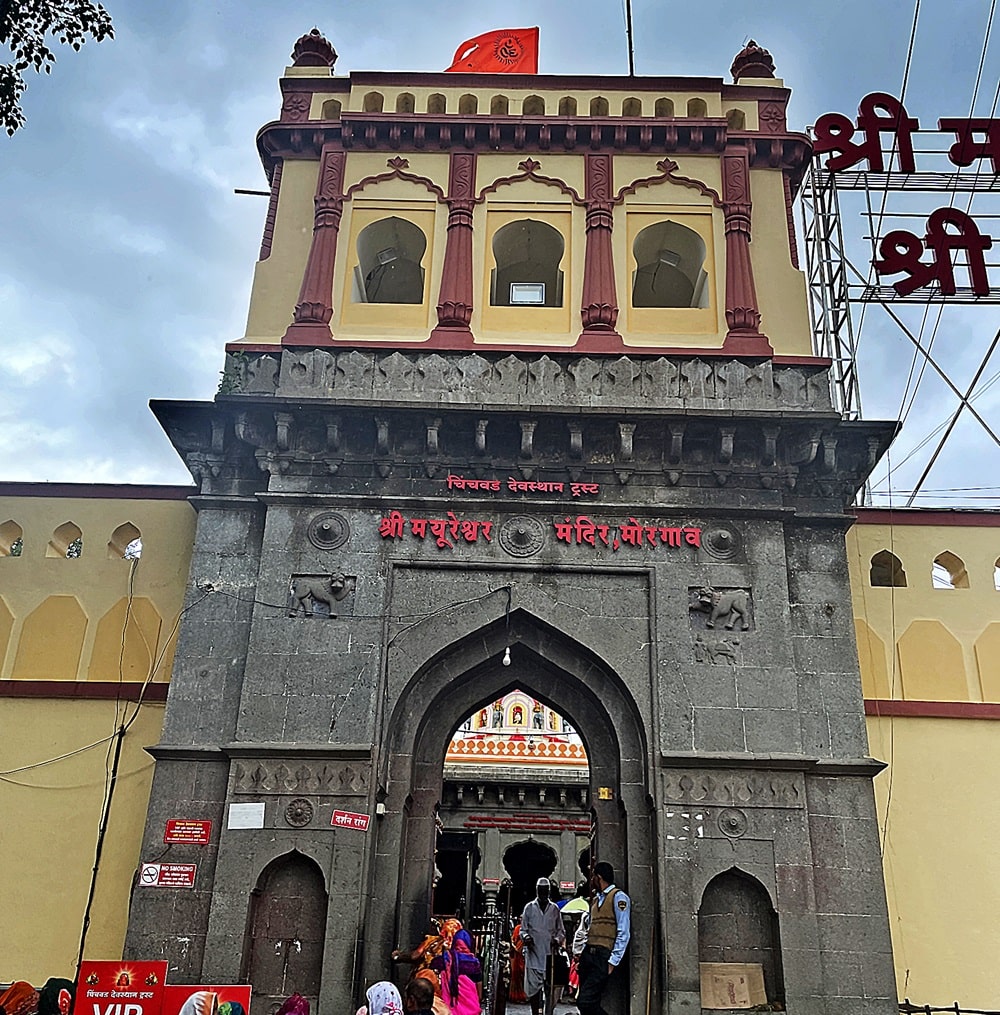
The temple is located in the densely populated area of Moregaon. It is surrounded by a fortification wall about 50 feet high, resembling a fortress. There are minaret-like pillars at the four corners of the fortification. The entrance to the temple is reached after climbing 12 steps outside the temple courtyard. In front of the entrance, there is a stone tortoise sculpture on the ground. Above the entrance is the Nagarkhana, where the drum is still played daily. Near the entrance stands a magnificent stone Mushaka (mouse) idol facing Ganesha. In front of it, on a 15-foot-high stone platform, is a large Nandi idol. The legend behind why a Nandi, typically found in Shiva temples, is in front of this Ganesha temple is that in ancient times, while this Nandi was being transported to a nearby Shiva temple, the cart’s wheel broke upon reaching the Mayureshwar temple. Despite many attempts, the Nandi could not be moved from there, and thus, it remained at this spot.
Next to the Nandi is the shrine of the naked Bhairava. It is believed that this deity protects the region. There are lamp pillars (Deepmalas) on octagonal platforms on both sides in front of the temple. Near one of these lamp pillars is a horse sculpture. Throughout the courtyard, there are seats for devotees, and there are cloisters (ovaris) along the fortification wall. In the back walls of these cloisters, there are rows of many niches containing sculptures of various deities. A wooden bridge has been built in the courtyard to create a queue pavilion (Rang Mandap), which has a tiled roof. Behind the temple is a Tulsi Vrindavan. The temple premises include a kitchen and a food distribution center (Annachhatra). The ancient Tarati tree located on the west side of the temple complex is known as the ‘Kalpavriksha’. It was while sitting under this tree that the great saint Morya Gosavi attained Siddhi. Many seekers still come to this place today to perform rituals.
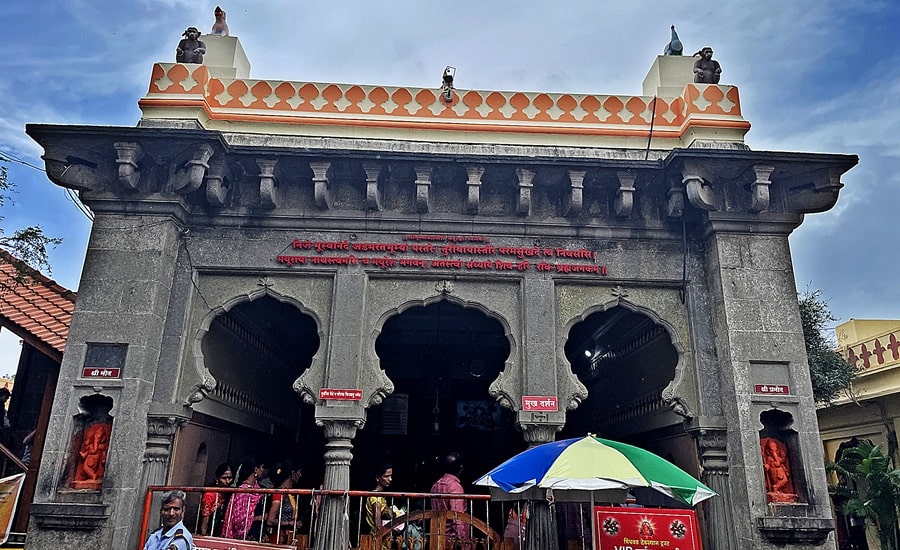
The temple structure consists of a Sabha Mandap (assembly hall), Antarala (vestibule), and Garbhagriha (sanctum sanctorum). At the entrance of the Sabha Mandap, there are four ornate pillars connected by arched lintels. There are two more doors on the right and left sides of the Sabha Mandap. On both sides of the entrance to the Antarala, there are two small niches containing idols of Lakshmi-Narayana on the left and the naked Bhairavanath on the right.
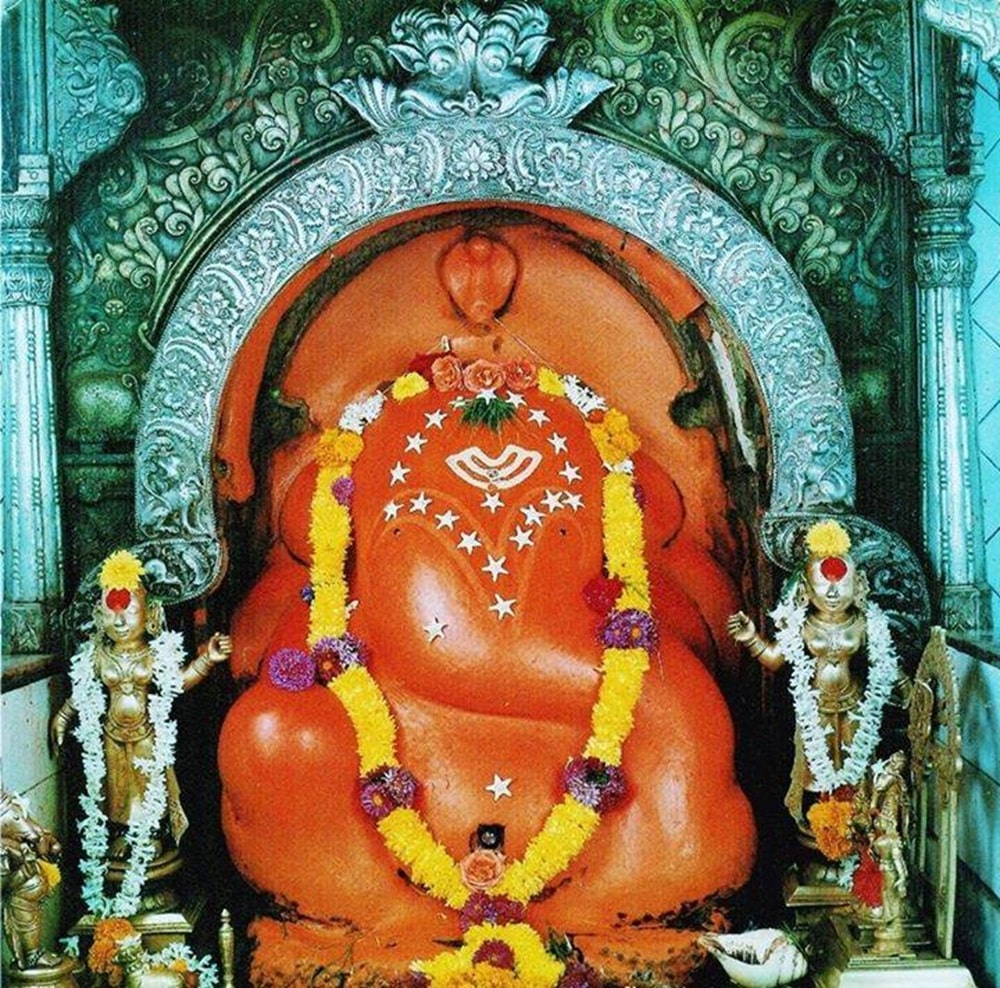
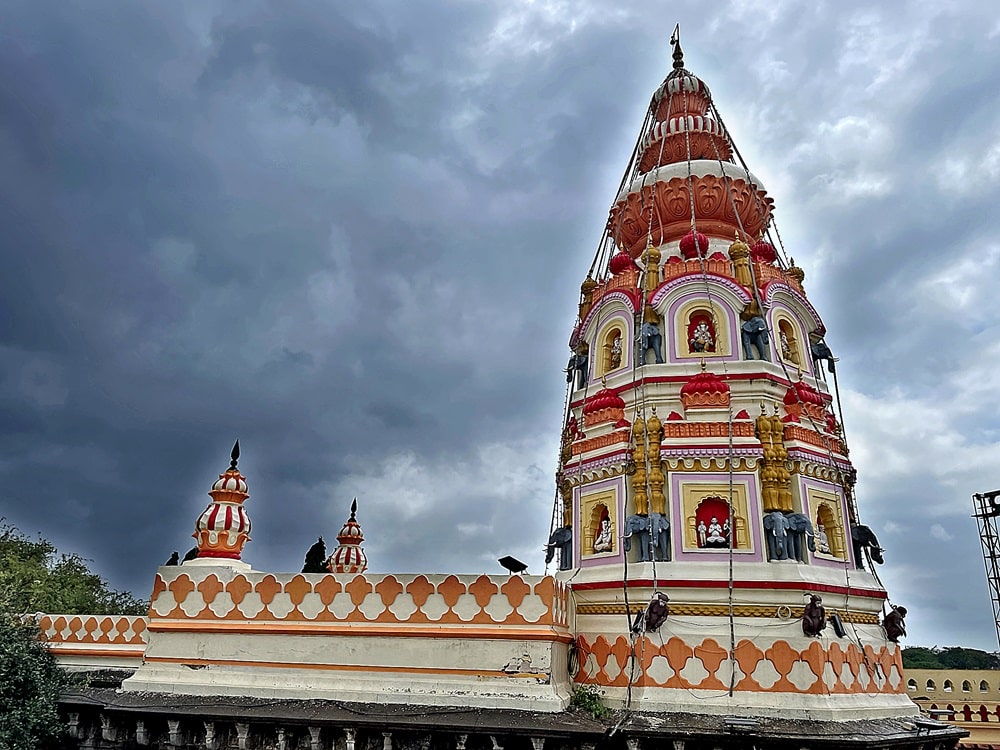
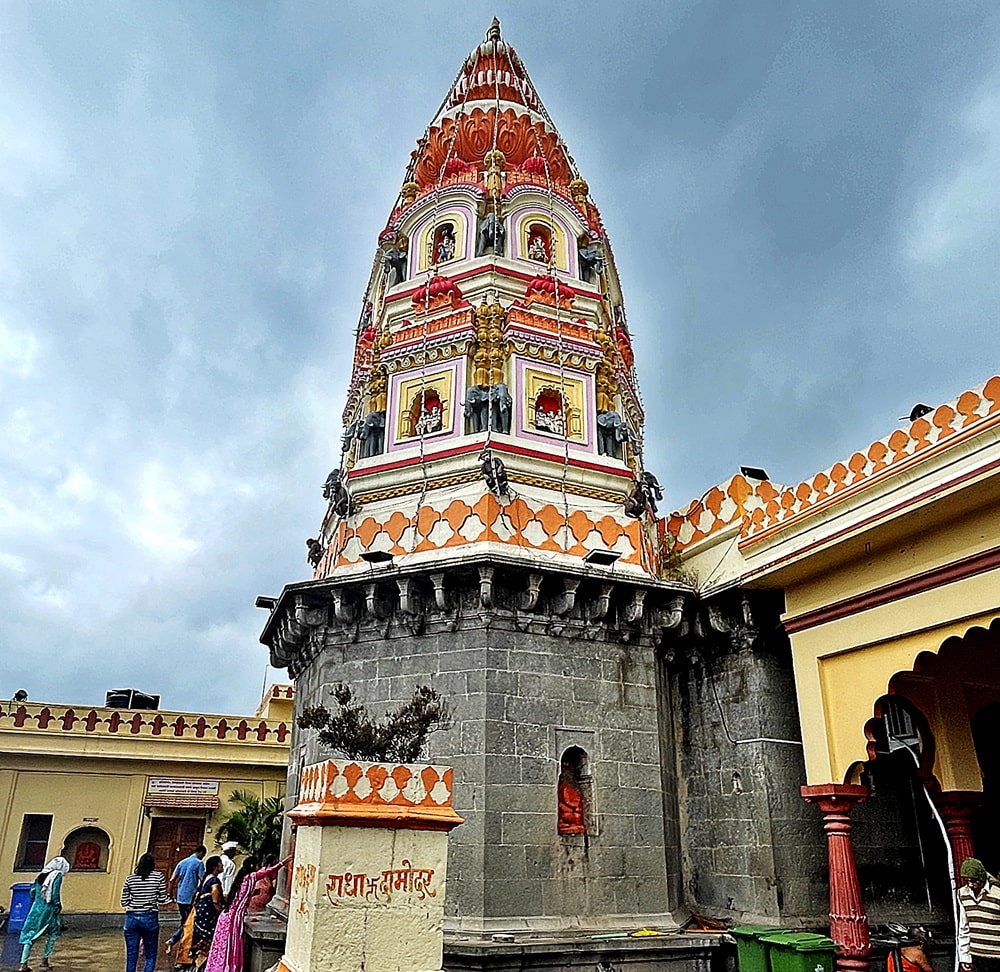
The entrance to the Antarala features ornate door frames, and on the lintel (Lalatbimba) is a sculpture of Ganesha with Riddhi and Siddhi. The Antarala has two more doors on the right and left sides. The entrance to the Garbhagriha has vertical carvings, and there is a Ganesha sculpture on the lintel. Inside the Garbhagriha is the self-manifested (Swayambhu) idol of Mayureshwar Ganesha. The Mayureshwar, whose trunk turns to the left, has diamonds embedded in his navel and eyes. There is a canopy of a serpent hood over the deity’s head. The silver arch (Prabhaval) behind the idol features sculptures of Riddhi-Siddhi, as well as carvings of the Sun, Moon, and a peacock arch. At the top center of the arch is a Kirtimukha. There is a circumambulation path (Pradakshina Marg) around the Garbhagriha. The roofs of the Sabha Mandap and Antarala have dome-shaped spires (Shikharas). Both these spires have two Amalakas and a finial (Kalash) each. The roof of the Garbhagriha has a three-tiered spire. The lower two octagonal tiers each have eight niches containing sculptures of various deities. The spire is adorned with sculptures of elephants, monkeys, and other animals and birds. The top tier of the spire is dome-shaped, topped with two Amalakas stacked one above the other, crowned by a finial.
At the Mayureshwar temple, the daily worship and festivals are organized in a systematic, scriptural manner. The deity is worshipped five times daily, with the Prakshal Puja performed at five o’clock in the morning and four o’clock in the evening. During these rituals, offerings of khichdi, chapati, and a full meal (Maha-Naivedya) in the afternoon are presented to Lord Ganesha. After the night worship, an offering of milk-rice is made. Among the significant festivals of the year, Bhadrapada and Magh Shukla Chaturthi hold special importance, during which a fair is held here. Grand celebrations also take place on Somvati Amavasya and Vijayadashami. The Mayureshwar Palkhi (palanquin procession) held on the day of Dussehra is the main attraction of this sacred site.
Departing late at night, this procession reaches the Someshwar temple at dawn. A unique tradition of reading out the names of all the prominent figures of the village is still preserved here to this day. A large fair is also held here on Somvati Amavasya, during which a massive crowd of devotees gathers to take a holy dip in the Karha River.
There is a tradition of organizing a Bhandara (community feast) at the temple on Bhadrapada and Magh Shukla Panchami. For devotees visiting here, a specific sequence of worship known as ‘Nitya Yatra’ is prescribed in the ‘Mudgala Purana’. This pilgrimage begins with the darshan of the Mushaka (the mouse) and seeking the permission of Lord Ganesha. Following this, one takes the darshan of Nandi, the tortoise in the Sabha Mandapa, and finally, Mayureshwar in the sanctum sanctorum. The shrine of Nagna Bhairava located outside the temple is also considered equally important, as he is regarded as the protector of this sacred region.
This sacred temple stands as a testament to deep spiritual devotion, ancient architectural grandeur, and rich local cultural traditions.
The sanctum sanctorum houses the divine idol consecrated according to ancient Vedic traditions, surrounded by serene courtyards and traditional temple architecture.

Navratri, Maha Shivratri, Annual Temple Jatra & Deepotsav
Compare and book flights, secure top-rated local hotels near the temple, hire reliable guides, and rent cars instantly.
Extend your pilgrimage by visiting other highly sacred temples located nearby.


Add ₹999 more to unlock FREE SHIPPING!
Your sacred cart is currently empty.
Shop Photo FramesFill in your delivery details below to place your order.
Add comment