
Add ₹999 more to unlock FREE SHIPPING!
Your sacred cart is currently empty.
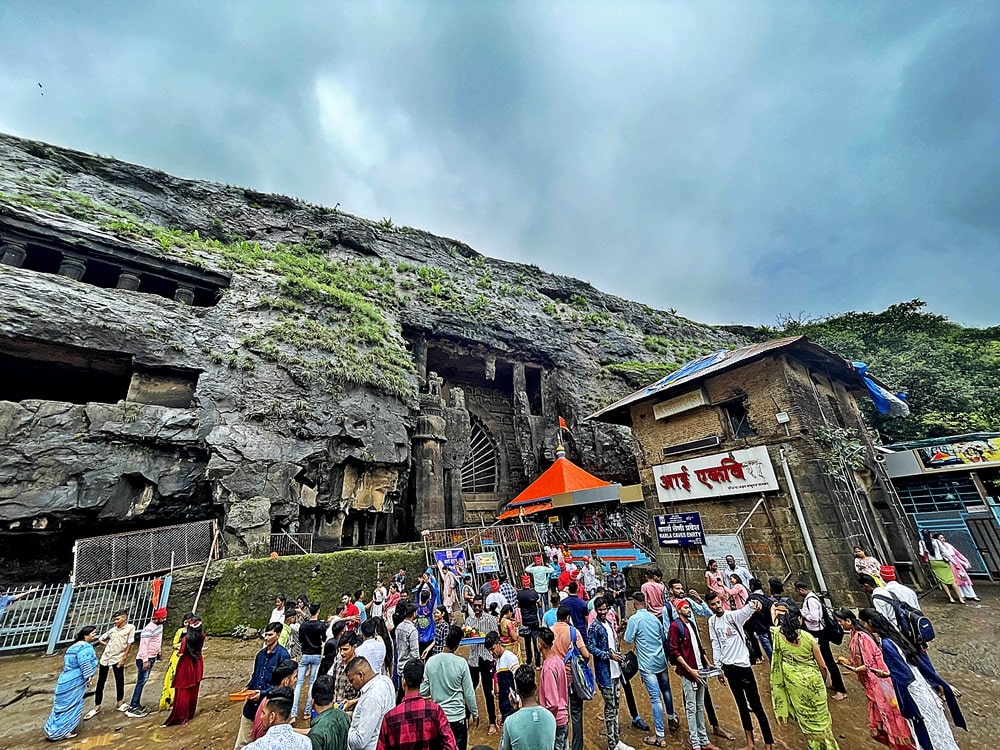
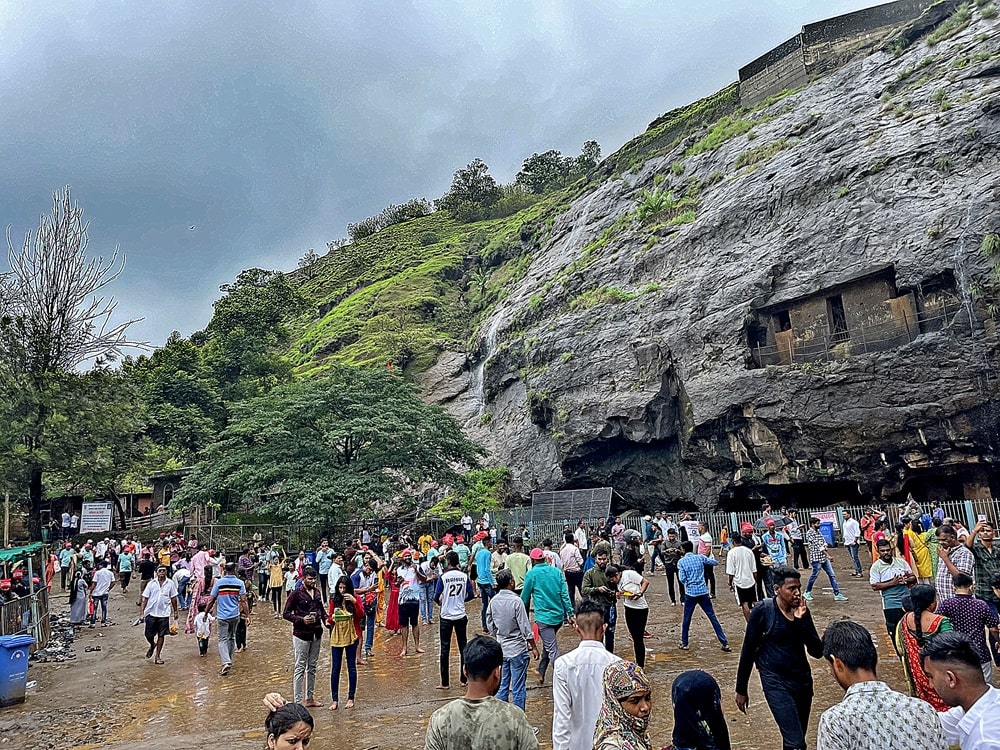
Shop Photo FramesSituated in the Sahyadri ranges in the Lonavala region of Pune district, on a hill at Vehergaon-Karla, stands the ancient and renowned temple of Goddess Ekvira. Adjacent to this divine abode of Mother Ekvira are the famous Karla Caves. The Archaeology Department has protected this site as a cultural heritage monument. These caves, housing the country’s largest Buddhist Chaityagriha, date back to ancient times. Revered as the Kulswamini (tutelary deity) of the Agri-Koli community of Maharashtra, devotees firmly believe that the history of this holy shrine dates back to the era of the Pandavas.
The holy abode of Goddess Ekvira here is extremely ancient. The famous Buddhist caves adjacent to this temple date back to around 160 BCE. The Archaeology Department has declared this entire area a protected cultural heritage site. In ancient times, this region was known as ‘Valuraka’. During that period, this area was situated on an important trade route connecting the Konkan and Desh regions. References to these caves are found in inscriptions from the Satavahana period, and the temple of the Goddess is located within the precinct of these very caves. According to historical references, the temple was renovated during the medieval period by Punyashlok Ahilyabai Holkar. Significant changes were also made to the structure of the temple in the year 1866 CE. Located near the historically significant Bhor Ghat, several rulers and traders contributed to the development of this shrine over time.
In the 13th chapter of the ‘Matsya Purana’, details about the 108 names of the Goddess and Her holy abodes are provided. Goddess Ekvira is mentioned in the 40th verse of this chapter:
Rudrani Rudrakotyam tu Vishalakshi tu Varanasi |
Pushpawati Gayayam tu Ekvira Sahyadrike ||
The verse translates to: Rudrani in Rudrakoti, Vishalakshi in Varanasi, Pushpawati in Gaya, and Ekvira on the Sahyadri mountains. This reference provides scriptural evidence for the antiquity of the Goddess temple at Karla and highlights the spiritual significance of this shrine nestled in the Sahyadris. The word ‘Sahyadrike’ in the Matsya Purana directly pertains to the surroundings of the Karla Caves. This verse is considered strong religious evidence demonstrating the ancient heritage of the temple. Owing to these scriptural references, this abode of Goddess Ekvira is not only the revered Kuldaivat of the Koli-Agri brethren of Maharashtra, but has also gained renown as a prominent Shaktipeeth across India.
In his autobiography ‘Majhi Jeevangatha’, Prabodhankar Thackeray described Mother Ekvira as the Kulswamini of the Agri, Koli, and CKP communities. Every year in the month of Chaitra, a grand fair (jatra) is held in honor of the Goddess. The Koli community from Mumbai and Konkan attends this fair with great enthusiasm. The entire hill reverberates with the grand palanquin procession (Palkhi Sohala) and traditional Koli songs. The divine form of Mother Ekvira is radiant and serene. One feels a divine bliss upon entering the sanctum sanctorum (garbhagriha) of the Goddess. This shrine is considered deeply awakening (Jagrut), and it is our firm belief that the Goddess swiftly answers the earnest prayers of Her devotees. Our father had unwavering faith in this Goddess, and through him, we too were taught reverence and devotion for this shrine. The hill of Karla, those ancient caves, and our Mother Ekvira residing there remain a vital source of inspiration in our lives.
The Karla Caves and the adjacent Ekvira Devi Temple are also mentioned in the original English encyclopedia ‘The Indian Encyclopaedia’. It describes Karla as a place near Lonavala in Pune district, famous for its ancient rock-cut caves. Among this group of caves is India’s largest and best-preserved ‘Chaityagriha’. Its origin is generally dated back to the 2nd century BCE. The temple of Goddess Ekvira is situated right at the entrance of this very Chaityagriha. This temple holds historical significance, and the presence of a Hindu deity’s shrine amidst Buddhist caves stands as a testament to Indian religious harmony. These caves were carved during the Satavahana period, and the religious and commercial use of this region began in that very era.
According to the legend of Goddess Ekvira, the Pandavas arrived on this hill during their period of exile (Vanvas). Mother Ekvira appeared before them in person and, to test them, expressed Her desire that a temple be built for Her at this spot. However, She imposed a condition that the task had to be completed in a single night. Constructing a temple overnight on such a high and difficult hill seemed impossible, yet the Pandavas successfully took up the challenge and fulfilled Mother Ekvira’s wish. Pleased with their devotion, Mother Ekvira blessed the Pandavas with a boon that no one would be able to recognize them during their period of incognito exile (Agyatvas). Because of this divine boon, the Pandavas successfully completed their hidden exile following their forest banishment.
According to mythological lore, Goddess Renuka is one of the three and a half Shaktipeeths on Earth. Mother Ekvira is an incarnation of Goddess Renuka Herself. Both Renuka and Ekvira are primal avatars of Goddess Parvati. Sage Jamadagni and Mother Renuka had an immortal son, Parashurama. The legend behind the name states that She was named Ekvira as the mother of the brave Parashurama. According to social and cultural scholars, since Mother Ekvira is the presiding deity (Kuldaivat) primarily of communities such as the Koli, Agri, and Kunbi, She is considered one of the primordial deities of Hinduism. Members of the Chandraseniya Kayastha Prabhu (CKP) and Daivadnya Brahmin communities also revere Her as their family deity.
The first welcome arch of the temple stands at the turn heading towards Karla Fort on the old Mumbai-Pune highway. Located three kilometers from this arch, the temple of the Goddess rests atop the hill. Private vehicles are allowed entry upon paying an entry fee at the Forest Department checkpoint situated at the foothills. From here, one road leads up the hill while another leads to the Base Temple (Paytha Mandir) of the Goddess. A parking facility is also available in front of the Base Temple. In the temple precincts, there are hundreds of shops selling worship items, toys, foodstuffs, and more. Many shops sell traditional pom-pom caps (gondyachya topya), which are a hallmark of Agri-Koli culture.
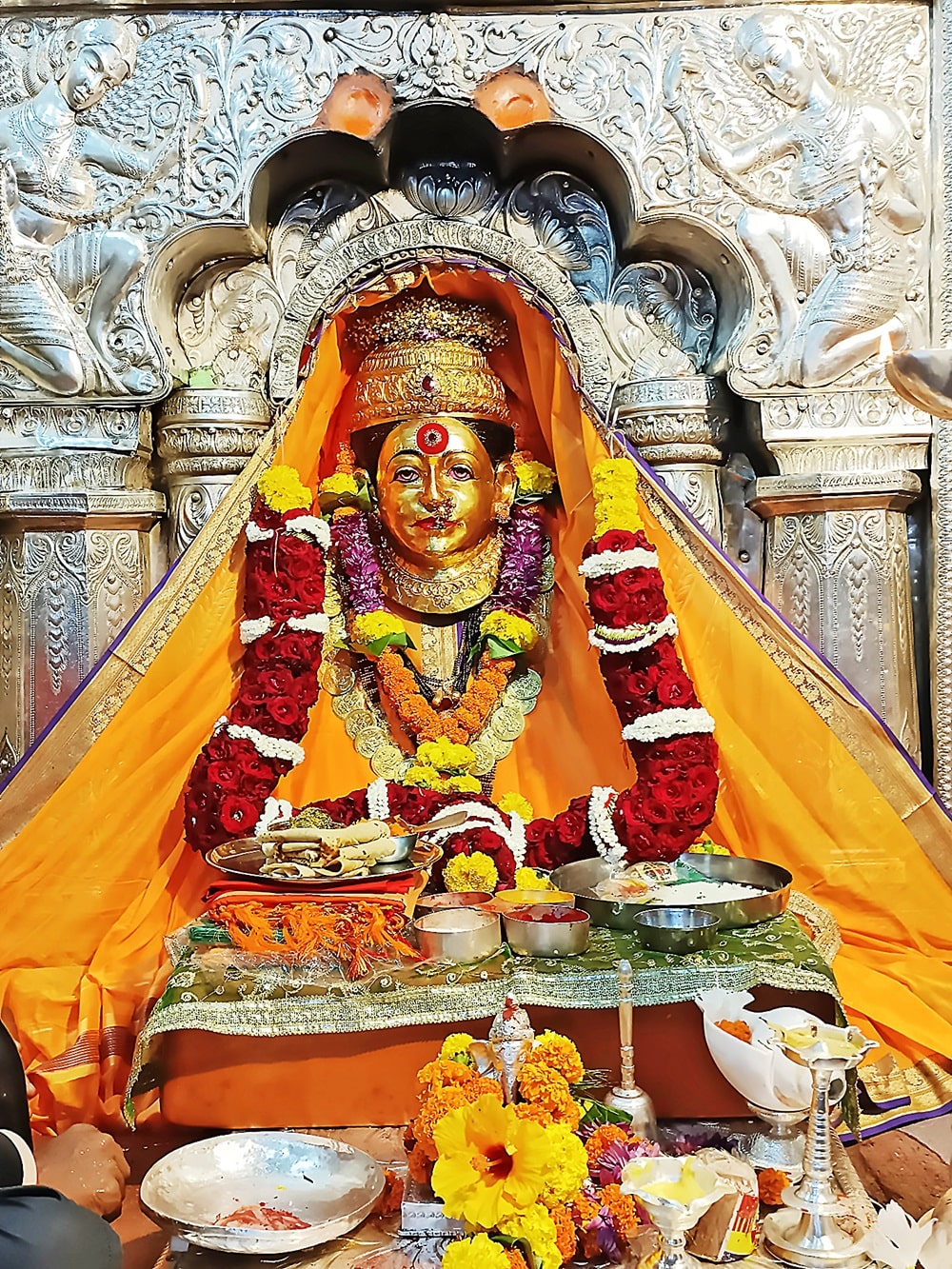
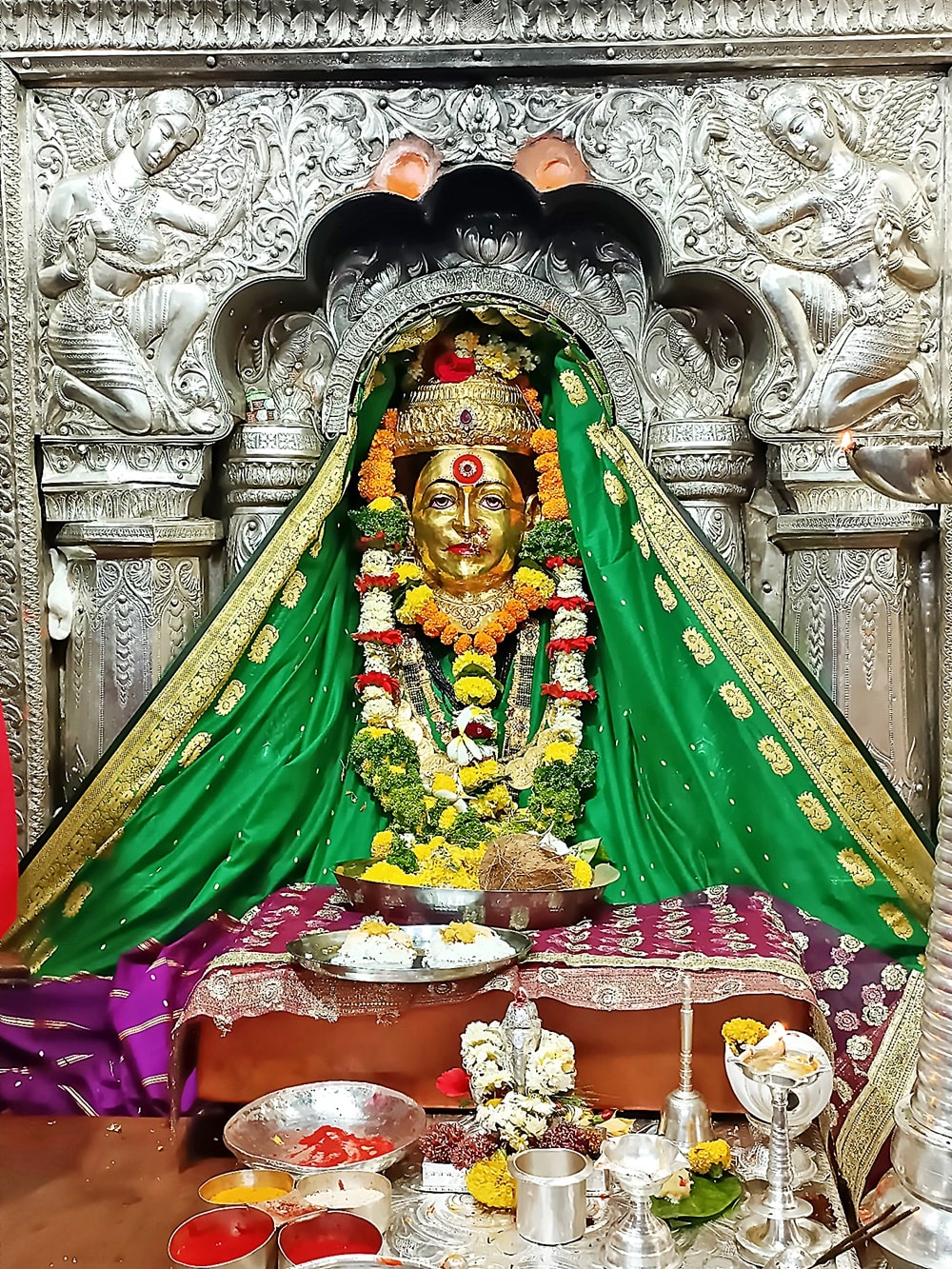
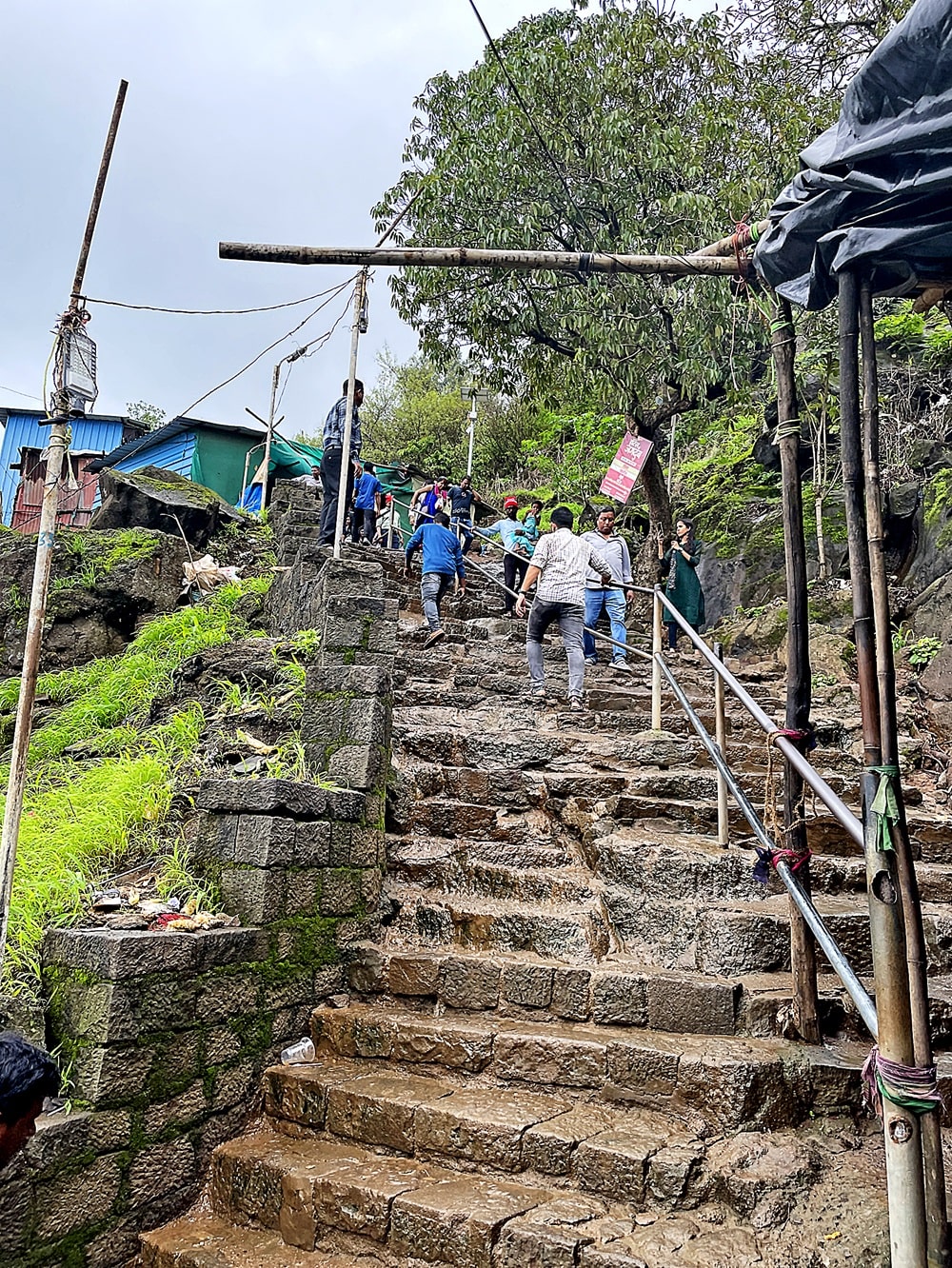
The Base Temple has been renovated in recent times. The architecture of this temple comprises an assembly hall (Sabhamandap) and a sanctum sanctorum (Garbhagriha). In the sanctum, a standing stone idol of the Goddess is consecrated on a Vajrapeetha. The Goddess holds a weapon in Her hand, and a sculpture of Her mount (vahana), the rooster, is placed near Her feet. Adorned with fine garments and ornaments, the deity is embellished with a silver mask. From beside the base temple, there is a stepped pathway to reach the main temple situated on the hill. After climbing about 150 steps from here, on the left is the Pachpairi Paduka Temple. In the sanctum sanctorum (garbhagriha) of this temple, there is a self-manifested (Swayambhu) idol of the Goddess in stone form. It is said that the footprints of the Goddess are imprinted on this very stone.
Ahead from here, on both sides of the stepped pathway, there are shops selling worship items. At the end of the stepped pathway, there is a courtyard and an entrance gate. On the right side inside the entrance gate is the ticket counter of the Archaeological Department. This ticket is required to gain entry into the Chaityagriha here. No ticket is required to go into the temple for darshan. On the left side of the courtyard, there is a natural fortification of the hill, which houses ancient caves. On the right side, there is a fortification of carved stone. In the courtyard, ahead of the ticket counter on the right side, is the ‘Jakaticha Ranjan’ (an ancient stone vessel). An information board detailing the history of the ancient caves is placed right here.
In the temple courtyard, there is an ancient Shami tree. Beneath this tree is a shrine dedicated to the Shami deity, which is said to be the only temple dedicated to Shamidevata in the country. On the day of Vijayadashami, thousands of devotees come here to worship this tree. In front of the queue hall (Rangmandap) of the main temple stands a small Samadhi shrine of Babaji Maharaj, built in carved stone. Inside the shrine is the platform (chauthara) of Maharaj’s Samadhi. In front of the Samadhi shrine, on a platform, stands a Deepastambha (lamp tower). Ahead of the Deepastambha is a two-storey entrance gate. The lower floor of the entrance gate is built of carved stone, while the upper floor construction is of old bricks. Inside the entrance gate, on both sides, are guard rooms. On the upper floor of the entrance gate, where the Nagarkhana (drum house) used to be, there is currently a police control room.
To the left of Babaji’s Samadhi shrine is the queue hall (Rangmandap). The iron-structured queue hall has a tin roof. The temple of the Goddess is situated on an elevated plinth. The temple architecture comprises a Sabhamandap (assembly hall) and a Garbhagriha (sanctum sanctorum). Although the temple is plastered with cement, the original temple is built of carved stone. The Sabhamandap has three entrance gates—one in front, and one each on the left and right sides. On the lintels of the entrance gates, there are sculptures of Lord Ganesha. In the center of the floor in the Sabhamandap, there is a carved turtle sculpture. The entrance to the Garbhagriha is elevated higher than the Sabhamandap. In the Garbhagriha, adjacent to the back wall, is the self-manifested (Swayambhu) stone idol of Goddess Ekvira, and adjacent to the right wall is the Swayambhu stone idol of Goddess Jogeshwari. Seated in an intricately carved silver archway (Makhar), the Goddesses are adorned with various fine garments and ornaments. The inner walls of the Garbhagriha are clad with carved silver paneling. The temple features a sloping square roof on all four sides. At the apex of the roof, there are two Amalaka placed one above the other, topped with a Kalash (spire) and a sacred flag. In front of the temple, on an elevated platform, are hero stone (Viragal) sculptures.
To the right side of the temple is a grand Chaityagriha. In front of the Chaityagriha stands an Ashoka Pillar, featuring four lion sculptures facing the four directions. This is the national emblem of India. At the entrance of the Chaityagriha, there are sculptures of elephants (Gajraj), Emperor Ashoka, his queens, Lord Buddha, Yakshas, Kinnaras, and others. Inside the Chaityagriha, there are pillars on both sides, with each pillar depicting two elephants and human figures seated on their backs. The ceiling is supported by wooden beams. Inside the Chaityagriha, there is a massive Stupa. A little further up the hill, there are more caves. Here lies a Buddhist Vihara and residential cells for monks.
Chaitra Shuddh Ashtami is celebrated here with great enthusiasm as the annual fair and festival (Jatrotsav) of the Goddess. During this time, lakhs of devotees from states like Maharashtra, Telangana, Karnataka, etc., arrive to seek the darshan of the Goddess. Palanquins arrive to visit the Goddess from districts like Thane, Palghar, Raigad, Ratnagiri, as well as from every Agri Pada and Koliwada in the cities of Mumbai and Thane. During this festival, the entire Karla Hill reverberates with the thunderous beats of dhol-tasha, banjo, and DJ music. The hill turns vibrant red with the showering of gulal. Animals like chickens and goats are sacrificed in thousands. Chaitra Purnima is celebrated here as ‘Kathichi Jatra’ (Stick Fair). On this occasion, decorated sacred poles are brought to the Goddess’s temple from nearby villages. Sharadiya Navratri festival is celebrated here with deep devotion. During these nine days of the year, the entire hill of the Goddess observes strict vegetarianism. On Navami, a Shatachandi Yajna is performed. Thousands of devotees visit the temple on this occasion to offer oblations into the sacred fire. The temple remains bustling with devotees throughout the year. Every Sunday and on public holidays, there is a large crowd in the temple premises.
Every morning at 5:00 AM, the worship of Goddess Ekvira Aai begins. The temple premises are cleansed, sanctified, and fragrant by sprinkling rose water, attar, and gomutra. At 5:30 AM, the Kakad Aarti is performed. At 6:30 AM, the Abhishek takes place. On Chaturdashi, the day preceding Purnima (full moon) and Amavasya (new moon), the Goddess is bathed with a Panchamrut Abhishek. Devotees can have darshan of Goddess Ekvira Aai from 6:00 AM to 8:30 PM.
This sacred temple stands as a testament to deep spiritual devotion, ancient architectural grandeur, and rich local cultural traditions.
The sanctum sanctorum houses the divine idol consecrated according to ancient Vedic traditions, surrounded by serene courtyards and traditional temple architecture.

Navratri, Maha Shivratri, Annual Temple Jatra & Deepotsav
Compare and book flights, secure top-rated local hotels near the temple, hire reliable guides, and rent cars instantly.
Extend your pilgrimage by visiting other highly sacred temples located nearby.


Add ₹999 more to unlock FREE SHIPPING!
Your sacred cart is currently empty.
Shop Photo FramesFill in your delivery details below to place your order.
Add comment