
Add ₹999 more to unlock FREE SHIPPING!
Your sacred cart is currently empty.
Shop Photo FramesThe ancient and famous temple of Riddhi-Siddhi Vinayak in the village of Vinayak near Uran is a place of faith for thousands of devotees in the taluka. This temple, dating back to the year १३६५, that is, the fourteenth century, was built by the Chakravarti King Hambirrao of Thane. This part of the Konkan land was under his dominion. Such references are found in ancient inscriptions discovered at Ranwad and Alibaug-Nagav. Currently, these inscriptions are in the museum in Mumbai. Apart from this, there is also a Gaddhegal (donkey curse stone) bearing the inscription of Hambirrao in this temple. It is said that the village was named ‘Vinayak’ because of this ancient temple.
The Siddhivinayak temple is located in Vinayak village, approximately 3 kilometers from Uran. In ancient times, this area was known as Ranwad. According to historical records, this region was under the rule of the Satavahanas, Traikutakas, Kalachuris, Mauryas, Chalukyas, Rashtrakutas, and Shilaharas. As per the inscriptions found at Chanje and Ranwad dating back to 1260 and 1259 AD respectively, Uran was under the control of the Shilahara king Someshwara Datta of North Konkan. Subsequently, the rule of the Yadavas was established here. Hambirrao was a chieftain of the Yadavas of Devagiri. It appears that he established his own kingdom here during the decline of the Yadavas. A twenty-line inscription is carved on the stone slab behind the Siddhivinayak idol in this temple. This inscription, found on a stone slab approximately five feet high and two feet wide, contains a mention of Hambirrao.
This stone slab is a Gaddhegal. A Gaddhegal is a curse or an insult directed at the women of the household of anyone who acts contrary to the text inscribed on the stone. Its uppermost part features the sun, the moon, and a Mangalkalash, while at the very bottom, a union between a donkey and a woman is depicted. The text on this Gaddhegal, written in the Sanskrit-Marathi language and Nagari script, is as follows –
Om Svasti Shri Ijarat 766 Sakusavatu 1287 Vishwavasu Samvatsara
Beginning from the first day of the waxing moon of the month of Magha, adorned with the entire royal lineage.
In the glorious and victorious reign of the King, the Lord of the Western Ocean, in the kingdom of Rajasa, at Sthitishurkananuye.
The illustrious place appointed (?) Thane Konkan Hambirrao kingdom, the Great Minister.
All the rights regarding the arrangements and administration as ordained by the Lord are vested in the authorities, etc.
At that time, as the process was underway, the deed of sale was inscribed as follows:
Residing in the village of Rane Agare, situated on that bank in the outer region, the son of Simukanta.
The Lord, united with the enemy at the Jalkeli sea, purchased ten rows of trees adorned with their own nature-
Along with the assembly of the celestial sages and the planetary deities, reaching the boundaries, the six wheels of the chariot have been constructed.
According to the sequence of the path, at the Jal Kanti Sihiprabhu purchase, on the 6th, the pilgrimage-procession will take place.
Vrivisem Thackeray Sianakaineyi Ari Shatam Dram Ajala Kam Naro 11(?)
By the grace of the Lord, the eternal divine master, Bhat Vartak Maidekantamal.
—Shri Vitthal Math, Padavise, Maidekan, Nayikan, Ravijak and Jyalun Maha
Upadhye of Kaule Ramdekant, Mhatara of Kanhuraetum, Mahadu
Elderly mother, mother of the elderly, the elderly one —————-
—————- Written for the merit of the morning
When I met this Lord, then this Padari Shri Prabhu became manifest at eight places.
In the religious work, sixteen offerings were made —————-
I surrender unto You, the protector of the universe. Please forgive my transgressions.
Dhar Mohi Palati …… Shri. Shri…….
(There are three more lines beyond this. However, they have now become illegible.)
This inscription records a deed of sale that took place on the first day of the waxing moon of the month of Magha in the Vishvavasu Samvatsara, corresponding to the Hijri year 766 and Shaka year 1287 (that is, 1365 CE), during the tenure of Hambirrao, the Lord of the Western Sea and the appointed governor of Shristhanaka. It documents the sale of a plot of land located near the seashore in Padivase, near Uran, and it appears that Arisimhi Prabhu was serving as the Mahamatya to Hambirrao at that time. The end of this inscription mentions the witnesses. The surnames of these witnesses are Vartak, Upadhye, and Mhatara/Mhatara (Mhatre?).
From this Gaddegala, the Riddhi-Siddhi Vinayak Temple here dates back to at least the fourteenth It appears to have a history spanning centuries. During the era of Shrimant Nanasaheb Peshwa, in the year 1753, the charter for the worship and rituals of this Ganpati was granted to the Gharat family of this place. That charter can still be seen with the Gharat family today. The Ganeshotsav festival in this temple began during the Peshwa period itself. More than 250 years have passed since then.
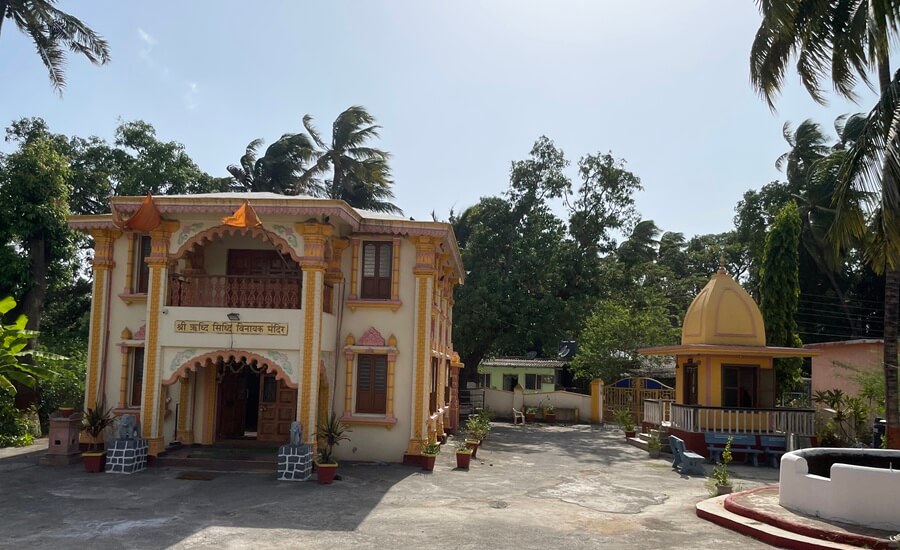
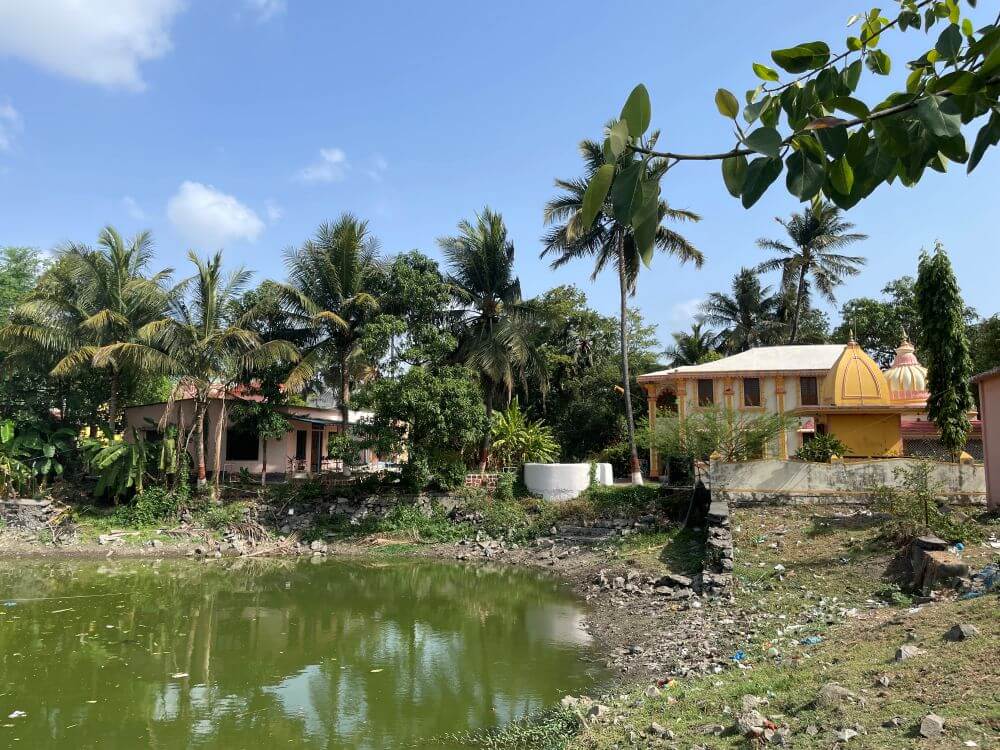
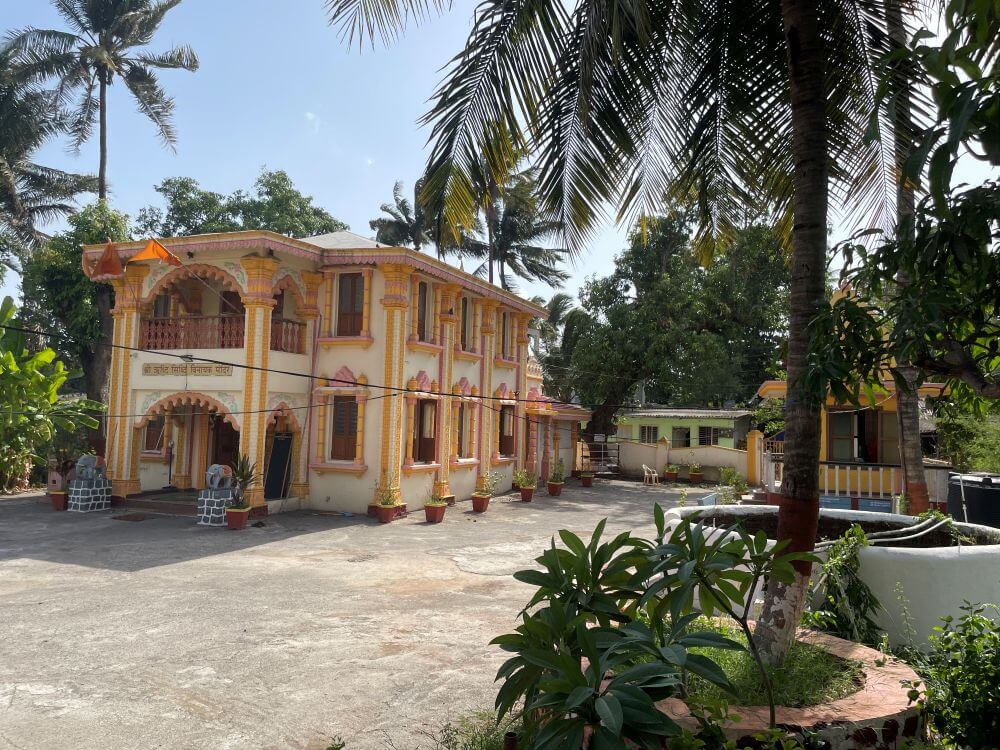
In the midst of lush green forests, on the banks of a lake, stands the temple of Riddhi-Siddhi Vinayaka. There is a well in the temple courtyard. The courtyard is paved with paver blocks, which makes the surroundings appear even more beautiful. Opposite the main temple is the temple of Hanuman. It feels as if Siddhivinayak and Hanuman are looking at each other. The temple of Siddhivinayak faces east, while the temple of Maruti faces west. Generally, a Maruti temple faces south, but here it faces west. There are two idols of Maruti in this temple. The second idol was found by a gentleman named Shamrao Naik in the stone quarries of Mora.
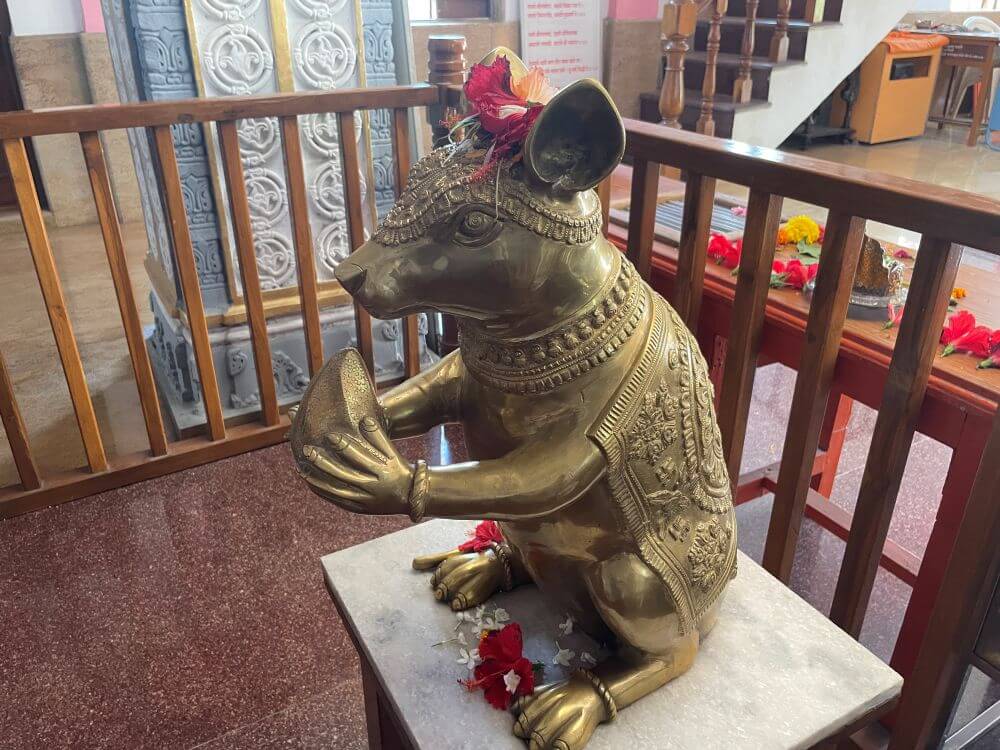
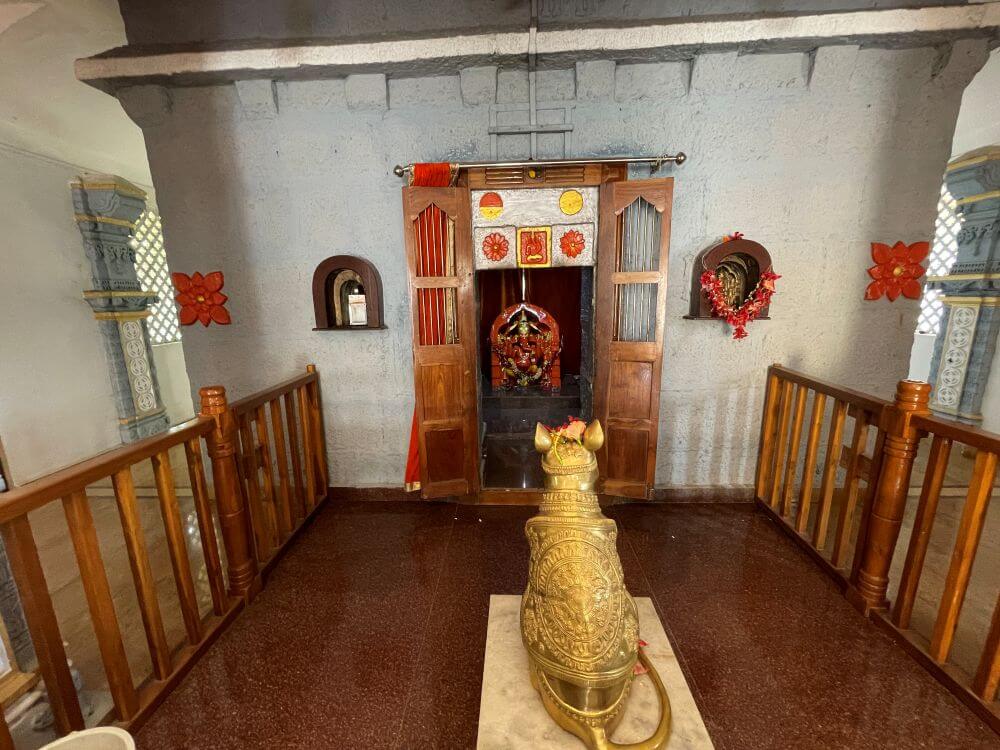
This two-story temple is structured with a Mukhamandapa (entrance hall), a Sabhamandapa (main assembly hall), and a Garbhagriha (sanctum sanctorum). On both sides of the entrance to the Mukhamandapa, there are sculptures of majestic elephants. The Sabhamandapa, which was built in front of the original temple at a later period, is spacious. There is a balcony on the second floor of the Sabhamandapa, accessible by wooden staircases on both sides. In front of the Garbhagriha, there is a large brass Mushakaraja (the mouse vehicle of Lord Ganesha). The niches on the front wall of the Garbhagriha house local deities. The entire construction of this Garbhagriha is made of stone, whereas cement-concrete has been used for the assembly hall. Glass chandeliers from the old temple have been preserved in the Sabhamandapa. These are illuminated during temple festivals and on Sankashti Chaturthi. On the upper part of the walls, a row of elephants can be seen on all four sides, topped with an intricately carved decorative border.
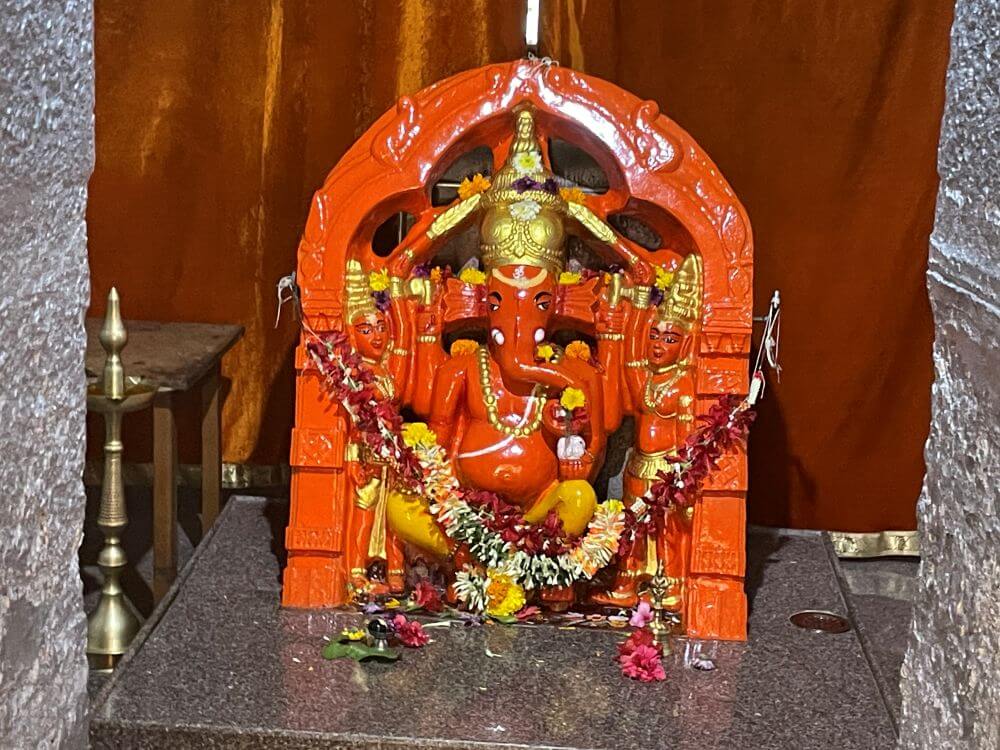
In the sanctum sanctorum, there is an idol of Vinayaka adorned with vermilion, seated upon a Vajrapitha. A unique feature of this place is that the idols of Riddhi and Siddhi are carved alongside Vinayaka from a single stone. It is believed that this stone is three and a half feet high, two and a half feet wide, and eight inches thick. The idol of Vinayaka is three and a half feet tall. The idols of Riddhi and Siddhi are two feet tall. Vinayaka wears an ornate crown on his head. He holds a parashu (axe) and an ankusha (goad) in his hands, and holds modaks and ladoos in the hand resting on his lap. Vinayaka is adorned in a pitambar (yellow silk garment) and both his legs are folded in a seated posture. Behind this idol is an inscription three and a quarter feet high. For a few days each year, the morning sun rays fall directly upon the Ganesha idol located in the sanctum sanctorum of this temple.
It is the firm belief of the devotees here that this Ganpati fulfills their vows. Vows are made in large numbers before this Ganpati for success in business, the birth of a son, peace at home, and the marriage of daughters. A grand festival is held here on Maghi Chaturthi. Apart from this, there is a constant stream of devotees here on every Chaturthi and Angarki. The Kakad Aarti takes place in the temple every morning at 5:30. The evening Aarti is at 7:30. Every Thursday of the week, Bhagwat Katha and Mahaprasad are organized in the temple. It is the tradition of the local villagers to seek the blessings of Vinayaka before starting any new task and to pray at his feet for the task to be completed without obstacles.
This sacred temple stands as a testament to deep spiritual devotion, ancient architectural grandeur, and rich local cultural traditions.
The sanctum sanctorum houses the divine idol consecrated according to ancient Vedic traditions, surrounded by serene courtyards and traditional temple architecture.
Navratri, Maha Shivratri, Annual Temple Jatra & Deepotsav
Compare and book flights, secure top-rated local hotels near the temple, hire reliable guides, and rent cars instantly.
Extend your pilgrimage by visiting other highly sacred temples located nearby.


Add ₹999 more to unlock FREE SHIPPING!
Your sacred cart is currently empty.
Shop Photo FramesFill in your delivery details below to place your order.
Add comment