
Add ₹999 more to unlock FREE SHIPPING!
Your sacred cart is currently empty.
Shop Photo FramesA distinct example of metropolitan Mumbai’s multicultural heritage is its Chinese community and the Chinese temple built by them. Situated in a quiet lane in the Vadibunder area of Mazgaon is the temple of Kuan Kung (Lord Kuan), a valiant warrior in Chinese history and a symbol of power. Chinese devotees believe that Kuan Kung is an incarnation of a Bodhisattva. He is considered the god of war and unwavering loyalty. Housing the deity Kuan Yin as well, this historic temple serves as a sacred sanctuary for the handful of Chinese-Indians remaining in Mumbai.
The history of relations between Mumbai and China is ancient. During the British period, opium and cotton were exported in large quantities from India to China. At that time, opium was cultivated extensively under the patronage of the erstwhile rulers of the Malwa region. Mumbai merchants would send this opium to China. Although opium was banned in China, this trade was carried on by bribing Chinese officials. Even though generation after generation of young people in China became addicted due to this trade, it resulted in a massive accumulation of capital in Mumbai. Thus, the progress of Mumbai is closely linked to its trade with China.
During this same period in the eighteenth century, many Chinese merchants, sailors, skilled artisans, and dentists came to Mumbai. These Chinese people predominantly settled in the areas of Mazgaon, Sewri, and Girgaon. There is a Chinese cemetery in Antop Hill. On November ১০, ১৮৮৯, five Chinese merchants purchased that land at the rate of six annas per square yard. Chinese sailors and other professional workers used to work in the ports near Mazgaon. Their settlement here was called ‘Old Chinatown’. The Chinese community living in the Mazgaon area mainly consisted of people who had come from southern China. This community was called ‘Siu Yip Koon’. They established the Kuan Kung Temple here in ১৯১৯. Kuan Kung is also known as Kwan Yu. He was a valiant commander in Chinese history. It is said that he was born around the year ১৬০ CE. After the end of the Han dynasty rule, which was established in ২০৬ BCE in China, three regimes emerged: Wei, Shu Han, and Eastern Wu. According to the text ‘Records of the Three Kingdoms’ written by Chen Shou in the third century CE, Liu Bei was the founder of the Shu Han regime among these. Kuan Kung was his loyal commander. He was known for his unmatched bravery and military strategy. Chen Shou wrote about him, saying, ‘He was extremely brave and had the capacity to fight ten thousand soldiers.’ In the year ২২০ CE, during a battle against the forces of Sun Quan, the king of Eastern Wu (the Battle of Fancheng), Kwan Yu’s army suffered a defeat. Many soldiers left him, while many others surrendered to the enemy. Even so, as Kwan Yu, his son Kwan Ping, and assistant Chao Lei were retreating, enemy troops suddenly surrounded them. In that battle, they fell into the hands of the enemy and were subsequently beheaded. About three and a half centuries later, Yang Jian, a powerful chieftain of the Sui dynasty, became the emperor of China, and the rule of the Sui dynasty (৫১৮ to ৬১৮ CE) began here. In the Sui regime, which brought stability and prosperity to China, Kwan Yu was deified. He was given the status of a deity in Chinese folk religion. In it, he is addressed as Kuan Kung (Lord Kuan). In Buddhism and Taoism, he began to be regarded as an incarnation of a Bodhisattva. He was also accorded a divine status in the sect called ‘Confucianism’, which is based on the thoughts of the great Chinese philosopher Confucius, who lived between ৫৫১ and ৪৭৯ BCE.
There are many temples dedicated to him in China, Hong Kong, Macau, Taiwan, Vietnam, South Korea, and Japan. In China, there is a tradition of building martial temples. Heroic warriors, skilled commanders, and strategists are worshipped there. There are many such martial temples dedicated to Kuan Kung. Devotees believe that the spirit of Kuan Kung assists commanders in winning battles. Legend has it that Kuan Kung assisted Zhu Yuanzhang, the founder of the Ming dynasty, in a battle fought in the fourteenth century. His idols are worshipped in homes as an ideal personality representing morality, justice, and adherence to one’s word. His idols are worshipped in many police stations in Hong Kong. Just as thugs in ancient India used to worship Goddess Kali, today’s Chinese mafia gangs like the ‘Triads’ revere Kuan Kung. The reason for this is that just as he is considered the god of war, he is also regarded as the god of prosperity. Most importantly, he is considered the god of loyalty. Kuan Kung’s devotion to his master, friends, and duty serves as an ideal for Chinese devotees. In Chinese Buddhism, he is considered a protector of the Dharma. His idol is installed at the entrance of many Buddhist temples there.
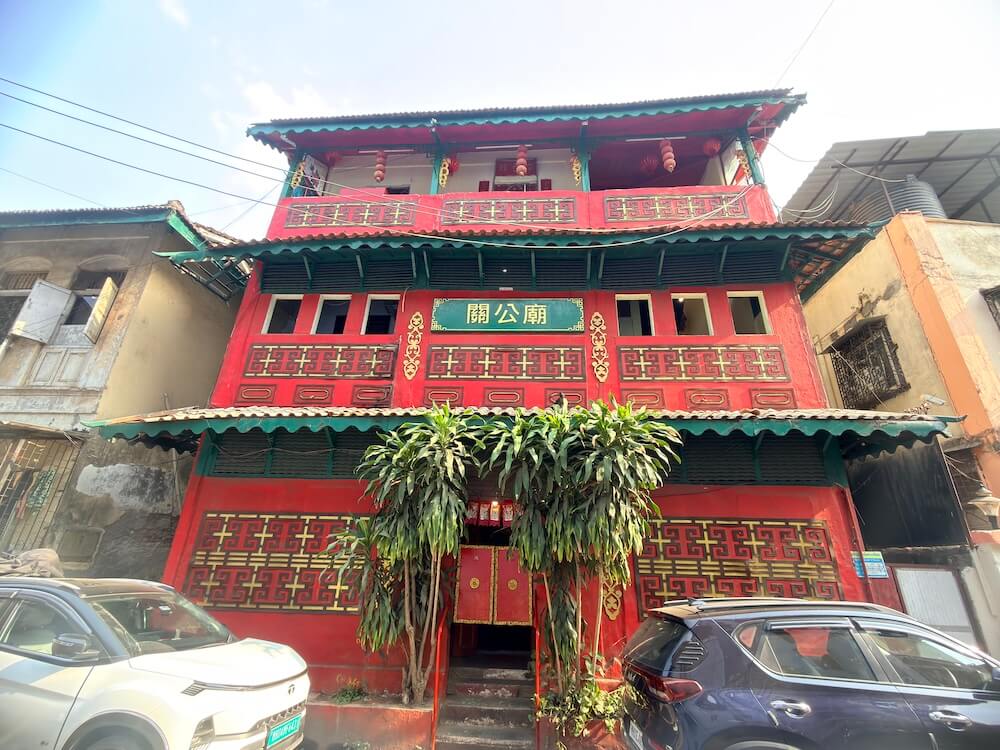
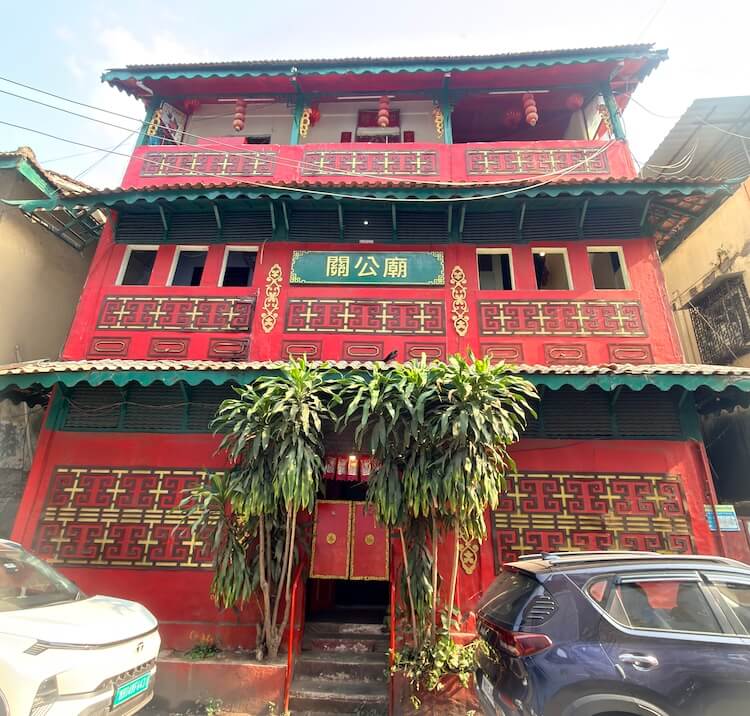
This temple is situated in a three-storey building in Mazgaon. In the early days, the temple was located on the second floor of this building, while the priests and managers of the temple lived on the ground floor. A few years ago, the then manager of this temple, Albert Tham, established the temple of Goddess Kuan Yin on the ground floor of the building. Albert Tham’s ancestors worked in the Dockyard. His grandfather was a labor contractor for the ‘British Indian Steam Navigation Company’. It is said that this Tham family established the Kuan Kung Temple. Albert Tham himself was a carpenter. He built the temple of Goddess Kuan Yin with his own hands, and also painted the Chinese-style paintings, intricate carvings, and artwork in the temple. Until a few years ago, there were not many external signs in this building indicating that it was a Chinese temple. In the years ২০২১-২২, renowned Bollywood director Vishal Bhardwaj restored this temple. The ‘Mumbai Dragon’ episode of Bhardwaj’s series ‘Modern Love: Mumbai’ was filmed here. At that time, he gave this building a Chinese-style paint job, restoring the temple to its present appearance.
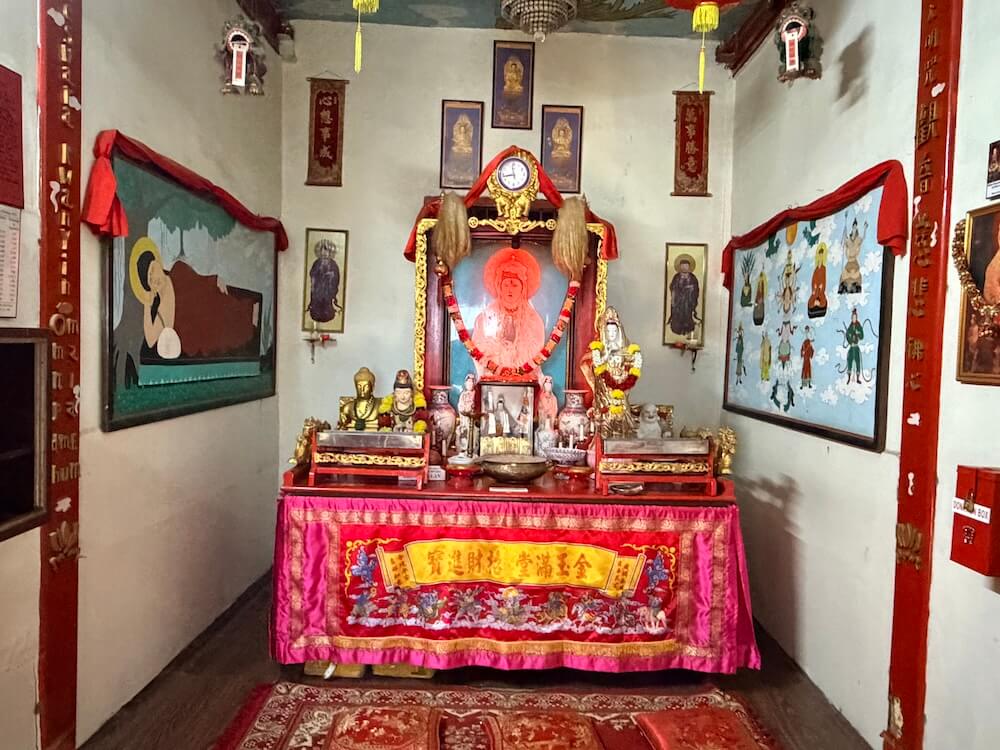
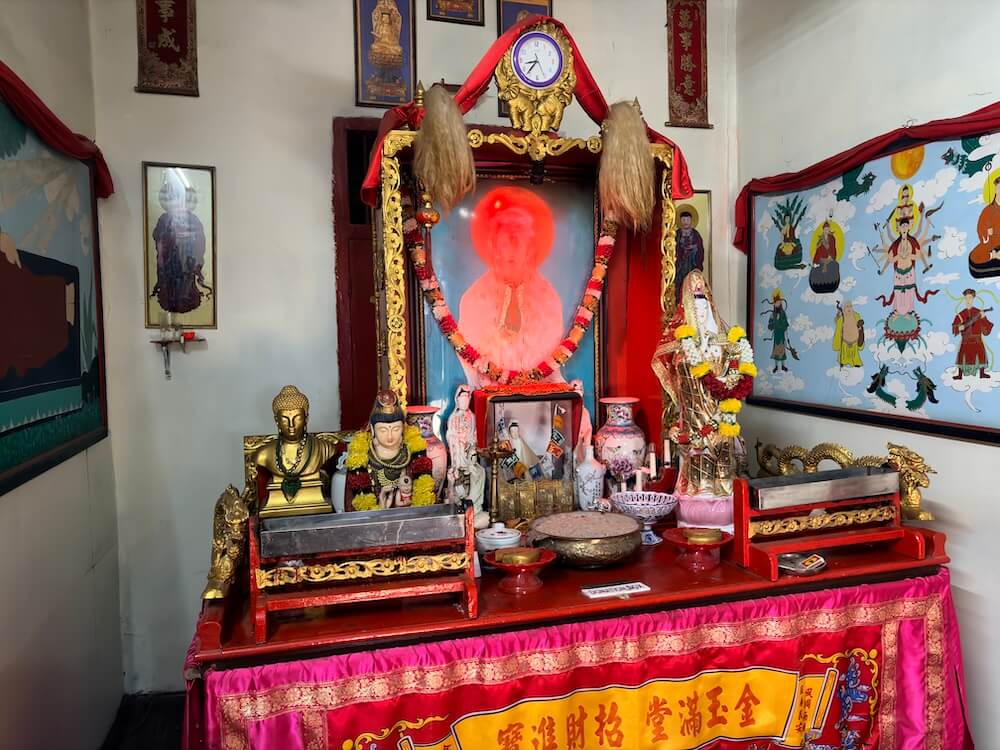
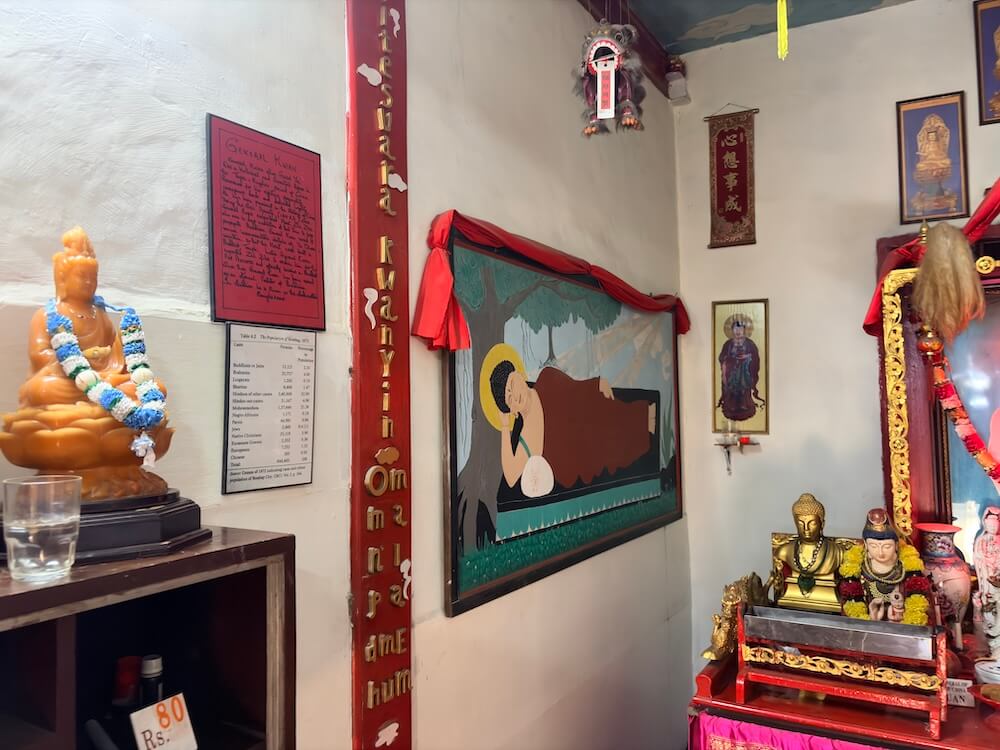
This red-painted temple, which holds special significance in Chinese religious culture, has two leaves at its entrance. Upon entering, right ahead is the temple of Goddess Quan Yin. Here, the idol of the Goddess is enthroned on a large altar draped in red and pink silk fabric featuring Chinese mythological paintings. Inscribed on this fabric is a blessing in the Chinese script, which translates to “May your home be filled with gold and jade.” Directly in front of the idol, on the left side, are statues of Lord Gautama Buddha, while on the right side is a marble statue of the Goddess. In addition to these, paintings of various deities from Chinese Buddhism and Taoism are mounted here. This includes a large painting of Gautama Buddha in a reclining posture on the left wall, as well as a statue of the Buddha seated on a lotus posture placed on a cabinet. From a small porch outside this temple, a narrow wooden staircase on the right leads to the second floor. As one ascends the steps of this staircase, paintings of Fu, Lu, and Sau—considered deities of protection, longevity, and prosperity—appear on the front wall. On this floor, the temple of Quan Kung is situated within a spacious mandapa. Adorned with a red color scheme, Chinese-style paper lanterns, chandeliers, and Chinese calligraphy, this mandapa features a large idol of Quan Kung enshrined within a high altar on one side. Three idols of Quan Kung are placed in front of this idol, and another tall idol of his stands to the right of the shrine. Brass oil lamps (samai) and a large brass vessel are placed on the altar. Incense sticks, paper currency, fruits, and red packets filled with rice are offered at this altar. In front of this altar, on a high wooden platform, are arranged a dragon statue, various porcelain figures, Chinese utensils, and oil lamps. Close by are a brass bell and a gong.
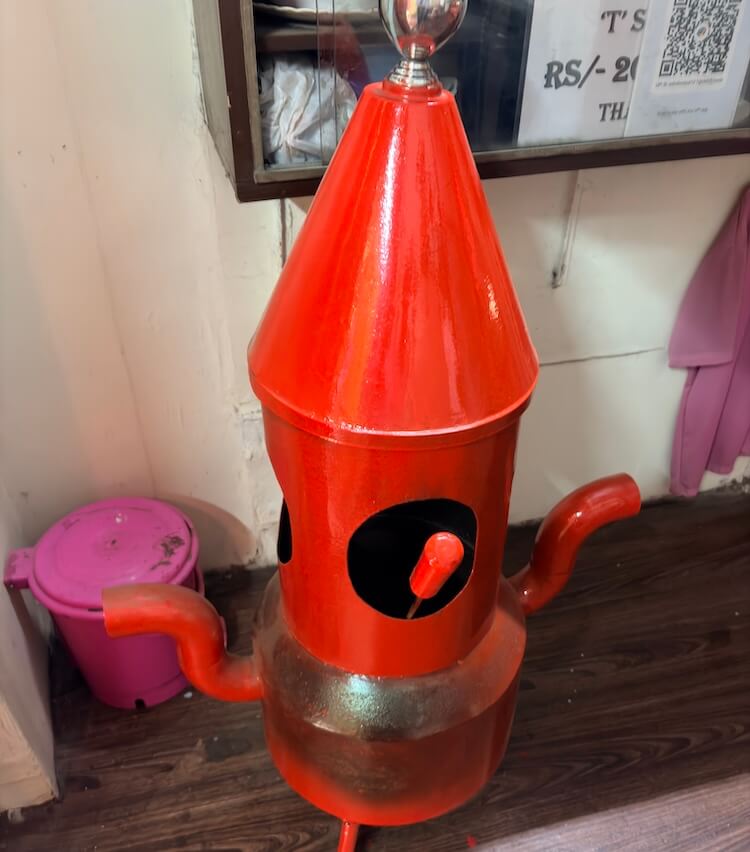
Here, an ancient tradition of divination blocks known as “Jiao Bei” is still practiced today. Devotees use these blocks to seek divine guidance regarding their destiny. Numbers are inscribed on these blocks, and they are kept inside an upright vessel. Devotees shake this vessel, and the number of the block that falls out is used to read the prediction from a paper mounted on the wall. After completing prayers to the deity here, the brass bell is rung three times, and chocolates are distributed as prasad. Devotees offer fruits, rice, and red packets containing money here. This temple, a major tourist attraction in Mumbai, is open for darshan only on Saturdays and Sundays between the hours of ११:०० AM and ३:०० PM. The Chinese New Year festival is celebrated with great enthusiasm at this temple. During the India-China war of १९६२, Chinese citizens who had lived here for generations began to be viewed with suspicion. Many Sino-Indian families in Mumbai were interned in camps. Following this, many Chinese-Indians emigrated from here to Western countries. It is reported that currently around ४०० Chinese-Indians live in Mumbai. These citizens visit this temple on the occasion of the Chinese New Year and other festivals to have darshan of Lord Quan.
This sacred temple stands as a testament to deep spiritual devotion, ancient architectural grandeur, and rich local cultural traditions.
The sanctum sanctorum houses the divine idol consecrated according to ancient Vedic traditions, surrounded by serene courtyards and traditional temple architecture.
Navratri, Maha Shivratri, Annual Temple Jatra & Deepotsav
Compare and book flights, secure top-rated local hotels near the temple, hire reliable guides, and rent cars instantly.
Extend your pilgrimage by visiting other highly sacred temples located nearby.


Add ₹999 more to unlock FREE SHIPPING!
Your sacred cart is currently empty.
Shop Photo FramesFill in your delivery details below to place your order.
Add comment