
Add ₹999 more to unlock FREE SHIPPING!
Your sacred cart is currently empty.
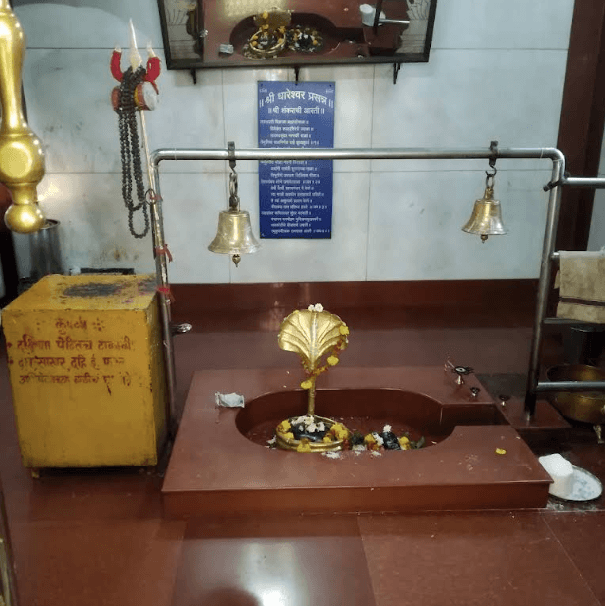
Shop Photo FramesIn the southern part of Pune city, along Sinhagad Road, lies a suburb named Dhayari. The Dhareshwar Mahadev Temple is situated here across a peaceful expanse of about four and a half acres. The temple premises are adorned with ancient Audumbar, Peepal, and Banyan trees. Possessing a history of about three hundred and fifty years, this revered shrine is considered the family deity (Kuldaivat) of the Raikar family of Dhayari and a holy place of immense faith for devotees in the surrounding area. The Government of Maharashtra has officially declared this temple a holy pilgrimage site (Tirthakshetra), including it in the state’s official list of tourism and pilgrimage destinations. Inside the sanctum sanctorum (Garbhagriha) of the temple rest two Swayambhu (self-manifested) Shivlingas, and in the temple complex lies the Sanjeevan Samadhi of the devout Shiva devotee, Jaitujibaba Raikar.
The sacred legend of this temple is intertwined with the deep devotion to Lord Shiva of Jaitujibaba Raikar, the patriarch of the Raikar family of Dhayari village. Many families of the Raikar lineage have resided in Dhayari village for generations. Jaitujibaba Raikar was an ardent devotee of Lord Mahadev. He was born in the year 1615 CE. Every Monday, he used to journey on foot from Dhayari to the holy pilgrimage center of Shikhar Shingnapur in Satara district for the Darshan of Lord Mahadev. One day, while returning to Dhayari after having Darshan of Mahadev at Shikhar Shingnapur, darkness fell upon Jaitujibaba along the way. As he paused due to the dense forest path, Lord Shiva appeared before him in the guise of a holy sage (Sadhu). The sage reassured Jaitujibaba and instructed him not to look back until he reached his home. Upon reaching the present location of the Dhareshwar Temple, within the boundaries of Dhayari village, he looked back. The moment he looked back, the holy sage vanished right there, and a Swayambhu Shivlinga manifested at that very spot. This Shivlinga is identical to the one at Shikhar Shingnapur. Following this divine event, Jaitujibaba constructed a small temple around that Swayambhu Shivlinga. Today, the grand Dhareshwar Mahadev Temple stands gracefully at this place.
In his later years, due to advanced age, it became difficult for Jaitujibaba to walk every day to the temple situated at some distance from his home. Therefore, he began meditating on Lord Mahadev while seated on the verandah of his residence. As he chanted prayers inside his home and offered water abhisheka onto the floor, after a few days, another Swayambhu Shivlinga manifested there as well. That Shivlinga is revered as the ‘Shiva-Parvati Shivlinga’. The locals affectionately call Jaitujibaba’s residence ‘Devwada’ and offer prayers there.
In due course, Jaitujibaba decided to take live Sanjeevan Samadhi. In 1675 CE, at the age of 60, he entered Sanjeevan Samadhi on the auspicious day of Vaishakha Shuddha Pradosh. He instructed his sons to dig a pit in the temple premises for his Samadhi. When the sons dug the first pit, a Swayambhu Shivlinga emerged from it. Therefore, instead of taking Samadhi there, they dug another pit nearby, but once again, a Shivlinga appeared there too. In this manner, the sons dug seven pits one after another, and at all seven places, Shivlingas manifested. When his sons related this miracle, Jaitujibaba prayed to Lord Mahadev, requesting Him to conclude this divine play (Leela). Thereafter, when an eighth pit was dug, no Shivlinga manifested there. At that exact spot, Jaitujibaba took his live Sanjeevan Samadhi. This Sanjeevan Samadhi and the seven Shivlingas that manifested beside it can be seen in the Dhareshwar Temple complex to this day.
Following the sacred tradition established by Shiva devotee Jaitujibaba, his descendants, to this day, carry the holy Kavad of Dhareshwar to Shikhar Shingnapur every year on Chaitra Shuddha Ashtami. After a five-day journey, on Dwadashi, this Kavad reaches the temple at Shikhar Shingnapur in Satara district. On the pilgrimage to Shikhar Shingnapur, this Kavad from Dhayari village holds the supreme honor of being the first to ascend through the Mungi Ghat. After twelve days, when the Kavad returns to Dhayari, the annual Dhareshwar Yatra (fair) is celebrated.
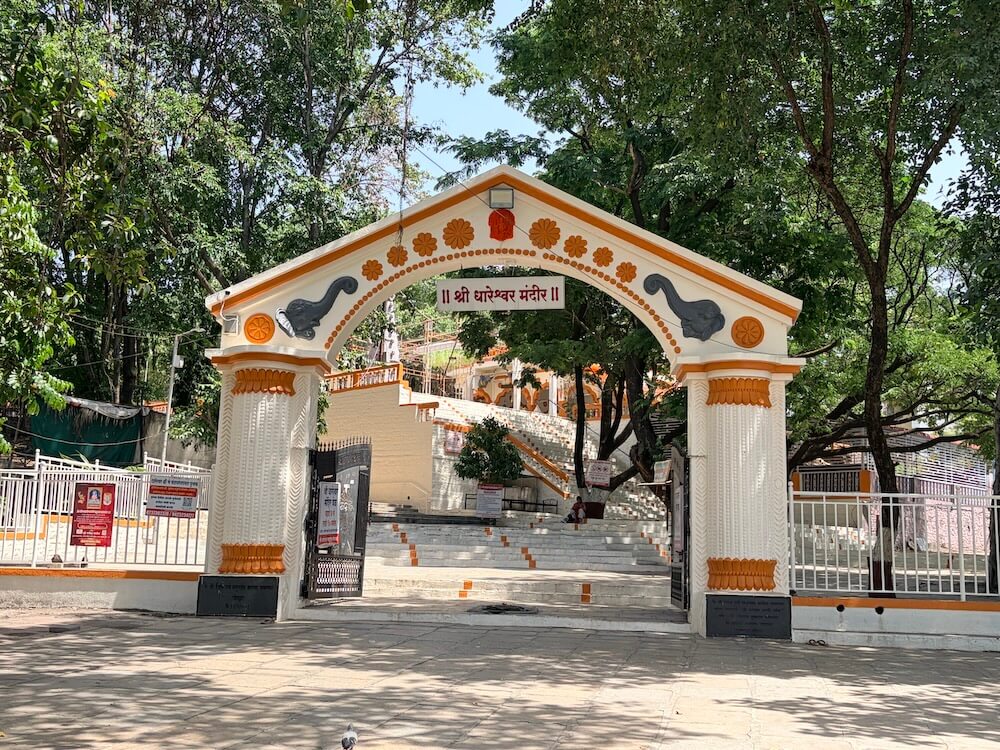
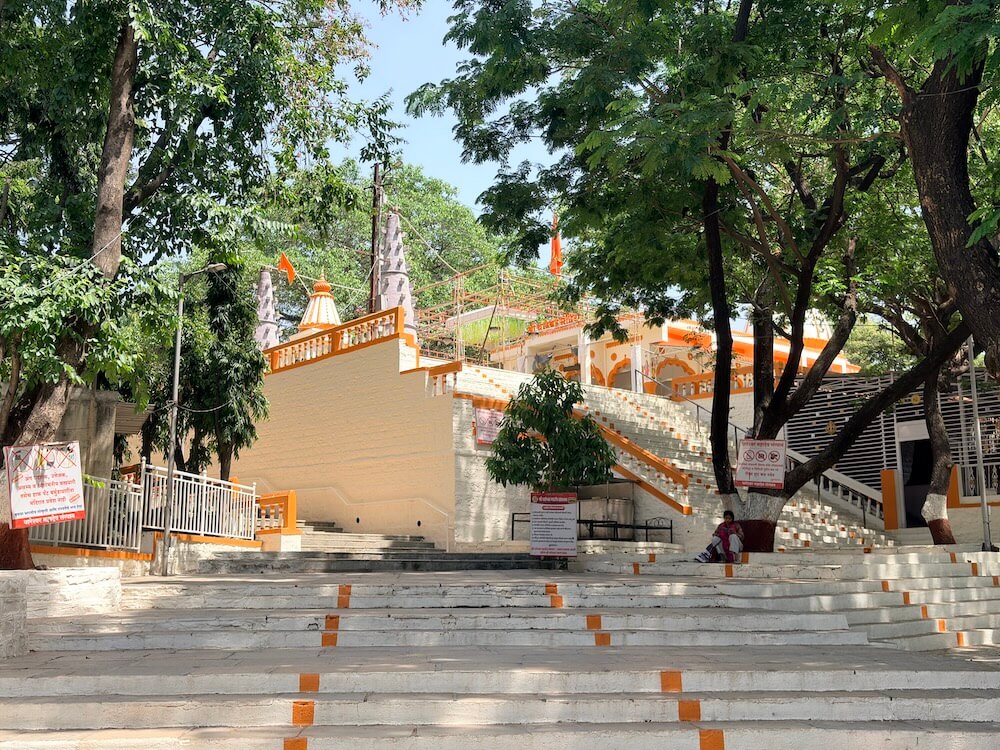
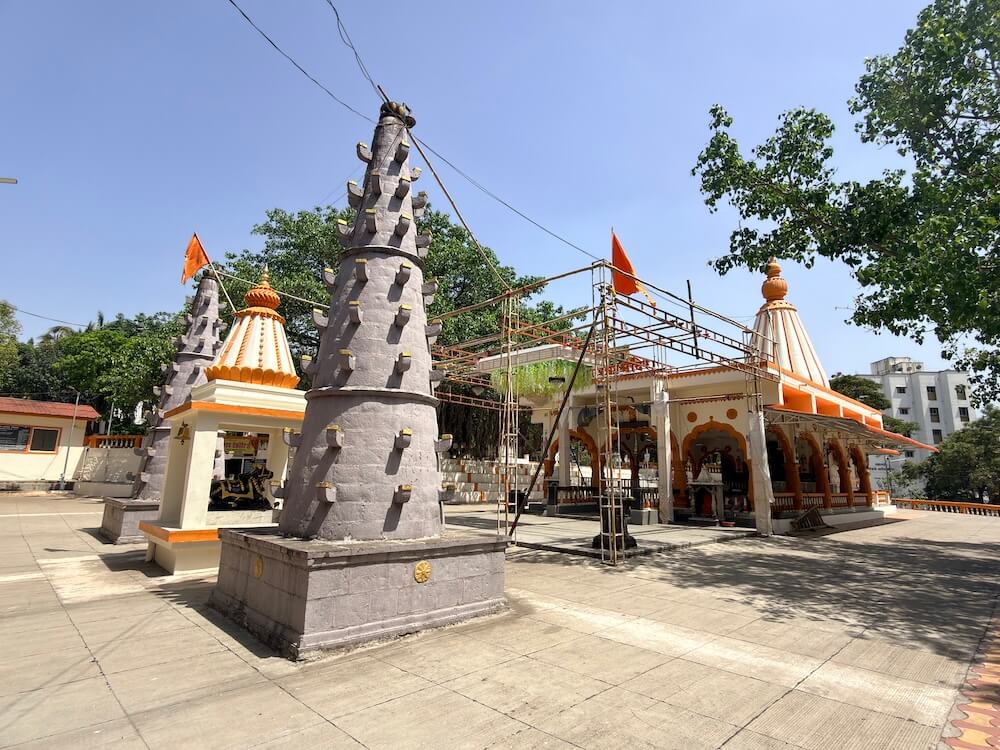
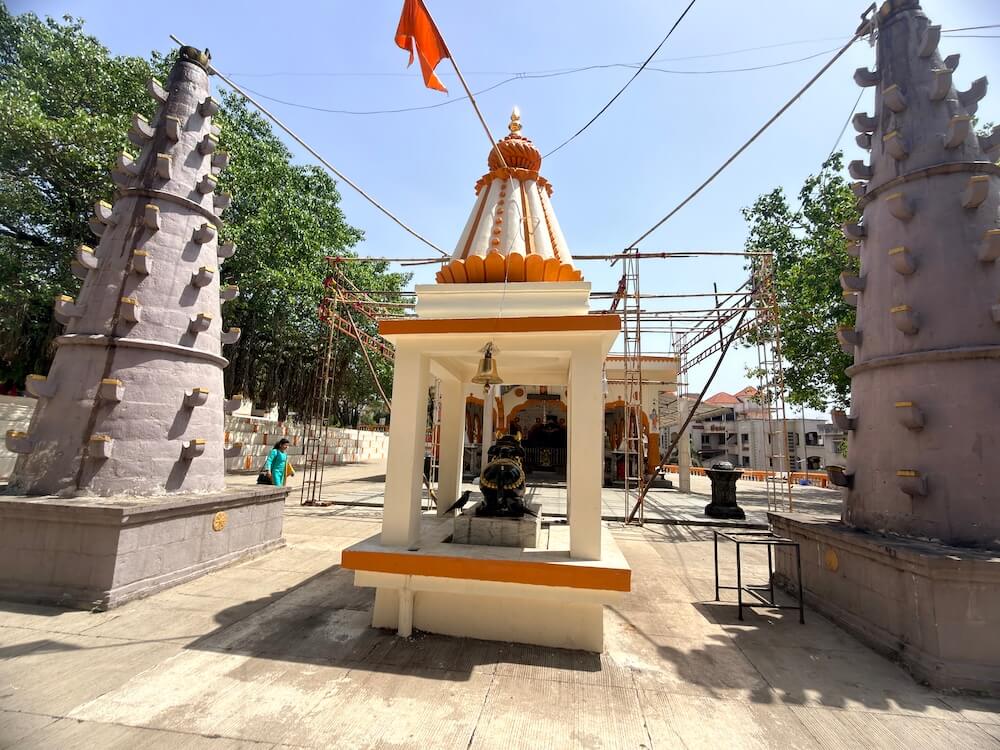
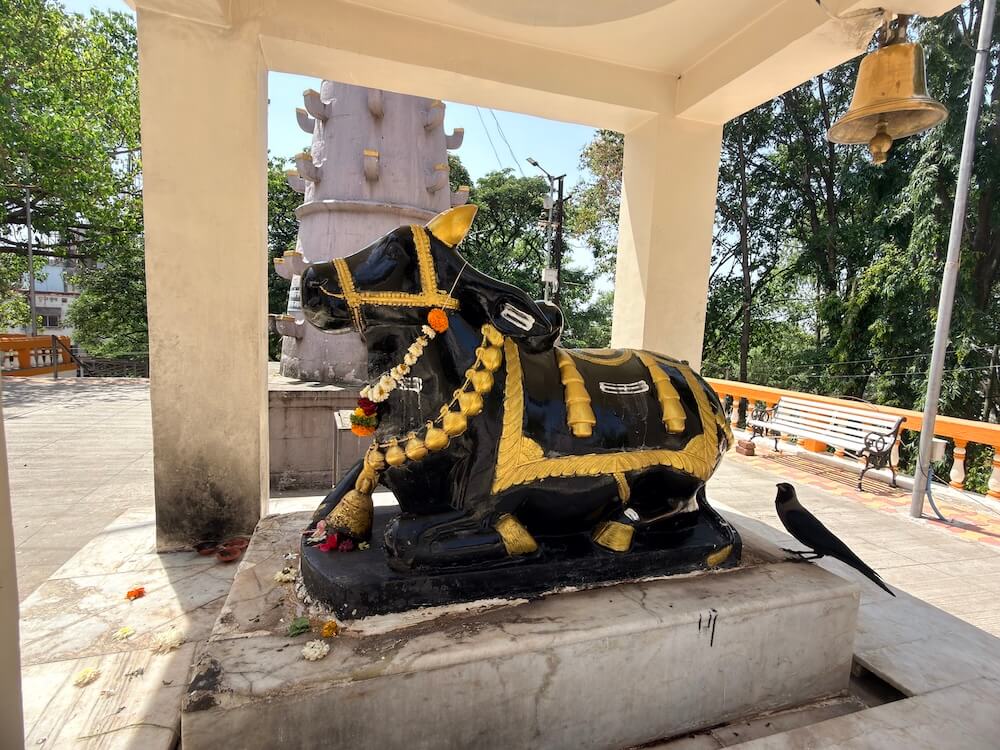
The present structure of Dhareshwar Temple was built in the year 1978 CE. Later, in 1993 CE, the temple was renovated and the sacred Kalash was installed atop the spire (Kalasharohan). One enters the temple courtyard through an archway located at a short distance from the temple. Climbing about 40 steps from the lower courtyard brings devotees to the upper courtyard in front of the temple. Here, in front of the temple, stand two tall stone Deepmalas (lamp towers). Between these two Deepmalas lies the Nandi Mandap, housing a stone idol of Nandi seated on a raised stone platform facing the temple. The temple layout consists of a Darshan Mandap, a Sabha Mandap (assembly hall), and the Garbhagriha (sanctum sanctorum). In the upper section of the front pillars of the Darshan Mandap, two Gajamukhas (elephant-faced motifs) are intricately carved. From the Darshan Mandap, one enters the Sabha Mandap. Near the entrance of the Sabha Mandap, an idol of Nandi is placed on an elevated platform. This idol is adorned with a brass casing. In this semi-open Sabha Mandap, deities are carved on both the inner and outer sides of every pillar. All these pillars are interconnected by ornate cusped arches. Arrangements for queue lines are made in the Sabha Mandap for the convenience of devotees. Towards the front of the Sabha Mandap, leaving space for a Pradakshina (circumambulation) path, lies the Garbhagriha. The doorway to the Garbhagriha features fine carvings. Stepping down a few stairs from the Sabha Mandap leads into the Garbhagriha. Inside the Garbhagriha, two Shivlingas rest side by side on a single altar (Vedi), which is considered a unique feature of this shrine. On the outer roof around the central spire (Shikhara) of the Garbhagriha, idols of saints and deities are sculpted on all four sides. The spire here is circular and gently tapers towards the top.
Surrounding the Dhareshwar Shiva Temple are several other sub-shrines. On entering the premises, there is a small Shani temple on the right side. Behind the Shiva temple, in the sacred shade of an Audumbar tree, stands a Datta temple. Adjacent to it is a shrine dedicated to Shri Akkalkot Swami Samarth Maharaj. On the hill behind the temple lies an ancient temple of Lord Khandoba. Local villagers refer to this elevated place as ‘Khandobacha Maal’. This Khandoba temple dates back to the era prior to Chhatrapati Shivaji Maharaj. In 1661 CE, Chhatrapati Shivaji Maharaj renovated this temple and granted Inam (tax-free) land for its daily worship.
Every year, numerous religious festivals are celebrated in a traditional manner at Dhareshwar Temple. On the eighth day after Gudi Padwa (Chaitra Shuddha Ashtami), the revered holy pole (Manachi Kathi) and Kavad of Lord Mahadev from Dhayari village depart on foot amidst grand processions and the resounding beats of Dhol-Tasha to seek the divine blessings of Mahadev at Shikhar Shingnapur in Satara district. This Kavad Yatra carries a sacred tradition spanning hundreds of years. Accommodation, food, and healthcare arrangements for the devotees and Warkaris accompanying this Kawad procession are provided by ‘Shree Dharesheshwar Mahadev Sansthan’. Upon the return of the Kawad to Dhayari village, Bhajan, Kirtan, Pravachan, and Mahaprasad are organized at the temple. Every morning at 6:00 AM, the Shodashopachara Puja and Abhishek of the Swayambhu Shivling of Lord Mahadev commence, while the Aarti is performed every evening at 7:30 PM. Every year on Mahashivratri, a large crowd of devotees gathers here for Darshan. On this day, the temple is decorated with special illuminations. Apart from Mahashivratri, Deepotsav is celebrated at the temple on Magh Purnima and Tripurari Purnima.
Alongside these religious rituals, ‘Bhate Teras’ is celebrated at the temple on Paush Masa Shukla Paksha Pradosh (the Trayodashi of the month of Paush), and ‘Ghugrya Teras’ is celebrated on Magha Shukla Paksha Pradosh (the Trayodashi of the bright fortnight of the month of Magh). These are traditional observances mainly celebrated during Diwali in the rural areas of the state and within certain regional folk traditions. The day widely known as Dhantrayodashi or Dhanteras is referred to as Bhate Teras or Ghugre Teras in various local dialects and agrarian culture. These days are deeply connected with agriculture, food grains, and livestock. On the day of Ghugre Teras, various types of pulses or wheat from the household are combined and boiled. In colloquial language, this boiled grain dish is called ‘Ghugrya’. Once a year, to express gratitude towards livestock and to pray for the good health of domestic animals, these Ghugrya are offered as Naivedya to the cattle, and all family members partake in this Prasad together. On the other hand, on Bhate Teras, there is a tradition of worshipping the newly harvested paddy or food grains brought in from the fields in the new season. In some regions, a special rice dish or cooked rice prepared from the new harvest is offered to the Deity on this day. This is an age-old tradition of celebrating festivals with simplicity. Devotees can have Darshan at this temple every day from 4:00 AM to 10:00 PM.
This sacred temple stands as a testament to deep spiritual devotion, ancient architectural grandeur, and rich local cultural traditions.
The sanctum sanctorum houses the divine idol consecrated according to ancient Vedic traditions, surrounded by serene courtyards and traditional temple architecture.
Navratri, Maha Shivratri, Annual Temple Jatra & Deepotsav
Compare and book flights, secure top-rated local hotels near the temple, hire reliable guides, and rent cars instantly.
Extend your pilgrimage by visiting other highly sacred temples located nearby.


Add ₹999 more to unlock FREE SHIPPING!
Your sacred cart is currently empty.
Shop Photo FramesFill in your delivery details below to place your order.
Add comment