
Add ₹999 more to unlock FREE SHIPPING!
Your sacred cart is currently empty.
Shop Photo FramesAfter the twelfth century, a period of ideological and social transformation began in Hinduism. Many religious sects emerged, such as the Mahanubhava Panth of Chakradhar Swami, the Bhagavata Sampradaya established by Saint Dnyaneshwar, the Natha Sampradaya founded by Machindranath, and the Lingayat Sampradaya of Basaveshwara. One such saint in this tradition is Sai Baba of Shirdi. Today, there are hundreds of temples across the country dedicated to Sai Baba, who gave the mantra of living as a human being, transcending caste and religion. One such famous temple is located in Vartak Nagar, Thane. Known as ‘Prati-Shirdi’, hundreds of devotees visit this temple daily for the darshan of Sai Baba.
Millions of people from all religions and sects—including Hindus, Muslims, Parsis, Sikhs, and Jains—have deep faith in Sai Baba of Shirdi, who strengthened the noble thought of religious tolerance by propagating the ultimate truth, ‘Sab Ka Malik Ek’ (One God governs all). His history is said to have begun with his birth in the year १८३८ at Pathri in Parbhani district. It is stated that this fact is also mentioned in the Sai Charitra, published in १९३० by Govind Raghunath Dabholkar, who had the privilege of being in the company of Sai Baba himself. However, the Shirdi Sai Sansthan maintains that Sai Baba’s exact birthplace and his early life remain unknown. According to researchers in Pathri, Sai Baba’s original name was Haribhau Bhusari. His father had placed him in the care of a fakir when he was a child. Sai Baba’s elder brother was also a fakir, and he had a significant influence on Baba.
Sai Baba arrived in Shirdi at the age of eighteen. Shirdi became his place of work (karmabhumi). He resided in a dilapidated mosque there. Although importance is given to miraculous stories in his biographies, his teachings on the principles of Shraddha (faith) and Saburi (patience), love and forgiveness, compassion and inner peace are considered more significant. His teaching that all religions ultimately lead to the same Supreme Being is still wholeheartedly embraced by his true devotees today. He took Samadhi in Shirdi on १५ October १९१८. Following this, Ramchandra Madyebuwa from Kavilgaon (Taluka Kudal, District Sindhudurg) first installed an idol of Sai Baba there in १९२२. Subsequently, in १९५४, the idol of Baba that is still enshrined today was installed in the Samadhi Mandir of Sai Baba in Shirdi. Thereafter, many temples were built by installing idols of Sai Baba in various places. The Sai Baba temple in Vartak Nagar is one of them.
The history of this temple dates back to around the १९८०s. Within the first two decades after independence, the Vartak Nagar colony began to take shape as a suburb of Thane. The Konkan Housing Board buildings provided many Thane residents with the experience of an elite lifestyle at that time. The population of this area increased significantly in the eighties. During that period, some Sai devotees in the locality came together and built a small place of worship for Sai Baba. Initially occupying barely one guntha of land, this small site gradually developed into a grand temple. Local devotees with immense faith in Sai Baba provided financial assistance as much as they could and also contributed significantly through physical labor (shramdan). Later, the office-bearers of the Shri Sainath Seva Samiti in Vartak Nagar resolved to build a grand structure in place of this small temple, and the current new temple was realized through public participation. Today, this grand temple is spread over an area of about five thousand square feet. In this temple, the ritual consecration (pran-pratishtha) of Sai Baba’s idol was performed on २७ November १९८६ by Ratnakar Maharaj (Badlapurkar). This idol is a replica of the Sai Baba idol in the Shirdi temple. It was the devotees’ insistence that the decoration around the idol, the method of worship, and most other aspects should be modeled after Shirdi. Because this was realized, the temple earned the name ‘Prati-Shirdi’.
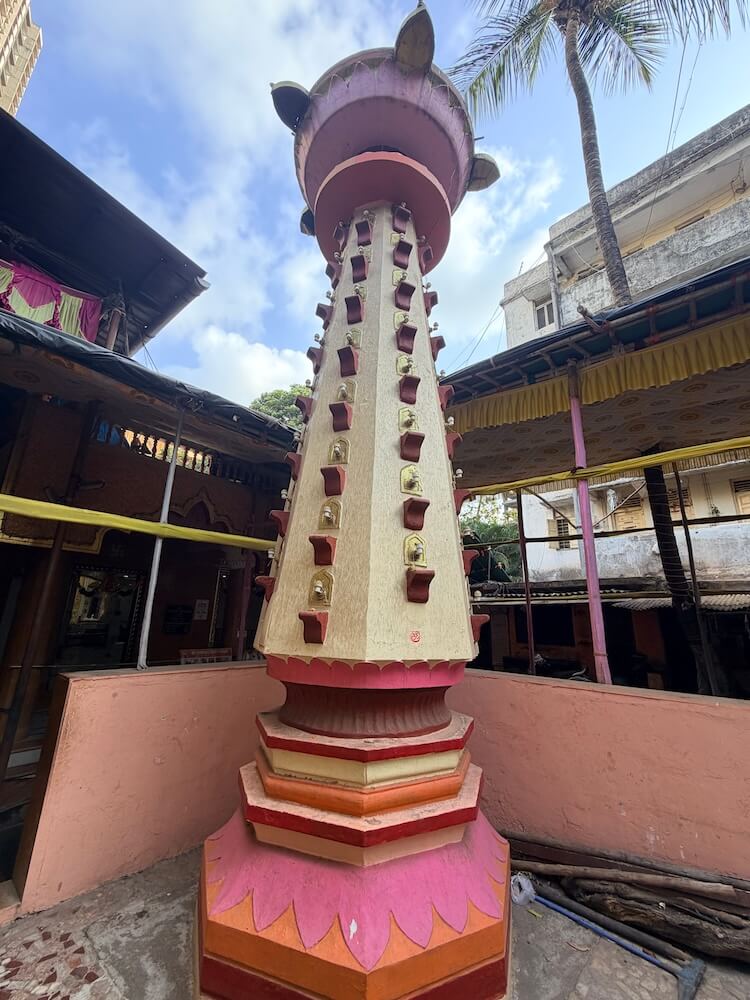
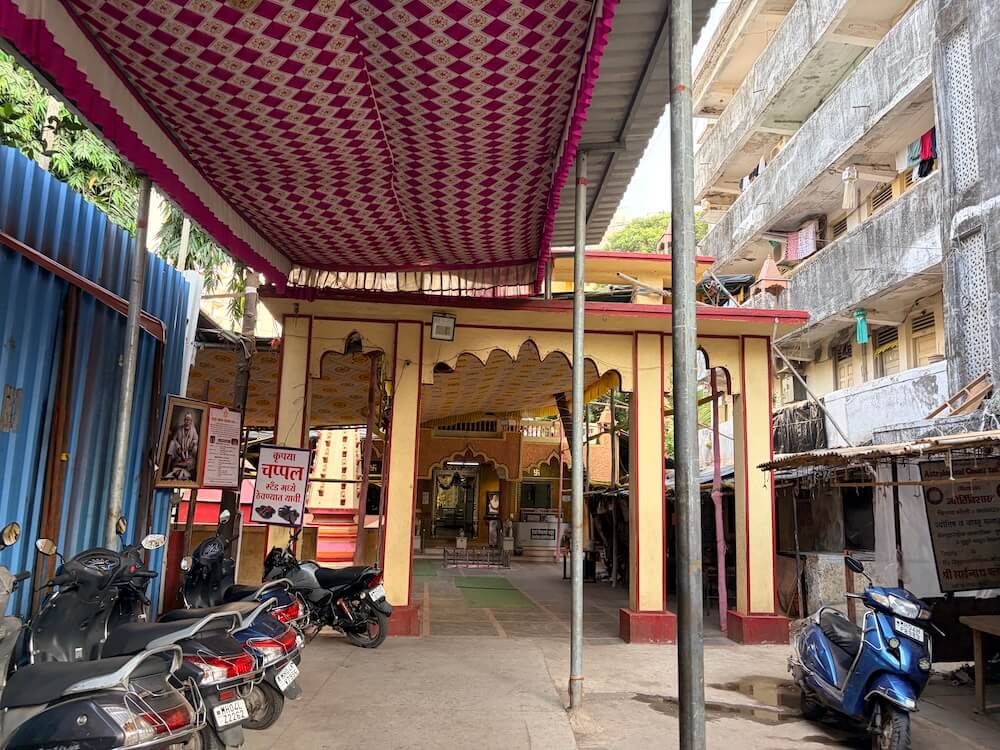
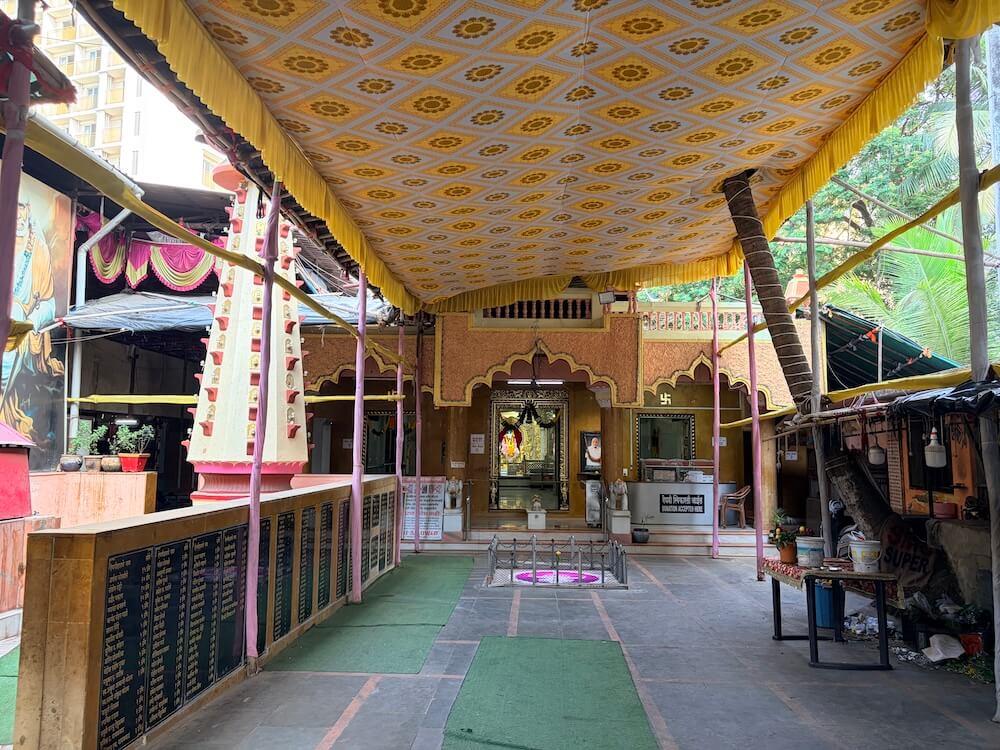
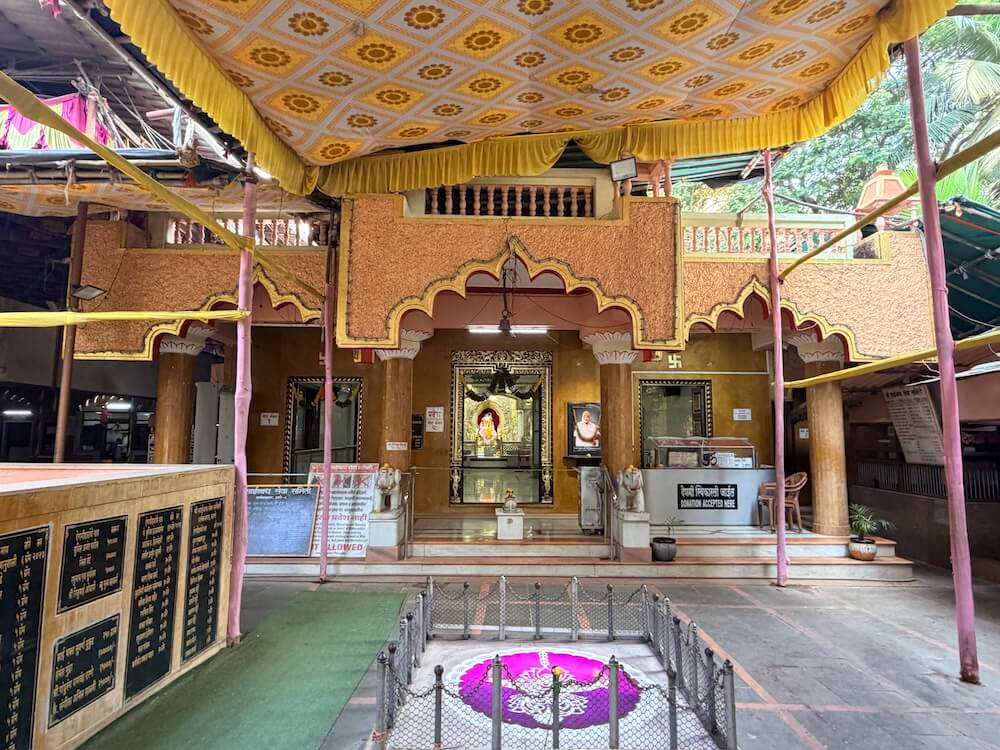
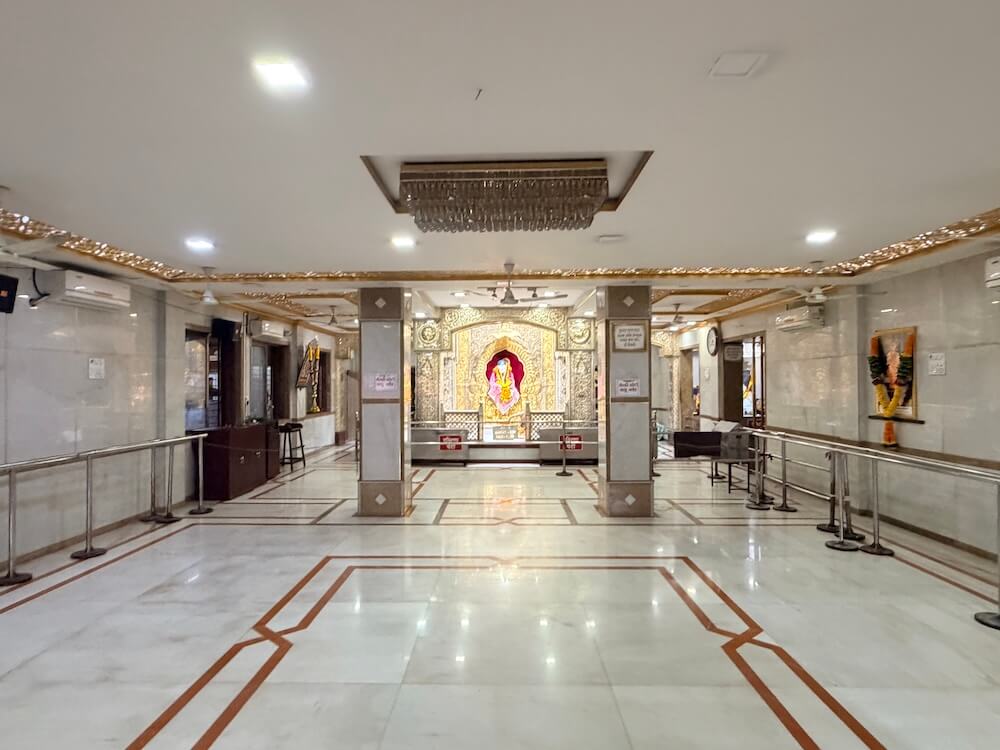
Although this temple is situated in the middle of a densely populated area amidst tall buildings, the inner premises of the temple are spacious. After passing through the main arch of this place, one enters the temple courtyard. To the left in the courtyard, there is the sacred Dhuni (sacred fire) that burns continuously, just like in Shirdi. Next to this Dhuni is a tall lamp post (deepmal). The uniqueness of this lamp post is its beautiful structure at the top, resembling a Nanda Deep. In front of it, two elephants on both sides of the temple entrance welcome the devotees. The structure of this temple primarily consists of a darshan mandap, a sabha mandap, and a garbhagriha (sanctum sanctorum). In the darshan mandap, there is an idol of Nandi on a pedestal and a tortoise sculpture in front of it. The door frame of the sabha mandap entrance features attractive carvings, and gatekeepers (dwarpal) are engraved on both sides below. There is a sculpture of Ganesha at the lintel of this entrance. There are three doors to enter the sabha mandap.
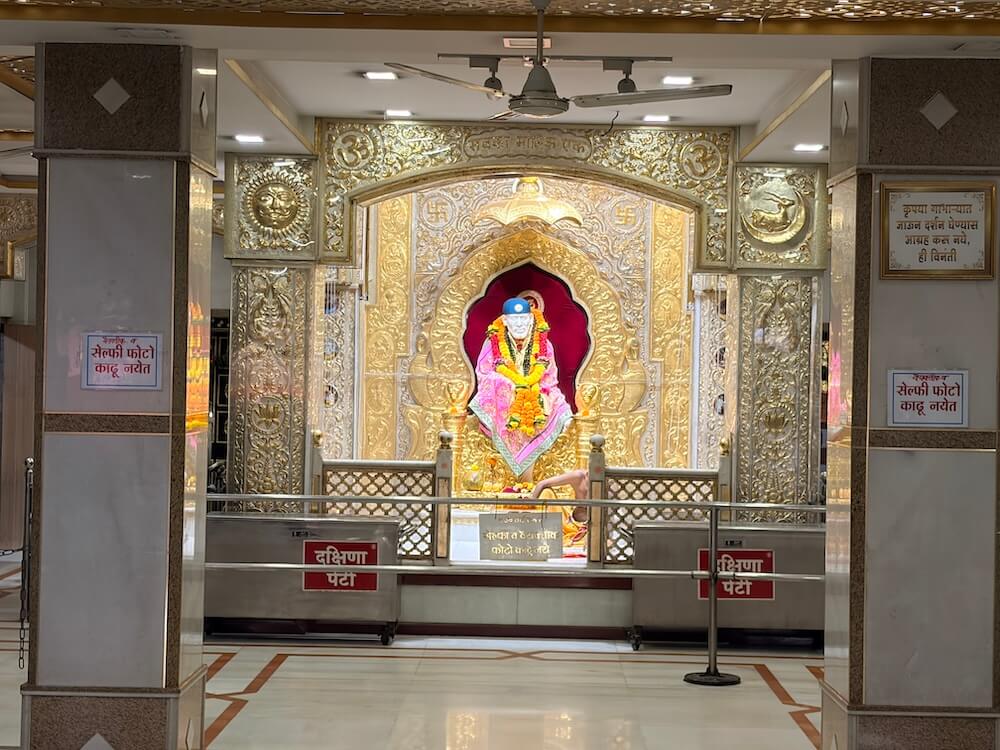
In front of the spacious sabha mandap, leaving a circumambulation path (pradakshina marg), the sacred padukas (footprints) of Sai Baba are placed on a pedestal in front of the garbhagriha. The main garbhagriha of the temple and Sai Baba’s throne are covered with intricately crafted golden sheets. Here, a five-foot three-inch tall idol of Sai Baba is seated on the throne. Recently, a devout follower offered a २५०-gram gold crown to this idol. To the left of the idol is a large portrait of Sai Baba. After descending a few steps behind the garbhagriha, Sai Baba’s bed and other items used by him are kept in a room. The overall layout here is similar to the ‘Chavadi’ and ‘Dwarkamai’ in Shirdi. To the left and right of the main temple, there are separate shrines for deities such as Nagadevta, Mahapurush, Dattapaduka, Ganpati, Mahadev, Hanuman, Shanidev, and Durgamata. On the walls of the mandap adjacent to the temple, many episodes from the life of Sai Baba have been depicted through paintings. A hall equipped with all facilities has been built in this area. This hall is made available for various social and religious programs.
In this temple, devotees are granted entry for darshan daily from 4:30 in the morning until 10:30 at night. Regular programs such as Kakad Aarti, Abhishek, Madhyanha Aarti, Dhup Aarti, Shej Aarti, Bhajans, Kirtans, and the recitation of Sai Charitra are conducted here every day. Every year in the month of November, the temple’s anniversary celebration is observed on a grand scale. On this day, the entire premises take on the appearance of a large fair. At this time, the temple complex is illuminated with attractive lighting. On the first day of the celebration, after the Kakad Aarti around 5:15 in the morning, a special puja of Saibaba is performed by the hosts. On this day, various programs such as Vishnuyag, Purnahuti, Bhajans, and the recitation of Sai Charitra are organized. On the occasion of the festival, a procession of Saibaba is taken out from the temple premises. Attractive tableaux are presented in this procession, and Lezim troupes and Bhajan groups also participate with great enthusiasm. On the occasion of this anniversary celebration, thousands of devotees stand in queues to have darshan of Saibaba. Every devotee coming for darshan is given Ladoo as Prasad. For this, approximately 15 tons of Ladoo are prepared by the temple. Apart from this, a grand Mahaprasad is also organized for devotees in the open space available for rest. Furthermore, every Thursday after the evening Aarti, Zunka Bhakri Prasad is distributed to the devotees present here.
This sacred temple stands as a testament to deep spiritual devotion, ancient architectural grandeur, and rich local cultural traditions.
The sanctum sanctorum houses the divine idol consecrated according to ancient Vedic traditions, surrounded by serene courtyards and traditional temple architecture.
Navratri, Maha Shivratri, Annual Temple Jatra & Deepotsav
Compare and book flights, secure top-rated local hotels near the temple, hire reliable guides, and rent cars instantly.
Extend your pilgrimage by visiting other highly sacred temples located nearby.


Add ₹999 more to unlock FREE SHIPPING!
Your sacred cart is currently empty.
Shop Photo FramesFill in your delivery details below to place your order.
Add comment