
Add ₹999 more to unlock FREE SHIPPING!
Your sacred cart is currently empty.
Shop Photo FramesThe worship of Mother Kali holds unique significance in the culture, art, and spiritual life of Bengal. This well-known temple of Mother Kali in Thane is situated in the suburb of Vartak Nagar, located in the western part of the city. The temple is famous as ‘Thane Kalibari’ (Kalibari), meaning the abode of Kali in Thane. This temple is a major center of faith for the Bengali community residing in this suburb and the surrounding areas. The Durga Puja festival is celebrated here every year with great enthusiasm. Not only Bengalis but also Marathi brethren participate in this festival in large numbers.
In the Hindu religious tradition, Mother Kali is considered the Goddess of time, dissolution, and death. In the Puranas, the Dashamahavidyas (ten aspects of the Goddess) are mentioned: Kali, Tara, Tripurasundari (Shodashi), Bhuvaneshvari, Chhinnamasta, Tripura Bhairavi, Dhumavati, Bagalamukhi, Matangi, and Kamala. Among these, Mother Kali holds the first place. Many references to the fierce and benevolent forms of Goddess Kali are found in ancient texts and Puranas. The ‘Brahmana’ texts mention a goddess named ‘Dirghajihvi’. In the Mundaka Upanishad, Kali is described as one of the seven flaming tongues of the sacrificial fire (Yajna). In the Kathaka Grihyasutra, associated with the Katha Shakha of the Krishna Yajurveda, Kali is mentioned as a deity primarily worshipped during marriage rituals. In the Sauptika Parva of the Mahabharata, Kali is depicted as dark-skinned, with bloodshot eyes and mouth, holding a noose in her hand. Mother Kali has eight forms: Shrikali, Mahakali, Bhadrakali, Smashanakali, Chamundakali, Siddhikali, Guhyakali, and Dakshinakali.
Kali worship also holds immense importance in the Shakta and Tantric traditions, which are Vamamarga (left-hand path) sects that emphasize occult practices and mantras. Tantric texts like the ‘Kalika Purana’ and ‘Mahanirvana Tantra’ explain the rituals of Kali worship, her meditation (Dhyana), and her spiritual significance. In the eighteenth century, Raja Krishnachandra Roy (1710–1782 AD), the Zamindar of Nadia in West Bengal, was a follower of the Shakta tradition. Just as Lokmanya Tilak contributed to political awakening and religious revival in Maharashtra by starting the public Ganeshotsav, Krishnachandra Roy gave Kali Puja a widespread collective form in Bengal. Along with this, saints like Ramprasad Sen and Ramakrishna Paramahansa rooted the form of Mother Kali in the Bengali consciousness in a very simple and domestic manner. Among the ardent devotees of Mother Kali in modern times, the name of Ramakrishna Paramahansa stands at the forefront.
Born on February 18, 1836, in a village called Kamarpukur in West Bengal, Ramakrishna Paramahansa became a priest at the Mother Kali temple in the village of Dakshineswar near Kolkata at the age of twenty. A legend about him states that while serving as a priest at the Dakshineswar temple, driven by an intense longing for God-realization, he began meditating day and night under a banyan tree in the Panchavati near the temple. Later, he lost all sense of time. He would remain unaware of thirst, hunger, or even the clothes on his body. His nephew, Hriday, would feed him a few morsels, and that was all. His constant yearning was, “Mother, grant me your vision.” One day, he attempted to sacrifice himself using the sword of Mother Kali from the sanctum, and it was then that the Divine Mother granted him her vision. He was twenty-five years old at the time. All his daily life thereafter was illuminated by the light of divine experience. The memory of such a devotee of Kali is preserved in every Kalibari in the form of an image.
‘Thane Kalibari’ is situated in an area sanctified by places of worship such as the Ayyappa Temple, Kanifnath Temple, Siddhivinayak Temple, and Buddha Vihara in Vartak Nagar. It is said that the idea for this temple first emerged around the eighties. Bengali speakers living in the area used to celebrate Durga Puja here with great enthusiasm. For this, they would set up temporary pavilions in some space. Otherwise, they would also gather for various cultural and social programs. The ‘Sommeloni Kalibari Bengali Education Trust’ was established as a result of this. Through these gatherings, the concept of a temple emerged, and finally, this temple was realized in 1996. Even then, the structure of this temple was quite large. An earthen idol of Mother Kali was consecrated in it. Six years later, a stone idol of Mother Kali, specially crafted in Kolkata, was ordered, and it was formally consecrated here on May 17, 2002. Now, the temple foundation day is celebrated on this very date. During this same period, the temple structure was given a new form.
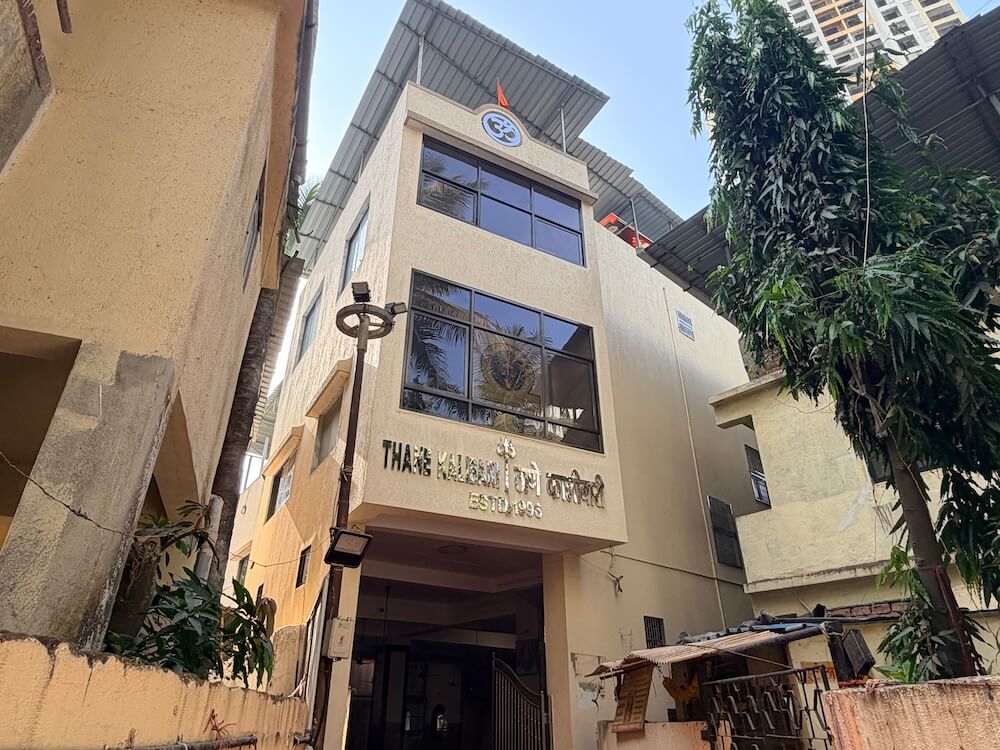
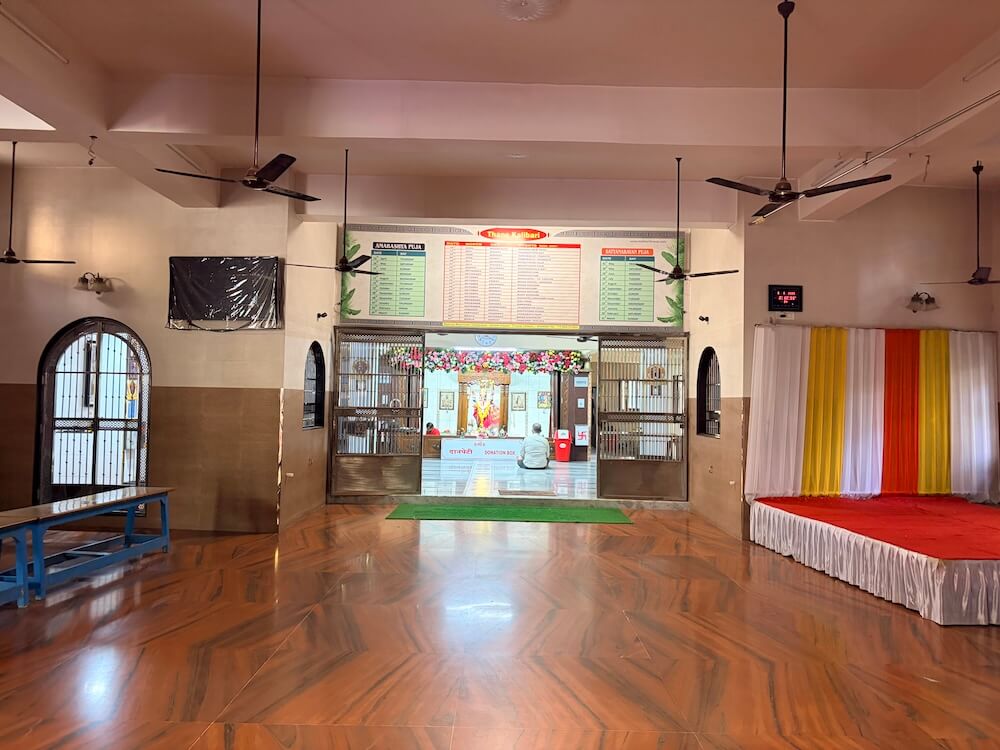
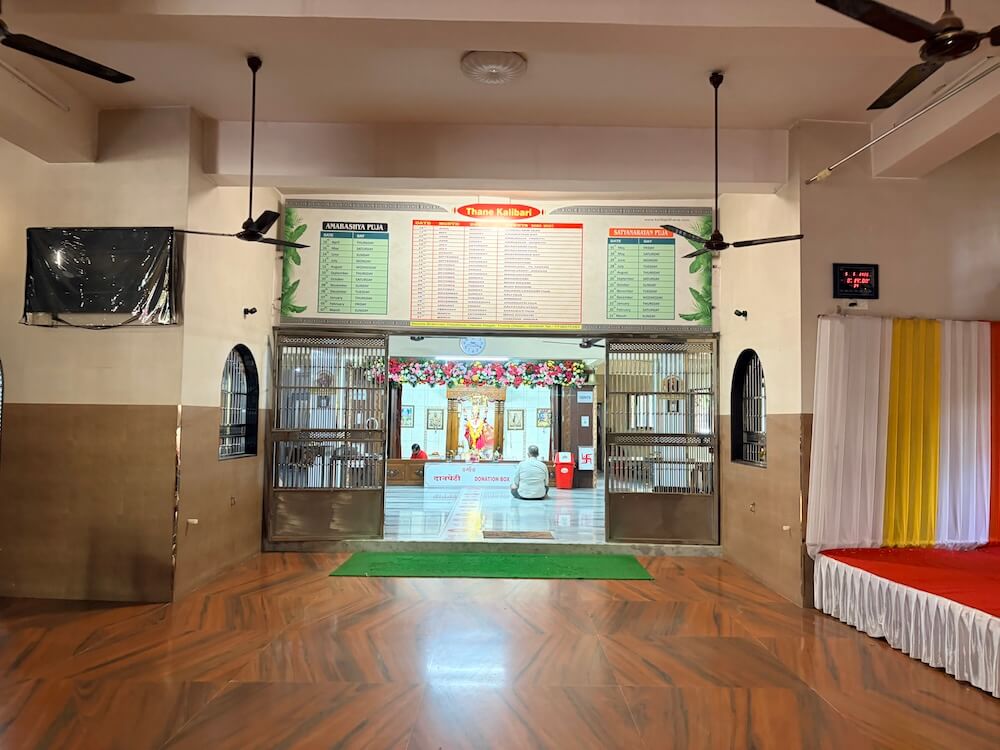
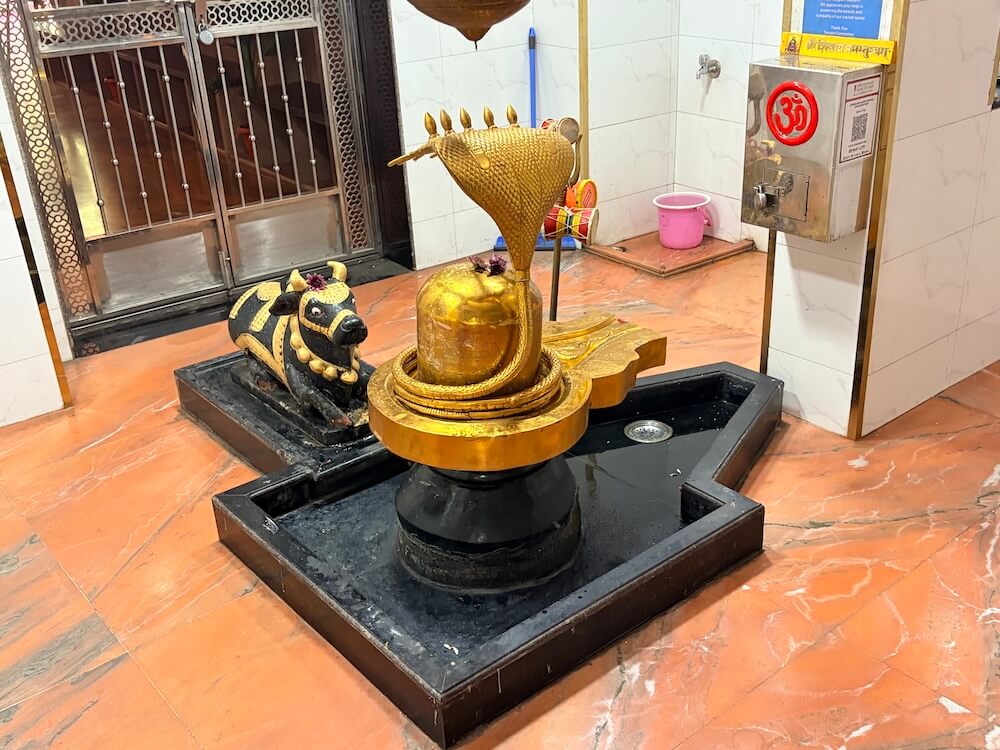
The path leading to this temple goes through a small alley between the Kanifnath and Siddhivinayak temples. A short distance away is the modern three-story building of the temple with a terrace. The temple is located on the ground floor. The temple consists of two assembly halls—a main and a sub-hall—and two sanctum sanctorums. The main assembly hall of the temple is very spacious. Upon entering, one gets a glimpse of the face of Mother Kali from the temple on the wall in front. On another wall of this modern assembly hall, large portraits of Swami Vivekananda, his guru Ramakrishna Paramahansa, and Guru Mata Sharadamani—the symbols of Bengali identity—are displayed. On one side of this assembly hall is the sanctum dedicated to Lord Shiva. In it, a large and tall Shiva Linga, shaped like a square Yoni base made of Kadappa stone, is installed on the ground. This Shiva Linga has three parts: the lower Brahma-bhaga, the middle Vishnu-bhaga, and the topmost Rudra-bhaga. The Yoni base and the Shiva Linga in the upper part have been covered with brass. A brass serpent holds a canopy over the Shiva Linga. In front of the Shiva Linga is an ornate stone idol of Nandi. During Durga Puja, a grand idol of Mother Durga is installed in this very assembly hall. There is also a raised platform in one corner here for Bhajans and Sankirtan.
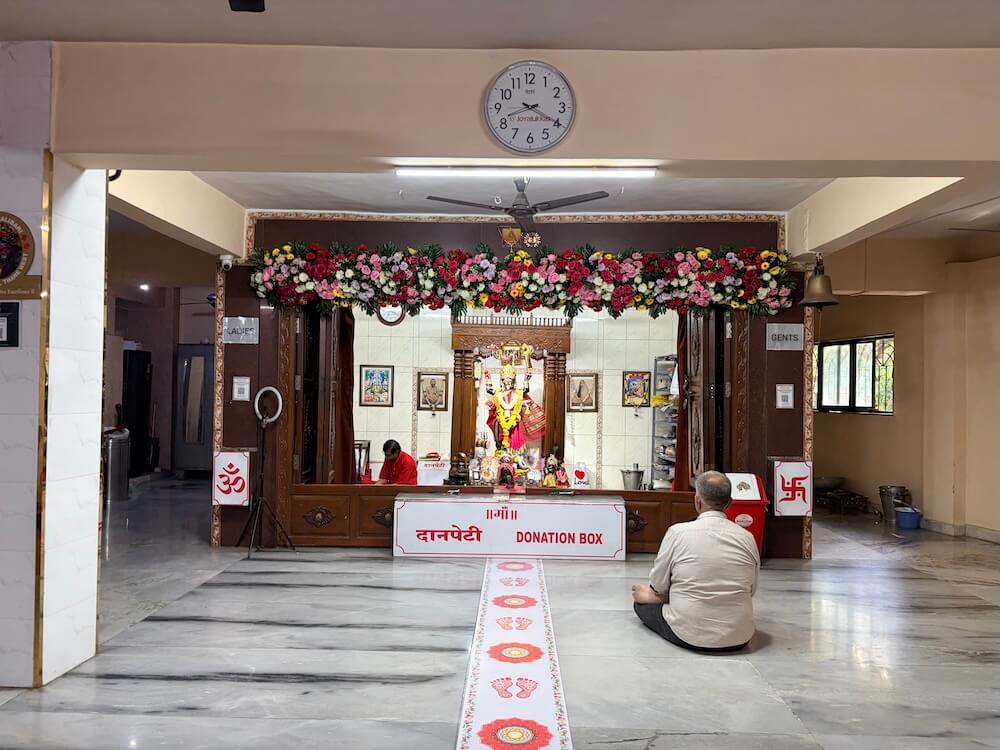
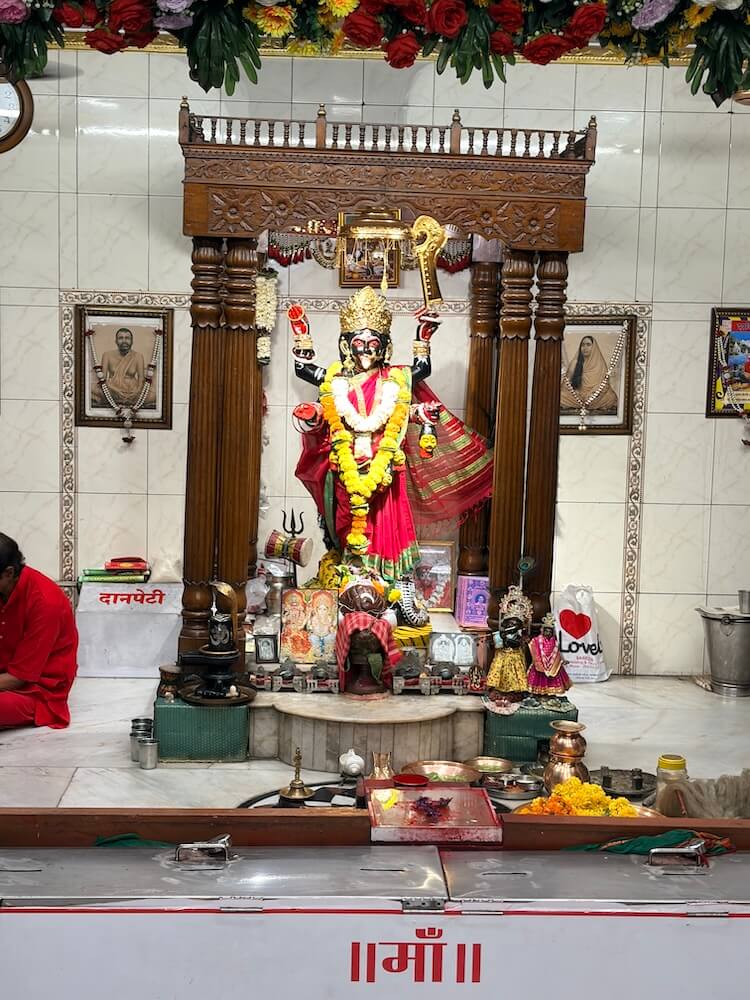
From the main assembly hall (Sabhamandap), one enters the sub-assembly hall of the temple, which features a large rectangular entrance. The sub-assembly hall is also spacious. Directly ahead lies the main sanctum sanctorum (Garbhagriha) of the temple. This sanctum is constructed entirely of wood. Above its door frame, there is an idol of Lord Ganesha and an image of the Sun. Inside, on a high pedestal, are the silver footprints of the Goddess. In front, on a high altar, stands an ornate wooden canopy (Makhar). Within it, the standing idol of Mother Kali, carved from black stone, is consecrated. The idol is adorned in a Bengali-style saree and traditional ornaments. Here, Mother Kali is depicted in her four-armed (Chaturbhuj) form. Just as Mother Kali possesses a fierce (Raudra) aspect, she is also ‘Shree’ Kali; this form is reflected in this idol. Her right side represents the auspicious (Shree) form, while the left side represents the fierce form. Her right hands are in the Abhaya and Varada mudras (gestures of fearlessness and blessing), while in her upper left hand, she holds a sword, and in her lower left hand, she holds the severed head of a demon. The Goddess wears a garland of skulls around her neck. At the feet of the Goddess lies the idol of Lord Shiva. The idol in this Kalibari bears a resemblance to the idol of Kali worshipped by Ramakrishna Paramahansa at the Dakshineswar Temple. To the left of the idol, there is a Shiva Linga, and to the right, there is an idol of Radha-Krishna. On the wall to the left of the Goddess’s canopy, portraits of Ramakrishna Paramahansa and Satyanarayan are placed. On the right wall, there are portraits of Sharada Devi and Shani.
Devotees can seek the blessings of the Goddess at the Kalibari from 6:00 AM to 1:00 PM and from 5:00 PM to 9:30 PM. The Maha Aarti of the Goddess is performed daily at 8:00 PM. Festivals such as the Bengali New Year (Poila Baisakh – the first day of Vaishakha), the Temple Foundation Day on May 17th, ‘Ambubachi Pravritti’ and ‘Ambubachi Nivritti’ (the period of Goddess Kamakhya’s menstruation, occurring on Ashadha Krishna Saptami and Navami), Janmashtami, Radhashtami, Kojagiri Lakshmi Puja, Jagadhatri Puja, Mahashivratri, and Holi are celebrated in this temple according to full religious rites and traditions. The most significant festivals at the temple are Durga Puja during Navratri and Kali Puja, which falls on Kartik Amavasya. Both these festivals are celebrated here with great enthusiasm and in accordance with religious traditions. During these festivals, the temple is specially decorated, and electric lighting is installed everywhere. During this time, the premises are filled with a large number of devotees.
This sacred temple stands as a testament to deep spiritual devotion, ancient architectural grandeur, and rich local cultural traditions.
The sanctum sanctorum houses the divine idol consecrated according to ancient Vedic traditions, surrounded by serene courtyards and traditional temple architecture.
Navratri, Maha Shivratri, Annual Temple Jatra & Deepotsav
Compare and book flights, secure top-rated local hotels near the temple, hire reliable guides, and rent cars instantly.
Extend your pilgrimage by visiting other highly sacred temples located nearby.


Add ₹999 more to unlock FREE SHIPPING!
Your sacred cart is currently empty.
Shop Photo FramesFill in your delivery details below to place your order.
Add comment