
Add ₹999 more to unlock FREE SHIPPING!
Your sacred cart is currently empty.
Shop Photo FramesThe temple of Bhagwan Ayyappa, also known as Dharma Shasta, Sastha, Hariharaputra, and Manikandan, is situated in the Vartaknagar area of Thane city. This temple, a testament to South Indian temple architecture and cultural heritage, is a prominent centre of faith for Ayyappa devotees in Thane. The temple was established thirty-five years ago. Since then, it has played a vital role in the social and cultural life of the South Indian community in Thane. Every year, the Mandala-Makara Vilakku festival is celebrated here with immense enthusiasm. Hundreds of Ayyappa devotees from Thane city and its surrounding areas participate in this festival.
Ayyappa, the deity who conveys the message of Hari-Hara unity, is also worshipped by the names Sastha, Hariharaputra, and Manikandan. Revered as a Naishthika Nitya Brahmachari (eternal celibate), Ayyappa is considered the son of Shiva and Vishnu in His Mohini form. Texts such as the Bhagavata Purana, Amsumadbhedagama, and Suprabhedagama narrate the story that Bhagwan Vishnu assumed the female form of Mohini to vanquish the demon Bhasmasura. Thereafter, Mohini enchanted Lord Shiva with Her beauty. From their union, Ayyappa was born. Hence, He is referred to as Hariharaputra. According to Ajit Kumar’s article, ‘Sastha Cult and the Sabarimala Temple,’ in the book ‘Rajavijayam’ edited by Prof. P. Chenna Reddy, Ayyappa is originally a Dravidian deity named Sastha. Ayyappa is also considered an avatar of Shasta. In ancient times, this Dravidian deity was assimilated into the Vedic tradition.
A mythological legend about Ayyappa recounts that after Devi Durga slew the demon Mahishasura, his sister, the demoness Mahishi, performed severe penance and received a boon from Brahma that no one except the son of Shiva and Vishnu could kill her. Knowing that a son of Shiva and Vishnu was impossible, she became arrogant. Finally, all the Devas prayed to Vishnu to end her atrocities. Vishnu had assumed the form of Mohini during the Samudra Manthan (churning of the ocean). In that form, Vishnu united with Shankara. From that union, they had a child. Vishnu decided to entrust the child to the childless King of Pandalam and placed the infant in the forest on the banks of the Pampa River.
According to divine indications, King Rajashekhara, the Vaishnava King of Pandalam in Kerala, went hunting there and saw the child. He accepted the child on the advice of Sage Agastya. The child was named Manikanta. After some time, King Rajashekhara’s queen gave birth to a son. However, the King considered Manikanta his eldest son. He had also decided to anoint him as Yuvaraja (crown prince). At that time, some wicked ministers in Rajashekhara’s court poisoned the Queen’s mind, and they decided to eliminate Manikanta.
They told the King that the Queen was suffering from stomach pain and needed tigress’s milk as a remedy. Manikanta then undertook the task of bringing tigress’s milk. While he was in the forest for this purpose, he encountered the demoness Mahishi. Since Ayyappa was the son of Shiva and Vishnu, he was able to slay the demoness Mahishi. After this, he returned to the palace riding a tigress. Everyone was then convinced that he was a divine avatar. As his life’s mission of slaying Mahishi was complete, he decided to leave the palace. Before doing so, he instructed the King to build his eighteen-step temple at Sabarimala. This temple is called Sannidhanam.
Ancient or medieval references to the Sabarimala temple are unavailable. Its oldest mention is found in a document of the Pandalam royal family from the year १७९३. Subsequently, there is a description of Lieutenant B. S. Ward’s visit to this temple in the year १८१८. It mentions that ten to fifteen thousand devotees attended the annual festival at the temple at that time. Today, it is counted among the world’s largest pilgrimage sites. Approximately one to one-and-a-half crore devotees visit for Darshan every year. A unique feature of this temple is that it is open for worship only during the Mandala Puja (approximately November १५ to December २६), Makara Vilakku (Makar Sankranti, January १४), Maha Thirumal Sankranti (on April १४), and the first five days of every Malayalam month. A surprising feature of the Sabarimala temple in the present era is the temple of Vavar Swami. According to the legend, Vavar, a Muslim saint, was formerly a pirate. Once, Bhagwan Ayyappa defeated him in battle. Thereafter, he became His ardent devotee. There are songs about him in texts like Sastham Pattu and Bhoothanatha Upakhyanam. Like the temple here, his mosque is also located at Erumeli, forty kilometres from Sabarimala. This mosque was built by the King of Pandalam country according to the command given by Ayyappa Himself. The practice of visiting this mosque before proceeding for Ayyappa’s Darshan at Sabarimala is still observed there today. Thus, temples of Bhagwan Ayyappa, symbols of religious unity and the unity between the Shaiva and Vaishnava Hindu traditions, are found today in various places across the country and abroad. The temple in Vartaknagar is one of them.
This settlement of Vartaknagar began to take shape as a suburb of Thane in the first two decades after independence. The buildings of the Konkan Housing Board offered many Thane residents an experience of affluent living at that time. In the eighties, the population here grew significantly. Around this time, the Malayali residents living here came together to establish the Ayyappa Bhakta Seva Sangham, and through it, they constructed this temple in the year १९९१. Thirty-five years ago, the ‘Ayyappa Prarthana Hall’ auditorium was built here for cultural and religious programmes. On January १, १९९१, Jagadguru Shankaracharya Jayendra Saraswati of Kanchi Kamakoti Peeth inaugurated this auditorium. After periodic renovations and refurbishments, the temple has attained its current form.
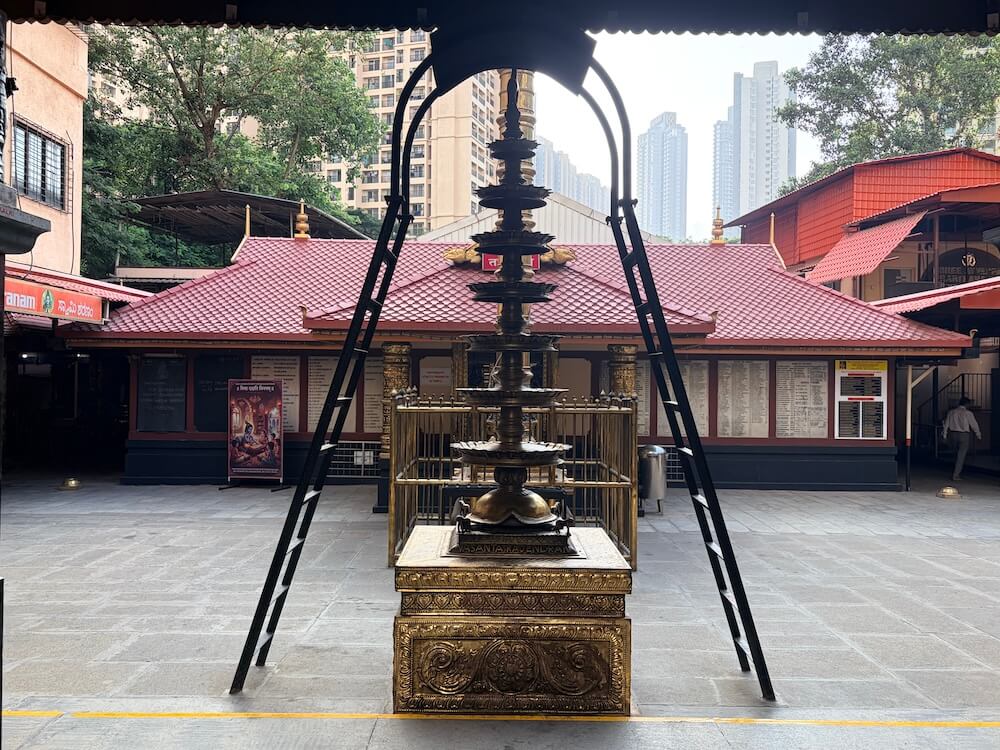
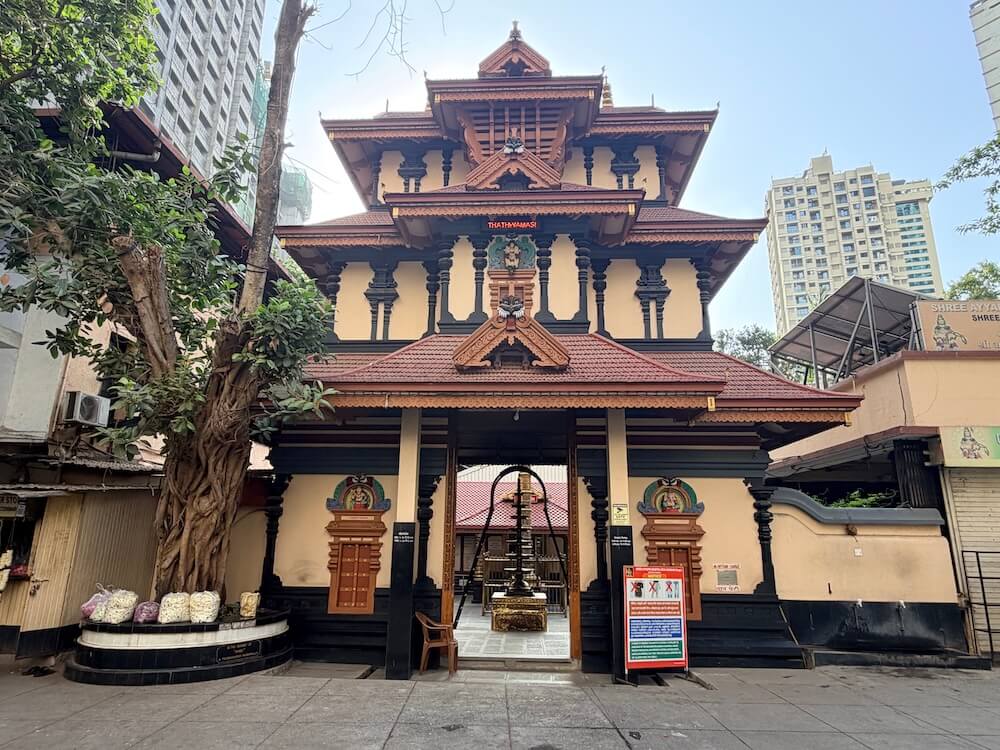
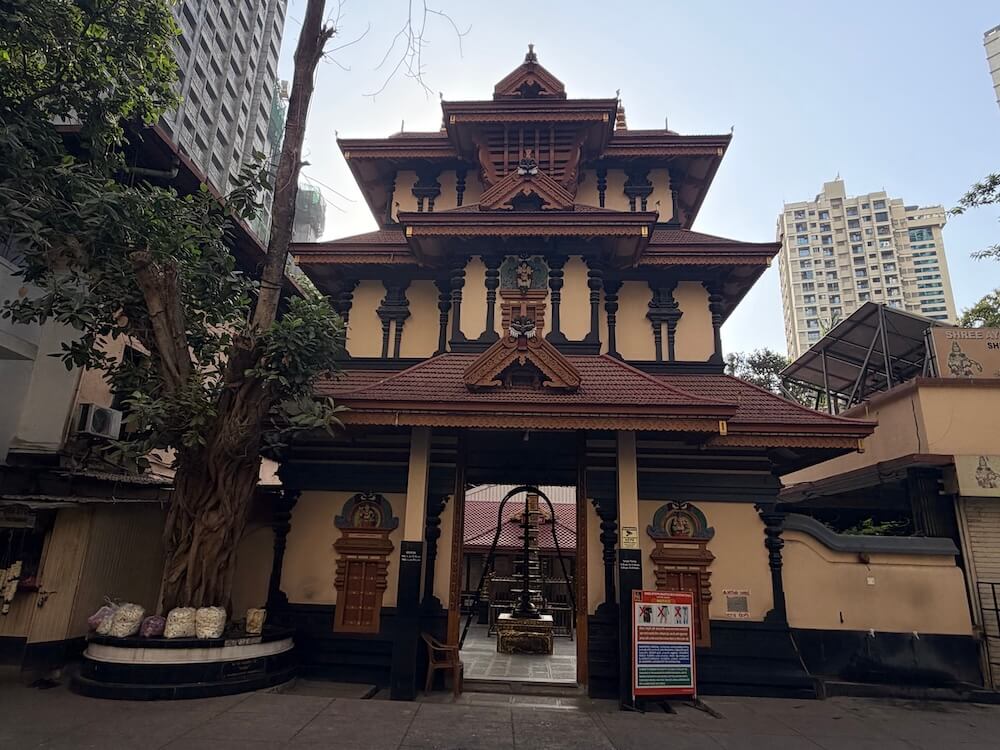
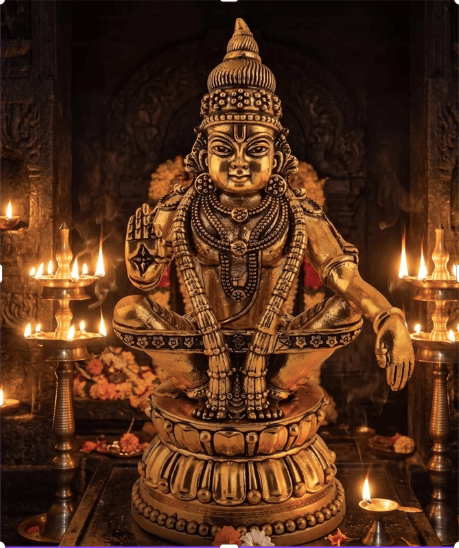
This temple has been constructed in the traditional Kerala temple architectural style. Here, one can witness the characteristic features of the Kerala temple style, such as the gopuram, the maryada (compound wall), the balikkal mandapam within the antarmandala, the kodimaram (flagstaff), the Sreekovil, as well as intricately carved, gleaming golden pillars, and metal sheeting adorned on the walls and entranceways. The gopuram here is three-tiered, featuring a sloping roof and a triangular structure resembling a devakoshtaka on its facade. It boasts a grand, intricately carved wooden entrance. Above the triangular arch of the entrance, Kirtimukhas are carved. Above the windows flanking the entrance, there is a carved image of Lord Ayyappa. From here, one enters the temple’s prakara (courtyard). Directly ahead, on a tall metal pedestal, stands a seven-tiered samai (lamp stand). Beyond it rises a towering, gleaming golden kodimaram, or flagstaff. Further ahead is the temple’s balikkal mandapam. In the triangular section above this mandapam, the mantra-vachana ‘Tat Tvam Asi’ is inscribed. This sacred utterance first appeared in the dialogue between Maharshi Uddalaka and his son Svetaketu in the sixth chapter of the Chandogya Upanishad, which is associated with the Samaveda. Its literal meaning is ‘That thou art.’ According to the Kevaladvaita philosophy, this statement is used to express the oneness of the jiva (individual soul) and Brahman (the Absolute). The balipitha in the balikkal mandapam represents the Ashtadikpalas and other deities. From here, one enters the main prakara of the temple, where the Sreekovil (sanctum sanctorum) is centrally located. In front of it, there is a structure with steps on both sides. On either side of the Sreekovil’s entrance are sculptures of dwarapalas (gatekeepers) carved from black stone. Within, on a raised platform, the idol of Bhagwan Ayyappa is consecrated. The idol here bears a resemblance to the original idol at the Sabarimala temple. Many lamps glow around the idol. Within the temple prakara, there are also shrines dedicated to Vishnu, Ganesha, Subramanyam, Santoshi Mata, Bhagwan Shiva, as well as Bhagwan Murugan, Navagrahas, and Nagaraja.
Devotees can partake in darshan at this temple from five-thirty in the morning to eleven in the morning, and from five-thirty in the evening to nine at night. Every day, after the temple doors open at dawn, the Nirmalya Darshan Puja is performed. This is followed by Abhishek and Naivedya rituals. The grandest among the annual festivals here is the ‘Mandala’ festival. This festival commences on the first day of the Malayalam month of Vrishchikam, which falls between November and December, and lasts for a total of forty-one days. During this period, hundreds of devotees visit this temple. Devotees who are unable to undertake the pilgrimage to the original temple in Sabarimala during the Mandala period come here to complete their vratadharana (observance of vows). At the beginning of the annual festival, an official flag-hoisting ceremony is performed on the flagstaff. This ritual is known as ‘Kodigettu.’ On the day of Makar Sankranti, the special festival of ‘Makaravilakku’ is celebrated here. Photography is prohibited in this temple.
This sacred temple stands as a testament to deep spiritual devotion, ancient architectural grandeur, and rich local cultural traditions.
The sanctum sanctorum houses the divine idol consecrated according to ancient Vedic traditions, surrounded by serene courtyards and traditional temple architecture.
Navratri, Maha Shivratri, Annual Temple Jatra & Deepotsav
Compare and book flights, secure top-rated local hotels near the temple, hire reliable guides, and rent cars instantly.
Extend your pilgrimage by visiting other highly sacred temples located nearby.


Add ₹999 more to unlock FREE SHIPPING!
Your sacred cart is currently empty.
Shop Photo FramesFill in your delivery details below to place your order.
Add comment