
Add ₹999 more to unlock FREE SHIPPING!
Your sacred cart is currently empty.
Shop Photo FramesMumbai has a deep historical bond with Japan. The relationship, forged through trade during the British colonial era, is still preserved today by the city through this Buddhist Vihara. This colonial-era Buddhist temple is located in Worli. It was established by followers of the ‘Nipponzan Myohoji’ Buddhist order, who participated in India’s freedom struggle under the leadership of Mahatma Gandhi. Records indicate that Dr. Babasaheb Ambedkar visited this temple. Furthermore, he praised it, stating, “This Buddhist Vihara is a source of inspiration for Buddhists.”
Trade relations between Japan and Mumbai began after 1858. The ‘Merchant Prince of Bombay,’ Baghdadi Jewish industrialist David Sassoon’s son Elias Sassoon, as well as Jamsetji Tata, played a major role in this. Sassoon and Tata companies began exporting cotton yarn to Japan. During that period, Tata partnered with a Japanese company to launch a cargo ship service on the Mumbai-Japan-China route under the ‘Tata Lines’ banner. These trade relations brought a large number of Japanese merchants and employees to the city. It is recorded that in 1908, about 600 Japanese citizens and 200 ‘Karayuki-san’ (Japanese sex workers, literally meaning women who went abroad) lived here. Compared to the population of Mumbai at the time, this was a significant number. In the same year, a Japanese cemetery (‘Nipponjin Boji’) was established on Dr. E. Moses Road in Mumbai. The Buddhist Vihara here has a unique connection to this cemetery.
During the era of the First World War, a period of global violence, human society felt an urgent need for the values of peaceful coexistence, harmony, and tolerance. Against this backdrop, the ‘Nipponzan Myohoji’ order was founded in Japan in 1917. It is a branch of the ‘Nichiren’ sect, which was established in the 13th century within Mahayana Buddhism. Buddhist monk Nichidatsu Fuji Guruji was the founder of ‘Nipponzan Myohoji.’ The ‘Saddharmapundarika Sutra,’ or the ‘Lotus Sutra,’ composed around the first century AD, is considered one of the most important scriptures in Mahayana Buddhism. It posits that all humans have the potential to attain Buddhahood—the highest state of wisdom, compassion, and courage. The core principle of the text is that just as the Pundarika (lotus) born from mud remains unstained by it, the Buddha born from the common people and the Dharma he preached remain free from the flaws of the common masses. According to the ‘Nipponzan Myohoji’ order, the world can be led on the path of peace through the teachings of this ‘Lotus Sutra.’ This sutra is known as ‘Myoho Renge Kyo’ in Japan. ‘Namu-Myoho-Renge-Kyo,’ meaning ‘I take refuge in the Lotus Sutra, the ultimate truth of the universe,’ is the sacred mantra of the ‘Nipponzan Myohoji’ order. It is inscribed on a large plaque in the Buddhist Vihara here. Nichidatsu Fuji Guruji, the founder of the order, believed that the revival of Buddhism would liberate India from British and European rule. With this vision, some of his followers, such as Anand Maruyama, actively participated in Gandhi’s freedom struggle.
On November 28, 1931, Nichidatsu Fuji Guruji arrived in Mumbai. At that time, the office of the Japanese trading company ‘Nichimen’ was located opposite the ‘Royal Institute of Science’ on Karmaveer Bhaurao Patil Marg (Mayo Road) in South Mumbai. The company welcomed him. Immediately after arriving, on December 1, Nichidatsu Fuji expressed his desire to begin penance. To build a hut for this purpose, the site of the Japanese Gymkhana opposite Cooperage Ground was shown to him. However, he decided to stay near the Japanese cemetery (‘Nipponjin Boji’) on Dr. E. Moses Road. A hut was built there using discarded packaging materials. On December 28, 1931, Mahatma Gandhi returned to India from the Second Round Table Conference in London. A massive crowd had gathered in Mumbai to welcome him. Nichidatsu Fuji Guruji participated in that welcome ceremony. Two years later, on October 4, 1933, he met Gandhi at his ashram in Wardha. He stayed there with his disciples for two months and engaged in close dialogue with Gandhi. During this period, he proposed the plan to build a ‘Nipponzan Myohoji’ Buddhist temple in India. J. K. Birla, a nationalist industrialist and associate of Gandhi in the freedom struggle, supported this plan. A small temple was built in Worli from the donation he provided.
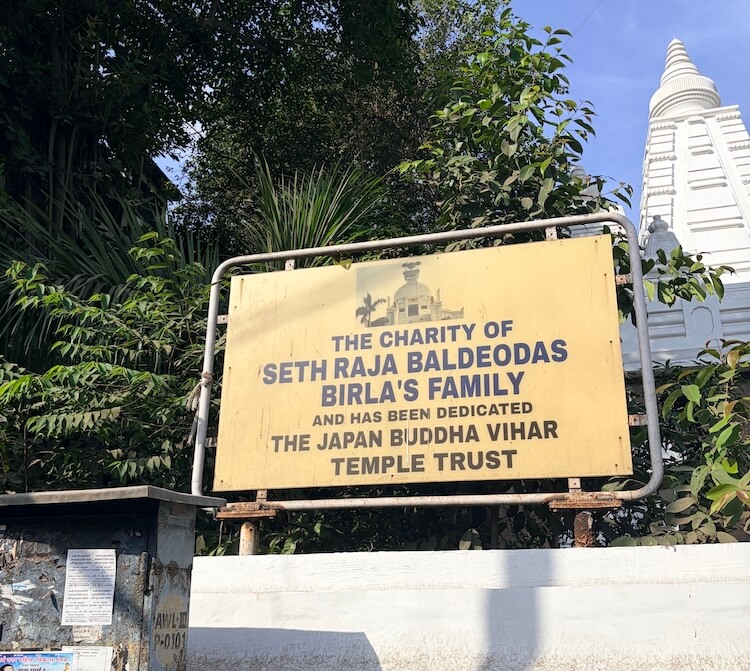
During the Second World War, Japan became an enemy nation to Britain, and the Japanese people here faced a crisis. The properties of Japanese companies and citizens were declared ‘Enemy Property.’ This included the temple. All these sites were confiscated. After the country gained independence, followers of the order recovered the land from the government department, the ‘Custodian of Enemy Property.’ However, some people had made unauthorized encroachments on the land. These encroachments were removed through legal and peaceful means, and finally, in 1952, the Nipponzan Myohoji Buddhist Vihara was renovated with a donation from the ‘Birla Trust,’ managed by the family of Seth Raja Baldevdas Birla. Industrialist Jugal Kishore Birla made a significant contribution to this.
During that period, a movement led by Gandhi was underway across the country demanding that Harijans be granted entry into temples. Orthodox people opposed this. Sane Guruji had to undertake a fast to ensure Harijans gained entry into the Vitthal temple in Pandharpur. Against this backdrop, free entry was granted to all Hindus in this Buddhist Vihara in Worli. An inscription was placed in the temple at that time stating, ‘Entry is open to all Hindus, i.e., people from various branches of the Hindu (Arya) religion including Buddhist, Sanatani, Jain, Sikh, Arya Samaji, etc., for daily worship and satsang in this temple. This temple is open to all Hindus, including Harijans.’ He is still here today. During the time this temple was being built, Dr. Babasaheb Ambedkar visited this Buddha Vihara on September 29, 1950. In the speech he delivered at that time, he appealed to the people to embrace Buddhism. He also declared that he would dedicate his life to the revival and propagation of Buddhism. Distressed by the opposition from orthodox elements to the ‘Hindu Code Bill’, Dr. Ambedkar resigned from Pandit Nehru’s cabinet. Two months later, when he came to Mumbai, he visited this Buddha Vihara again on December 22, 1951, and gave a speech on Buddhism. This record is found in the Hindi biographical work ‘Dr. Babasaheb Ambedkar’ (Vasant Moon, translated by Prashant Pandey, National Book Trust, 1991, pp. 190, 193).
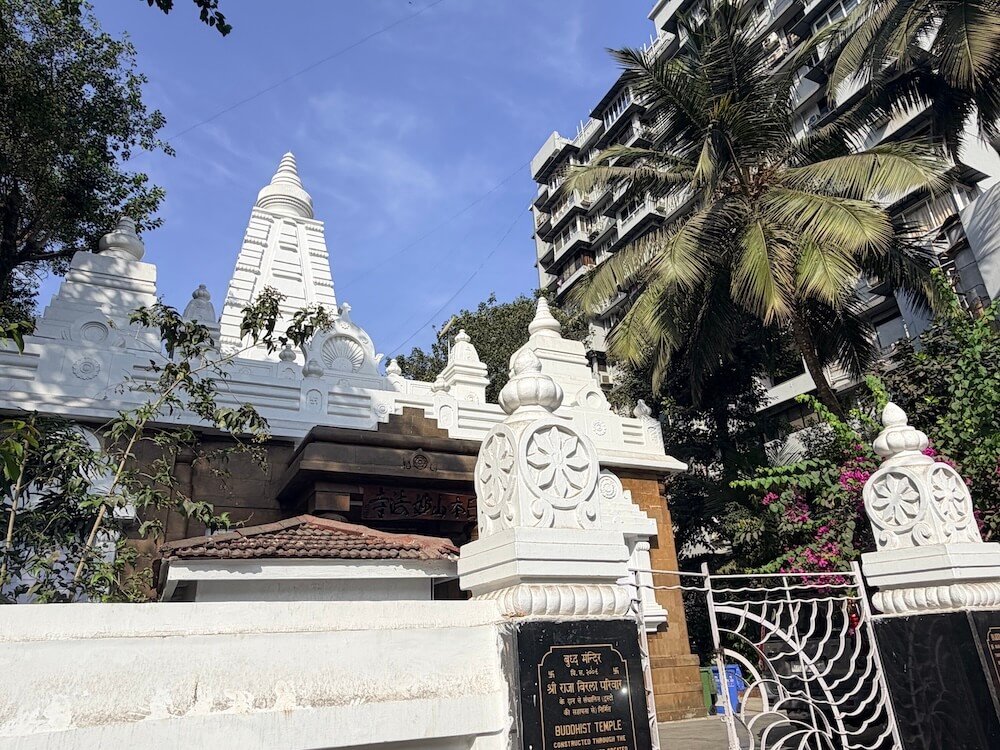
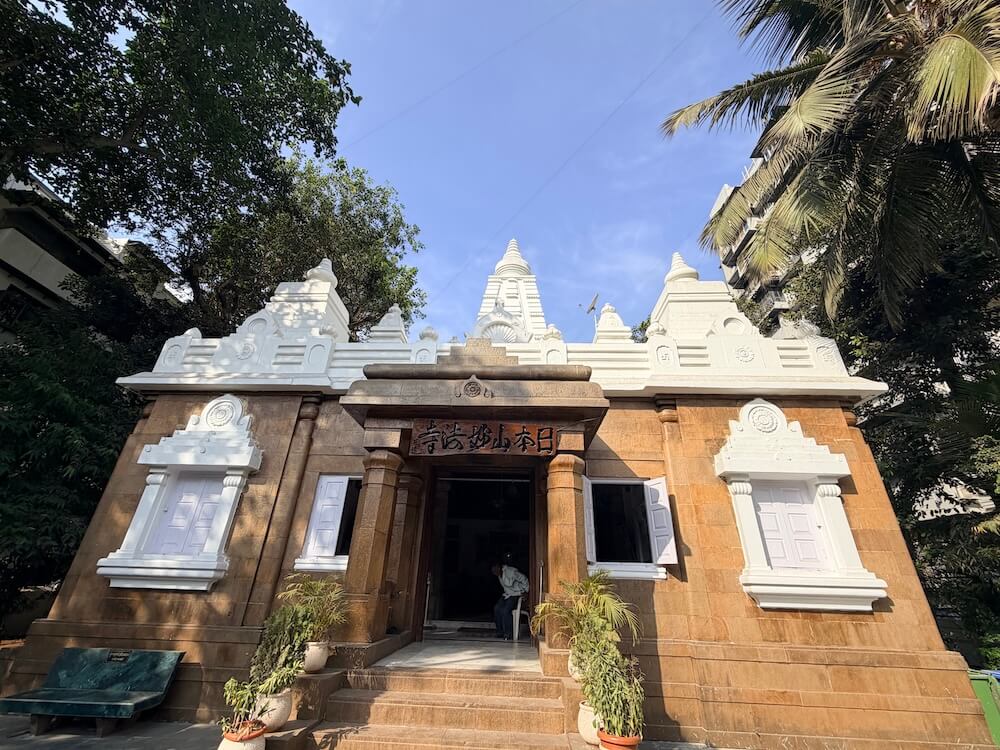
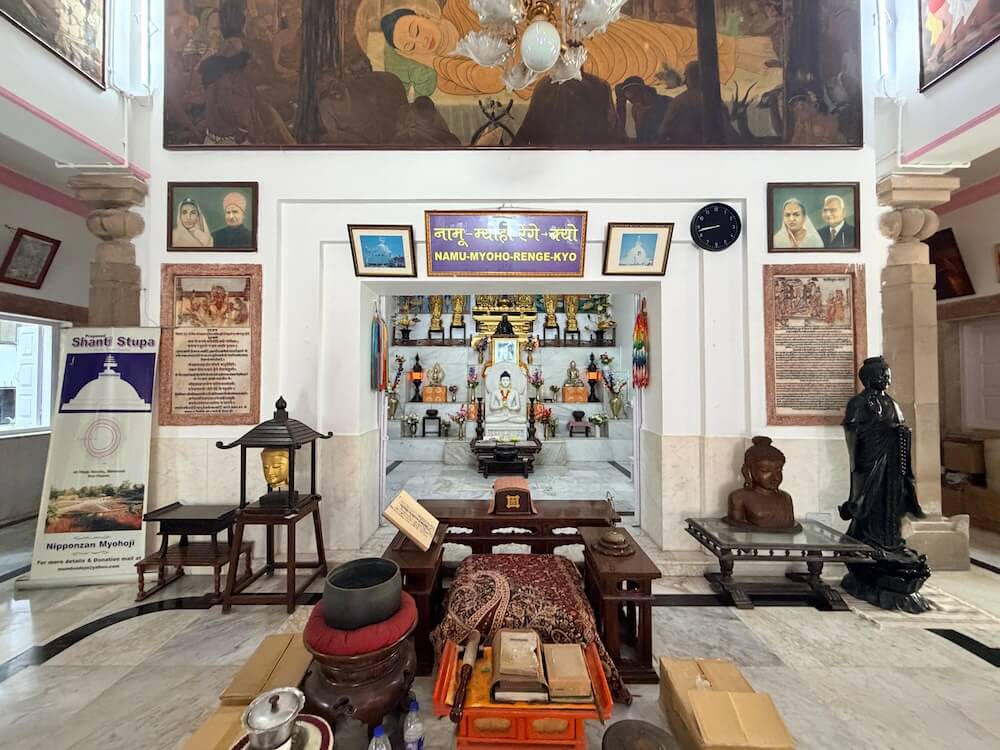
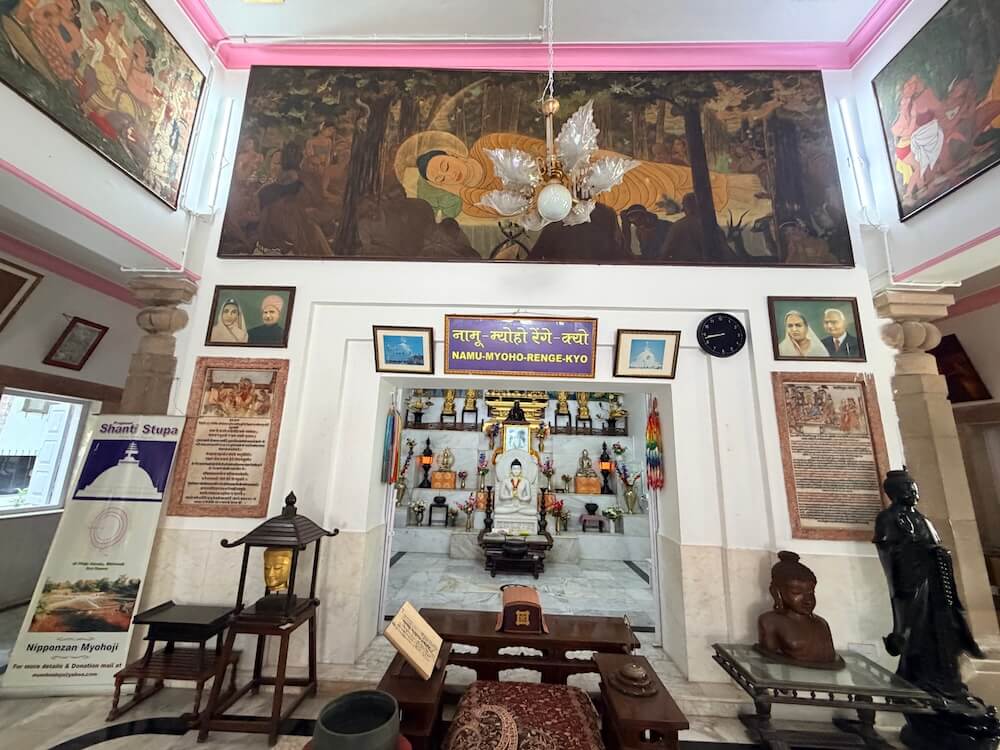
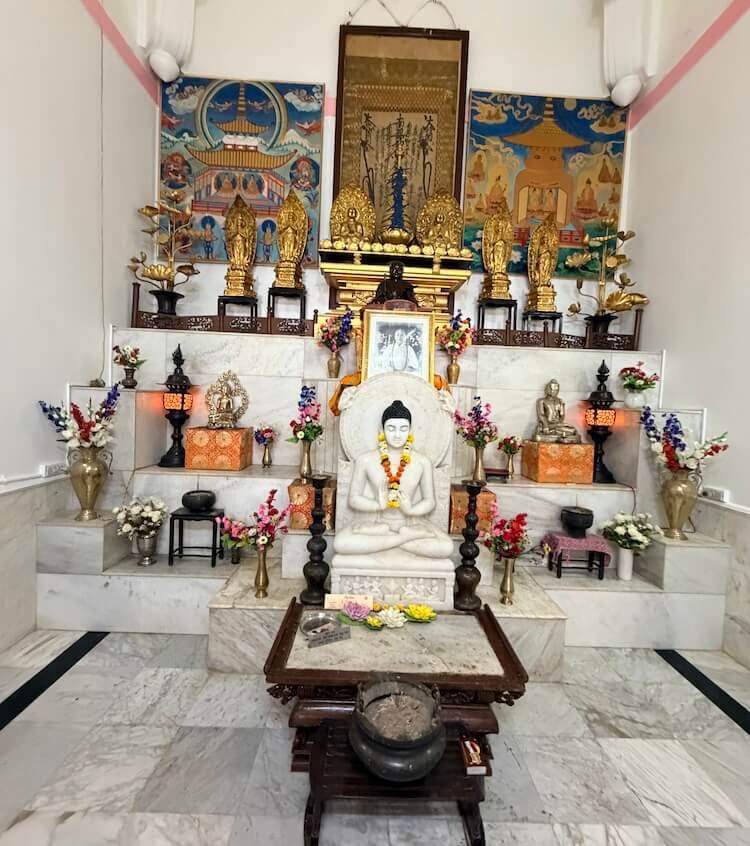
The temple is situated in a spacious courtyard behind boundary walls on Dr. Annie Besant Road in Worli. Its exterior resembles the Mahabodhi Temple, while the interior is like a main Chaitya. In the terminology of temple architecture, its structure consists of a porch (Mukhamandapa), an auxiliary hall (Upasabhamandapa), a main assembly hall (Sabhamandapa), and a sanctum sanctorum (Garbhagriha). The temple is built of sandstone on a high plinth. It has a porch with octagonal stone pillars. Above it is a nameplate inscribed in Japanese script that reads ‘Nipponzan Myohoji Temple’. On the facade, there are two small and two large windows painted in pristine white. The roof of the temple has a parapet on all four sides. At its four corners are four pillar-spires, and there is a tall spire over the sanctum sanctorum, topped with a kalasha-like structure. These spires are painted white, the color of peace. The temple’s assembly hall is spacious and two stories high. Inside, there are octagonal carved stone pillars set at a distance from the walls. On the walls above these pillars, large paintings depicting various episodes from the life of Gautama Buddha are displayed. In the center of the flat ceiling, a large lotus flower is carved. A large carpet is spread over the marble flooring of the assembly hall. Near the pillars, cane and wooden chairs are arranged for devotees and monks to sit. A drum, used during prayers, is kept in one corner. The sanctum sanctorum of this Vihara or temple has a wide, square entrance. On the adjacent walls, one can see portraits of members of the Birla family, the edicts of the Buddhist Emperor Ashoka, and several Buddha statues. Above the entrance is a large board inscribed with the mantra ‘Namu Myoho Renge Kyo’. On the wall above it is a magnificent mural of Gautama Buddha. The image of Shakyamuni Buddha in a reclining position at the time of Mahaparinirvana is a well-known icon in Buddhism, and it is depicted here. In the sanctum sanctorum, a marble statue of Gautama Buddha is enshrined on a tiered marble pedestal. The statue is in the ‘Asina’ (seated) posture. Here, the Buddha is seated in the Padmasana (lotus position) in a meditative state. There is an expression of profound peace on his face. He has curly black hair on his head, topped with an ‘Ushnisha’ (the raised part of the head symbolizing wisdom). His hands are in the ‘Vyakhyana’ or ‘Dharmachakra Pravartana’ mudra. This mudra is considered a symbol of the Dharmachakra Pravartana, the first sermon given by Gautama Buddha at Sarnath. Behind the statue, the stone slab is carved with specific animals and swan motifs. There is a circular halo behind the Buddha’s face. Behind the statue, there is a photograph of Nichidatsu Fuji Guruji, the founder of ‘Nipponzan Myohoji’, as well as his statue. On the pedestal behind the main statue, various golden Buddha idols are placed. There are also some religious paintings in the Japanese style.
Devotees can benefit from the darshan of the Buddha in this temple from 5:30 AM to 12:30 PM and from 3:30 PM to 7:30 PM. Prayers are held in the temple every day at 6:00 AM and between 5:30 PM and 7:00 PM. The day of September 29, when Dr. Babasaheb Ambedkar first visited the temple and performed Buddhavandana, is celebrated here with various programs. In the year 2025, the Amrit Mahotsav of this Buddhavandana was celebrated here with great enthusiasm.
This sacred temple stands as a testament to deep spiritual devotion, ancient architectural grandeur, and rich local cultural traditions.
The sanctum sanctorum houses the divine idol consecrated according to ancient Vedic traditions, surrounded by serene courtyards and traditional temple architecture.
Navratri, Maha Shivratri, Annual Temple Jatra & Deepotsav
Compare and book flights, secure top-rated local hotels near the temple, hire reliable guides, and rent cars instantly.
Extend your pilgrimage by visiting other highly sacred temples located nearby.


Add ₹999 more to unlock FREE SHIPPING!
Your sacred cart is currently empty.
Shop Photo FramesFill in your delivery details below to place your order.
Add comment