
Add ₹999 more to unlock FREE SHIPPING!
Your sacred cart is currently empty.
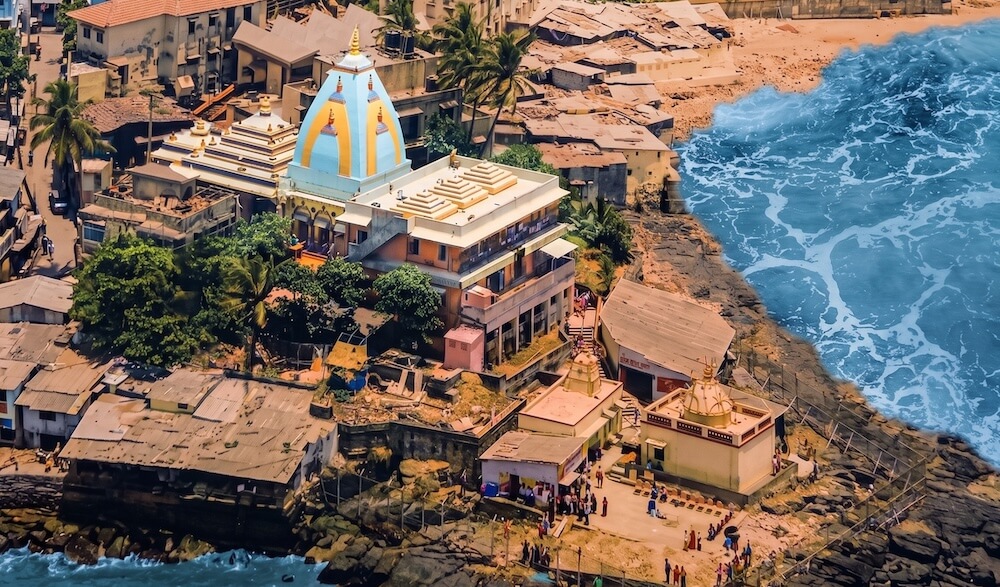
Shop Photo FramesMahalakshmi Temple, Bhulabhai Desai Road, Mahalakshmi, Mumbai. Mahalakshmi is considered the presiding deity of wealth for the great city of Mumbai. Nestled on a small hill by the seashore, the Mahalakshmi Temple is an integral part of the city’s historical and geographical fabric. During periods of foreign invasions, the idols were hidden in the sea to prevent their desecration. Later, around the year 1775, while work was underway to connect the seven islands of Mumbai through land reclamation, the contractor Ramji Shivji Prabhu received a divine vision in a dream in which the Goddess commanded him to retrieve her idols. Subsequently, the idols of the three Goddesses—Mahakali, Mahalakshmi, and Mahasaraswati—were recovered from the sea and consecrated here. The presence of these three Adi Shakti forms in one place is the unique specialty of this temple. This temple is considered a symbol of Mumbai’s prosperity and unwavering faith. Devotees firmly believe that it was only after the establishment of this temple that Mumbai began to flourish.
The history of this temple dates back roughly to the 14th century. Two Bimb kings, whose capital was in Mahim, ruled over the islands of Mumbai. The first among them, and the original king of Mumbai, was Pratap Bimb. His capital was initially at Kelwe-Mahim. Later, in the year 1138, he arrived at an island then known as Baradbet. He named it ‘Mahim’ after his first capital. He granted this Mumbai-Mahim the status of a capital. The region from Walkeshwar to Vasai was part of his kingdom. The second Bimb king here was Bimbdev Yadav. Bimbdev, the fourth son of Ramdevrao Yadav of Devgiri, is referred to as Bhimdev in Muslim chronicles. He established his capital here in the year 1295. The Prabhadevi Temple here was built during his reign. The last Hindu king of Thane-Mumbai was Nagardev, also known as Nagarsha. In the 14th century, Mubarak Shah I was the Sultan of Gujarat. In the year 1318, he captured the regions of Mahim and Salsette. During this invasion in 1318, his army destroyed the Mumbadevi Temple here. S. M. Edwardes, the author of the Mumbai Gazetteer, noted in his book ‘The Rise of Bombay’ (1902) that ‘due to this policy of oppression, Mahalakshmi and her sisters temporarily departed from their shores.’ Christian missionaries Jordanus and Odoric, who resided in Thane between 1321 and 1324, wrote: ‘The Saracens (meaning Muslim invaders) have recently seized power and gained control over the entire region. They have destroyed numerous idol-worshipping temples and have also demolished many churches, seizing their properties for themselves.’
Later, in 1347, a great battle took place at Byculla between his commander Malik Nika and Nagarsha. Nagarsha was defeated, and Muslim rule was established over Mumbai. By the 16th century, as things were settling down, another crisis befell the islands of Mumbai: the Portuguese invaders. In the year 1534, the Portuguese conquered seven islands—Big Colaba, Little Colaba, Mazgaon, Parel, Worli, Matunga, and Mahim—from Sultan Bahadur Shah of Gujarat. According to records in the ‘Greater Bombay Gazetteer’, the Portuguese Jesuits, who were extremely intolerant of other religions, destroyed many temples here during this period. Like the Prabhadevi and Walkeshwar temples, the Mahalakshmi Temple also suffered from their religious fanaticism. It is said that during that time, the people of the Pathare Prabhu community hid the idols from the Prabhadevi temples in wells for safety. Similarly, it is believed that the idols of the Mahalakshmi Temple were hidden in the sea. The ‘Greater Bombay Gazetteer’ indicates that this event occurred around or before the year 1570. Regarding this, the Gazetteer states: ‘The Jesuits owned the most temples (places of worship), and almost all the land from the northern islands to the far south at Byculla was leased to them. They held great influence, but their reckless actions not only stunted the growth of population and trade but also became a source of danger for the Portuguese. They continuously destroyed Hindu temples and Muslim mosques. This spread discontent among the people, and they began to flee. The public was deeply hurt, leading to acts of retaliation. For example, the incident that occurred in Thane in December 1570. That year, Malabar pirates looted the city and stole the great bell of the cathedral. During this period, the old temple of Walkeshwar was demolished. The temples of Mahalakshmi and her sisters disappeared for that time, and the Goddesses remained in exile.’
Later, during the British era, seeing that the social situation had returned to normal, these idols were retrieved and re-consecrated in the temple. A story is told regarding this as well. During the time of Mumbai’s Governor Charles Boone, in June 1720, work began to close the Great Breach at Worli by building a dam. This task was entrusted to Captain Elias Bates. Bates gave the construction contract to a young man named Ramji Shivji Prabhu. This work was expected to be completed in 1721. However, the dam could not withstand the onslaught of the sea waves. This continued until 1724. One night, Ramji Shivji received a divine vision from Mother Mahalakshmi. She indicated that she, along with Mahakali and Mahasaraswati, was in the sea in the form of idols. She signaled that if these idols were retrieved and consecrated, the work of building the dam would be successful. The next day, Ramji Shivji cast nets into the Worli creek and searched for the idols. There, he found three stone idols of Mahakali, Mahalakshmi, and Mahasaraswati. These idols were placed on the hill where the Mahalakshmi Temple currently stands. Later, the hill and the land were received as a gift from the government, and the Mahalakshmi Temple was built on this hill. This story is provided in a chronicle (bakhar) obtained from a wealthy local Prabhu gentleman by Govind Narayan Madgaonkar, the author of ‘Mumbai che Varnan’. Although Ramji Shivji is mentioned in this chronicle, there is no mention of any English official.
Later, between the years 1771 and 1784, William Hornby, the Governor of Mumbai, repaired and fortified this embankment. This embankment was named ‘Hornby Vellard’. Consequently, its name became etched in public memory, and the legend of the temple became linked to his era. According to ‘The Gazetteer of Bombay City and Island’, it is estimated that this temple was likely built around the year 1785. In the book ‘Mumbai-til Aadya Jagrut Shaktipeethe’, Dr. Bhalchandra Aklekar has stated this period to be between 1761 and 1771. In reality, this embankment was completed in 1728. It was constructed during the time of Captain Elias Bates, with the assistance of Ramji Shivji. That period spans from 1720 to 1728. Therefore, Nitin Salunkhe, the author of the book ‘Adnyat Mumbai’ and a scholar of Mumbai’s history, has expressed the opinion that the Mahalakshmi temple must also have been erected during this same interval.
Another story related to the manifestation of the Mahalakshmi temple is that during the pre-monsoon season, Koli fishermen had gone far out into the sea for fishing. Due to a sudden storm and rain, their boat went astray, and their lives were in danger. In such a life-threatening crisis, they began to call upon Mother Jagadamba and sang the Aarti of the Goddess. Within a short time, the fury of the sea calmed, and the sky cleared. When the Koli fishermen pulled up the nets they had cast into the sea, instead of fish, they found three beautiful idols of the Goddess. Everyone was astonished to see these idols. The Koli fishermen brought these idols to the shore, and the place where they were installed is the present-day Mahalakshmi temple. In the book ‘Mumbai-cha Vrittant’ (1889) by Balkrishna Bapu Acharya and Moro Vinayak Shingne, it is stated that ‘the consecration of the Mahalakshmi temple was performed by a local resident Yajurvedi Brahmin named Shamacharya.’
Mahakali, Mahalakshmi, and Mahasaraswati—these three deities hold great importance in Hinduism. Mahalakshmi is the Goddess of wealth, beauty, and prosperity. She is the consort of Vishnu and is considered a symbol of good fortune. Mahakali, Mahalakshmi, and Mahasaraswati—these three Goddesses are the fundamental basis of human life. It is a unique feature of this temple that all three forms are seated together in the same sanctum sanctorum on the western coast of Mumbai. In Indian culture and spirituality, the number three holds extraordinary significance. The Trinity of Brahma, Vishnu, and Mahesh, and the Tridevi of Saraswati, Lakshmi, and Parvati are the foundations of the creation’s functioning. The three Gunas (qualities) of Sattva, Rajas, and Tamas; the three times of past, present, and future; and the three Doshas (humors) of Vata, Pitta, and Kapha in the body are recognized. The presence of these three powers together in the Mahalakshmi temple is considered a miraculous union.
The fierce form of Mother Parvati is called Mahakali or Kalika. When the gods went to the Himalayas and prayed to be freed from the torment of the demons Shumbha and Nishumbha, Kaushiki manifested from the body of Parvati, and Parvati’s body turned dark. She came to be known as Mahakali. Mahakali slew the demon named Raktabija. Raktabija had a boon that every drop of his blood that fell on the ground would give rise to a new demon. Mahakali consumed all his blood with her tongue and destroyed him. Even after the slaying, the Goddess’s anger would not subside, so Mahadeva lay down in her path, and as soon as she touched his body, the Goddess calmed down. Seven forms of Mahakali, such as Dakshina Kali, Bhadrakali, and Chandikali, are recognized. The Dakshineswar temple in Kolkata is a famous site of Mahakali, where Ramakrishna Paramahansa performed his spiritual practices. Apart from this, there are also ancient temples of Mother Kali in Chittorgarh, Delhi, Pavagadh, and Akola.
The story of the churning of the ocean (Samudra Manthan) is famous regarding the origin of Mahalakshmi. When Indra lost his wealth due to the curse of Durvasa, the gods churned the ocean at the behest of Vishnu. Lakshmi was one of the fourteen gems that emerged from it. Adorned with divine garments and ornaments, this Lakshmi appeared seated on a lotus and accepted Vishnu as her husband. Mahalakshmi is also called Bhargavi because she was born to Sage Bhrigu. Eight forms of Mahalakshmi are recognized: Adyalakshmi, Vidyalakshmi, Bhagyalakshmi, Amritalakshmi, Kamalakshmi, Bhogalakshmi, Satyalakshmi, and Yogalakshmi. Gaja-Lakshmi is her majestic form, in which elephants are shown performing an ablution (Abhishek) on the Goddess from both sides. There are important temples of Mahalakshmi in Kolhapur, Goa, Jhansi, and Chennai.
Mahasaraswati is the presiding deity of intellect, knowledge, and art. She is considered the daughter of Lord Brahma. In the Vedas, she is mentioned as Vagishwari. In Vedic literature, Saraswati is primarily mentioned as a river goddess or a goddess of knowledge. The story of the Saraswati river is told that to calm the Vadavanala fire, Brahma ordered her to carry this fire. Saraswati carried this fire through the subterranean path, and on the way, she appeared in the form of a river near the hermitages of sages. The birth story of Saraswati varies according to the Puranas. According to the Brahmavaivarta Purana, she appeared from the mouth of Vishnu, while according to the Shiva Purana, Brahma gave birth to her. Saraswati is worshipped in the form of being dressed in white, playing the Veena, and riding a swan. It is believed that intellect and the talent for new discoveries are attained only by her grace.
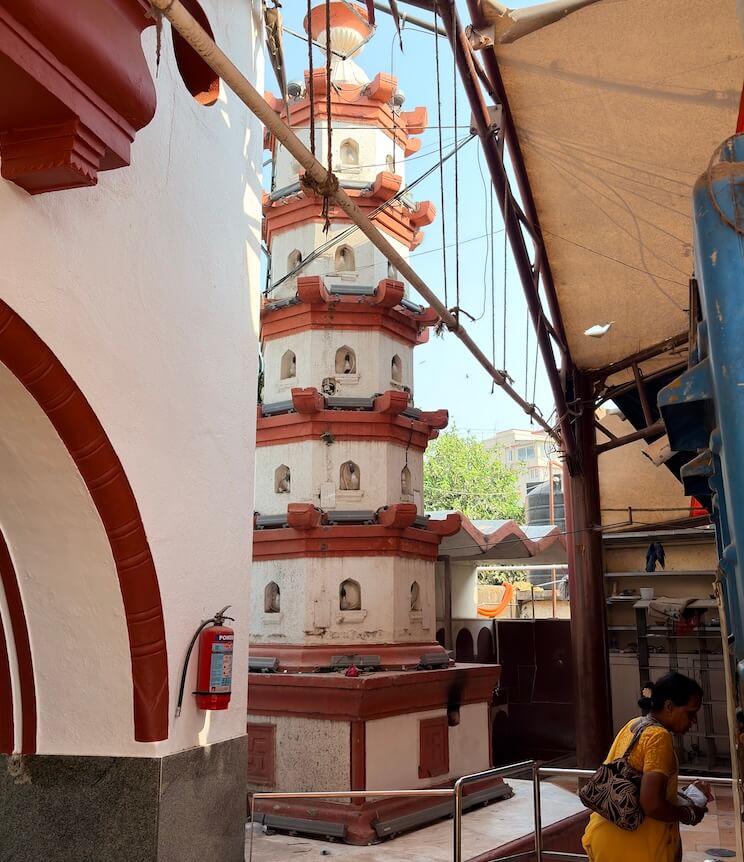
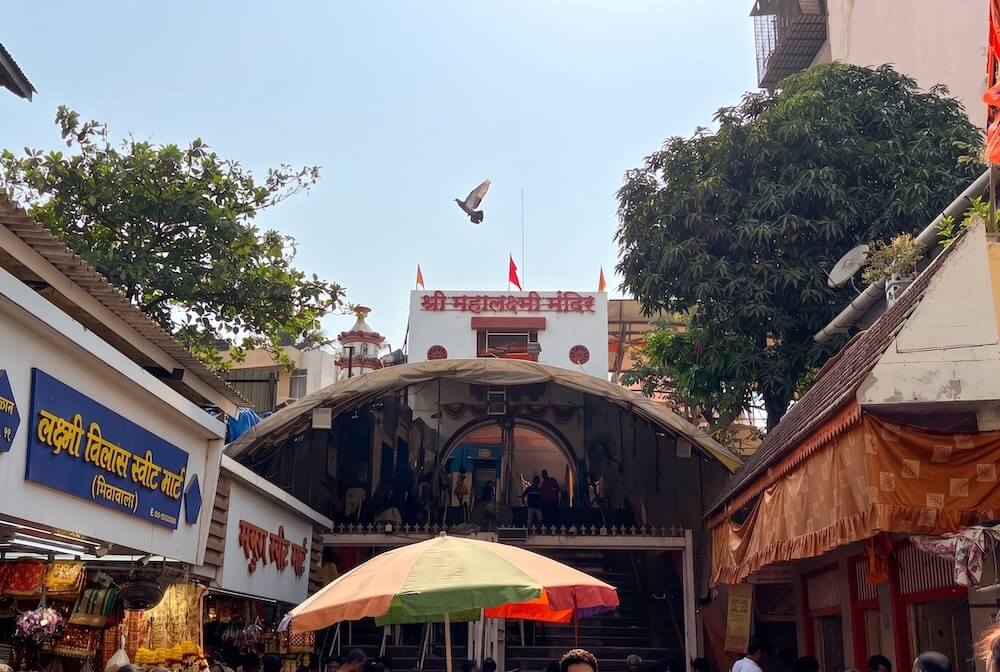
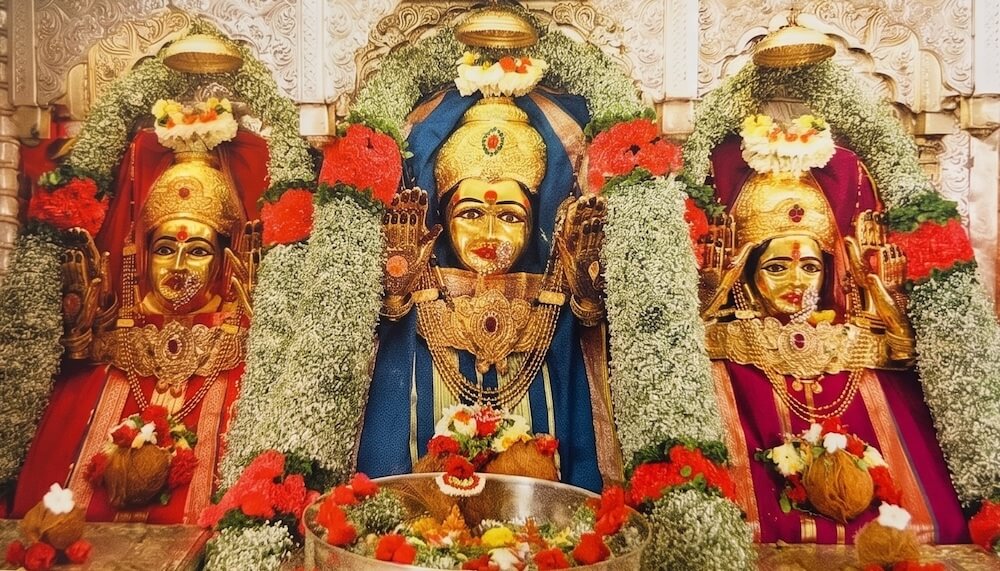
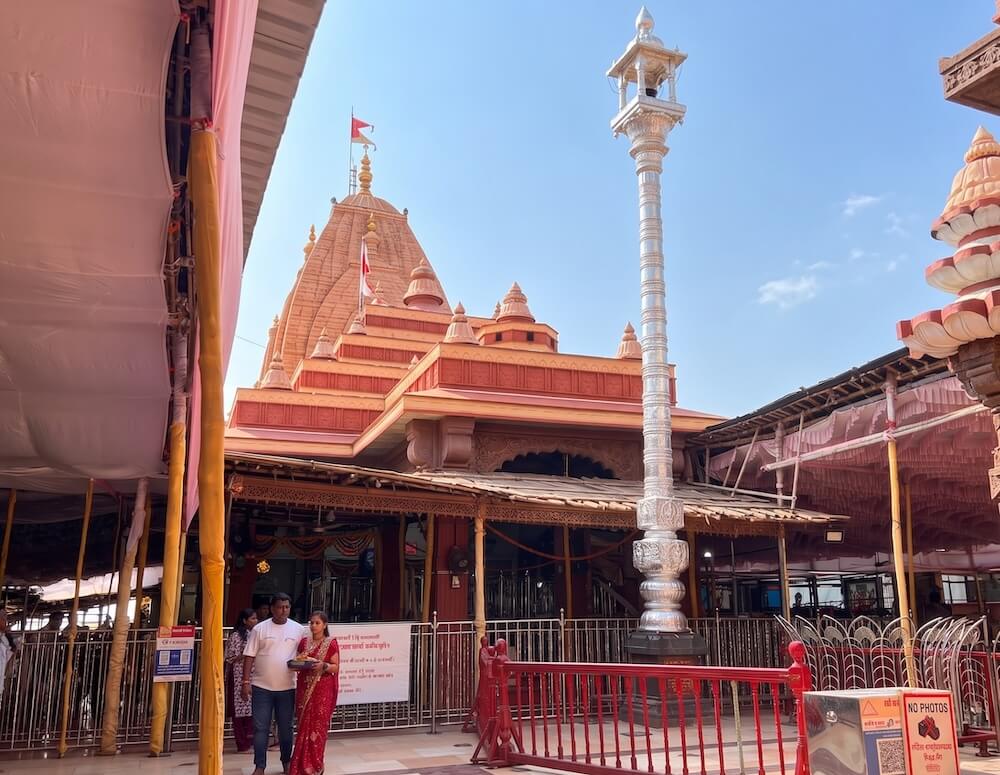
This temple of these three Goddesses is situated in a bustling part of the city, adjacent to the seashore. On the path from the main road to the temple, there are hundreds of shops selling worship materials and offerings. In front of the main temple, there is a Deepmal (lamp pillar), a Deepstambh, and a tall flagpole covered with silver sheets. The structure of this temple consists of a Darshan Mandap, Sabha Mandap, and Antarala. Arrangements for a queue for devotees have been made in the Darshan Mandap and Sabha Mandap for their convenience. The Darshan Mandap and Sabha Mandap here are open in nature. In the Sabha Mandap, there are black stone idols of Vitthal and Rukmini in a niche on the right side of the front wall of the sanctum sanctorum, and an idol of Ganesha in a niche on the left. In the sanctum sanctorum, Mahalakshmi is seated in the center on a silver throne, and the idols of Mahakali on her right and Mahasaraswati on her left are installed. There are a total of nine spires (Kalash) on the temple. On 29 April 2002, the installation of these spires and the Mahakumbhabhisheka ritual were performed by Shankaracharya Jayendra Saraswathi Swamigal of the Sri Kanchi Kamakoti Peetham. After descending a few steps at the back of the temple, there are temples of Ganpati and Mahadeva.
The daily rituals and festivals at the Mahalakshmi Temple are conducted according to tradition. The Goddess’s Aarti is performed every morning and evening. During this time, saffron-infused milk and shira are distributed to devotees as prasad. On Shukla Panchami, the idols of the Goddess are anointed with vermilion (hingul), and on Shukla Ashtami, the Navchandi Yaga is performed. On the full moon day (Purnima), a special Aarti is performed using lamps made of wheat flour dough. Twice a year, the Kiranotsav festival takes place here, during which the sun’s rays fall directly upon the idols in the sanctum sanctorum. The temple is constructed in such a way that the sun’s rays reach deep inside, serving as a magnificent example of its architecture.
The Navratri festival is celebrated with great enthusiasm during the months of Chaitra and Ashwin. Navratri begins with the hoisting of the flag on Gudi Padwa. During this period, a palanquin procession is held daily, and the Chandi Path is recited. Throughout the nine days of Navratri, the trident of Mahakali is placed near the sacred pot (ghat) and worshipped. The festival concludes on Dussehra. In the month of Vaishakh, the Mango Festival is celebrated on Akshaya Tritiya, during which heaps of mangoes are offered to the Goddess. The anniversary of the flagstaff (dhwajastambha) is observed on 17 June. Special worship of Vitthal-Rukhumai is conducted in the temple on Ashadhi and Kartiki Ekadashi. A five-day Ganeshotsav is celebrated during Ganesh Chaturthi. In the month of Shravan, Rudrabhishek is performed at the Mahadev temple every Monday. On Tripurari Purnima, the Goddess is offered Chhappan Bhog, also known as Annakuta. All these offerings are prepared in the temple kitchen and subsequently distributed to the devotees. Satyanarayan Puja is performed on Makar Sankranti, and Ganesh Jayanti is celebrated in the month of Magh. On Mahashivratri, Laghurudra is organized at the Mahadev temple.
This sacred temple stands as a testament to deep spiritual devotion, ancient architectural grandeur, and rich local cultural traditions.
The sanctum sanctorum houses the divine idol consecrated according to ancient Vedic traditions, surrounded by serene courtyards and traditional temple architecture.
Navratri, Maha Shivratri, Annual Temple Jatra & Deepotsav
Compare and book flights, secure top-rated local hotels near the temple, hire reliable guides, and rent cars instantly.
Extend your pilgrimage by visiting other highly sacred temples located nearby.


Add ₹999 more to unlock FREE SHIPPING!
Your sacred cart is currently empty.
Shop Photo FramesFill in your delivery details below to place your order.
Add comment