
Add ₹999 more to unlock FREE SHIPPING!
Your sacred cart is currently empty.
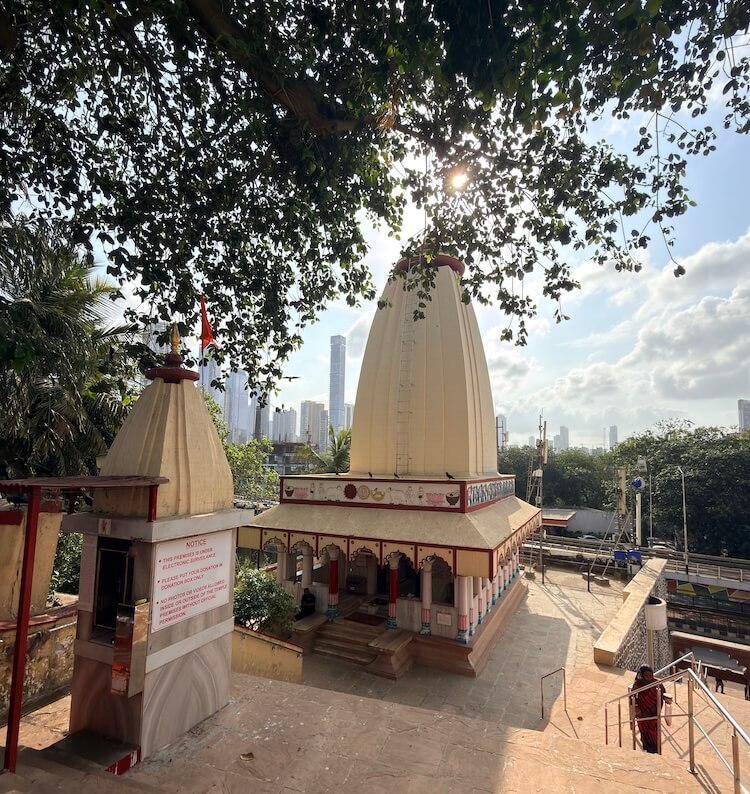
Shop Photo FramesThe Markandeshwar Mahadev Temple, dedicated to Lord Shiva, the beloved deity of Sage Markandeya, is located in Worli. This Shaivite temple is situated on a high hillock opposite the well-known ‘Atria Mall’ in Worli. With its grand temple architecture set away from the hustle and bustle, surrounded by trees, a small garden nearby, and a panoramic view of the prosperous Worli area, this temple complex attracts both devotees and tourists alike. A large number of devotees visit this temple during the morning and evening hours. During Mahashivratri, the area takes on the appearance of a fair.
The legend of Markandeshwar Mahadev is associated with Sage Markandeya. Born into the lineage of Sage Bhrigu, Markandeya was destined to live for only 16 years. From his childhood, he was a supreme devotee of Lord Shiva. He constantly worshipped Shiva in the form of a Shivling. When his life was set to end at the age of 16, the messengers of Yama, the God of Death, arrived to take his soul. Because Markandeya was constantly engaged in Shiva worship, the messengers could not cast the noose of death upon him. Eventually, Yama himself went there and cast the noose upon Markandeya. The noose mistakenly fell upon the nearby Shivling. Instantly, Lord Mahadev appeared from the Shivling and, in his fury, attacked Yama, leaving him lying on the verge of death. Yama began to plead with Mahadev for his life. Mahadev granted life to Yama in exchange for granting immortality to Markandeya.
The ‘Mahamrityunjaya Stotra’ is believed to be the composition of the Shiva devotee Markandeya. He narrated the ‘Markandeya Purana’, one of the 18 Mahapuranas of Hinduism. This Purana consists of 137 chapters and 6,900 verses. Ludo Rocher, a Sanskrit scholar and author of many books on Hindu theology, holds the opinion that the ‘Markandeya Purana’ is the most ancient Purana. This Purana offers a glimpse into the culture of the Gupta period. The ‘Marathi Vishwakosh’ states that this Purana was likely written in the region of the origin of the Godavari river during the Gupta period, i.e., the 4th to 5th century AD. The ‘Devi Mahatmya’, famous as ‘Durga Saptashati’, is contained in the 13th chapter of this Purana. Hymns to Agni and Surya are also found within it. It also includes other narratives such as the biography of King Avikshit, the story of King Nala, the tale of Ramchandra, and the childhood stories of Shri Krishna. It contains the childhood pastimes of Shri Krishna, his leelas in Mathura and Dwarka, and stories of all his incarnations. Shivlings established by Sage Markandeya, a supreme worshipper of Shiva, are referred to as ‘Markandeshwar’. The village of Shahabad Markanda is situated on the banks of the Markanda River in the Kurukshetra district of Haryana. Legend has it that Sage Markandeya worshipped Shiva in the vicinity of this village, and it was here that Yama came to take his life. There is an ancient Markandeshwar Mahadev temple in this village. Shivlings have been established in the name of Markandeshwar at various places across the country, and one such temple is located in Worli.
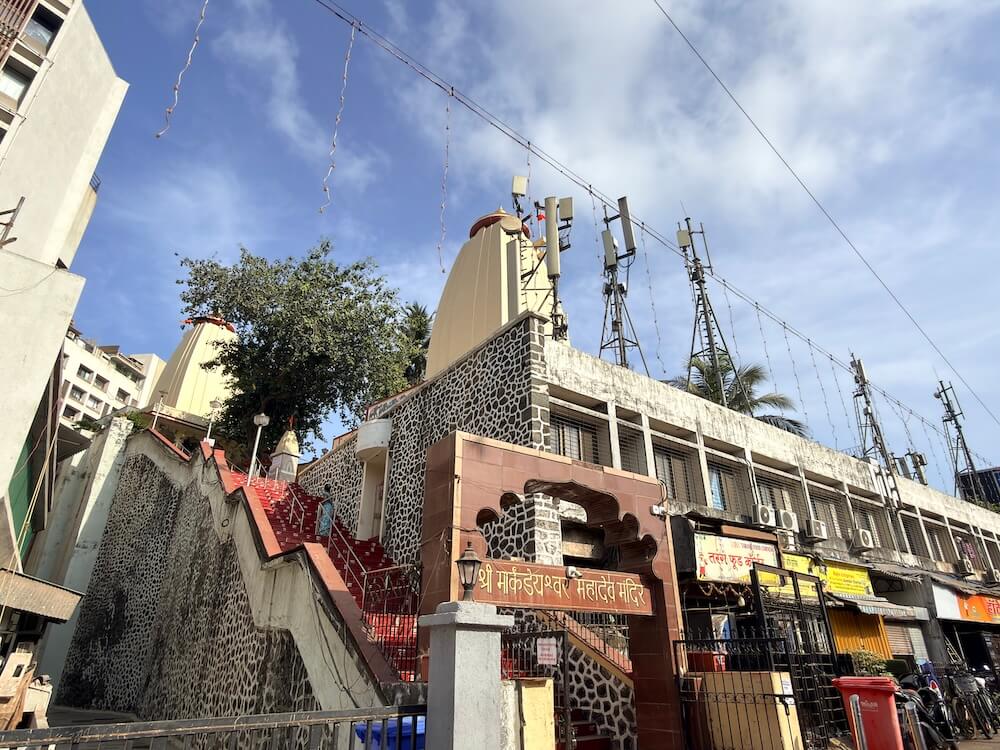
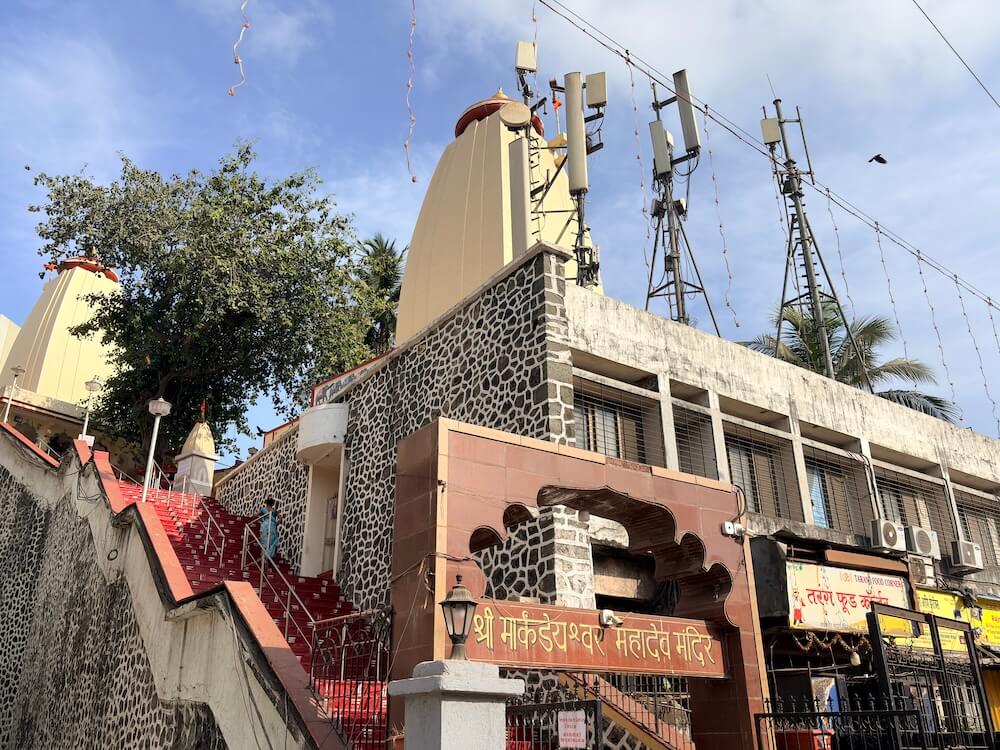
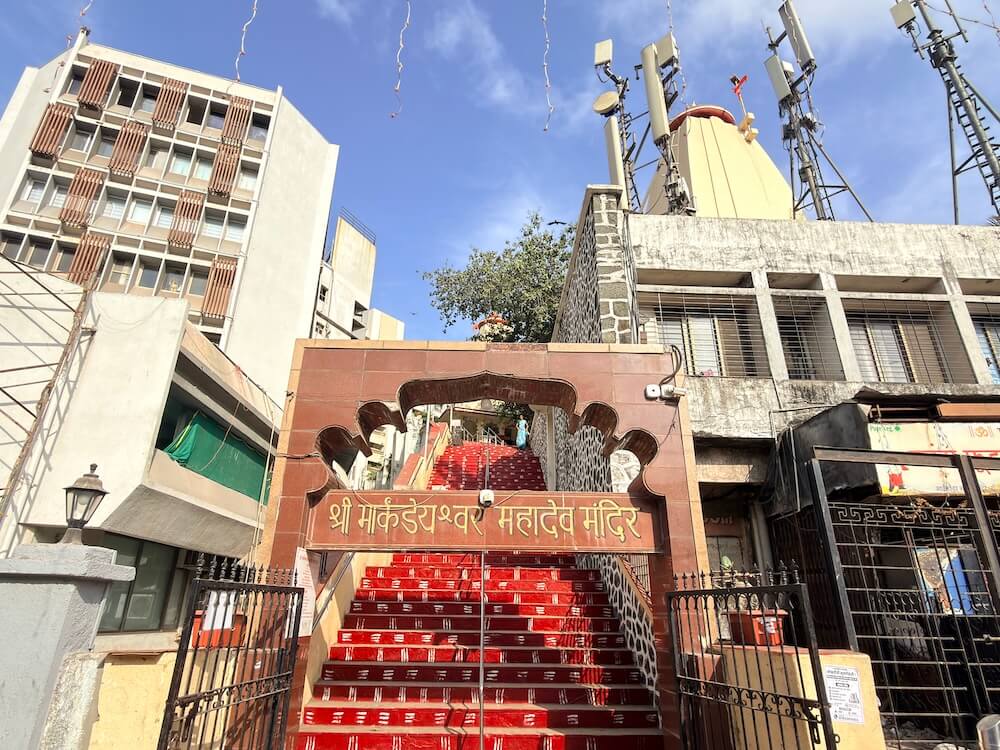
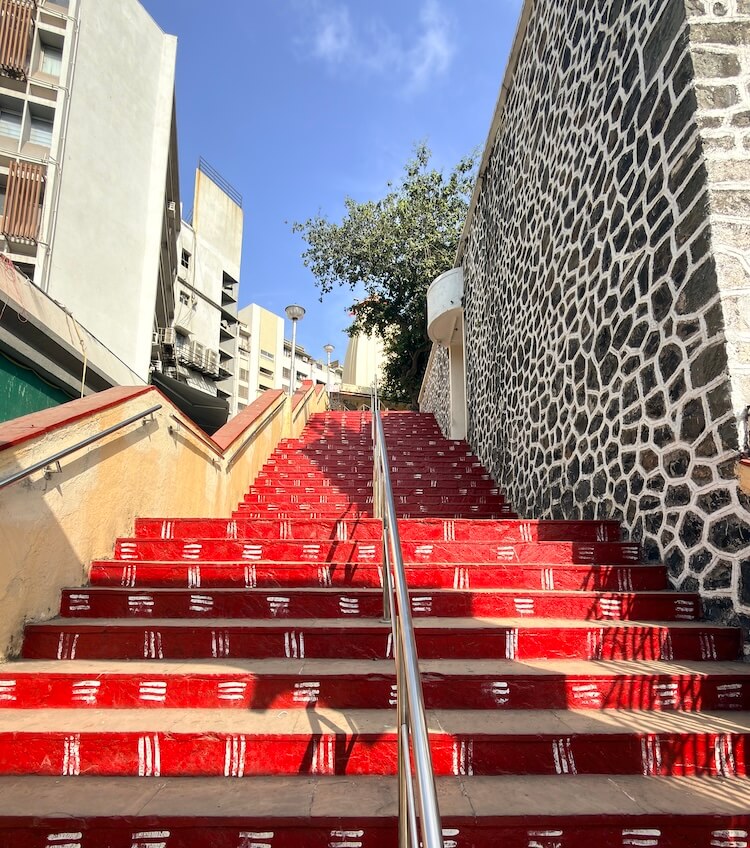
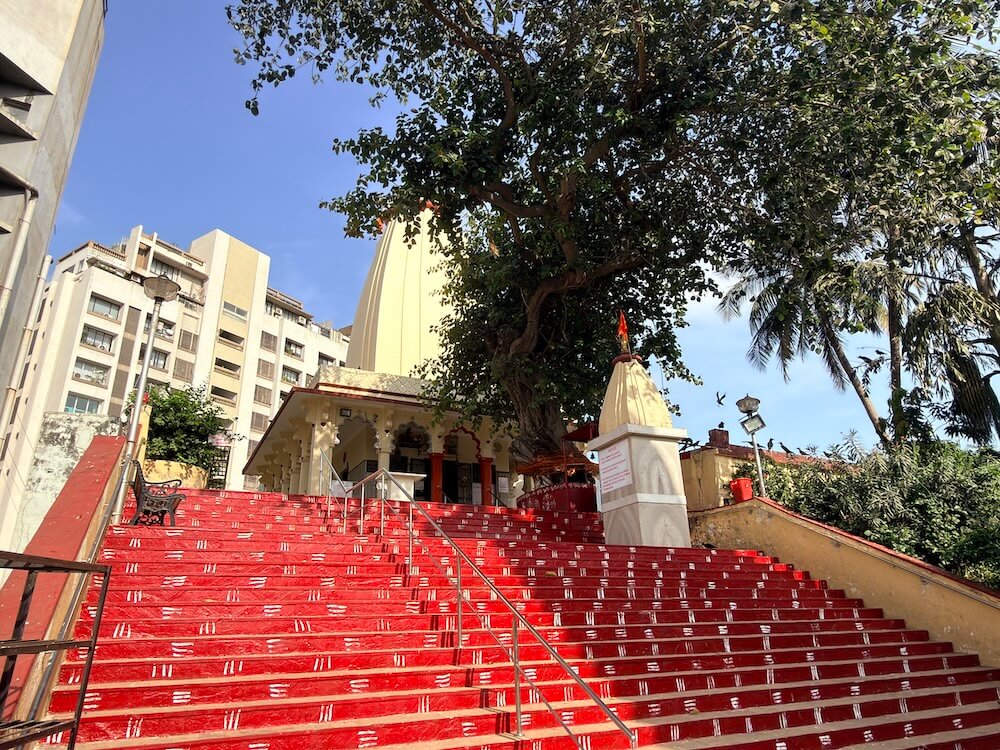
One enters the temple courtyard by climbing 73 steps painted in red. The Markandeshwar temple is situated in the middle of this spacious, paved courtyard. In front of the temple stands a large banyan tree. On the platform of this tree, decorated with paintings of a peacock, serpent, and Ganesha, sits a brass idol of Sage Markandeya. Next to this idol is a marble Nandi. This Sandhara-style temple is built on a high platform of 6 steps. The temple structure consists of a Sabha Mandap (assembly hall) and a Garbhagriha (sanctum sanctorum). The roof of the Sabha Mandap is flat. Above the Garbhagriha is a grand Shikhara (spire) that tapers towards the top on all four sides. Atop the Shikhara are a circular Amalaka and a Kalash.
This Sabha Mandap is of an open type. The Garbhagriha is located in the center of this hall, which features square carved pillars and arched doorways. There is a circumambulation path (Pradakshina Marg) around the Garbhagriha. In front of the entrance to the Garbhagriha, there is a beautiful black stone idol of Nandi on a stone pedestal. In front of that idol is a Kurma (tortoise) sculpture. In the center of the Garbhagriha, adorned with marble tiles, is a large marble Makhar (shrine).
Inside this Makhar, the stone Linga of Markandeshwar Mahadev is seated on a Shalunka (base) covered with silver plates featuring intricate carvings. Near the spout of the Shivling are idols of Ganesha and Kalabhairava. Nearby is a sculpture depicting the scene of Shiva worship from the legend of Markandeya. This sculpture shows the child Markandeya embracing the Shivling and Lord Shiva granting him protection. In the niche on the back wall of the Garbhagriha, idols of Parvati, Ganesha, and Hanuman are seated.
On the path of steps going down from the temple courtyard, there is a marble shrine of Hanuman at one point. After descending some steps, there is a temple of Mahalakshmi in a courtyard on the left. The structure of this temple consists of a Sabha Mandap, Antarala (vestibule), and Garbhagriha. Above the Garbhagriha is a high Shikhara that tapers towards the top on all four sides. It is topped with a circular Amalaka and a Kalash. On the railing at the base of this Shikhara, relief sculptures of a lotus, cow, moon, deer, sun, drum, musician, and elephant are carved. In the semi-open Sabha Mandap of this temple, there is a marble Havan Kund (sacrificial fire pit). The idol of Mother Mahalakshmi is installed in the shrine on a high altar in the Garbhagriha. This idol, crafted from marble, is adorned with clothes, various ornaments, and flower garlands. Above this idol is a silver umbrella.
The ‘Markandeshwar Mahadev Trust’ manages these temples. Devotees can have darshan at the Markandeshwar Mahadev Temple every Monday from 6 AM to 10 PM. From Tuesday to Sunday, devotees can have darshan from 6 AM to 12 PM and from 4 PM to 9 PM. There is a large crowd of devotees here every Monday and Tuesday. Mahashivratri and Navratri are the two major festivals at this temple. During these times, the temple premises take on the appearance of a fair due to the influx of devotees.
This sacred temple stands as a testament to deep spiritual devotion, ancient architectural grandeur, and rich local cultural traditions.
The sanctum sanctorum houses the divine idol consecrated according to ancient Vedic traditions, surrounded by serene courtyards and traditional temple architecture.
Navratri, Maha Shivratri, Annual Temple Jatra & Deepotsav
Compare and book flights, secure top-rated local hotels near the temple, hire reliable guides, and rent cars instantly.
Extend your pilgrimage by visiting other highly sacred temples located nearby.


Add ₹999 more to unlock FREE SHIPPING!
Your sacred cart is currently empty.
Shop Photo FramesFill in your delivery details below to place your order.
Add comment