
Add ₹999 more to unlock FREE SHIPPING!
Your sacred cart is currently empty.
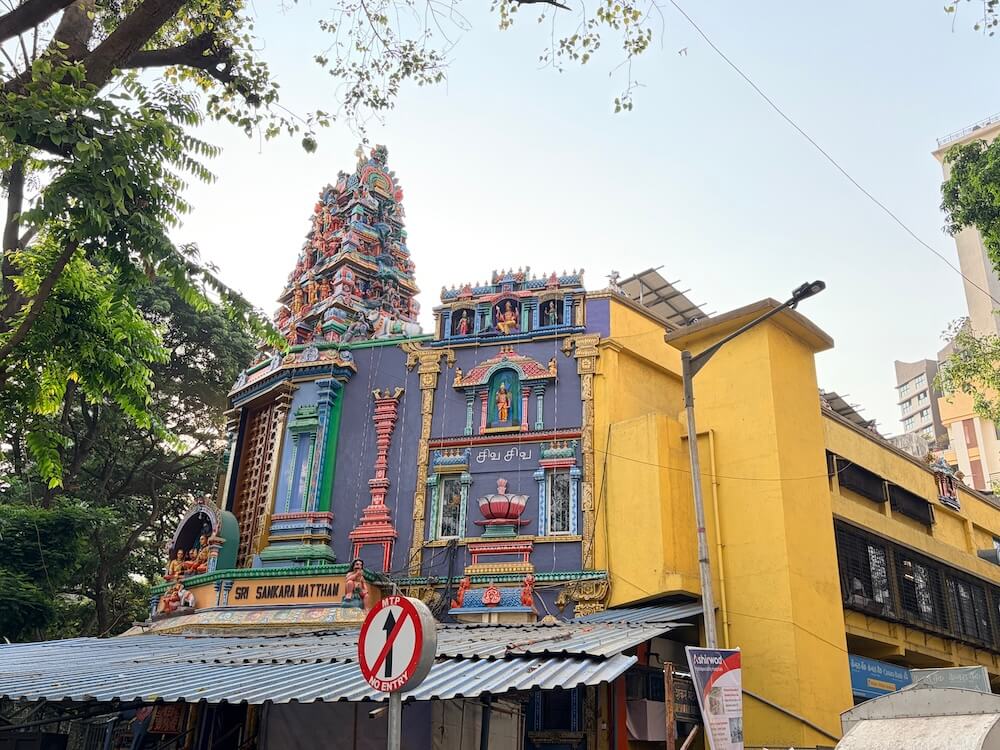
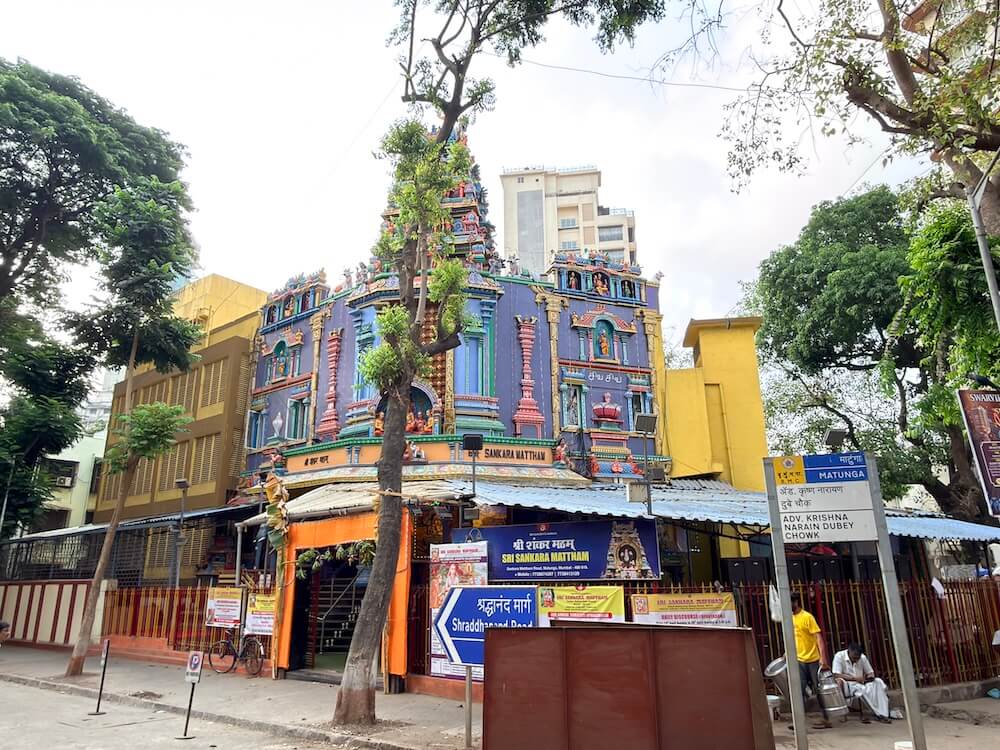
Shop Photo FramesIn Matunga, there is a temple dedicated to Adi Shankaracharya Bhagavatpada, who is revered by devout Hindus as Dakshinamurti or Lord Shiva Himself. This temple is situated within the Shri Shankara Matham, which is built in the South Indian architectural style. A unique feature of this Matham-temple, established 87 years ago, is that it is one of the few temples in India where Adi Shankaracharya is the principal presiding deity. Similarly, it is the only temple where the Shankaracharyas of both Kanchi and Sringeri Peethams visit annually. This temple-Matham, which preserves Vedic culture in Mumbai, hosts various religious programs throughout the year.
Adi Shankaracharya is glorified as ‘Shanmathasthapakacharya’ (the establisher of the six systems of worship) for his great work of uniting the followers of the six Hindu sects: Shaiva, Vaishnava, Shakta, Saura, Ganapatya, and Kaumara (the sect worshipping Kartikeya). He showed the harmonious path of worshipping five popular deities of that time – Aditya, Ambika, Vishnu, Gananatha, and Maheshwara – together through the Panchayatana Puja. The systematic refutation of ‘Astika’ (theistic) philosophies like Samkhya-Yoga, Nyaya-Vaisheshika, Purva Mimamsa, and ‘Nastika’ (atheistic) philosophies like Buddhism, Jainism, and Lokayata, and establishing the Kevaladvaita (Absolute Monism) philosophy on a strong foundation, is considered the Acharya’s greatest contribution. There is no consensus among scholars regarding his period. However, his era is generally considered to be from 788 CE to 820 CE.
Adi Shankaracharya was born in a village named Kalady, near the town of Aluva in Kerala. His lineage belonged to the Nampoothiri (Nambudri) Brahmins of the Krishna Yajurveda’s Taittiriya Shakha. As matters like his birth and period are debated, his scriptures are considered his true biography, and his life story is recounted in the following shloka: ‘Ashtavarshe Chaturvedi Dvadashye Sarvashastravid. Shodashe Kritavan Bhashyam Dvatrimshe Munirabhyagat.’ This means: ‘At the age of eight, he mastered all four Vedas; at twelve, he became proficient in all scriptures; at sixteen, he composed commentaries on the Prasthanatrayi; and at thirty-two, he attained Mahaprasthana (final departure).’ The Prasthanatrayi comprises the Srimad Bhagavad Gita, the Upanishads, and the Brahma Sutras. Adi Shankaracharya is known as a great commentator on these texts, the proponent of Kevaladvaita philosophy – which states that the one attributeless Brahman alone is real, the individual soul is not different from it, and all other existence is illusory – and a transformative Vedantin who advocated religious reform with profound words like, ‘There is no rule that one should be foolish simply because one’s ancestors were foolish’ (Nahi purvojo mudha asitityatmani mudhena bhavitavyamiti kinchidasti pramanam – Brahma Sutra 2.1.11). During his 32 years of life, the Acharya wrote approximately 400 minor treatises in addition to his commentaries on the Prasthanatrayi. The stotras composed by him, such as ‘Dakshinamurti Stotram’, ‘Harim Ide’, ‘Anandalahari’, and ‘Saundaryalahari’, are particularly famous. To ensure the continuous propagation of his philosophy, he established Mathams in all four directions of India: Badrinath, Dwarka, Jagannath Puri, and Sringeri. In addition to these four Mathams, he also established the Sumer Math in Kashi and the Kanchi Kamakoti Peetham. Adi Shankaracharya appointed authoritative pontiffs (Peethadhishas) to these Mathams. That tradition continues to this day.
In the country, there are only a few temples where Adi Shankaracharya is the principal deity. Among them, the temples at Kalady (his birthplace), Kanchipuram, and Enathur are famous. The temple at Shankara Matham in Matunga is one of them. The story of the establishment of this Matham is told as follows: Subramanya Shastrigal was a Vedic scholar from Chennai. He was a supreme devotee of Adi Shankaracharya. In 1939, he came to Mumbai for his livelihood. Here, as a Vedic scholar, he performed various religious rituals for people. During this period, he repeatedly began to have visionary dreams of Adi Shankaracharya. Through these dreams, Adi Shankaracharya was inspiring him to impart the teachings of the Vedas, Upanishads, and Dharma Shastras to people and to establish a center. Disturbed by these visions, Subramanya Shastrigal went to Kanchipuram in Tamil Nadu and met the then Shankaracharya of Kanchi Kamakoti Peetham, Shri Chandrashekarendra Saraswati Swami. At that time, the Swami advised him to start Vedic classes based on the Kevaladvaita philosophy propounded by Adi Shankaracharya. Accordingly, he established this Matham in Matunga in 1939. It is said that initially, the Vedic classes began in Subramanya Shastrigal’s house (Room No. 218, Mahavir Building). After the number of disciples grew, these classes were moved to a two-room house (Room No. 1-2, Mohan Mansion, currently Dhabawala Mansion). In 1954, some prominent individuals from the community came together and decided to construct a larger building for the Matham. Accordingly, the Srinivas Building in Matunga was purchased, and the Matham was established there.
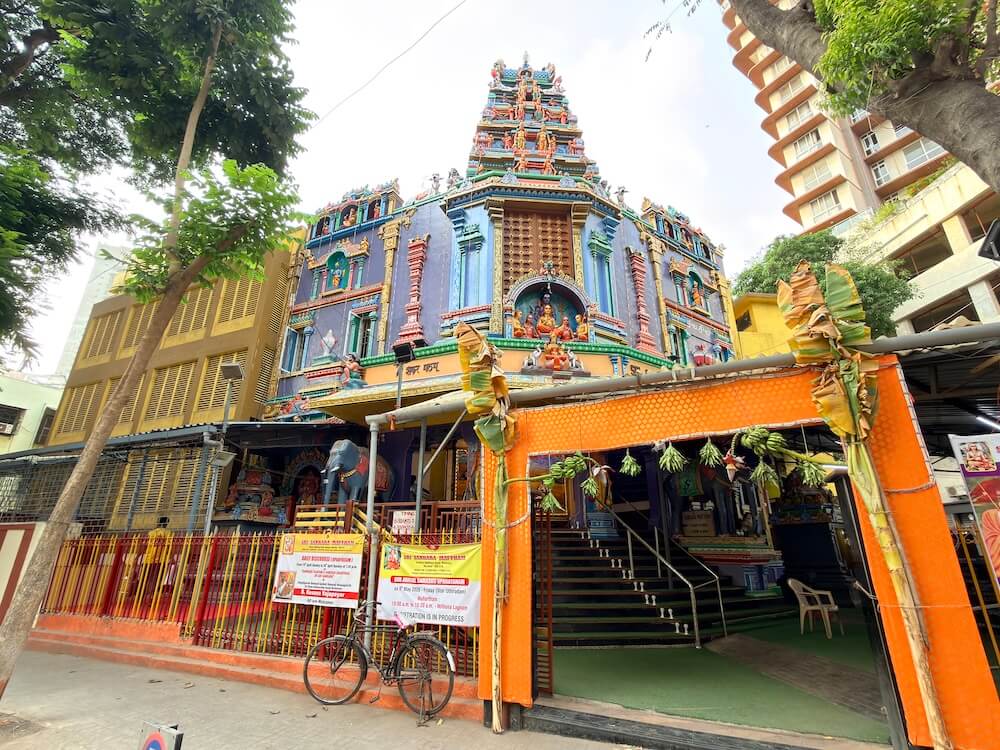
In 1959, a noble gentleman named M. Venkataramayya offered a marble idol of Adi Shankaracharya to the Matham. This Matham houses a Banalinga, a Panchayatana set, and sandalwood Acharya-Padukas (sandals). These were gifted by the Shankaracharya of Kanchi Kamakoti Peetham, while the Shankaracharya of Sringeri Peetham provided the idol of Ganesha and a Shaligram for daily worship. On May 10, 1978, on the auspicious occasion of Akshaya Tritiya, the present temple was consecrated with its first Kumbhabhishekam performed by Shankaracharya Abhinava Sachchidananda Tirtha Swami of Dwarka Peetham. This temple is located on the second floor of the three-story Matham, which was constructed at a cost of millions of rupees. The facade of the temple is built in the South Indian temple style. The temple features a magnificent Rajagopuram. It has five sections, representing the five elements or Panchamahabhutas of the universe. This Gopuram is also referred to as Sthula Linga. It features images of Shivashankara, Vishnu, Brahma, and the essence of Shankara. On both sides of the Gopuram are Shankhanidhi and Padmanidhi. On the walls adjacent to the Gopuram (on the Salai Gopuram), in the upper right niches, there are images of Ganesha, Vyasa, and Agastya. To the left, in the upper niches (devakoshthas), are enshrined the idols of Murugan, Valli, and Devasena.
Upon entering the temple precincts, one is greeted by ten steps directly ahead. Flanking these steps are the majestic idols of the elephant kings, Airavat and Pushpadant. Beside them are the images of Vayu and Varun, representing the West and Southwest directions respectively. Within the courtyard, to the right, are beautifully adorned shrines dedicated to Varsiddhi Vinayak, and to the left, to Anjaneya (Hanuman). Ascending these steps leads one into the Ardhamandapa of the temple. Directly ahead, on the wall, is a magnificent bas-relief depicting Lord Shri Krishna imparting the Gita Upadesha to Arjuna on the battlefield of Kurukshetra. Here, within a glass casing, is enshrined the idol of Ashtabhuja Durga Devi. From here, to the left, is a flight of 22 steps. Ascending these steps leads one into the Mahamandapa of the temple. On the lintel above the entrance to the Mahamandapa are 36 lotus motifs. Each of these lotus motifs has 36 petals. This entrance is known as ‘Torana Vasal’. In the Sankhya Darshana of Hindu Dharma, 24 tattvas (principles) of Dharma are expounded. The Puranas speak of 30 tattvas, while the Kashmiri Shaiva Agamas enumerate a total of 36 tattvas. These tattvas include Shiva, Shakti, Sadashiva, Ishwara, Shuddhavidya, Maya, Kala, Vidya, Kala, Purusha, Prakriti, Buddhi, Mahabhute, and others. These 36 lotus blossoms symbolize these 36 tattvas.
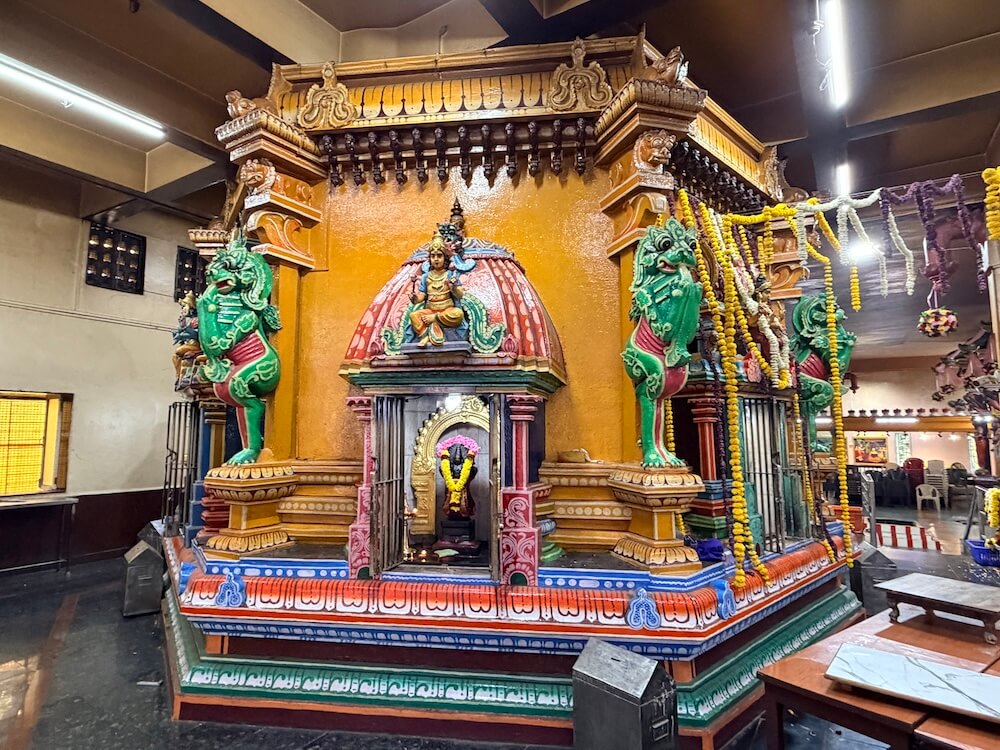
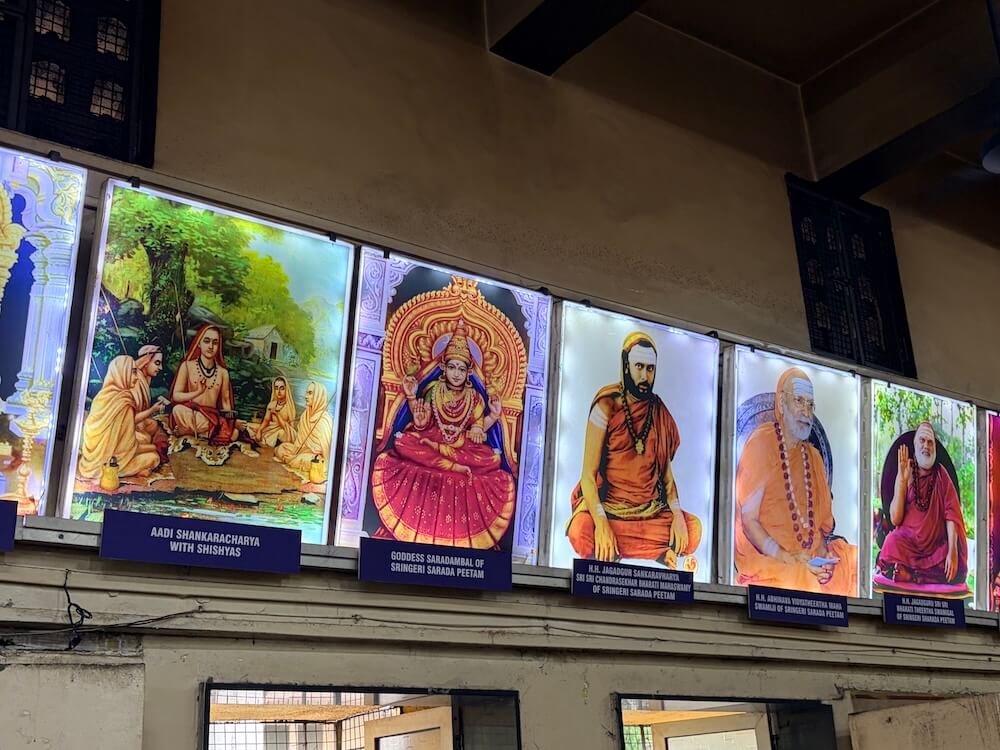
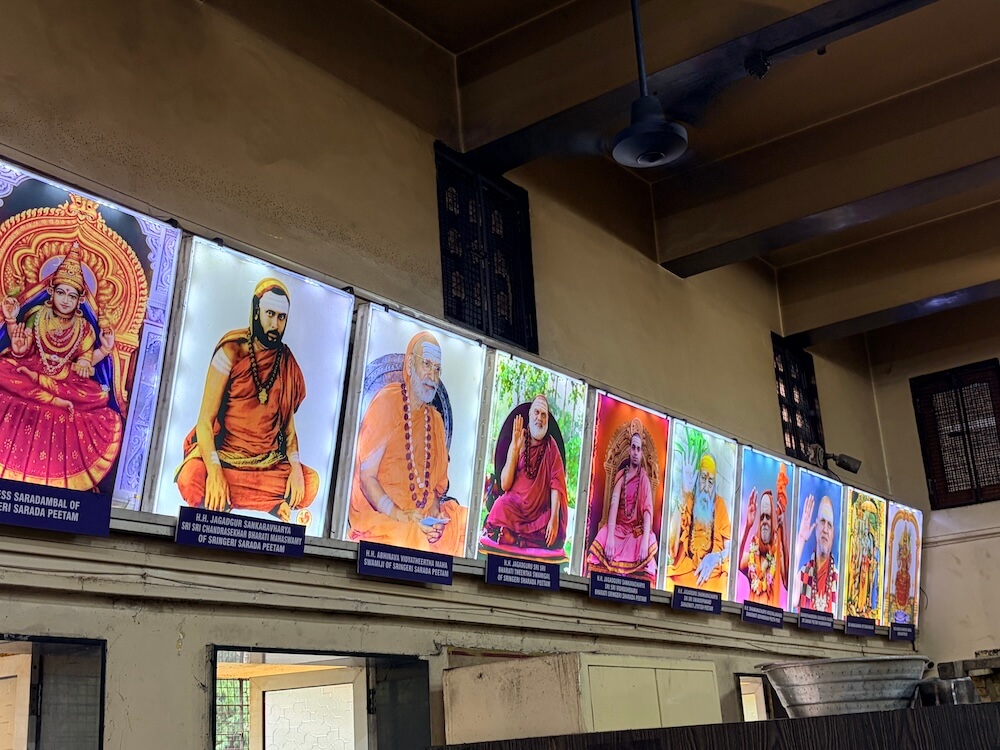
The Mahamandapa of the temple is spacious and adorned with marble flooring. On both sides of the Mahamandapa, there are five pillars each. Upon them are enshrined the idols of Dattatreya, Narayan, Padmodbhava, Vasistha, Shakti, Parashar, Vyas, Shuk, Gaudapada, and Govinda Bhagavatpada. This represents the Guru Parampara (lineage of preceptors) of Adi Guru Shankaracharya. On the walls of the Mahamandapa, significant events from the life of Shankaracharya are depicted in paintings. On the ceiling (vitan), there is a mythical lotus with 1008 petals. At its center is a Bindukon (a point or dot). This is considered the abode of Adi Parashakti. Ahead, on a tall and broad Adhishthana (pedestal), is the Garbhagriha (sanctum sanctorum) of the temple. One enters this Adhishthana by ascending five steps. On both sides of the entrance to this South Indian style Garbhagriha are traditional Dwarapalas (gatekeepers). Above the entrance is an image of Swarnalakshmi. Here, on both sides, are large idols of two Dwarasevakas (attendants). Inside, on a tall marble altar (vedi), is enshrined the idol of Jagadguru Adi Shankaracharya in a serene posture, adorned in saffron robes (kashayavastra). This idol is sculpted from white marble. In front of the altar is a small structure resembling a snow-capped peak, upon which a Shivalinga is enshrined. Further ahead, a small Panchadhatu (five-metal alloy) idol of Shankaracharya is enshrined. Adjacent to the altar, on a high platform, is an idol of Shiva in his Nataraja form. In the circumambulatory path (prakara) outside the Garbhagriha, there are small shrines housing idols of Ganesha, Shakti, Surya, Vishnu, Dakshinamurti, and Kartikeya, sculpted according to Agama Shastras. The sacred water (tirtha) from the abhisheka performed for all these deities flows back into the Garbhagriha. It then circumambulates the Shivalinga and the idol of Adi Shankaracharya there, before exiting through a Gomukha (cow’s mouth spout). On the wall at the rear of the Garbhagriha, along with images of Adi Shankaracharya and Devi Sharadamba of the Sringeri Sharada Peetha, large portraits of all Shankaracharyas who have visited this temple to date are displayed.
Devotees can have Darshan of the idol of Adi Shankaracharya in this temple daily from 5:30 AM to 11 AM and from 4:30 PM to 9 PM. The temple’s Pratisthapana Day (consecration anniversary) is celebrated on Akshaya Tritiya. This day commences with Suryanamaskara (sun salutations). Following this, Kalashabhisheka (ablution with sacred water from a pot) is performed for the various deities in the temple. Rituals such as offering new garments (navavastra), archana (devotional offering), naivedya (food offering), and deepapradana (offering of lamps) are performed for them. Since 1941, an 11-day Shankar Jayanti Utsava (celebration of Shankaracharya’s birth anniversary) has been observed in this Matha-temple. During this period, a Maharudra (grand ritual dedicated to Lord Shiva) is performed here. The Jayanti (birth anniversary) and Vardhanti (ascension anniversary) celebrations of the Acharyas of the Kanchi and Sringeri Peethas are also observed in the temple. Festivals and celebrations such as Navaratri Utsava, Ram Navami, Skanda Shashti, Ganesh Chaturthi, Arudra Darshanam, Vaikuntha Ekadashi, Annabhishekam, and others are observed here according to Vedic traditions. During the Ram Navami Utsava, the Sanskrit Ramayana is recited here for nine days, from Pratipada to Navami. On Maha Shivaratri, four Yama Pujas are performed here from 4 PM in the evening until 6 AM the next morning. During these pujas, a large number of devotees are present in the temple.
Regular Veda and Sanskrit classes are conducted at this Matha. To date, over 5000 students have benefited from Vedic education here. Under the guidance of the Matha, approximately 39 students are studying Yajurveda and Samaveda at the Shri Vitthal Rukmini Veda Pathshala in Pandharpur. Their examinations are conducted through the ‘Veda Rakshan Nidhi Trust’ of the Kanchi Matha. This Matha also provides assistance to the Veda Sanrakshan Samiti in Palakkad, Kerala; the Shrauta Veda Pathshala in Deulgaon Raja, Maharashtra; the Yagneshwar Pratishthan Vedshastra Pathshala in Parbhani; the Rigveda Pathshala in Tamil Nadu; and Gurukulas in Kumbakonam, Parbhani, and Pune. Furthermore, the Matha provides a monthly pension of 5000 rupees to each of 31 Vedic Pandits and Agnihotris. Most of these Pandits are over 75 years of age. Annually, a Sanskrit scholar is honored with the ‘Adi Shankar Puraskar’. This award comprises a cash prize of one lakh rupees and a citation (manpatra). In addition to religious activities, the Matha provides medical assistance to the poor, food to many cancer patients in the city, and educational materials to needy children.
This sacred temple stands as a testament to deep spiritual devotion, ancient architectural grandeur, and rich local cultural traditions.
The sanctum sanctorum houses the divine idol consecrated according to ancient Vedic traditions, surrounded by serene courtyards and traditional temple architecture.
Navratri, Maha Shivratri, Annual Temple Jatra & Deepotsav
Compare and book flights, secure top-rated local hotels near the temple, hire reliable guides, and rent cars instantly.
Extend your pilgrimage by visiting other highly sacred temples located nearby.


Add ₹999 more to unlock FREE SHIPPING!
Your sacred cart is currently empty.
Shop Photo FramesFill in your delivery details below to place your order.
Add comment