
Add ₹999 more to unlock FREE SHIPPING!
Your sacred cart is currently empty.
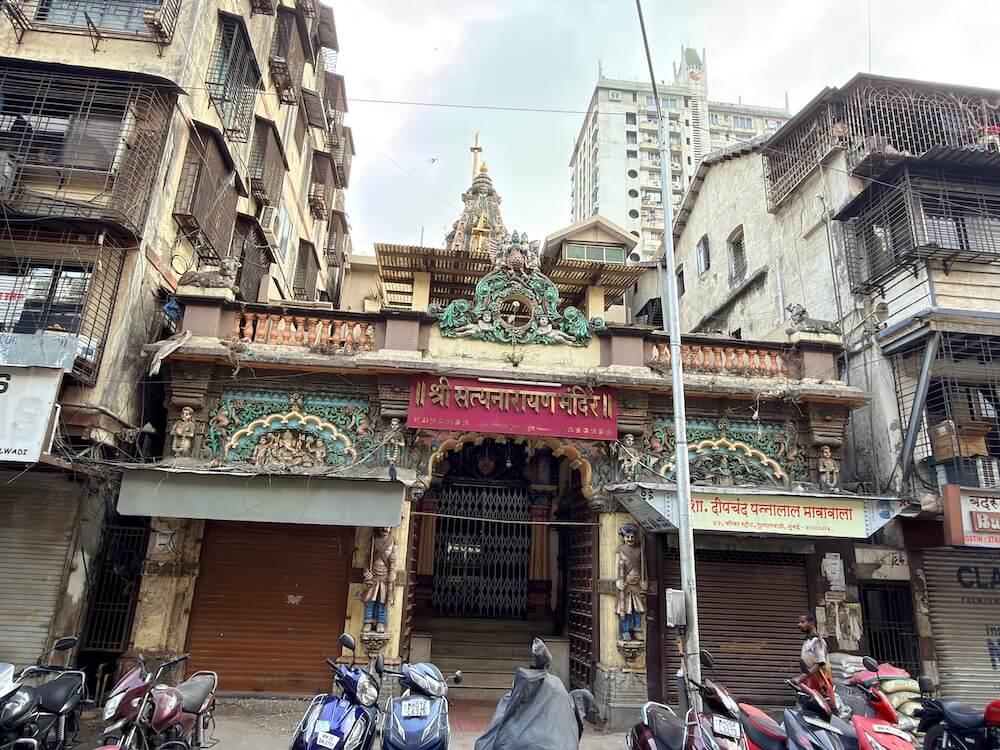
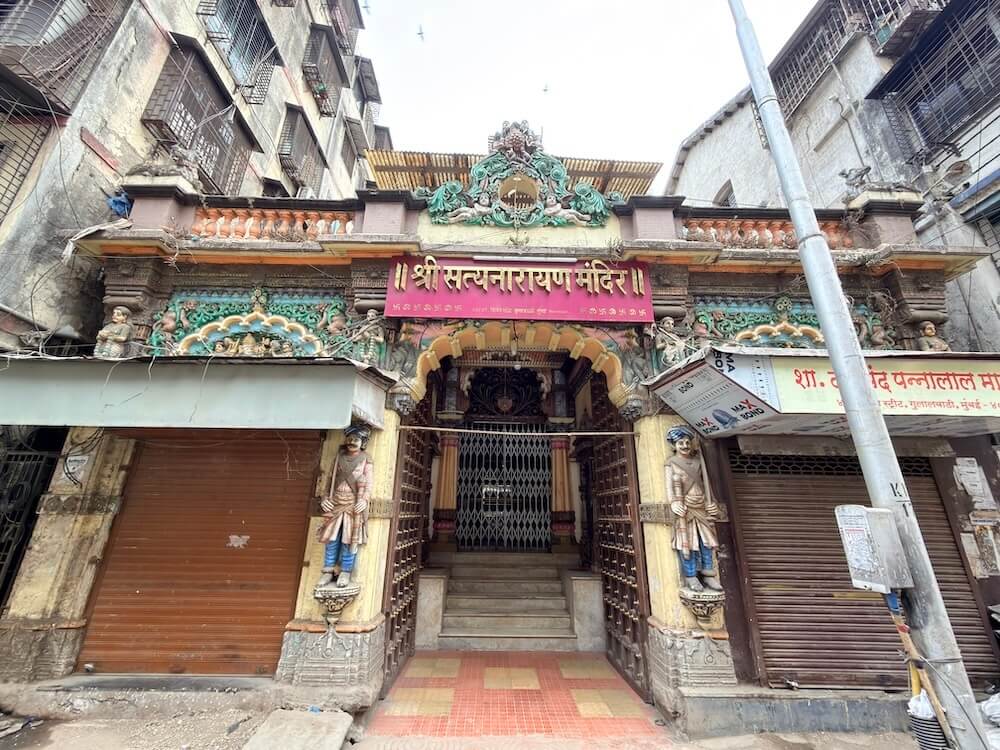
Shop Photo FramesThe Bhuleshwar and Cawasji Patel Tank (C.P. Tank) area developed as a major commercial and cultural hub in Mumbai during the late nineteenth and early twentieth centuries. Traditional merchant communities such as the Gujaratis, Marwaris, and Bhatias who settled in this region established numerous temples dedicated to their family deities, chosen deities, and revered gods. The Satyanarayan Temple is considered one of the old temples from this prosperous mercantile era. This temple is situated at Gulalwadi in the C.P. Tank area.
According to the Marathi Vishwakosh, Satyanarayan is a ‘Kamya’ vow—a ritual performed with specific desires in mind—which is popular in Bengal and Maharashtra. Lord Satyanarayan is the presiding deity of this vow. Additionally, family deities such as Ganapati, Gauri, Varuna, the Ashtadikpalas, and the Navagrahas are also worshipped during this ritual. The story of Satyanarayan is found in the Reva Khanda of the Skanda Purana. Skanda is the son of Shiva, and this Purana is famous by his name. According to the narrative, sages like Shaunaka asked Suta in the Naimisharanya forest, “O greatest of sages, please tell us which vow fulfills all the desires of the heart.” To this, Suta replied that Narada had once asked the same question to Lord Vishnu. Lord Vishnu then said, “Narada, I am pleased with you. I shall tell you of a meritorious vow unknown to anyone in heaven or on earth. Whoever performs this vow enjoys happiness throughout life and eventually attains salvation. This vow destroys sorrow and grants wealth, prosperity, good fortune, and progeny.” This is known as the vow of Shri Satyanarayan. This is the very vow that Lord Vishnu himself imparted to Sage Narada.
There are many stories of this vow in the Reva Khanda. A poor Brahmin and an impoverished woodcutter from the village of Kashipur attained prosperity after performing the Satyanarayan vow. Similarly, a king named Ulkamukha was blessed with progeny after performing this ritual. These stories are narrated during the Satyanarayan Puja. The story of the merchant Sadhu Vani, who faced calamities after failing to perform the vow despite his wishes being fulfilled, is particularly famous. A note on this vow by A. R. Kulkarni in the Marathi Vishwakosh states, “There is no mention of this worship (vow) in documents from the Peshwa era… There is some similarity between the worship of Satyanarayan and the worship of Muslim Pirs. There is a tradition of offering ‘Shirni’ (prasad) to Muslim Pirs. A similar practice is seen in the Satyanarayan Puja of Bengali Hindus. From there, it became prevalent in Maharashtra and other regions… Public worship of Satyanarayan is also performed. Currently, this puja has taken the form of a grand celebration.”
Many Satyanarayan temples have been built across the country. Among these, the Veer Venkata Satyanarayan Swamy Temple is especially famous. Established in the year १८९१ on the ‘Ratnagiri’ hill in Annavaram, Andhra Pradesh, this is considered the most famous, largest, and primary temple of Lord Satyanarayan in the country. It is recognized as the second most important pilgrimage site in Andhra Pradesh after the Tirupati Balaji Temple. Similarly, the Satyanarayan Tulsi Manas Mandir (Varanasi, Uttar Pradesh, established १९६४), Gudem Gutta Satyanarayan Swamy Temple (Gudem-Dandepally, Telangana, established १९६४), and the Satyanarayan Temple (Malhapara, Mungeli, Chhattisgarh) are also very popular. Raja Rai Bahadur Shivbaksh Bagla, founder of the ‘Bagla Group’ of industries in Bengal, was a staunch devotee of Satyanarayan. He started a timber business in Myanmar in the year १८७१. He built grand marble temples for Satyanarayan and Mother Lakshmi in Moulmein, Myanmar in १८७५, on Cotton Street in Kolkata in १८८३, and in Varanasi in १८८७. The family of Rai Bahadur Shivbaksh Bagla originally hailed from Charu in Rajasthan. Satyanarayan has been worshipped since ancient times by merchants coming from Rajasthan and Gujarat. One such merchant built this Satyanarayan temple in the C.P. Tank area.
This temple was built by a merchant named Sheth Bhanji, but the exact history of its establishment is unavailable. Krishnarao Raghunathji Navalkar, alias K. Raghunathji, published the book ‘The Hindu Temples of Bombay’ in the year १८९५. This book, praised by many prominent citizens of that time, British officials, as well as periodicals like ‘The Times of India’, ‘Newsman’, ‘Bombay Gazette’, and ‘The Christian Patriot (Madras)’, provides information on many temples in Mumbai. It contains information about a simple, six-by-ten-foot, dome-less Satyanarayan temple on ‘Shidi Road’ at Malabar Hill. However, there is no mention of this large temple in the C.P. Tank area. This makes it clear that this temple must have been built after the year १८९५.
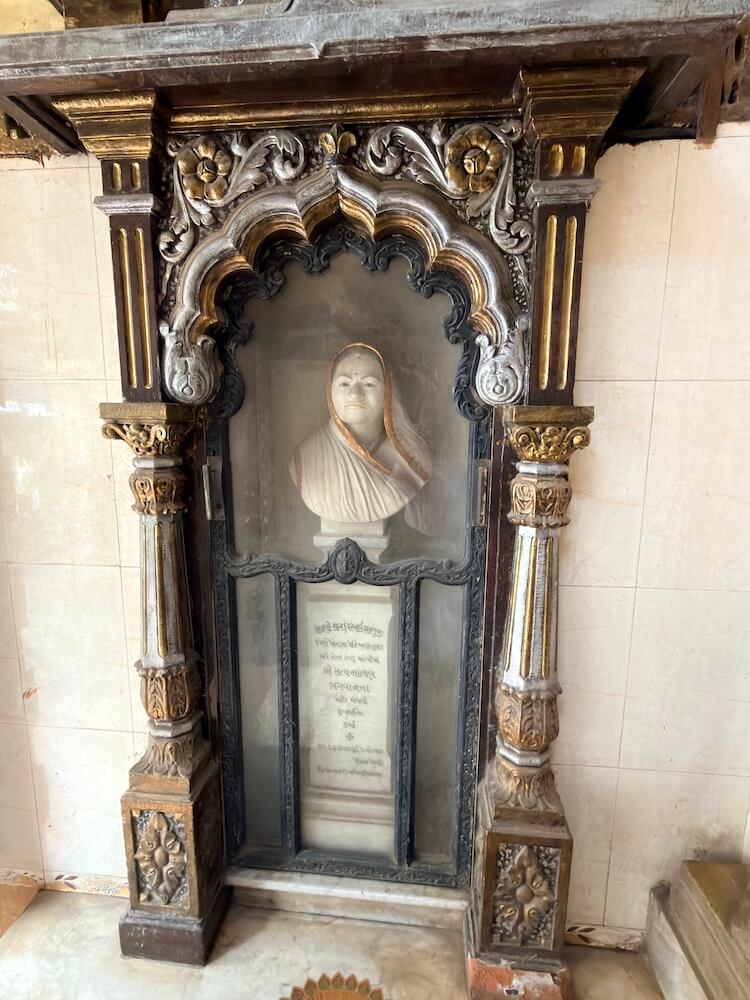
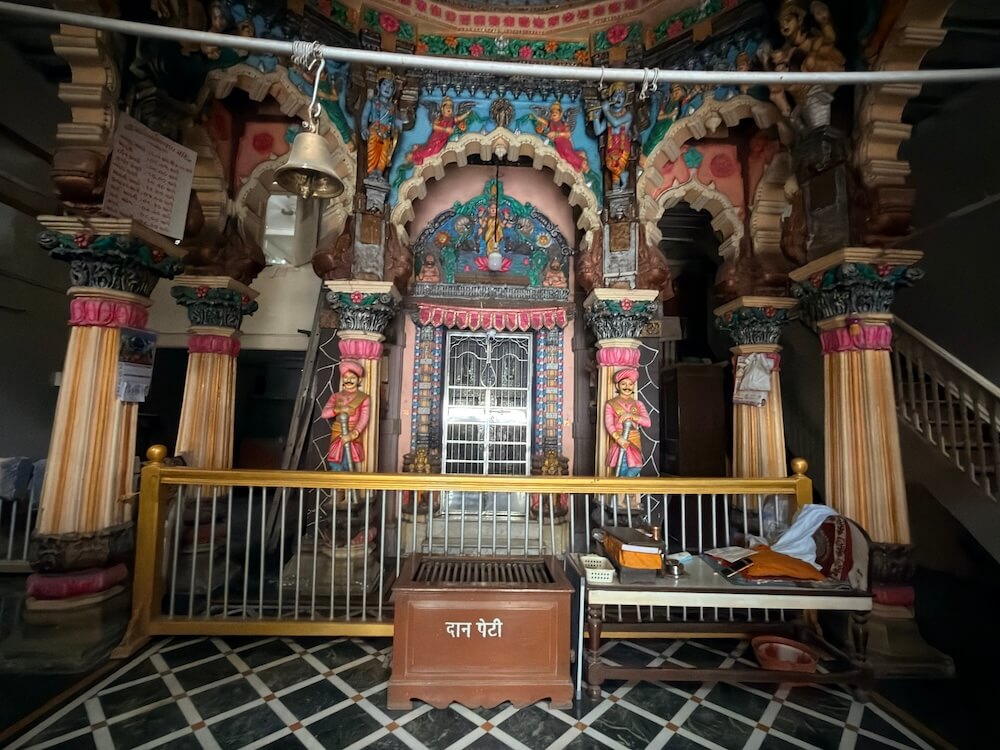
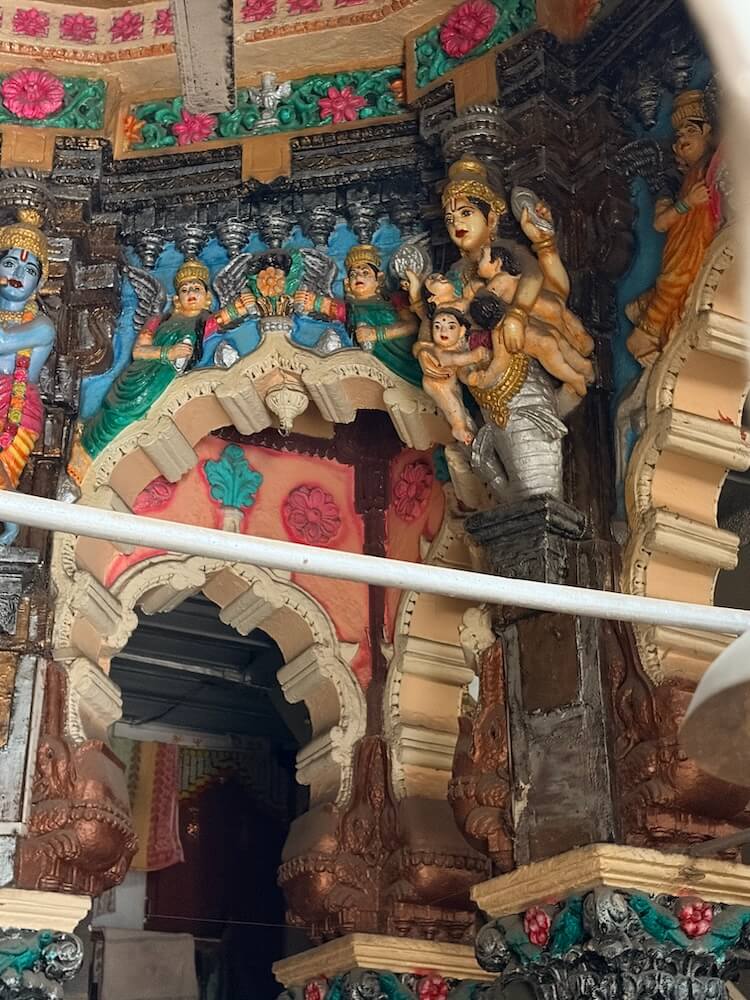
Located in the bustling market here, this temple is built on a high plinth. The temple has a small entrance porch. On the pillars of its arched gateway are statues of door-guardians in the Rajasthani style, holding staffs and swords. On the front wall of the temple, in a carved, decorative arched niche on the upper left, is an idol of Ganesha, and on the right is an idol of Shri Krishna. This entrance has a sturdy teak wood door, just like those found in old mansions (havelis). Above the entrance, on the ceiling, is a distinctive structure bearing the imprint of the contemporary Baroque architectural style. At its base are sculptures of angels from the Western tradition. At the pinnacle sits the idol of Lord Vishnu mounted on Garuda. One enters the main hall of the temple by ascending six steps at the entrance pavilion. The main hall features a high entrance gate with a Makara Torana supported by two large pillars. In this spacious main hall with marble flooring, the sanctum sanctorum of the temple is directly ahead. In front of this sanctum is an Ardha Mandapa, built on tall and wide pillars with a domed ceiling. This Ardha Mandapa is adorned with intricately carved pillars, sculptures of deities like Shri Ram, Shri Krishna, and Mother Lakshmi at their tops, arched gateways between the pillars, floral patterns on these arches, and sculptures of Surasundaris. On the two pillars on either side of the sanctum entrance, there are sculptures of Rajasthani-style gatekeepers holding staffs. Sculptures of gatekeepers are also carved at the base of the ornate door frame of the sanctum, while in the upper section, a relief sculpture of the four-armed Goddess Lakshmi standing on a lotus flower is carved. On both sides of this sculpture are images of two sages. Inside the sanctum, on a high altar, stands the idol of Lord Satyanarayan carved in marble stone. Satyanarayan is considered a form of Vishnu. The idol here, like the Vishnu idol, is Samapada and four-armed. In its upper two hands, it holds a conch and a flower, while in the lower hands, it holds a discus and a mace. This pleasant-faced idol is adorned with rich garments and jewelry. In front of the idol, on the steps of the altar, are two silver idols of the Mother Cow and two of the King of Elephants. The temple features a tall South Indian-style Shikhara. Atop it is a three-tiered Amalaka crowned with a golden Kalash. Near the Shikhara, there is a tall golden flagstaff, similar to the one found in front of Balaji temples in the south.
Devotees can have Darshan in this temple from 6 to 7, 9 to 12, and in the evening from 5 to 8.30. The Aarti takes place here at 6.05 in the morning. At 10 in the morning, the deity is adorned with Shringar. At 10.30, Bhog (offering) is presented. Following this, Aarti is performed at 11 in the morning and again at 6.30 in the evening. After the Bhog is offered at 7.30 in the evening, the Shayan Aarti of the deity is performed at 8.30. Various festivals and celebrations are observed in the temple. During the month of Shravan, the formal Satyanarayan Mahapuja is conducted here.
This sacred temple stands as a testament to deep spiritual devotion, ancient architectural grandeur, and rich local cultural traditions.
The sanctum sanctorum houses the divine idol consecrated according to ancient Vedic traditions, surrounded by serene courtyards and traditional temple architecture.
Navratri, Maha Shivratri, Annual Temple Jatra & Deepotsav
Compare and book flights, secure top-rated local hotels near the temple, hire reliable guides, and rent cars instantly.
Extend your pilgrimage by visiting other highly sacred temples located nearby.


Add ₹999 more to unlock FREE SHIPPING!
Your sacred cart is currently empty.
Shop Photo FramesFill in your delivery details below to place your order.
Add comment