
Add ₹999 more to unlock FREE SHIPPING!
Your sacred cart is currently empty.
Shop Photo Frames“There is not a single Hindu person—whether poor or wealthy, educated or uneducated—who knows about Bhuleshwar and Mumbadevi, yet does not know about Madhavbaug.” This statement, written 132 years ago in K. Raghunathji’s famous book “The Hindu Temples of Bombay,” highlights the preeminent position of Madhavbaug in the religious and cultural history of Mumbai. Situated in the bustling commercial hub of Bhuleshwar-C.P. Tank, which holds a significant place in South Mumbai’s economy, this Madhavbaug houses the Lakshmi-Narayana Temple with a heritage spanning a century and a half.
During the 18th and 19th centuries in the British colonial era, Mumbai was taking shape as an international trading port and a vital economic center of the country. The merchant community arriving from Gujarat and Rajasthan had firmly established themselves here. Gujarati and Kutchi merchant communities had settled in large numbers around the Bhuleshwar, Kalbadevi, Zaveri Bazaar, and Cawasji Patel Tank areas. During this period, affluent individuals from various communities in Mumbai established their own places of worship here to preserve their religious faith and identity, and to fulfill their cultural and social needs. The Lakshmi-Narayana Temple is one of them. According to mythology, this temple is dedicated to Lord Vishnu, the preserver of creation, and Goddess Lakshmi, the deity of wealth and prosperity. The Madhavbaug complex and the temple within it were founded in the year 1875 CE by the city’s then wealthy merchants and bankers, the brothers Varjivandas and Narottamdas Shah.
Varjivandas Shah was originally from the village of Ghogha in the Bhavnagar district of Gujarat. He was born on 28 January 1817 into the Kapol Gujarati Vaishya/Bania community, originating in Saurashtra-Kathiawad. His ancestor, Rupaji Dhanji, first migrated from Ghogha to Diu, where he worked as a contractor for the Portuguese. In the year 1692, he came to Mumbai and began working as a contractor for the East India Company. Alongside this, he also started a money-lending business here. Through these contracting and money-lending enterprises, he amassed great wealth. His eldest son Manordas, who later became the Nagarseth (chief merchant) of Mumbai, his grandson Ranchhordas, and his great-grandson Madhavdas further expanded their family business. Madhavdas had five sons: Mohandas, Muljibhai, Gopaldas, Narottamdas, and Varjivandas. In the year 1837, Mohandas passed away. Following this, among the five sons, Narottamdas and Varjivandas joined forces to start their independent enterprise. In a short span of time, Varjivandas earned renown as a successful and prestigious merchant. During that period, in the year 1874, he purchased and developed a large plot of land in the C.P. Tank area. It is said that he spent about one and a half lakh rupees for this purpose. At that time, this land was known as Lalbaug. Varjivandas named this area “Madhavbaug” in memory of his father.
Madhavbaug holds a significant place in the social and cultural history of Mumbai. In the year 1886, the British government decided to enact a law to prevent child marriage, stipulating that the marriageable age for girls should not be lower than 14 or 16 years. At that time, Varjivandas organized a massive gathering at Madhavbaug to oppose this law, which was attended by 150 orthodox Hindu leaders. Due to this strong opposition, the bill for that law was not passed that year. Varjivandas held immense respect not only among Hindus but also within the Muslim community. On 11 August 1893, a major Hindu-Muslim riot broke out on Hanuman Lane in Kalbadevi. Before long, it spread to Parel, Kamathipura, Grant Road, Chinchpokli, Mazgaon, and the Tank Bunder area. To bring the riots under control, the British government deployed two naval contingents. The riots lasted for three days. With the objective of restoring peace and harmony between the Hindu and Muslim communities, Varjivandas convened a meeting of leaders from both communities at his residence on 31 August. In this very Madhavbaug, Vaijnathshastri Athavale—the father of Pandurangshastri Athavale, the proponent of Vedic religious philosophy and socio-spiritual leader—established the Srimad Bhagavad Gita Pathshala in the year 1926. The seeds of Pandurangshastri’s Swadhyaya movement were sown right here. In the very next year following the establishment of Madhavbaug, on the auspicious occasion of Vikram Samvat 1931 Vaishakh Shukla Dwadashi, the consecration ceremony (Pran Pratishtha) of the Lakshmi-Narayana Temple took place here.
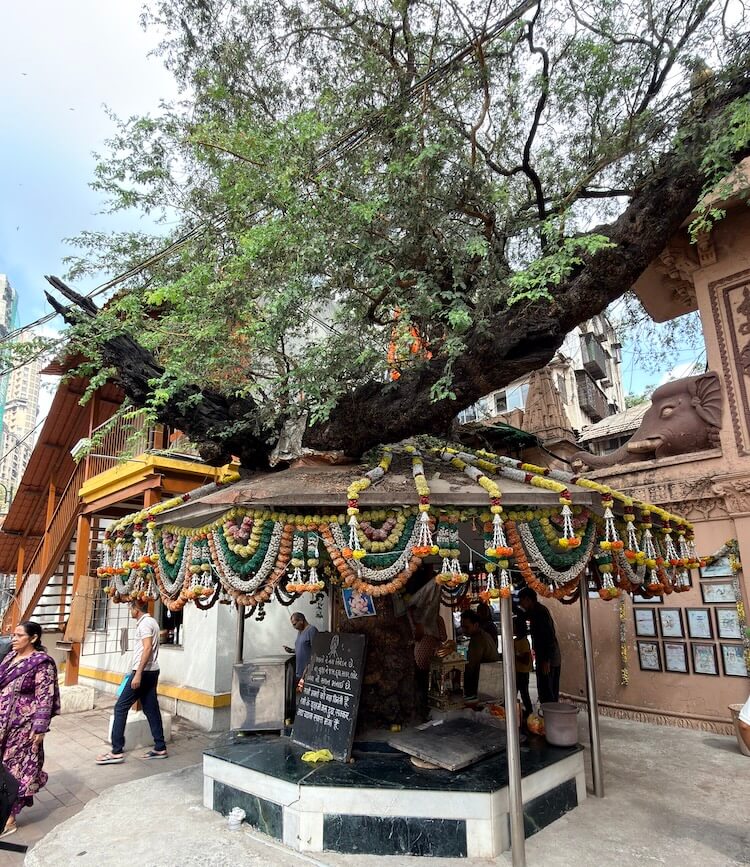
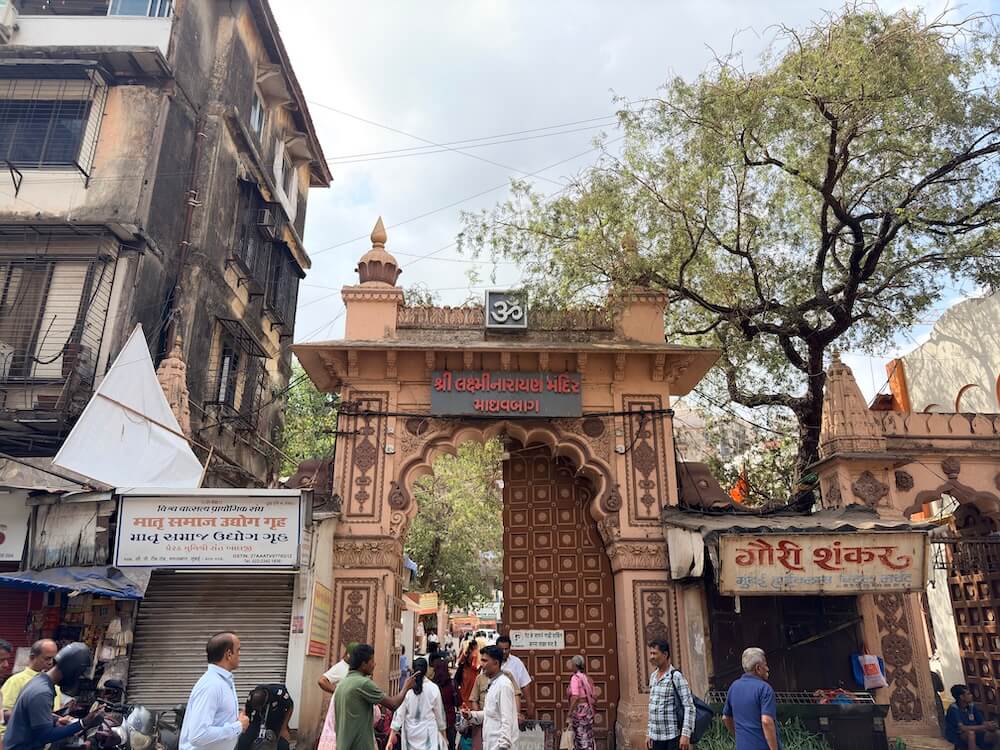
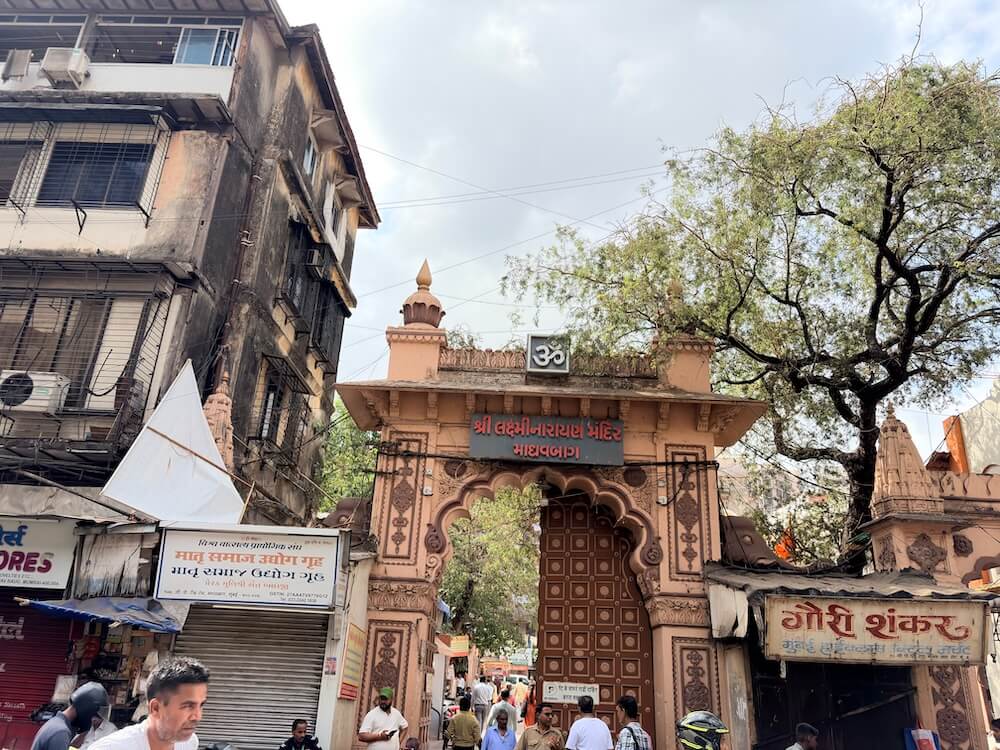
One enters the expansive courtyard of Madhavbaug through a tall, arched gateway. Immediately to the right upon entering is a Shami tree. Many devotees worship this tree. To the right here is the temple of Ichhapurna Ganesh. In the sanctum of this temple, which features a distinctive circular design, a marble idol of Lord Ganesha is enshrined on a high pedestal. The walls here feature depictions of the Ashtavinayaks. A short distance ahead on the right side is the Lakshmi-Narayana Temple.
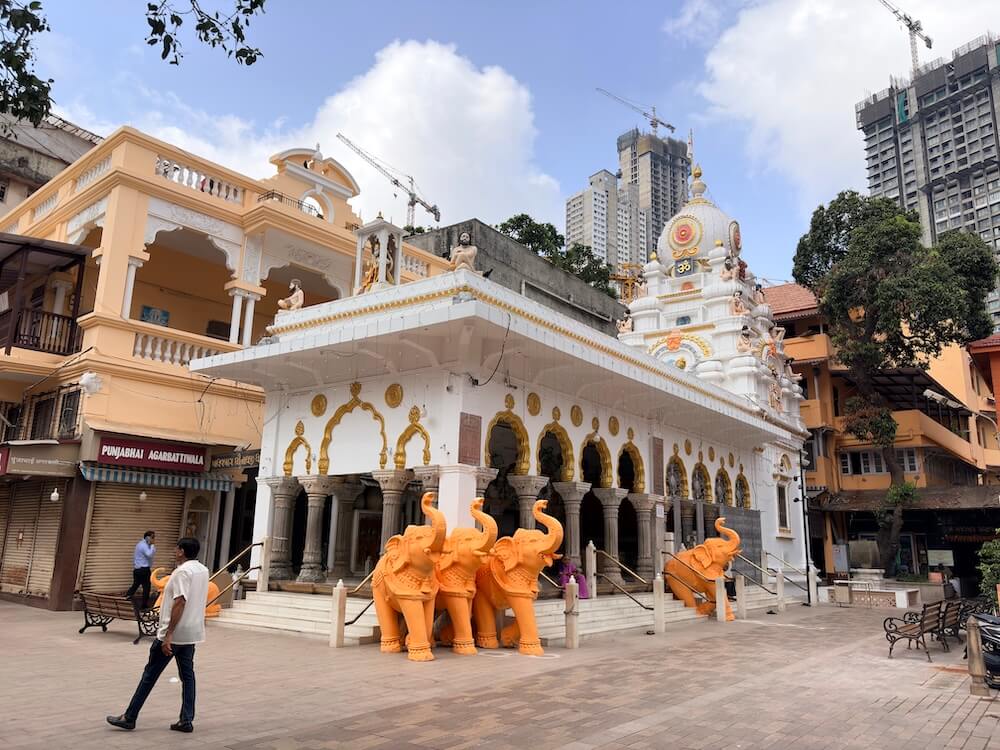
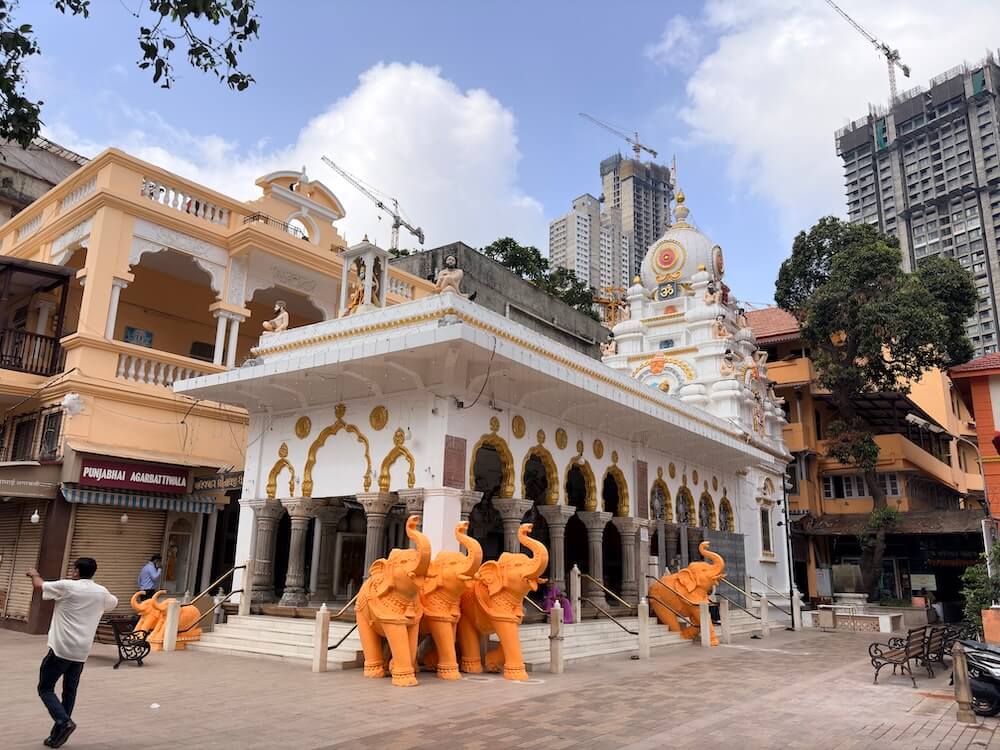
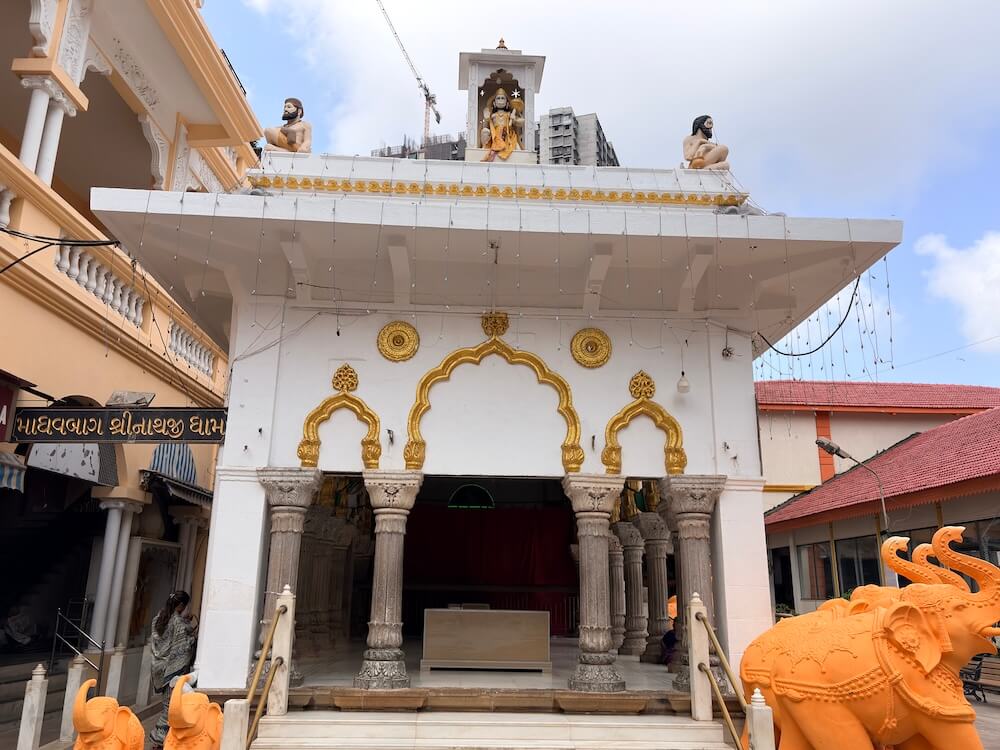
Influenced by nineteenth-century indigenous architectural styles, this temple was built by Bhima Ramji, a renowned architect of that era. Comprising a Sabhamandapa (assembly hall), a sanctum, and a tall spire (Shikhara), Porbandar stone has been extensively used in the construction of this temple. The Sabhamandapa, built on a raised platform (Jagati) several feet high, features marble steps on all three sides. Near these steps are placed sculptures of majestic elephants (Gajrajas). The Sabhamandapa is of an open type and features ancient-style circular carved stone pillars. These pillars are connected to each other by trefoil arches. The ceiling of the Sabhamandapa is flat. On the railing in its front section are two statues of sages in yogic postures. In the central marble shrine, an idol of Lord Hanuman is enshrined. The exquisite carvings on the ceiling of the Sabhamandapa show a clear influence of Gujarati and Rajasthani temple architecture.
The sanctum of the temple has a triple-branch marble doorway. The pillar jambs of the doorframe feature delicate, intricate carvings. Large idols of Lord Ganesha and Riddhi-Siddhi are enshrined on the lintel portion above the doorframe. Inside, on a high pedestal, the marble idols of Lakshmi-Narayan are enshrined. Regarding these idols, adorned with silk garments and ornaments, a legend is told that when the establishment of this temple was decided, the task of sculpting these idols was entrusted to the finest sculptor of that era. Putting his artistic skills to the test and with utmost concentration, the sculptor crafted this idol of Sri Lakshmi-Narayan. Upon completion, the divine form was so pure, lifelike, and a feast for the eyes that even the sculptor himself was mesmerized by its beauty. Overwhelmed by the beauty manifested in this idol, the sculptor vowed to spend the rest of his life not carving any other idol, but solely in service at the lotus feet of this very Lakshmi-Narayan. Here, along the circumambulation path and within the complex, alongside Sri Lakshmi-Narayan, there are independent sub-shrines dedicated to Muralidhar Sri Krishna and Kalabhairavi Mahalakshmi Mata as well. Above the sanctum sanctorum of the temple stands a spire approximately १७ feet in height. The architecture of this spire is of a very unique style. Built with a distinctive use of square and circular patterns, this spire features statues of sages on all four sides. Within its niches, idols of various deities along with Sri Krishna are enshrined. At the apex of the spire is a large dome, atop which rests a two-tiered Kalash.
In this temple, devotees can have darshan of the deity from सुबह ६ to दुपारी १२ and दुपारी ४ to रात्री ९. Here, the Mangal Aarti takes place at सुबह ६.३०. Following that, the Shringar and Rajbhog Aarti are held at सुबह ११.३०. At रात्री ७, the Evening Aarti and Bhog take place, and at रात्री ८.३०, the Shayan Aarti is performed. Ramnavami and Krishnashtami are the principal festivals of this temple. Both of these festivals are celebrated on a very grand scale in this temple. On these days, the main sanctum sanctorum and the entire temple are specially decorated with flowers and lights. Due to the proximity of the commercial area, during Diwali on Ashwin Amavasya, which is Lakshmi Pujan, an immense crowd gathers here. During this time, a special offering of ५६ food items (Annakut) is presented to Lakshmi-Narayan.
In the rear portion of this temple complex, there is a Goshala. At a short distance in front of the temple, a marble bust of Seth Varjivandas Shah, the founder of Madhav Baug, has been installed. On २७ मे २०२५, the १५०th anniversary celebration of this temple was celebrated here in an extremely grand manner.
This sacred temple stands as a testament to deep spiritual devotion, ancient architectural grandeur, and rich local cultural traditions.
The sanctum sanctorum houses the divine idol consecrated according to ancient Vedic traditions, surrounded by serene courtyards and traditional temple architecture.
Navratri, Maha Shivratri, Annual Temple Jatra & Deepotsav
Compare and book flights, secure top-rated local hotels near the temple, hire reliable guides, and rent cars instantly.
Extend your pilgrimage by visiting other highly sacred temples located nearby.


Add ₹999 more to unlock FREE SHIPPING!
Your sacred cart is currently empty.
Shop Photo FramesFill in your delivery details below to place your order.
Add comment