
Add ₹999 more to unlock FREE SHIPPING!
Your sacred cart is currently empty.
Shop Photo FramesRudreshwar is a special name among the many names of Lord Mahadev. ‘Rudhir’ means blood and ‘Rudra’ means angry or fierce in nature. Unable to tolerate evil deeds and tendencies, Mahadev assumes a fierce form and performs the Tandava dance to destroy them completely. It is a religious belief that the fire generated from this dance destroys all evil. There is an ancient tradition of worshipping Rudreshwar Mahadev to destroy these evil tendencies. Many ancient temples of Rudreshwar Mahadev can be seen across India. Jalna district holds special importance in the historical and cultural tradition of Marathwada. In the village of Ner in this very Jalna district, there is a very old and historical temple of Rudreshwar Mahadev. Devotees believe that one experiences the divine presence of the deity here. Influenced by the Hemadpanti architectural style, this temple is considered a major religious center in the region.
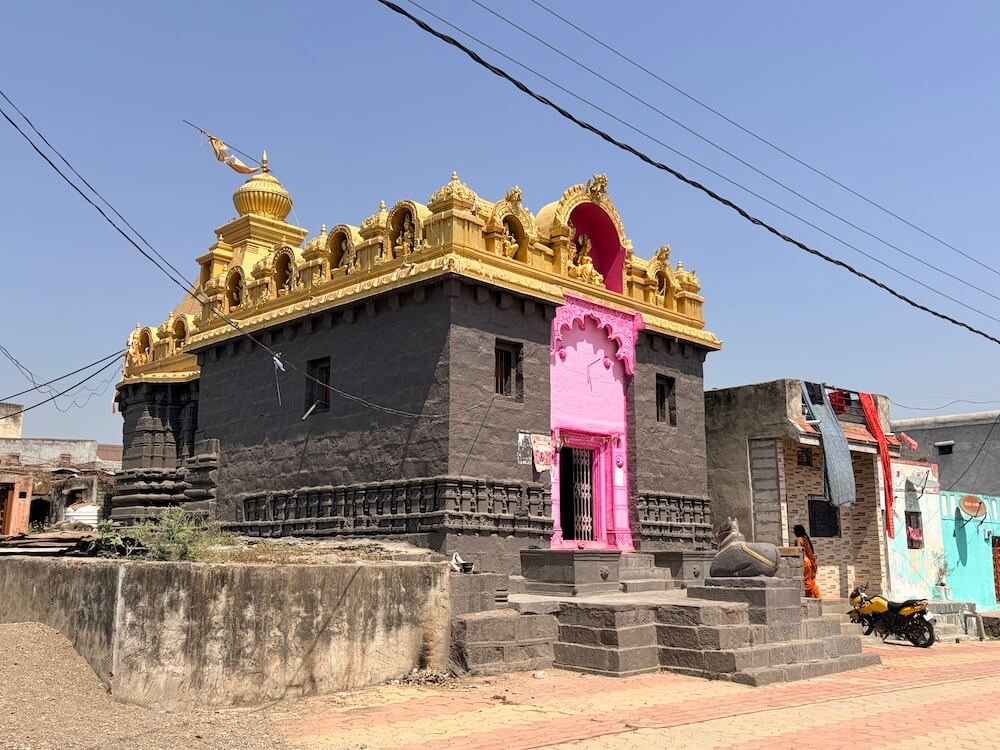
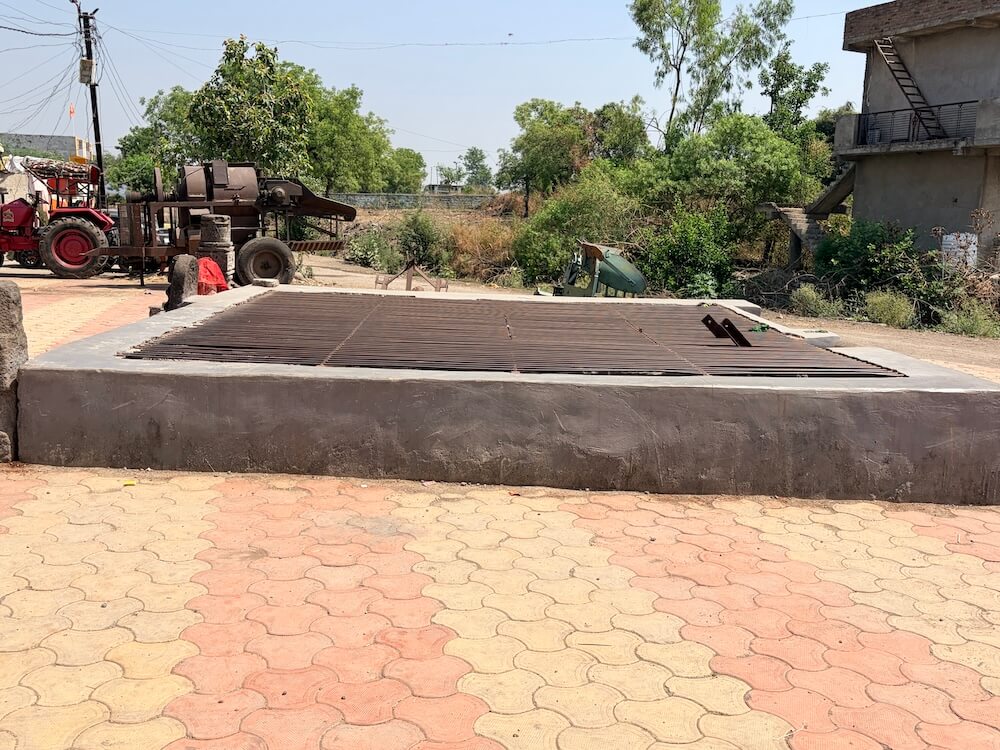
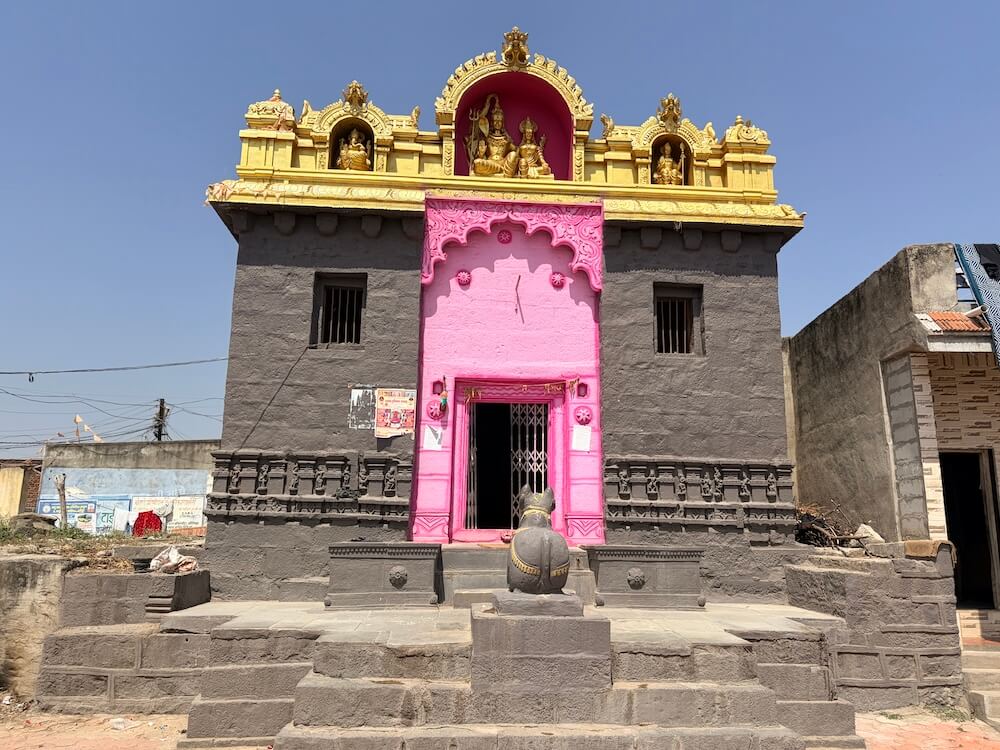
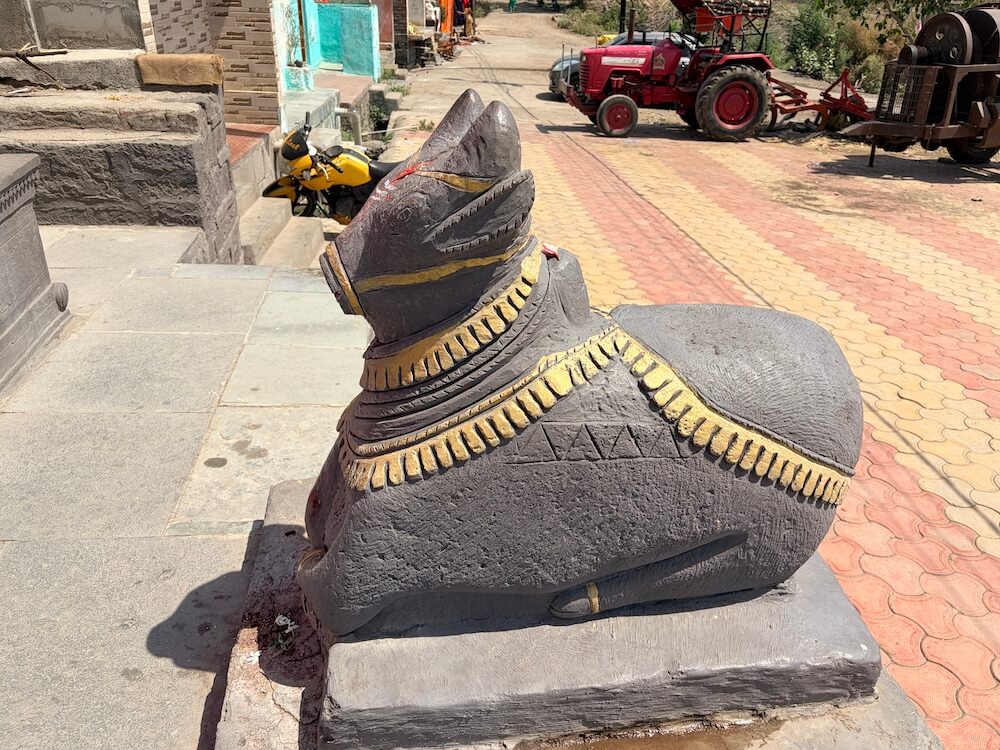
Ner village was an important trading center in ancient times. There are many ancient temples in this village. This is one of them. Villagers state that this temple dates back to the twelfth century. Although there is no concrete evidence available, scholars express the opinion that the temple must be five to six hundred years old, looking at the structure of the temple and the carvings on the entrance. The twelfth century was the period of the Yadava kings in Maharashtra. This must be one of the many sturdy stone temples built during this period. The temple is situated near the road close to the village. In front of the temple, there is an ancient stepwell (Barav) built of carved stone. Many ancient remains of the temple can be seen scattered around this stepwell. These include ancient pillars and some sculptures of the temple. A Shivling is placed near the stepwell. In the olden days, the water from this stepwell was used for performing Abhisheka to the deity. This temple is built on a stone plinth about three feet high. There is a spacious courtyard with paver blocks installed in front of the temple. Three steps are built to reach this plinth. On the pedestal (Vajrapitha) on the plinth, there is a black stone idol of Nandi. The structure of this temple consists of a Sabha Mandap (assembly hall), Antarala (vestibule), and Garbhagriha (sanctum sanctorum). On the front wall of the Sabha Mandap, on both sides of the entrance, carvings on pillars and sculptures of Sursundaris are etched. There are wheel-shaped carvings on the left and right sides of the entrance. Beautiful carvings of leaves and flowers are etched on the door frames. On the lintel (Lalatbimba), there is a sculpture of Ganpati, and a Kirtimukh is carved on the Mandarka. Also, an arched torana carved on the entrance can be seen.
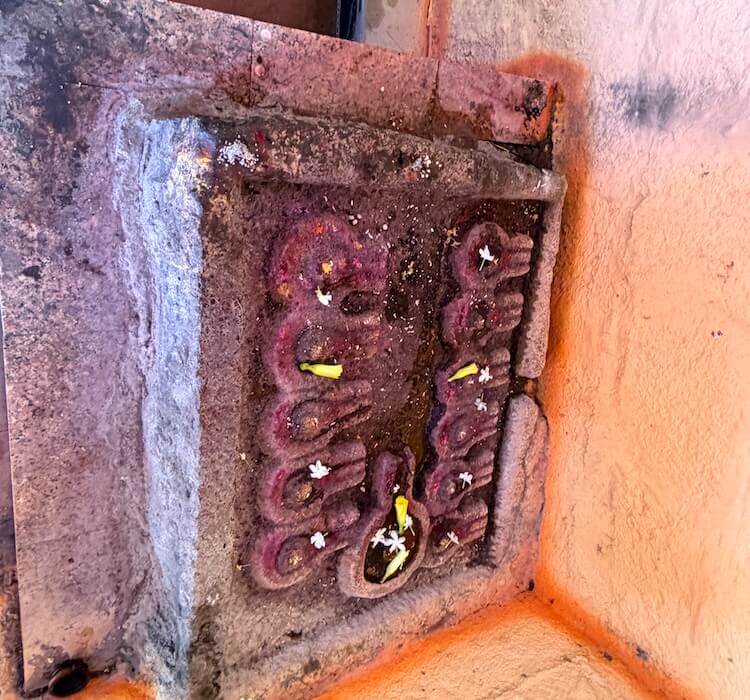
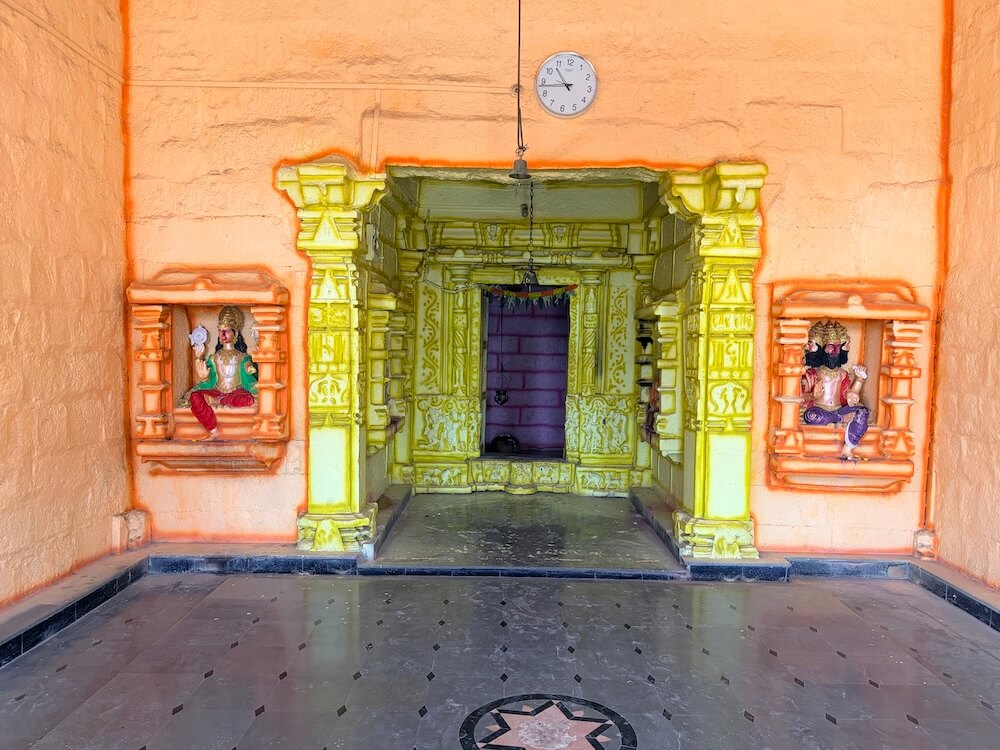
The Sabha Mandap here is enclosed. Windows are provided in the walls for light and ventilation. In the Sabha Mandap, on the right side of the entrance, symbolic Shivlings of the twelve Jyotirlingas are installed on a pedestal. All these Shivlings, carved from a single stone, are very unique. The art of carving twelve Jyotirlingas in a single stone is seen in only a few ancient temples in Marathwada. A Naga sculpture is placed next to this pedestal. In the Sabha Mandap, there are two niches (Devkosthakas) on the left and right sides of the entrance in the front wall of the Antarala. They contain idols of Shri Vishnu and Brahmadev respectively. The roof of the Sabha Mandap is supported by the walls. Due to the recent application of cement plaster to these walls, the original pillars within the walls are now invisible.
Two ornate pillars are erected on both sides near the entrance of the Antarala. There are two niches in the Antarala on the left and right sides. They contain stone idols of Gaurihar and Ganpati respectively. Beyond this is the main entrance to the Garbhagriha. Leaf branches, flower branches, and pillar branches are carved on this entrance. On the lower side of the door frames, sculptures of Ganga, Yamuna, Bhairav, and gatekeepers (Dwarpal and Dwarpalika) are carved. There is a sculpture of Ganpati on the lintel. Also, there are Gajmukh (elephant face) sculptures in the torana. There is a Chandrashila on the Mandarka and Kirtimukhas on both its sides. Gajmukh sculptures can also be seen carved on both sides of the Mandarka. The main Shivling is installed on the floor in the Garbhagriha. The octagonal roof of the Garbhagriha is supported by the walls. A wheel design is carved in the center of this ceiling.
On the exterior of the temple, sculptures of Sursundaris are carved on the walls of the Sabha Mandap. There is pillar ornamentation on the outer body (Mandovar) of the temple. A parapet wall shaped like a Bashingi is built on all four sides of the temple roof. There are three niches in this parapet on the front side. They contain idols of Gaurihar, Ganpati, and Kartikeya. There are also niches on the left, right, and back sides of this parapet. Idols of various deities are installed in them. Miniature Shikhars (Kut Shikhars) are created at various places on this parapet. A two-layered main Shikhar is built on the roof of the Garbhagriha. The lower layer of this Shikhar is square-shaped and has niches on all four sides. The second layer of the Shikhar is like a round dome. There is a stupika on the topmost part of the Shikhar, and a Kalash is installed on it.
The main annual festival is celebrated here on Mahashivratri. Apart from this, festivals like Vaikuntha Chaturdashi, Aamli Baras, and Dev Diwali are also celebrated with great enthusiasm. During all these festivals and throughout the month of Shravan, especially on all Mondays, thousands of devotees from the surrounding area visit here for the Darshan of the deity. On the occasion of festivals, Kirtans by renowned Kirtankars of Jalna district are organized, and Bhajan programs are held. Annadan (offering of food) is provided as a special service for devotees during festivals. There is a large crowd of devotees in the temple on Mondays, Pradosh, Purnima, and Amavasya. Devotees can take Darshan here daily from 6 in the morning to 8 at night.
This sacred temple stands as a testament to deep spiritual devotion, ancient architectural grandeur, and rich local cultural traditions.
The sanctum sanctorum houses the divine idol consecrated according to ancient Vedic traditions, surrounded by serene courtyards and traditional temple architecture.
Navratri, Maha Shivratri, Annual Temple Jatra & Deepotsav
Compare and book flights, secure top-rated local hotels near the temple, hire reliable guides, and rent cars instantly.
Extend your pilgrimage by visiting other highly sacred temples located nearby.


Add ₹999 more to unlock FREE SHIPPING!
Your sacred cart is currently empty.
Shop Photo FramesFill in your delivery details below to place your order.
Add comment