
Add ₹999 more to unlock FREE SHIPPING!
Your sacred cart is currently empty.
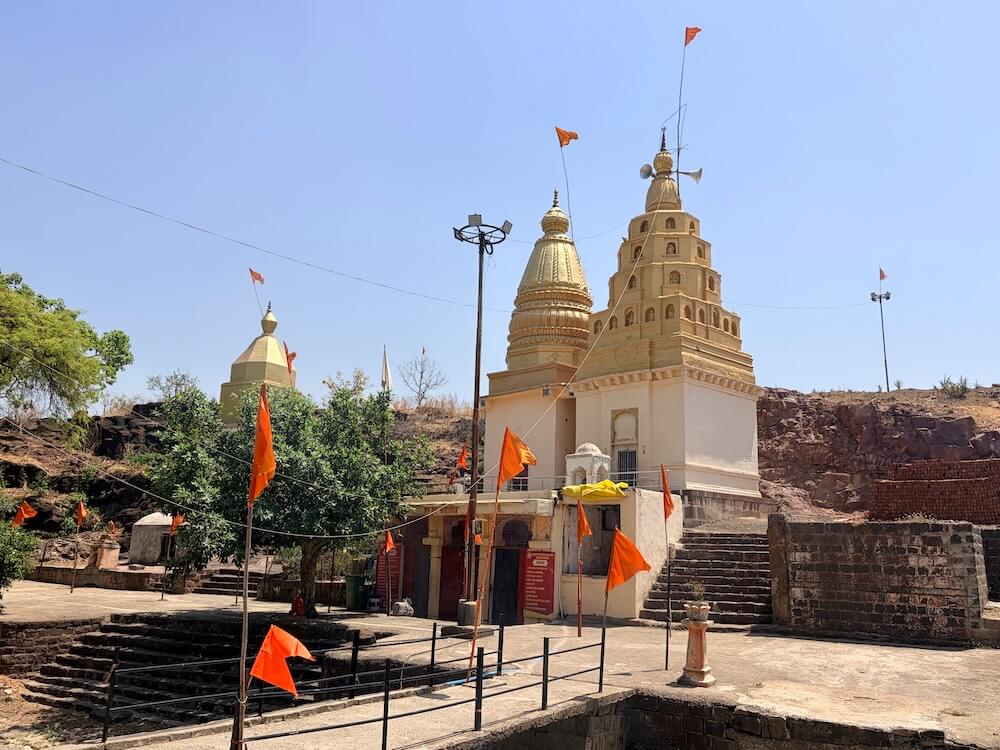
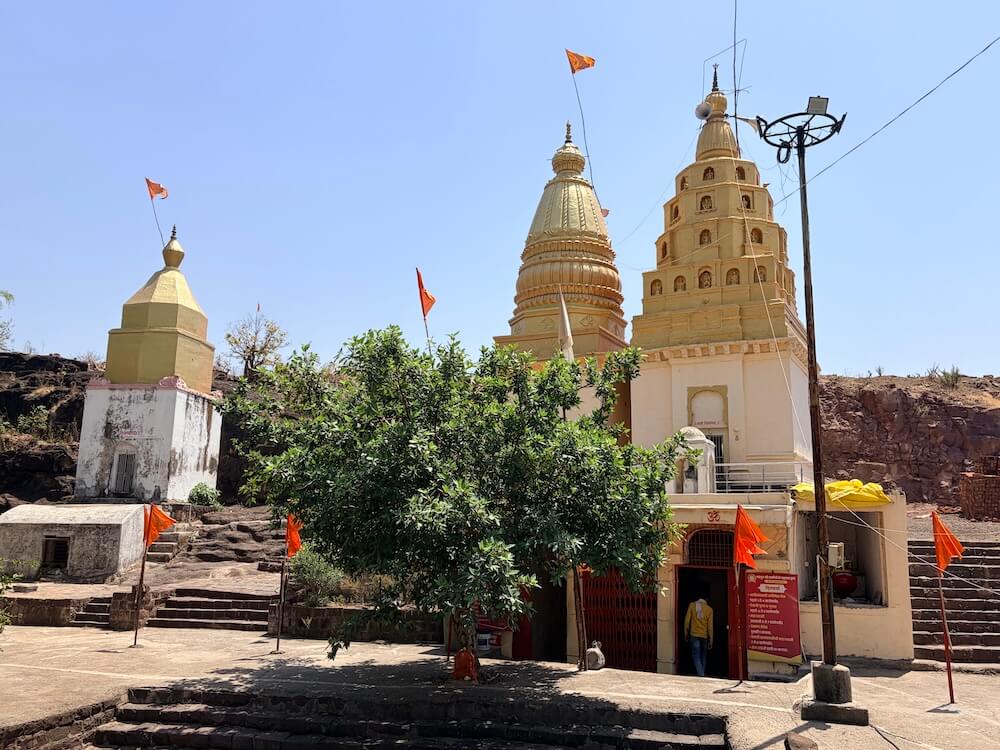
Shop Photo FramesSituated in Savargaon in the Jalna district of Marathwada, the ancient Shambhu Mahadev Temple is a significant symbol of the local spiritual and cultural heritage. This temple is a place of faith for local devotees and is considered important for its historical legacy and unique architecture. Located on land sanctified by the touch of Lord Shriram’s feet, this temple is also known by the local people as the ‘Rameshwar Temple’. The entire temple complex, nestled in the Savargaon area, bears witness to constructions from various historical eras. Here, one can find caves dating back a thousand years and the samadhi shrines of saints. This place is famous throughout Marathwada.
It is clear from the stories of the Ramayana that Shriram was a devotee of Shiva. For this reason, temples where Shriram installed Shiva Lingas hold special significance in Hindu religious tradition. Hundreds of such temples established by Shriram are famous across the country, including the well-known Rameshwar Temple in South India, Koteshwar in Prayagraj, the Rameshwar Temple in Banaras, the Shiva temple at the confluence of the Krishna and Warna rivers in Sangli district, as well as the Shiva temple at the Triveni Sangam of the Chambal, Banas, and Sip rivers in Mirzapur. Geographically located in the heart of Maharashtra in Jalna district, Savargaon is home to one such ancient temple established by Shriram. It is believed that the Mahadev here is extremely awakened and responsive.
This entire temple complex is situated in an area at some distance from the main settlement of Savargaon. Historians and scholars express the opinion that the temples here were built in different periods. The chief priest of the temple states that the Shambhu Mahadev Temple located inside the cave here is about one thousand to twelve hundred years old. An ancient legend is told regarding the construction of this temple, stating that Lord Shriram stayed in this area during his fourteen-year exile. During that time, for his daily worship, he created a temple himself inside this cave and installed a Shiva Pindi there. It is because of this connection with Shriram that this temple is also locally called the Rameshwar Temple.
A fortification wall has been built around this temple near Savargaon for security. There is a main entrance gate within this fortification. The temple courtyard is paved with paver blocks. A natural stream of water flows through this courtyard. Stone steps have been built to descend into the water of this stream. In the center of the courtyard, one can see a fifty-foot-deep well built of carved stone. Due to the perennial water storage in this well, its water does not dry up even in summer. In the main courtyard, there is a Tulsi Vrindavan, a Yajna Kund for religious rituals, a large hall building for devotees, residences for the temple priests and attendants, and several other small and large structures.
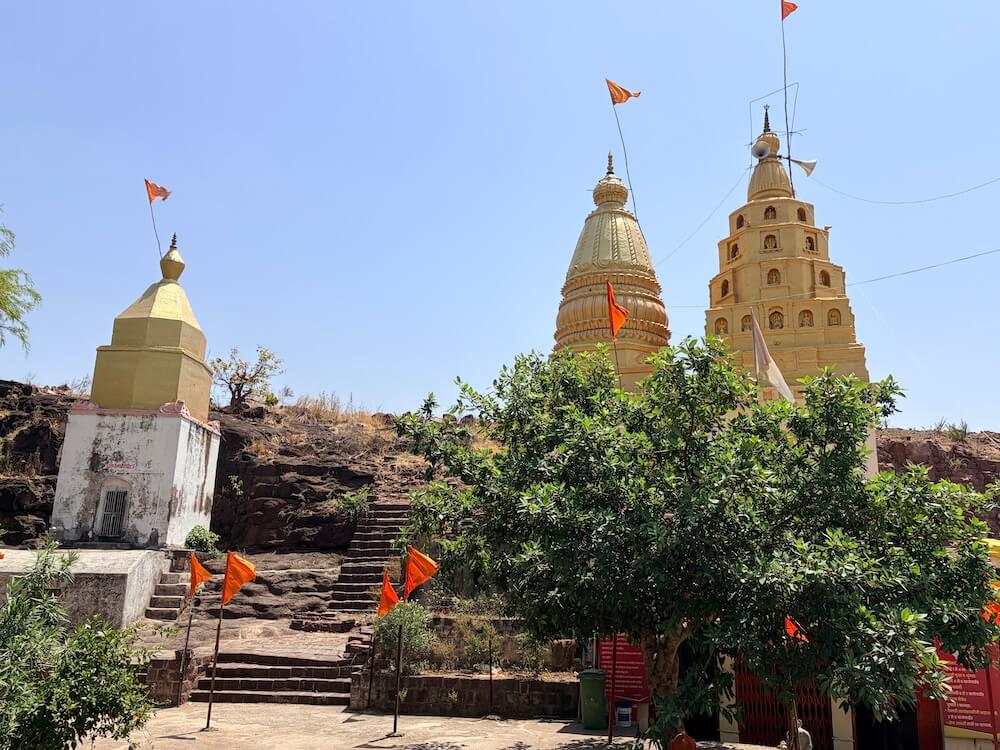
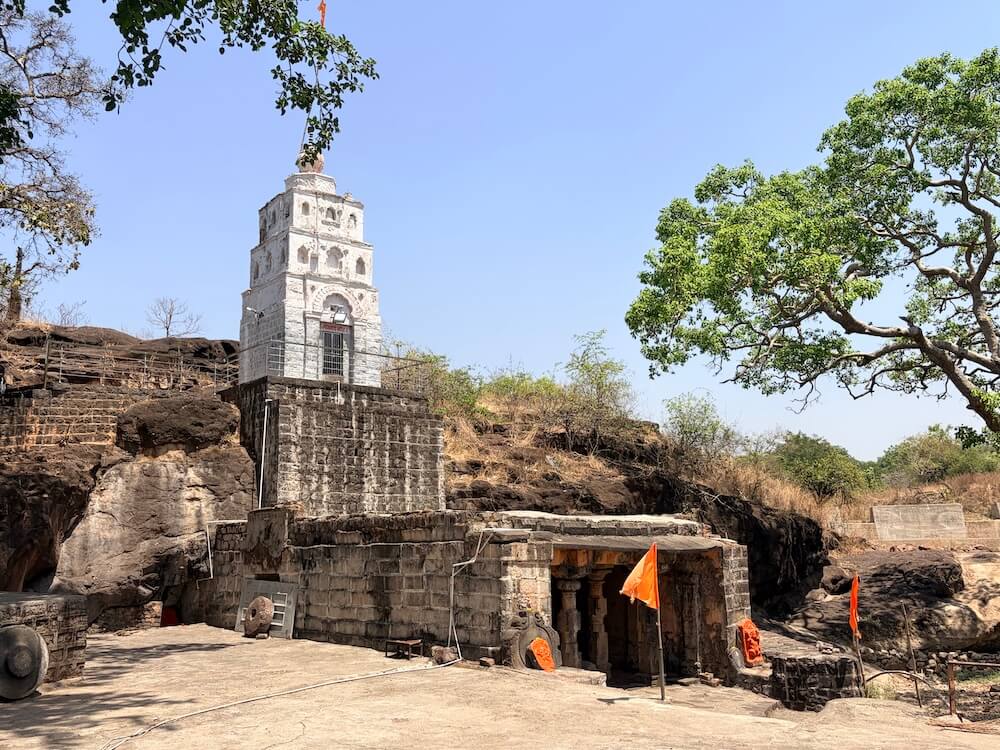
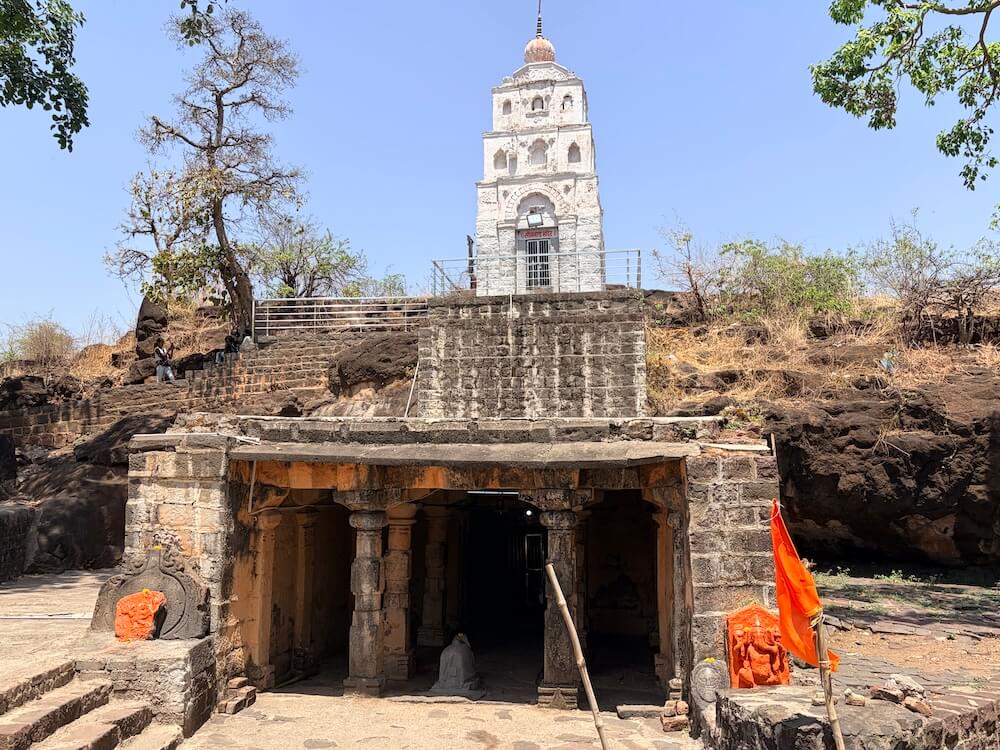
Within the entire temple complex, the Rameshwar Shambhu Mahadev Temple is the main temple. The open space in front of this temple is in a sunken area about two feet deeper than the main courtyard level. Steps have been carved into the bedrock to descend here. The structure of this temple is primarily designed in the traditional manner with a Sabhamandapa (assembly hall), Antarala (vestibule), and Garbhagriha (sanctum sanctorum). The Sabhamandapa of the temple is an example of stone construction in the ancient Hemadpanti architectural style, created by stacking stones upon one another. The front side of this Sabhamandapa is open. On both sides in front of the main entrance of the Sabhamandapa, vermilion-smeared stone idols of Ganpati and Maruti are installed. Inside the Sabhamandapa, there are four rows of four square pillars each. All these pillars stand on square bases. Various geometric shapes such as squares, hexagons, octagons, and circles are carved on the middle sections of these pillars. The upper parts of the pillars have capitals, and upon them are brackets. Stone beams are placed on these brackets, which support the roof of the temple. In the Sabhamandapa, in front of the main entrance, an idol of Nandi made of black stone is seated on a Vajrapitha. The Antarala and Garbhagriha located ahead of this Sabhamandapa are carved inside the main cave. The entrance to the Garbhagriha is of the Trishakhi (three-branched) style, and vertical carvings can be seen on it. A small sculpture of Ganpati is carved on the Lalatbimba, i.e., the upper central part of this entrance. Inside the Garbhagriha, a Shiva Pindi is installed in the center on the floor, and sculptures of various deities are carved on the back wall. On the roof of the Garbhagriha, there is a four-layered square-shaped stone Shikhara (spire). This Shikhara has been erected on the upper part of the original mountain where the cave is located. In the first layer of this Shikhara, there is an empty room, while in the second and third layers, there are niches for placing idols. The fourth layer of the Shikhara is octagonal in shape, and at its topmost part, there is an Amalaka and a Kalasha.
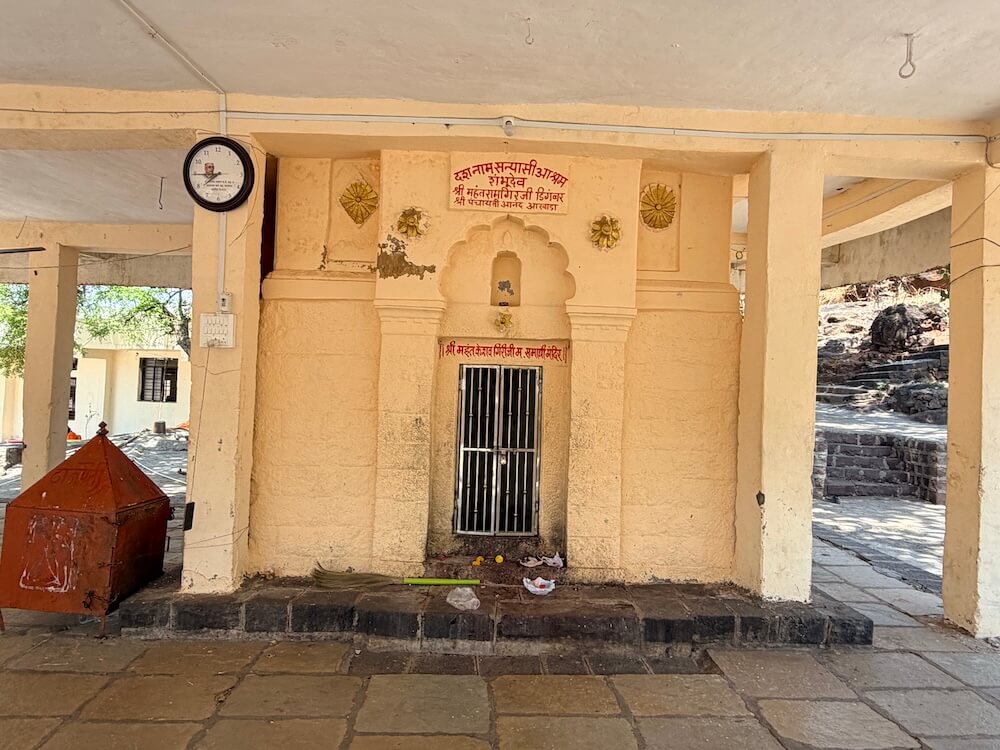
Beside the Shambhu Mahadev Temple is the Samadhi temple of Mahant Ramgiriji Maharaj. The design of this temple, which has two Garbhagrihas, is unique. In one of the Garbhagrihas of this temple, there is a Shiva Pindi installed by Mahant Ramgiri Maharaj himself, while in the second Garbhagriha, the Samadhi of the Maharaj is built. This temple, which also has a structure consisting of a Sabhamandapa, Antarala, and Garbhagriha, is also built in stone according to the ancient Hemadpanti architectural style. The entrance to the Sabhamandapa of this temple is in a sunken area about two feet deeper than the main courtyard, and steps have been made to descend there. In front of the entrance, there are Padmapadukas (lotus footprints) on a stone pedestal. There are four square pillars on the front side of the assembly hall, and three separate entrances are provided for entry. Arched toranas are carved onto these entrances. In the center of the assembly hall, on a vajrapitha, stands a Nandi idol made of black stone, and padmapadukas are installed in front of it. Beyond this lies the antarala of the temple. On both sides of the entrance to the antarala, guardian sculptures are carved, and the sculpture of Lord Ganapati is seated on the lalata-bimba above. Beyond the antarala, there are two separate sanctum sanctorums. In one of these sanctums, there is a Shiva Linga on the floor, while the other sanctum houses the samadhi of the Maharaja. Both these sanctums are two-storied. A circular-shaped shikhara is built on the roof of the sanctum containing the Shiva Linga, while a four-tiered octagonal shikhara is erected on the roof of the sanctum containing the samadhi. At the top of both these shikharas, there is an amalaka, upon which kalashas are mounted. Beside this samadhi temple is the newly constructed Siddheshwar temple. The specialty of this temple is the continuous flow of water from the gomukha here, which runs for twenty-four hours. In the main courtyard of the temple, there is also a samadhi temple of Mahant Keshavgiri Maharaj. A new assembly hall has been built in front of this temple for the convenience of devotees. Inside the main sanctum located in front of the assembly hall is the samadhi of Mahant Keshavgiri Maharaj.
Various religious festivals are celebrated throughout the year in the Shambhu Mahadev temple. Especially during the month of Shravan, there is a large crowd of devotees here for darshan. Every Monday in the month of Shravan, special worship and festivals are organized in the temple. The new moon day of Shravan and Mahashivratri are considered the major annual fairs of this temple. During these festivals, thousands of devotees from the entire Marathwada and neighboring Vidarbha regions come to Savargaon for darshan. On the occasion of these festivals, various programs such as Rudrabhishek, Mahapuja, Akhand Bhajan, Kirtan, Pravachan, recitation of religious texts, Bhagavata Katha, and distribution of Mahaprasada are organized in the temple. Apart from these main festivals, festivals like Dussehra, Diwali, Kartik Amavasya, Vaikuntha Chaturdashi, and Nag Panchami are celebrated in the temple in a traditional manner throughout the year. On normal days, the worship and decoration of the deity take place daily from four o’clock to six o’clock in the morning. The Maharati takes place at six o’clock in the morning, Naivedya at one o’clock in the afternoon, Maharati at seven o’clock in the evening, and Shejarati at ten o’clock at night. This temple is open for devotees for darshan twenty-four hours a day.
This sacred temple stands as a testament to deep spiritual devotion, ancient architectural grandeur, and rich local cultural traditions.
The sanctum sanctorum houses the divine idol consecrated according to ancient Vedic traditions, surrounded by serene courtyards and traditional temple architecture.
Navratri, Maha Shivratri, Annual Temple Jatra & Deepotsav
Compare and book flights, secure top-rated local hotels near the temple, hire reliable guides, and rent cars instantly.
Extend your pilgrimage by visiting other highly sacred temples located nearby.


Add ₹999 more to unlock FREE SHIPPING!
Your sacred cart is currently empty.
Shop Photo FramesFill in your delivery details below to place your order.
Add comment