
Add ₹999 more to unlock FREE SHIPPING!
Your sacred cart is currently empty.
Shop Photo FramesPimpalgaon-Ner, situated on the banks of the Kundalika River in the Jalna Taluka of Jalna District, is a place blessed with historical heritage. The Shri Vateshwar Mahadev Temple here is considered the main place of faith and the village deity of the entire region. This ancient temple is dedicated to Lord Shiva. As a beautiful example of historical heritage, this temple is known as the Vateshwar Mahadev Temple of Ner or, in the local language, as the Katneshwar Shiva Temple. This temple holds great historical, religious, and mythological significance. It is believed to be a testament to the glorious architecture of the era of the Yadava kings of Devgiri. Thousands of devotees come here for darshan on Mahashivratri and on Mondays during the month of Shravan. A great tradition of Shiva worship has been practiced in this area since ancient times. The original structure of the temple is believed to date back to approximately the 11th to 12th century, i.e., the Yadava period. During the reign of the Yadava kings of Devgiri, a large number of sturdy and intricately carved temples were built in the Marathwada region. This temple clearly demonstrates the architecture and culture of that period. Built from black stone, the temple primarily shows the influence of the Hemadpanti architectural style, and along with it, the imprint of the Southern architectural style is also clearly visible on this structure. The original grand assembly hall (sabhamandap) of the temple had collapsed over time, so the temple was renovated in the 18th century. The inscription carved on the entrance of the temple and on an important pillar is a very important document of this renovation. In this inscription, a clear mention of “1863 Ner Shri Vateshwar Mahadev Temple 1863” is found. While going towards the temple from the main road outside, one encounters a grand stone welcome arch. This arch is completely in harmony with the design of the ancient temple. Beautiful idols of Lord Shankar and Mother Parvati are carved on this welcome arch. A structure similar to a gopuram, as seen at the entrance of the main temple, can also be seen at this entrance. There is a paved path from this arch to the temple. Many trees have been planted around this path. The temple courtyard is spacious. On the right side, there is a large shelter, i.e., a shed, built for devotees to rest and for organizing festivals, celebrations, and various religious activities. On the left side of the courtyard, a small Mahadev temple is visible, and some ancient historical idols in a dilapidated state have also been preserved in the temple premises. In this vast courtyard, on the left side, there exists a historical hexagonal stone stepwell (barav) from the olden days.
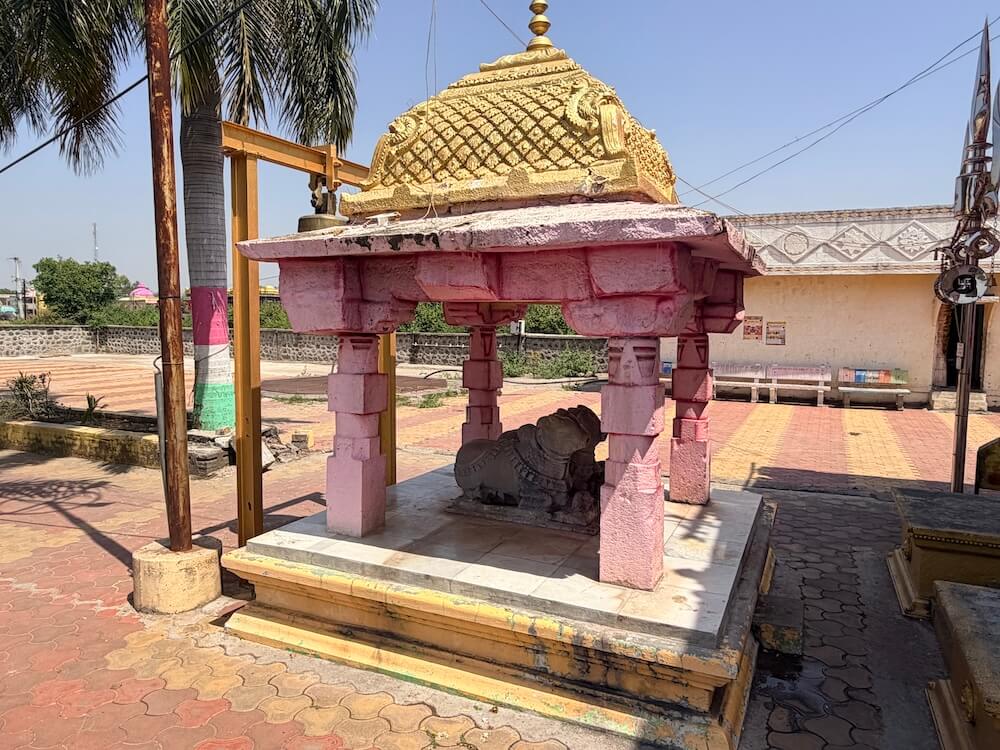
While approaching the main temple, a large ancient brass bell first catches one’s attention. The weight of this bell is a full 256 kilograms. Right behind this bell and in front of the main temple is a Nandi Mandap made of black stone. The structure and design of this Nandi Mandap match the original structure of the main temple. The roof of this Nandi Mandap is supported by four sturdy stone pillars. A special feature of this mandap is that two stone Nandis of the same size are installed in it. Striking ornamental carvings are etched on both these Nandis.
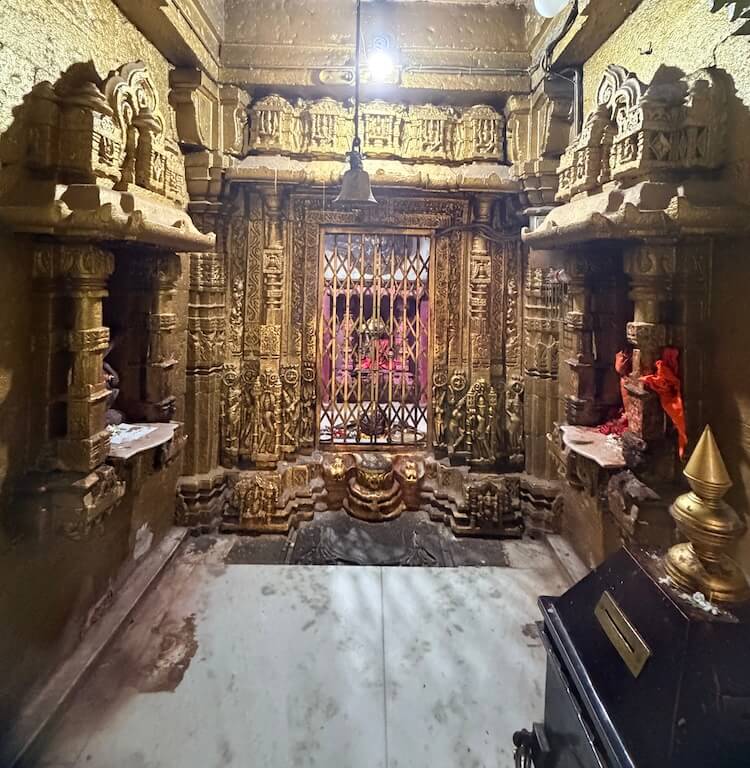
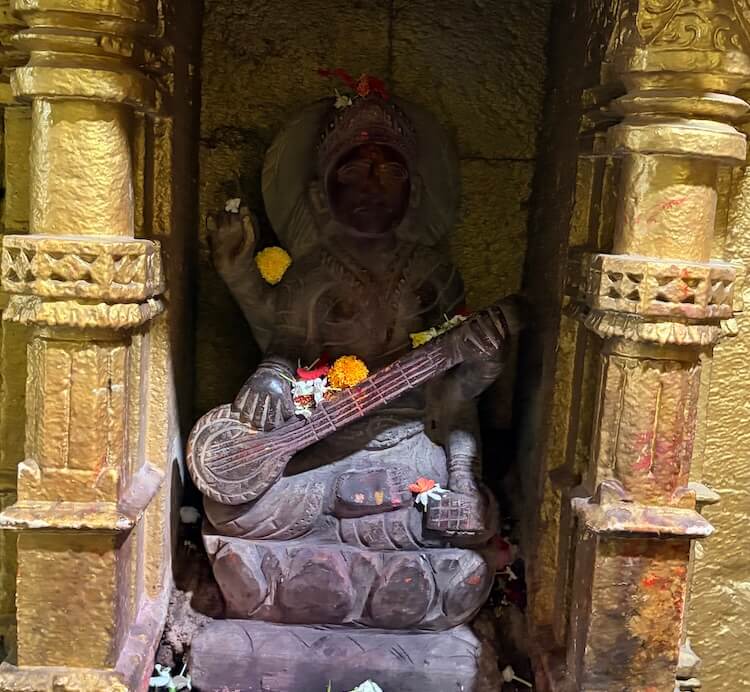
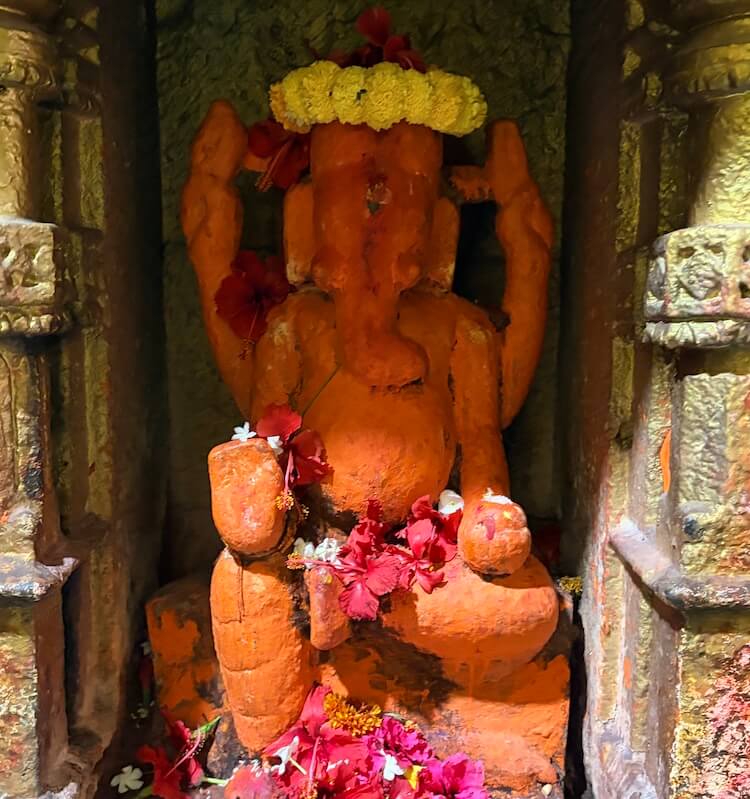
Above the main entrance of the Vateshwar Mahadev Temple, there is a beautiful structure resembling a Southern-style gopuram. In its center are the idols of Mahadev, and in the niches (devkoshtakas) on both sides are the idols of Ganpati and Kartikeya. Excellent stone carving has been done on both sides of the entrance. A large metal trident (trishul) is kept to the right of the entrance. From this entrance, one enters the enclosed assembly hall (sabhamandap) of the temple. This assembly hall is built on a total of sixteen sturdy stone pillars. These pillars are carved and decorated with various deities, Ganpati, and mythological scenes and sculptures of the various incarnations of Lord Vishnu. A part of this assembly hall was rebuilt in the 18th century. A square space has been left open in the center of the roof of this assembly hall for light and ventilation. There is circular carving on the ceiling, and the entire roof of the assembly hall is made of circular and rectangular structures. There are ornate niches in the walls of this assembly hall. In one of these niches, beautiful idols of Lord Vishnu riding on Garuda and Mother Lakshmi are seated. In the antarala (vestibule), there are two ornate niches on the left and right sides. The idol of Ganpati is installed in the right niche and Saraswati in the left. Idols of the Saptamatrikas and other deities are carved on the doorframes (dwarshakhas) of the sanctum sanctorum (garbhagriha). The artistry here is considered a fine example of stone carving. The dual image of Shiva-Parvati here, the lotus flower in their hands, and their abhaya mudra are accurately carved according to the rules of ancient iconography. Along with the idols of the sub-deities, the depiction of their vehicles—the lion, Garuda, and peacock—highlights their mythological importance. In many sculptures, important weapons such as the pasha (noose), ankusha (goad), gada (mace), and chakra (discus) held in the hands of the deities can be clearly identified.
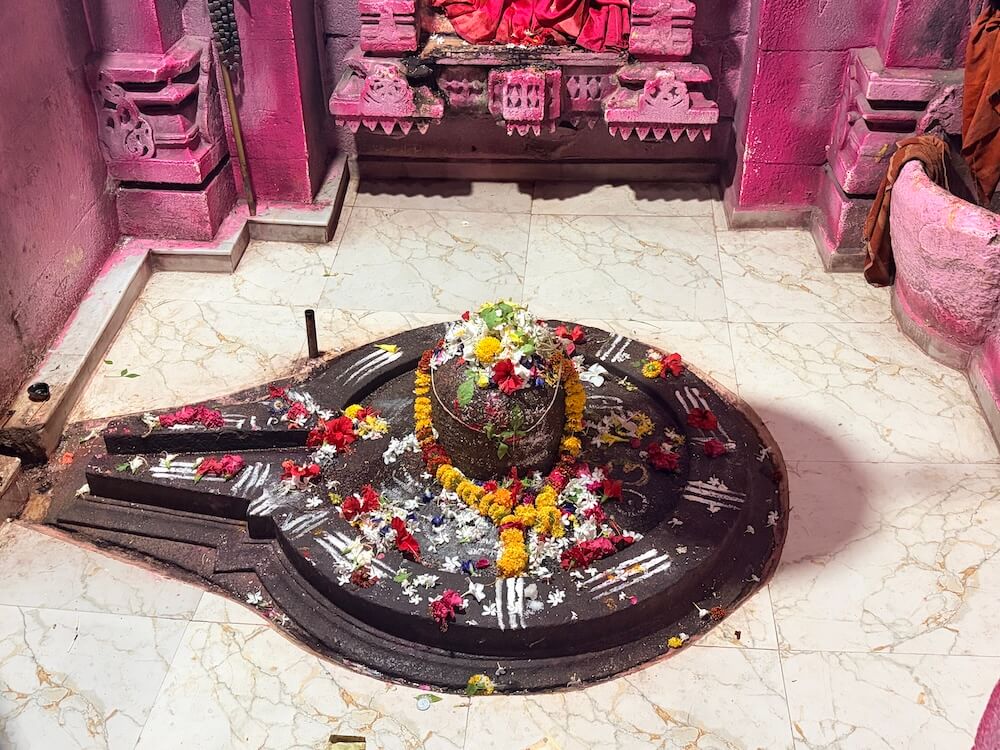
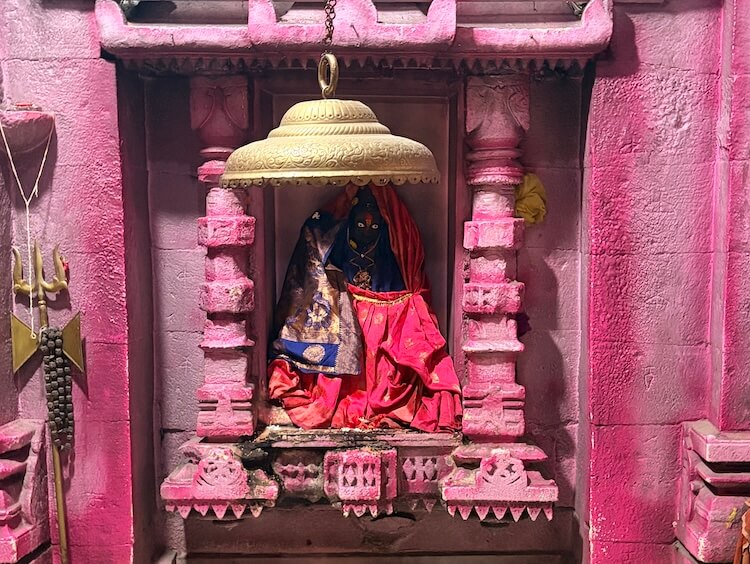
The sanctum sanctorum of the temple is small in size, and a Shiva Linga is installed in the center. The idol of Mother Parvati is seated in a niche on the wall in front of the sanctum sanctorum. The ceiling of the sanctum sanctorum is also decorated with various geometric designs. While circumambulating the temple, there is characteristic stone carving on the outer walls. On the left side of the circumambulation path, there is another small Mahadev temple with a separate Nandi in front of it. On the outer walls of the sanctum sanctorum, i.e., on the jangha, there are many idols of sub-deities and ornate niches. In them, images of Lord Shiva in various mudras are carved. The vine patterns and circular carvings in the stone are etched very finely. The main spire (shikhara) of the temple is built of bricks, and attractive painting has been done on it in later times.
Daily Puja and Aarti are performed in the temple every morning and evening. Mahashivratri is considered the largest and most significant festival at this temple. A grand fair, known as the Jatrotsav, is held for Lord Vateshwar Mahadev on Mahashivratri. This festival begins with great enthusiasm a week before Mahashivratri. On this occasion, various religious programs such as Akhand Harinam Saptah, Haripath, Ramayana recitation, Kakada Aarti, and Kirtan are organized in the temple. On the final day of the festival, Mahaprasad is distributed after the Kirtan. As this is a very famous temple in Ner village and the entire Jalna district, there is a large crowd of devotees here for Darshan every day. Devotees can have Darshan here daily from five o’clock in the morning until eight-thirty in the evening.
This sacred temple stands as a testament to deep spiritual devotion, ancient architectural grandeur, and rich local cultural traditions.
The sanctum sanctorum houses the divine idol consecrated according to ancient Vedic traditions, surrounded by serene courtyards and traditional temple architecture.
Navratri, Maha Shivratri, Annual Temple Jatra & Deepotsav
Compare and book flights, secure top-rated local hotels near the temple, hire reliable guides, and rent cars instantly.
Extend your pilgrimage by visiting other highly sacred temples located nearby.


Add ₹999 more to unlock FREE SHIPPING!
Your sacred cart is currently empty.
Shop Photo FramesFill in your delivery details below to place your order.
Add comment