
Add ₹999 more to unlock FREE SHIPPING!
Your sacred cart is currently empty.
Shop Photo FramesGoddess Mahalasa, the presiding deity of countless devotees in Goa and the Kuladevi (family deity) of the Karhade and Padye Brahmin communities, is the female incarnation of Lord Vishnu. Mahalasa is the Mohini avatar assumed by Vishnu during the churning of the ocean (Samudra Manthan) by the Devas and Asuras. Because she is an avatar of Vishnu, she is known as Mahalasa Narayani. The temple of the Goddess in the village of Mardol is considered one of the largest temples in Gomantak (Goa). Devotees from Goa, as well as from Maharashtra and Karnataka, participate in large numbers in the two major festivals held at this temple: the Jatrotsav and the Navratrotsav.
According to the mythological legend of this Goddess, fourteen treasures (Ratnas) were obtained from the churning of the ocean by the gods and demons, including Lakshmi, the Kaustubha gem, Kalpavriksha, Sura, the Halahala poison, Dhanvantari, the Moon, Kamadhenu, Airavata, Rambha-Menaka, the seven-headed horse Uchchaihshravas, the Sharanga bow, the Panchajanya conch, and Amrita (nectar). A dispute arose between the gods and demons over the pot of nectar. To resolve the conflict through diplomacy, Vishnu assumed the form of the world-beautiful and enchanting Mohini. That is the Mahalasa avatar. While distributing the nectar to the gods and demons, Rahu and Ketu disguised themselves as gods and sat in the row of the gods. As they were consuming the nectar, the Moon and the Sun recognized them and informed Mohini. According to the legend, Mohini then beheaded them.
The story of how this Goddess came to Gomantak is that after Parashurama settled Gomantak, he performed a Yajna for his conquest. For the success of this, he brought ascetic and scholarly Saraswat Brahmins—Bharadwaj, Kaushik, Vatsa, Kaundinya, Kashyap, Vashistha, Jamadagni, Vishwamitra, Gautam, and Atri—from Trihotrapura in the north (Tirhut, the region north of the Ganges in the present-day state of Bihar) to Gomantak. There were 66 clans of these Brahmin sages. They brought their family deities—Mangeshi, Mahalaxmi, Mahadev, Shantadurga, Nagesh, Saptakoteshwar, and Mahalasa—with them. Mahalasa Devi was among them. The village of Verem is the original abode of Mahalasa Devi. There are records of a Mahalasa Devi temple existing there before December 1567. The site of this temple is called ‘June Mhaddol’ or ‘Old Mardol’. Legend has it that Lord Parashurama himself installed Mahalasa Devi there. According to the book ‘Devbhumi Gomantak’ by temple researcher Vinayak Narayan Shenvi Dhume, in the 11th century, a Saraswat Brahmin chieftain of the Kaushik Gotra named Mhalu Pai, who served the then-rulers, built a grand temple for Mahalasa Devi in the village of Verem.
Later, in 1510, the Portuguese arrived in Gomantak. A letter dated 12 December 1567, sent from Goa by the Jesuit priest Fr. Gomes Vaz, which is included in the seventh volume of the book ‘Documenta Indica’, records that the Portuguese destroyed the Mahalasa Devi temple and mandap in Verem and broke the idols. However, the broken idol was not that of Mahalasa Devi. The villagers had already relocated that idol or the symbol of the Goddess to the village of Priol in Antruz Mahal (present-day Ponda Taluka). According to the story narrated by Premanand Kamat, who served as the president of the Mahalasa Narayani Sansthan, the original idol of Mahalasa Devi was crafted from a Shaligram stone found in the Gandaki River in Nepal. From Nepal, the idol was first taken to Nevasa in the present-day Ahilyanagar district. However, due to the harassment under the Muslim rule there, the idol was first brought to Bicholim in Goa and eventually taken to Verem.
The locality in Priol village where the Goddess was installed after being brought from Verem came to be called ‘Mhaddol’. The reason for this is that when the Mahalasa temple was in the village of Verem in ancient times, it was called ‘Mhaddol’ (‘Ponne Mhaddol’ meaning Old Mhaddol). The same name was given to the new location. Over time, a separate village was formed with this new locality, known as Mhaddol or Mardol. According to a legend, there was already a Sateri Devi temple in this new location. This Goddess gave space to Mahalasa Devi to settle next to her. At that time, Mahalasa Devi told Sateri, “You have the first right here. Therefore, devotees will visit you before having my darshan.” This tradition continues to this day. Every day, the Aarti of Sateri Devi is performed first. After that, the Aartis of the Grampurush, 64 Yoginis, Kalbhairav, Dad, and other deities located behind the Mahalasa temple are performed, and only then is the Aarti of Mahalasa Devi performed.
This seat of Mahalasa Devi at Mardol is at least 450 years old. During this period, the temple has been renovated many times. Additions have been made to the temple structure. Ramchandra Baba Malhar, alias Ramchandra Baba Shenvai Sukhtankar, a Diwan of Ranoji Shinde and a prominent diplomat of the Peshwa era, had issued a Sanad (decree) for a locality in Mauje Priol in 1754, and through this document, he had warned that the temple should not be subjected to any harassment.
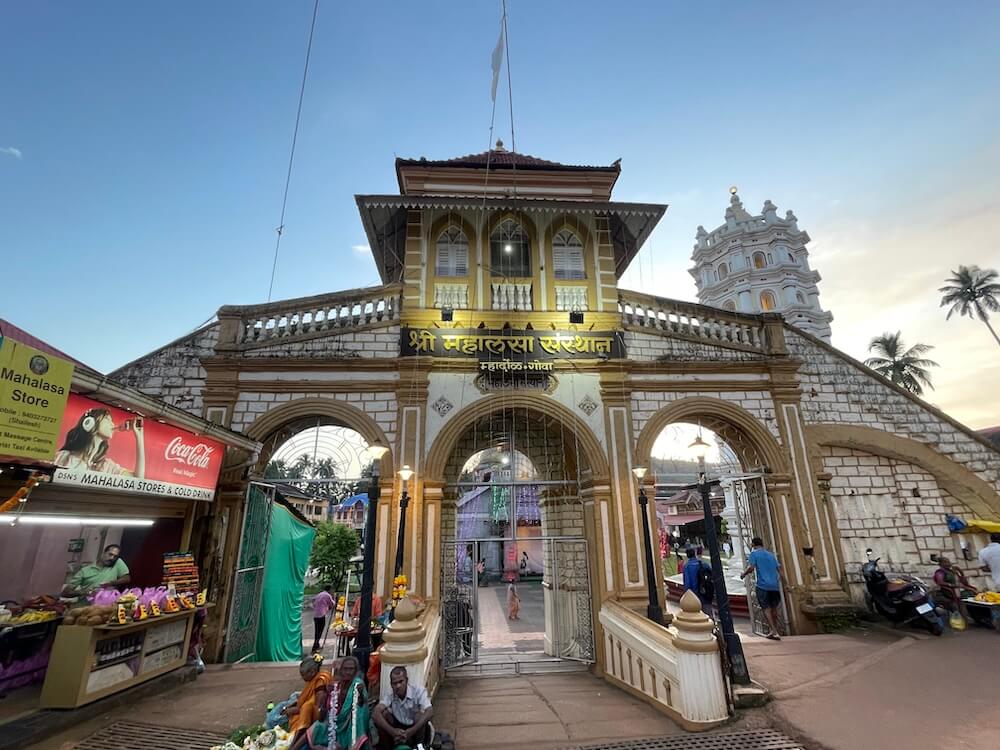
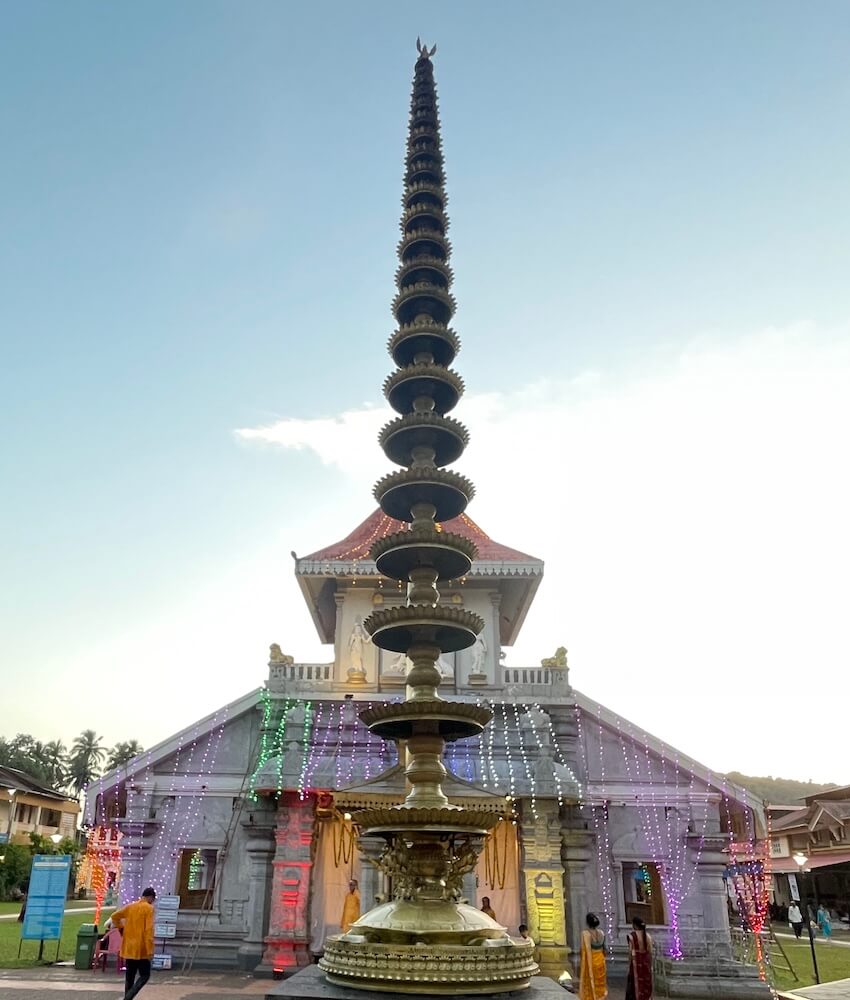
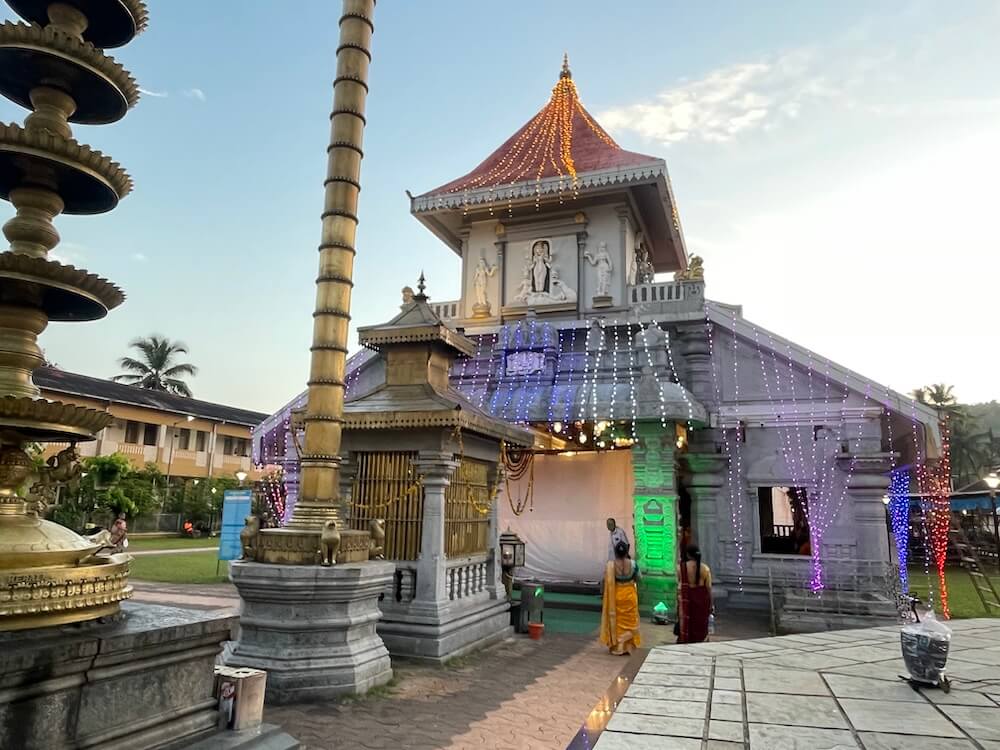
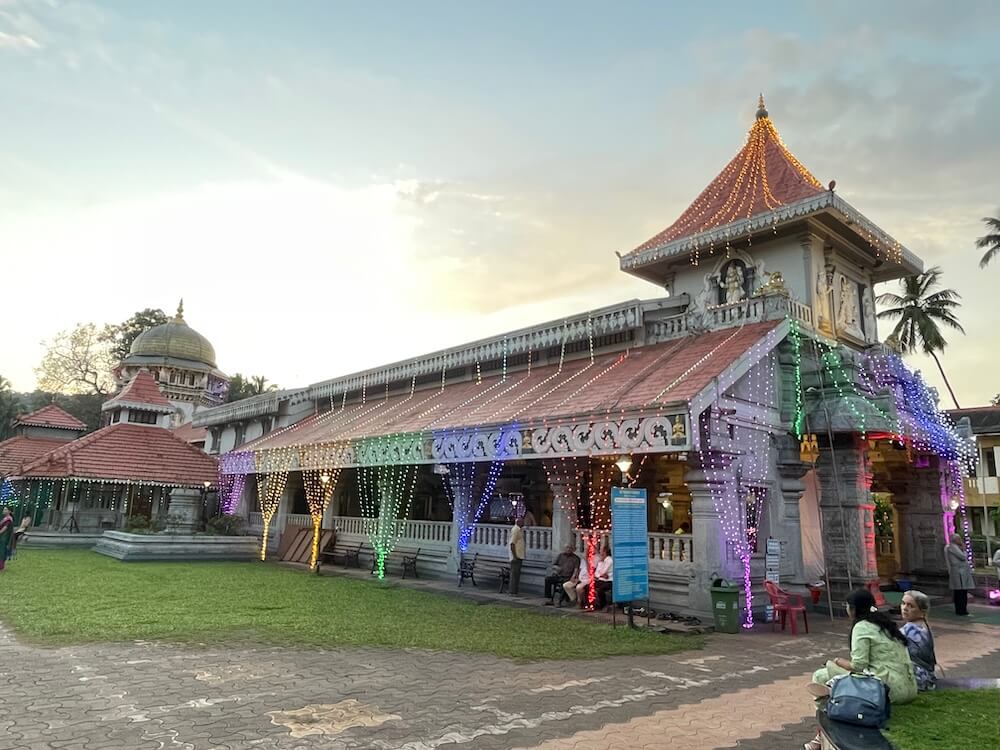
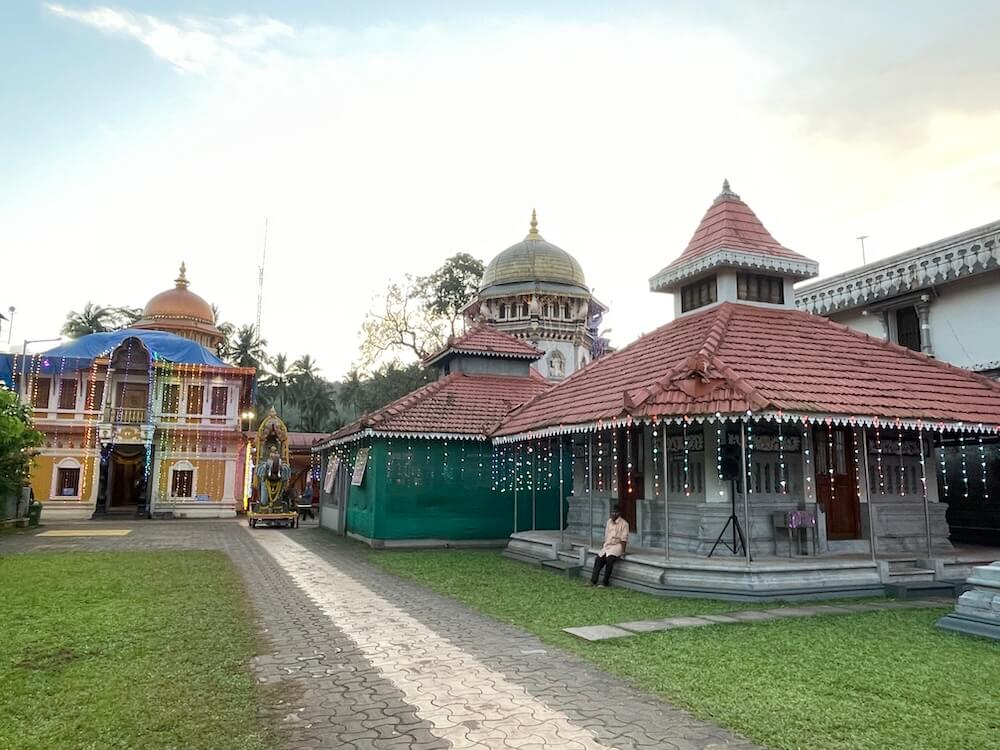
Situated on a vast expanse of land in Mardol, the temple courtyard is surrounded by large buildings on all four sides. One enters the temple courtyard through a grand main gate with three arched doorways. Upon entering, the grand structure of the temple, the tall Deepastambha (lamp pillar) on the left that resembles a large tower, and the magnificent 20-tiered Samai (oil lamp) nearby catch the eye. In front of this Samai stands a tall brass flagstaff, similar to those found in the temples of Balaji in the south. The temple is built in the characteristic Gomantak architectural style. The structure consists of a Mukhamandapa (entrance porch), a grand Sabhamandapa (assembly hall) known as the Chowk, an Ardhamandapa, a Mahamandapa, an Antarala, and a Garbhagriha (sanctum sanctorum). On the walls of the square Nagarkhana located above the Mukhamandapa, an upright idol of Goddess Mahalasa is seated in the front. On the left and right sides are the idols of Adimaya Bhagwati and Saraswati Devi. This chamber has a sloping roof on all four sides with a Kalash on top. The Sabhamandapa, Ardhamandapa, and Mahamandapa also have sloping tiled roofs on both sides. The Garbhagriha of the temple has an octagonal, low-tower-like Shikhara (spire) with a dome and a golden Kalash on top. This Shikhara is covered with copper plates. There was formerly a copper plate in the temple providing information about this. It stated –
Shri Mahalasa Vijayate
Shri. In the Shaka year 1789, in the Prabhava Samvatsara, in the month of Vaishakha. The ancient temple of Shriman Mahalasa had become dilapidated. Through the contributions collected by the Mahajanas (community members) of Gomantaka and Karnataka, the temple was rebuilt firmly with copper plates.
This means that the renovation of the ancient temple of Goddess Mahalasa was completed in the month of Vaishakha in the Prabhava Samvatsara of Shaka 1789 (1867 CE), using funds raised by the Mahajanas of Goa and Karnataka. This clearly indicates that a renovation of this temple took place 158 years ago. The antiquity of the temple is also evident from the carved pillars in the Mahamandapa (great hall) in front of the sanctum sanctorum. There is a row of black stone pillars set at a distance from the outer walls of the Mahamandapa. Both these pillars and the brackets above them feature intricate carvings. The ceiling of the Sabhamandapa (assembly hall) is also adorned with carvings. Along with glass chandeliers, a unique brass bell is hung here. The bell lacks the clapper (ringer) usually used to sound it. This bell was used to deliver justice in disputes. Devotees believed that if anyone lied while ringing this bell, that person would die within three days. This belief was so strong that testimonies given here were considered acceptable in the courts during the Portuguese rule. The clapper is inserted into the bell only when someone needs to give a testimony. Another unique feature of this Mahamandapa is the wooden sculptures of various deities on the ceiling side.
Like other important temples in Goa, the walls of the Antarala (vestibule) and the entrance doors are covered with silver plates featuring intricate carvings. Along with floral patterns and Swastika symbols, large images of the Goddess are embossed on them. Since Mahalasa is a form of Mohini, the scene of the Samudra Manthan (churning of the ocean) is carved on the upper part of the door frame. In the sanctum sanctorum, the four-armed idol of Goddess Mahalasa is installed on a silver Vajrapitha (throne). The Goddess holds a Trishula in her upper right hand. In her lower right hand, she holds the head of an Asura by the hair and a sword. In her upper left hand, she holds a vessel of Amrita (nectar), and in her lower left hand, she holds the head of the Asura who had disguised himself to obtain the nectar. There is also a sculpture of a tiger that has come to drink the blood dripping from this head. Beneath the feet of the Goddess lies the severed body of Rahu. The Goddess wears a Yajnopavita (sacred thread). It is said that she is the only Goddess in Goa who wears a Yajnopavita. Since the Goddess is an incarnation of Vishnu, she wears the Yajnopavita. All rituals of Vishnu worship are performed here, along with traditional Goddess worship rituals like offering sarees and Oti. Furthermore, as the Goddess holds a Trishula, she is also considered to be Rudrashakti. Thus, she is a Goddess who embodies the three powers of Vishnu, Shiva, and the Goddess.
Goddess Mahalasa is seated on a high throne with a beautiful silver Prabhavali (halo) in the sanctum sanctorum. Additionally, Shri Mahalpurush is placed below near her seat. Apart from this, on the outer wall of the sanctum sanctorum, there is Ganapati on the right and Sankashti, the remover of obstacles, on the left.
Behind the Mahalasa temple, on the right side, is the temple of Goddess Santeri, the original deity of this place. In the sanctum of this temple, Lakshminarayana is seated on the right and Goddess Santeri on the left. To the left of the Santeri temple is another temple where the idols of Shri Rampurush, Bhagavati, Sonalbhairav (Samharbhairav), Chatushthi Devi, Kalbhairav, and the Dad deity are installed. Behind the sanctum of the Dad deity, in a niche, is the seat of Lord Malhar. The Yajna Mandapa is also located here. There is a large stone pond at the back of the temple premises.
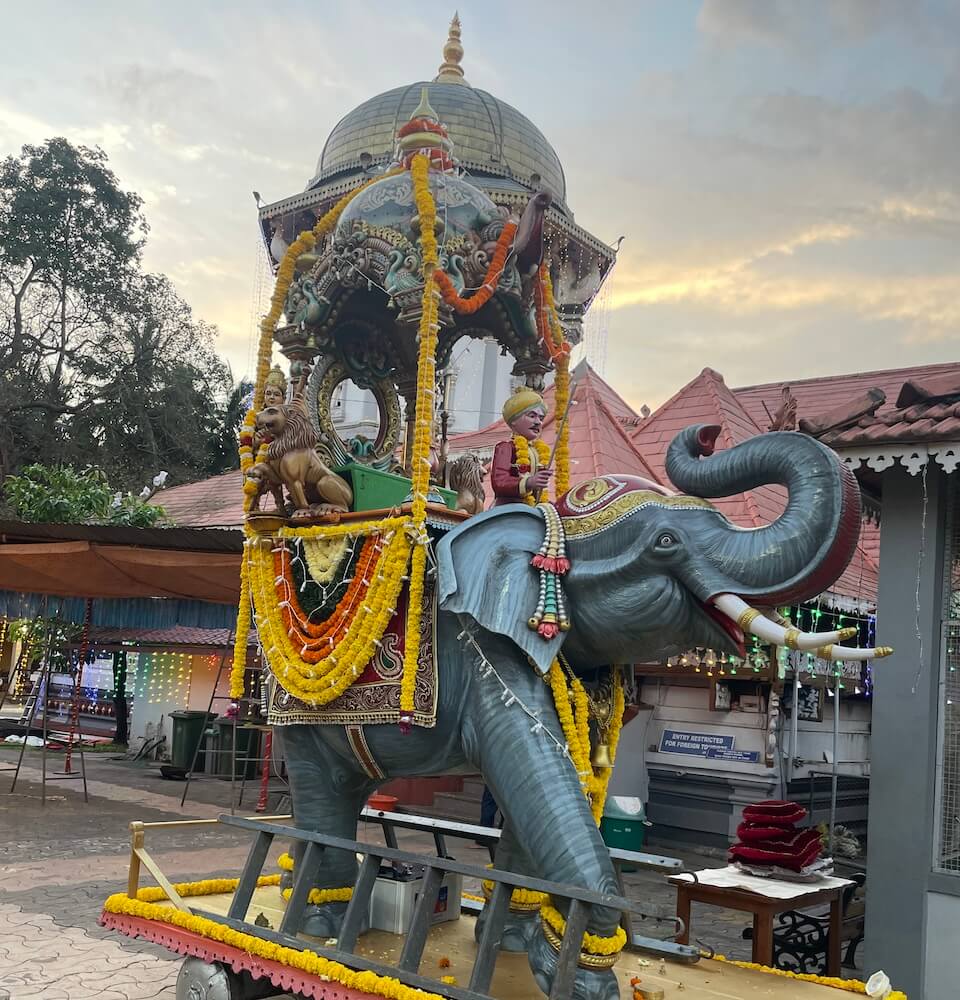
Daily morning rituals like Mahabhisheka are performed in the Mahalasa temple. Thereafter, the Goddess is adorned in the attire of a young maiden (Kumari). A Mahapuja is performed in the afternoon, during which she is adorned in the attire of a young woman. Every Sunday, the Shibikotsava (palanquin procession) of Goddess Mahalasa takes place. Similarly, on the Panchami of every Shukla or Krishna Paksha, the palanquin of Goddess Santeri is taken out. The special festival of this temple is the Jatra. This festival, which lasts from Magh Shuddha Shashthi to Magh Vadya Dashami, concludes with the Vijayarathotsava (victory chariot procession) of Goddess Mahalasa. This festival is famous throughout Goa as the ‘Mahalasa Jatra’. Apart from this, Navaratri, Deepavali, and all other festivals are celebrated with great devotion.
This sacred temple stands as a testament to deep spiritual devotion, ancient architectural grandeur, and rich local cultural traditions.
The sanctum sanctorum houses the divine idol consecrated according to ancient Vedic traditions, surrounded by serene courtyards and traditional temple architecture.
Navratri, Maha Shivratri, Annual Temple Jatra & Deepotsav
Compare and book flights, secure top-rated local hotels near the temple, hire reliable guides, and rent cars instantly.
Extend your pilgrimage by visiting other highly sacred temples located nearby.


Add ₹999 more to unlock FREE SHIPPING!
Your sacred cart is currently empty.
Shop Photo FramesFill in your delivery details below to place your order.
Add comment