
Add ₹999 more to unlock FREE SHIPPING!
Your sacred cart is currently empty.
Shop Photo FramesNarasimha or Narasingh is the fourth avatar of Lord Vishnu. In India, images of Vishnu in this avatar along with Goddess Lakshmi have been worshipped since ancient times. The Shri Laxminarasingh Temple at Veling is a notable example of this. Here, Narasimha is worshipped in his serene avatar alongside Goddess Lakshmi. This deity originally belonged to the ancient village of Shankhavali (present-day Sankhali). In the latter half of the sixteenth century, the deity migrated from there to Veling. Today, a magnificent temple of Laxminarasingh, established by the Gaud Saraswat Brahmins of the ‘Shankha Ping Kuts’ gotra, stands here.
Laxminarasingh was the ancestral family deity (Kuldaivat) of the Vijayanagara royal dynasty. Goa became a part of the Vijayanagara Empire in the year 1370 CE during the reign of Vijayanagara Emperor Bukkaraya. Vijayanagara rule prevailed here for about a century. During this period, the worship of Laxminarasingh became established here. Documents from the Portuguese archives reveal that in the village of Shankhavali, this deity was consecrated under the name ‘Narsu’. Regarding the presence of this deity here, the book ‘Devbhumi Gomantak’ narrates the following legend: Brahmins belonging to seven gotras, who were worshippers of deities such as Santeri, Ishwar, Dharojisini, Narayan, Bhagavati, Ajoshini (Vijayadurga), and Narsu, lived in Shankhavali. After some time, a Saraswat Brahmin with the surname Nayak arrived here from the Karnataka region, carrying his cherished Narasimha Shaligram. The villagers held him in high reverence. At that time, there was a boundary dispute between the villagers of Shankhavali and neighboring Kushasthali (present-day Cuttarkhal). The people of Cuttarkhal had annexed a large part of Shankhavali’s border into their own village by force. To find a permanent resolution to this boundary dispute, the villagers of Shankhavali requested the Brahmin who had come from Karnataka to act as a mediator. The villagers of Kushasthali also accepted his mediation. Thereupon, the Brahmin said, ‘I am a stranger. How would I know your documents? Therefore, I have devised this method for the settlement: I shall fill this spouted vessel (jhari) with water and keep letting its stream flow starting from this location. Wherever it ends, it should be considered the boundary of the village.’ Everyone agreed to this condition. Then the Brahmin consecrated the water in the jhari and began letting the stream flow. The water showed no signs of running out even after a large part of Kushasthali was included within Shankhavali. The people of Kushasthali had to accept this judgment. However, some people from that village grew resentful. One day, while the Brahmin was asleep, some people angrily threw his deities secretly into a pond. The Brahmin would take his meal only after worshipping his Narasimha Shaligram. With that Shaligram missing, the Brahmin renounced food. While he was observing this fast, one day he received a divine vision in a dream. The Lord told him, ‘Dive into the pond in front, and whatever touches your hands, consider that to be Me and worship it.’ Accordingly, when he took a dive, a stone lingam about a cubit and a quarter in length touched his hands. The Brahmin worshipped it, believing it to be Narasimha. Later, the Narasimha Shaligram was also found. Subsequently, that Brahmin named the said lingam ‘Stambha’ (pillar), matching the concept of the Narasimhavatara, and consecrated his Narasimha deity upon it. The gotra of this Brahmin was Kauts, and his pravaras were Shankh, Pingal, and Kust. He later became famous by the surname Shankhavalikar.
Later, in the latter half of the sixteenth century, a few days prior to 1 May 1560, due to the cruel atrocities of the zealotic Portuguese, this deity of Shankhavali was relocated. In the chapter titled ‘Deivatanche Sthalantar’ (Migration of Deities) from the text ‘Koknakhyan’, composed in Shake 1643 (1721 CE), it is stated regarding this: ‘Kushasthali Shri Mangesh Priyoli, Verane Mhasla Mhadadoli, Shankhavali Dev Doni Sthali, Keri Ani Velingasi… Velingasi Narasimha Santeri, Vijaydurga Te Keri Majhari, Ani Keloshichi Shantadurga Bari, Rahili Kavale Te Grami..’ This makes it clear that the image of Narasimha was brought to Veling. In the course of time, a magnificent temple of the Lord was built here. Following periodic renovations and restorations, the temple attained its present form.
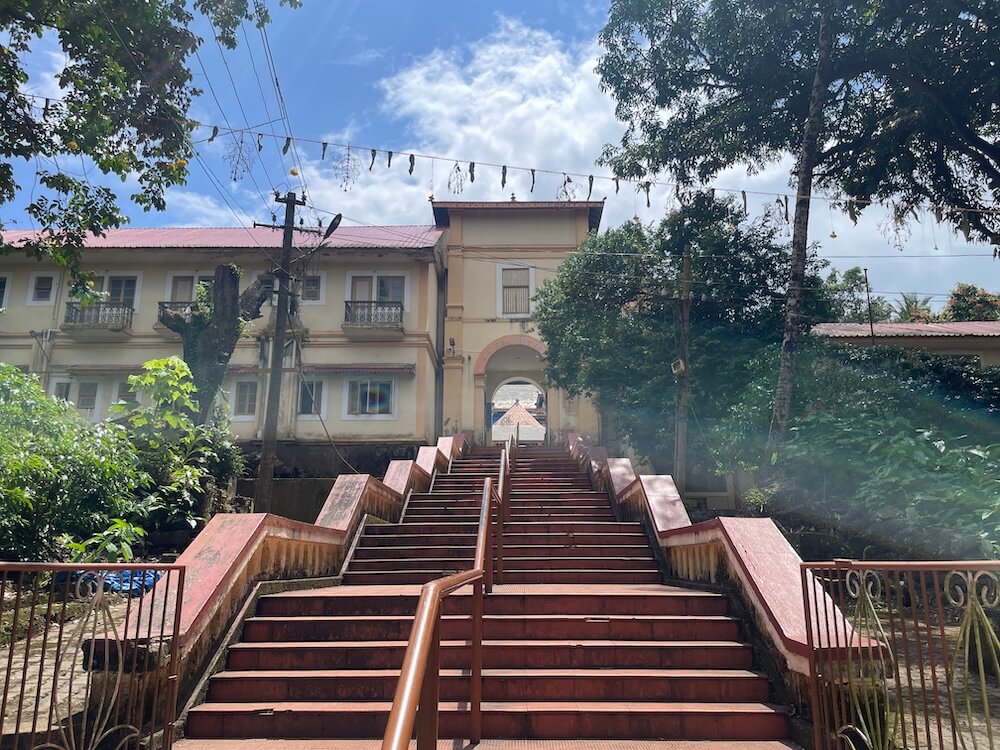
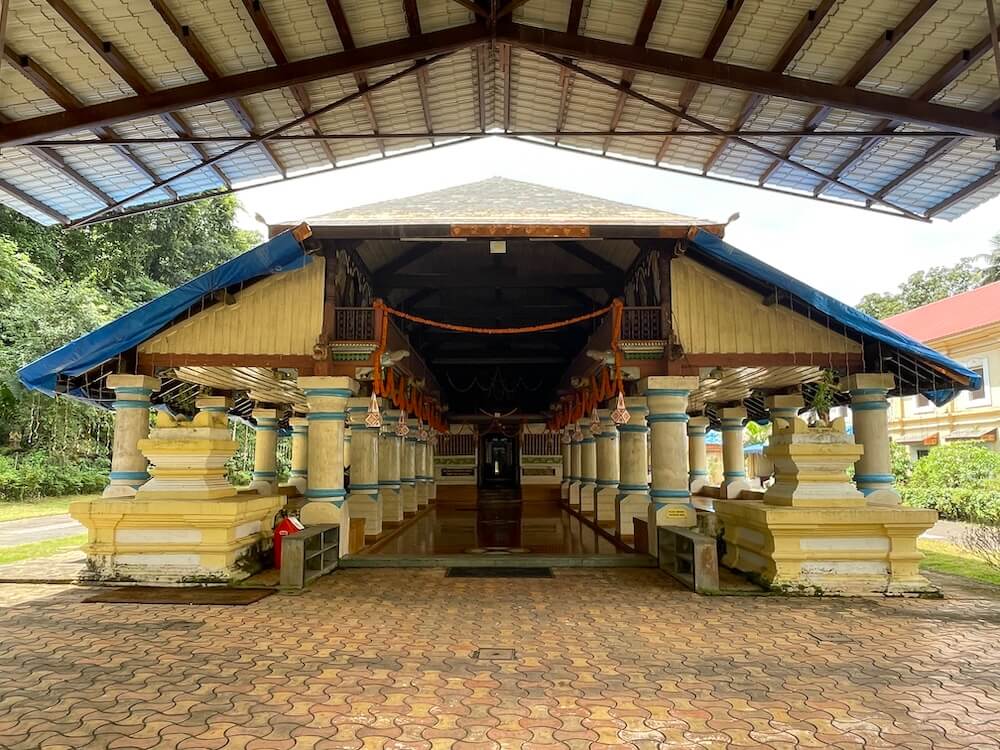
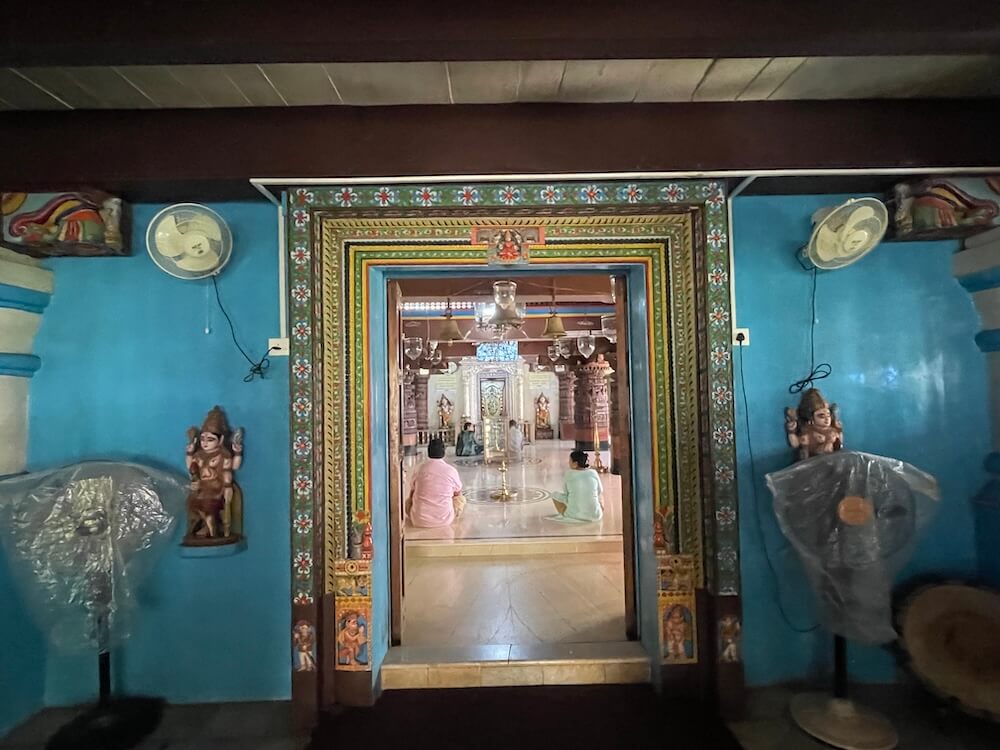
The temple is situated within a spacious courtyard. Ascending a few flights of steps, one enters the temple courtyard through a gopuram-like grand gateway. Right ahead stands the magnificent structure of the temple built in the Gomantak architectural style. The temple’s layout consists of a sabhamandapa (assembly hall), ardhamandapa (semi-hall), mahamandapa (great hall), antarala (vestibule), and garbhagriha (sanctum sanctorum). The sabhamandapa is semi-open in nature. In the sabhamandapa, there are Tulsi vrindavans on large platforms on both sides in the front. There are kakasanas (stone benches with backrests) along the sides of the sabhamandapa. Leaving some distance from there, there is a row of circular pillars. Above it is a gallery. Ascending five steps, one enters the ardhamandapa. Above the front wall of the ardhamandapa, an image of Ganesha is enshrined in a devhara (niche) in the gallery. The ardhamandapa has an ornate entrance, and on both sides of the door frame, there are large vyala (mythical beast) sculptures carved in wood. On the front wall within the ardhamandapa, on both sides of the entrance to the mahamandapa, are sculptures of the Vaishnava door guardians (dwarapalas) Jaya and Vijaya. The entrance to the mahamandapa is quite wide, and floral designs are carved on the door frame. An image of Lakshmi is carved on the lalatbimba (center of the lintel) of the door frame.
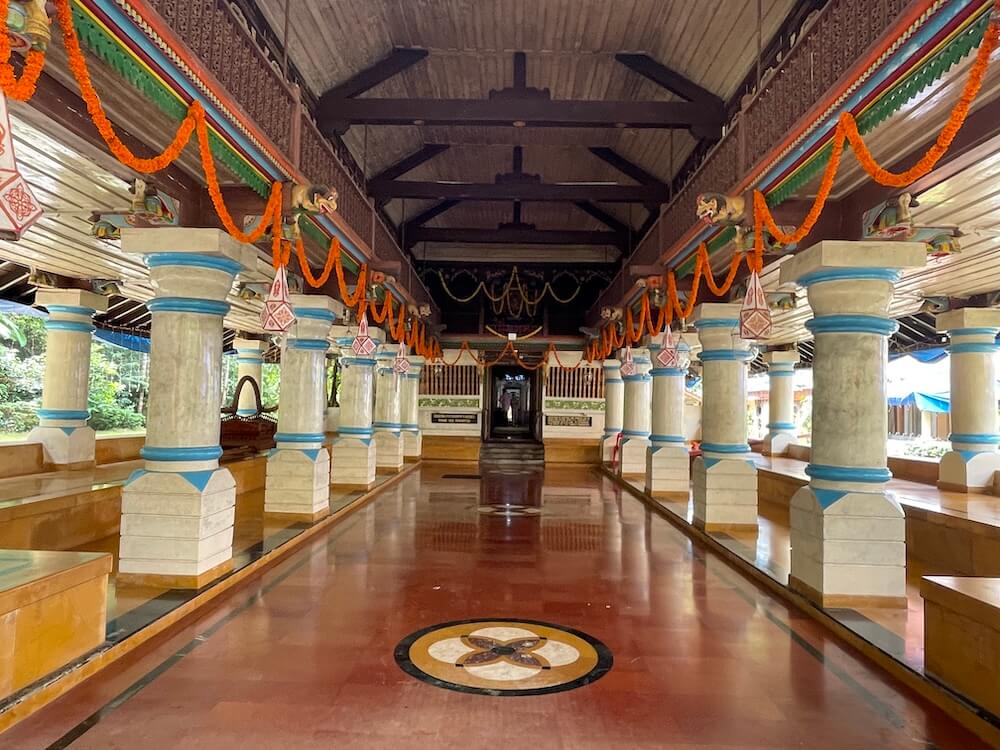
The beauty of the mahamandapa in the temple is doubled due to the carved circular pillars and the taranghastas (wave-like brackets) on them, the wooden carved niches in the mezzanine containing wooden sculptures of various gods and goddesses, and the glass hanging lamps and chandeliers suspended from the ceiling. The pillars here feature carvings of the Dashavatara as well as various mythological episodes. At the capitals of the pillars, circular areas depict multiple hooded serpents. The wooden sculptures of deities and mythological episodes here are also captivating. Temple scholars and tourists eagerly visit this place to witness this sculptural artwork. Large brass samayas (oil lamps) are placed in the center of the mahamandapa. From the mahamandapa, there is a pradakshina marga (circumambulation path) around the garbhagriha. The entrance to the antarala resembles a beautiful makara arch. It is covered with finely carved silver sheeting.
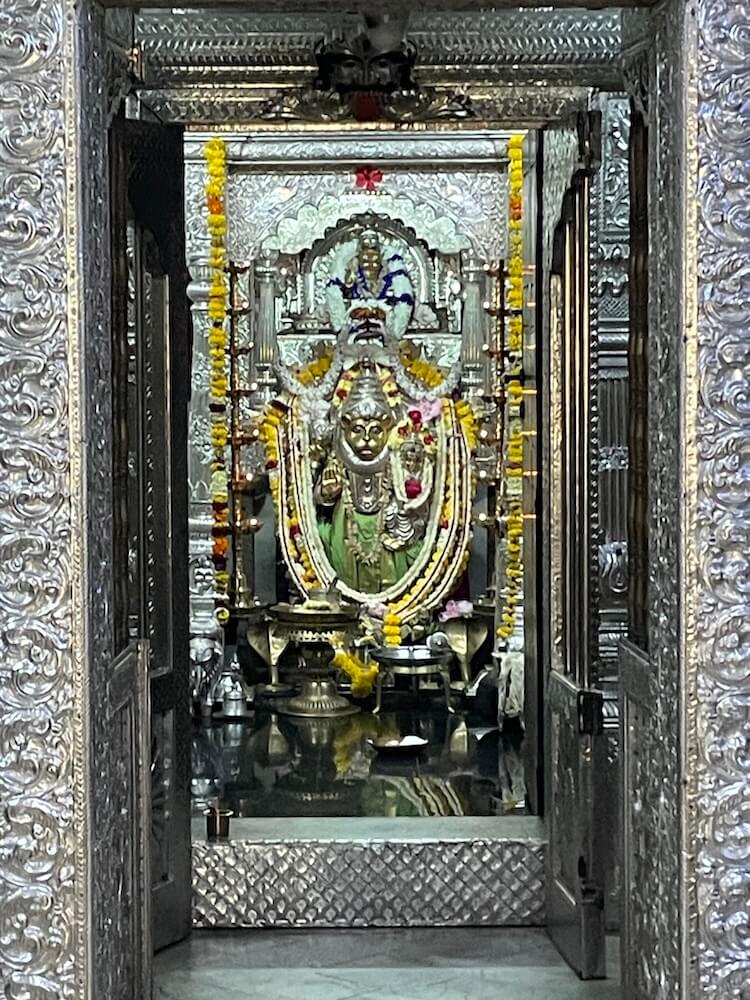
In its upper part, there is a small dome-shaped shikhara (spire). There are Vaishnava dwarapalas on both sides of this entrance. There are a total of three small antaralas in this temple. The entrance to the garbhagriha also has an ornate silver covering. At the upper part of its door frame is a kirtimukha. Inside, an image of Laxminarasimha made of black stone is enshrined upon a high seat within a tall silver devhara. Here, Narasimha is in the alidhasana posture, with Goddess Lakshmi seated on his left thigh. Both Narasimha and the Goddess wear crowns on their heads. One hand of both deities is in the Abhaya mudra (gesture of fearlessness). Narasimha holds the Shankha (conch shell) and Chakra (discus) in his two upper hands. A large Gada (mace) is placed near his lower outstretched feet. The idols are adorned with a garland around the neck and a waist belt (Kamarpatta). After the daily Abhisheka, the idols are adorned with a brass mask, a silver crown, and other coverings, and are decorated with rich garments, ornaments, and flower garlands. In front of the idols are small Panchaloha idols of Garuda and Hanuman. On both sides, there are also two brass serpent idols. In the sanctum sanctorum, a Panchaloha idol of Nrsimha is enshrined in a recessed alcove on the upper back side.
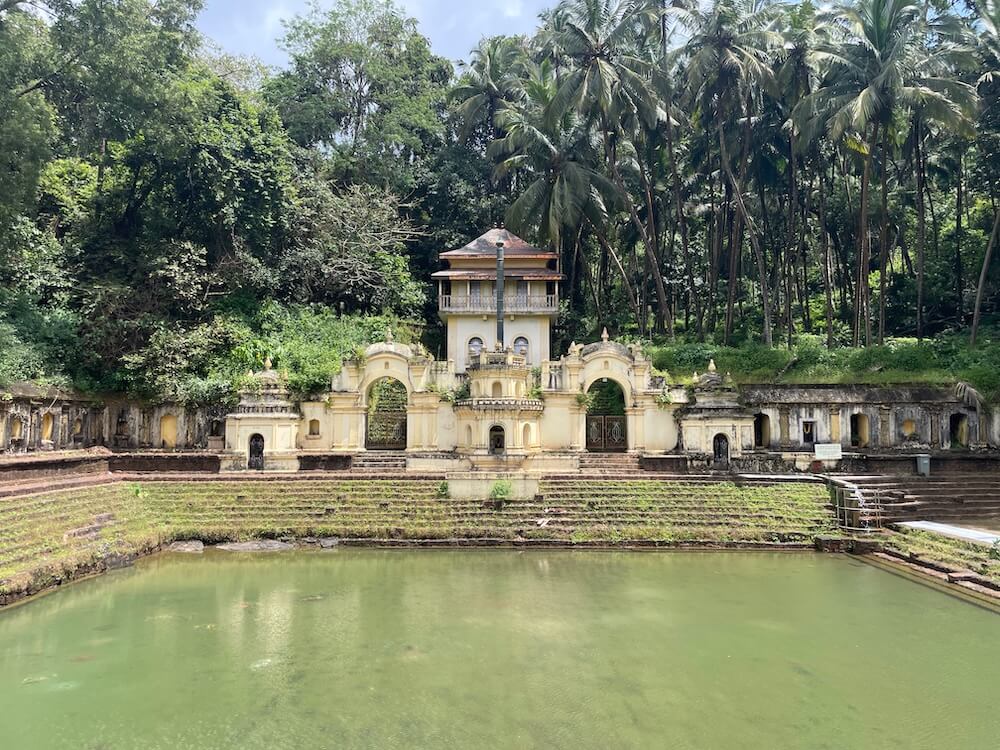
Above the sanctum, the Shikhara (spire) features a square base at the bottom, an octagonal structure above it, and a triangular pyramid-like structure at the top. This triangular Shikhara is covered with copper sheets and surmounted by a Kalash. In the shrines located within the temple courtyard, there are carved stone idols of Kshetrapala as well as Chaturmukha Brahma. Similarly, the memorial shrines of the ancestors of the Bhandarkar and Nayak families are located here in the form of stone Lingas. A special feature of the temple courtyard is the enchanting freshwater Pushkarani (temple tank). Enclosed on all sides by neatly carved stone steps, this pond features numerous halls built into the surrounding walls. On the front side, there are two small temples, featuring a circular structure with arches on all sides and a flagstaff atop it, behind which are two arches, and further behind them in the center is a two-story building, making this a magnificent piece of architecture. Water flows continuously twelve months a year from the Gomukha (cow-faced spout) situated in this pond. The area behind the pond is surrounded by dense foliage and trees.
In this temple, the Shibikotsava (palankin procession) is held at night on the Chaturdashi of the Shukla Paksha (waxing phase of the moon) every month. Apart from this, the most important festival here is Narasimha Jayanti. This festival lasts for four days and is known here as the Vaishakh Purnima festival. A grand fair of Lord Narasimha is held here on Kartik Purnima. This fair begins the day before. On the night of Purnima, the festival of Sangodvihara, which is a boat-ride celebration of the Lord, takes place in the pond here. At that time, dazzling fireworks are displayed. On the very next day, the Rathotsava (chariot festival) of Pratipada is held here. The chariot of the Lord is carried in a special dancing motion to the tree where the Lord first arrived in Veling. After performing Aarti there, the chariot returns to the temple. Following this, a four-day festival is celebrated in Magh Purnima. For the visiting devotees and Mahajans (community members), there is a pilgrim rest house (Agrashala) as well as a Prasadalaya (dining hall).
This sacred temple stands as a testament to deep spiritual devotion, ancient architectural grandeur, and rich local cultural traditions.
The sanctum sanctorum houses the divine idol consecrated according to ancient Vedic traditions, surrounded by serene courtyards and traditional temple architecture.
Navratri, Maha Shivratri, Annual Temple Jatra & Deepotsav
Compare and book flights, secure top-rated local hotels near the temple, hire reliable guides, and rent cars instantly.
Extend your pilgrimage by visiting other highly sacred temples located nearby.


Add ₹999 more to unlock FREE SHIPPING!
Your sacred cart is currently empty.
Shop Photo FramesFill in your delivery details below to place your order.
Add comment