
Add ₹999 more to unlock FREE SHIPPING!
Your sacred cart is currently empty.
Shop Photo FramesShantadurga is a popular deity among the devotees of the Goddess in Gomantak. Goddess Shantadurga is worshipped as the deity who established peace in the universe by ending the great war between Lord Vishnu and Mahadeva. Sateri or Santeri, who is worshipped in the form of an anthill in Konkan and considered one of the Saptamatrikas, is the very same Shantadurga of Gomantak. This Goddess, originally from the Puranic and historically renowned Shankhavali, known today as the village of Shankhwal, is now enshrined at Gothan. The ancient temple of this Goddess, known here as Shantadurga Shankhvaleshwari, is a place of faith for countless devotees.
The story of the ancient city of Shankhavali is given in the Sahyadri Khanda of the Skanda Purana. In it, this city was an ornament of the Ramakshetra named Ishupat, and the temple of Chitragupta was located here. Lord Vishnu and Mahadeva themselves resided in this place. Every day, a line or row of conch shells would arrive here from the sea. Because of this, it was named Shankhavali. Its corrupted form became Shankhwali. There was a large temple of Goddess Sateri in this city. According to Hindu religious tradition, an anthill is considered a symbol of Goddess Sateri. A mythological legend regarding Renuka, the mother of Lord Parashurama, states that Renuka was born from an anthill and also disappeared into an anthill. The worship of the anthill holds an important place in the Shakta tradition.
The mythological legend explaining the name of the Shantadurga form of Goddess Sateri is that in ancient times, a fierce war took place between Shiva and Vishnu. It lasted for two thousand years. The entire world was shaken by the clashing of Vishnu’s Sudarshana Chakra and Shankara’s Pashupatastra. The possibility of the end of the universe arose due to this war. Because of the war, the duties of protection and destruction of these two deities began to stall. Seeing this, Lord Brahma finally created Adishakti Jagadamba with his divine radiance. He sent her to the earth and asked her to bring about reconciliation between these two gods. Accordingly, the Goddess arrived on the battlefield and, standing between the two warriors, she preached to them. According to the Ambika Khanda of the Skanda Purana, the Goddess preached to them that Brahma is the same as Hari and Maheshwara. In this way, the Goddess stopped the war and established peace. That is why she was named Shantadurga.
Like many temples in Gomantak, the Sateri (Shantadurga) temple at Shankhwal also had to be relocated. On the dark day of 28 February 1510, the Portuguese entered Gomantak and conquered the island of Goa in November of the same year. After this, their religious fanaticism made life difficult for the Hindus of Goa. In the year 1560, the Inquisition, or the religious review institution, was established in the island of Goa. Through this institution, the cruel persecution of Hindus began. They were forced to convert. They were strictly forbidden from worshipping Hindu gods and goddesses. Their temples began to be demolished and burnt. The Shankhwal region was also affected by this. At that time, the idols from many temples here were relocated elsewhere. This included Shantadurga, as well as deities like Lakshminarasimha and Vijayadurga. Fearing the cruel and fanatical Portuguese, the Mahajans and tenants who were devotees of the Goddess decided to take the idol of the Goddess from the Portuguese territory to the neighboring Muslim territory. Accordingly, one day, some people took the idol of the Goddess and crossed the Zuari river. They first came to the village of Madkai. They stayed at a place called Karanjal on the shore of this village. Later, after finding a suitable place in Veling village of Ponda Mahal, which was under the control of Adilshah, this idol was brought here. It was installed at Gothan Wada here. In the chapter ‘Daivatanche Sthalantar’ (Relocation of Deities) of the book ‘Konkanakhyan’, composed in Shake 1643 (1721), it is said about this:
‘Kushasthali Shrimangesh Priyoli. Verane Mhalasa Mhad-doli. Shankhavali dev donhi sthali. Keri ani Velingasi.. Velingasi Narasimha Santeri. Vijayadurga te Keri majhari. Ani Keloshichi Shantadurga bari. Rahili Kavale te grami..’ In this, it is clearly stated that Goddess Santeri was relocated to Veling. There is evidence that Christian missionaries entered Sasashti on 1 May 1560 for conversion. From this, it is clear that the idols from the temples of Shankhwali were relocated before 1 May 1560. Over time, a large temple of the Goddess was built here. The temple attained its present form after periodic renovations and restorations.
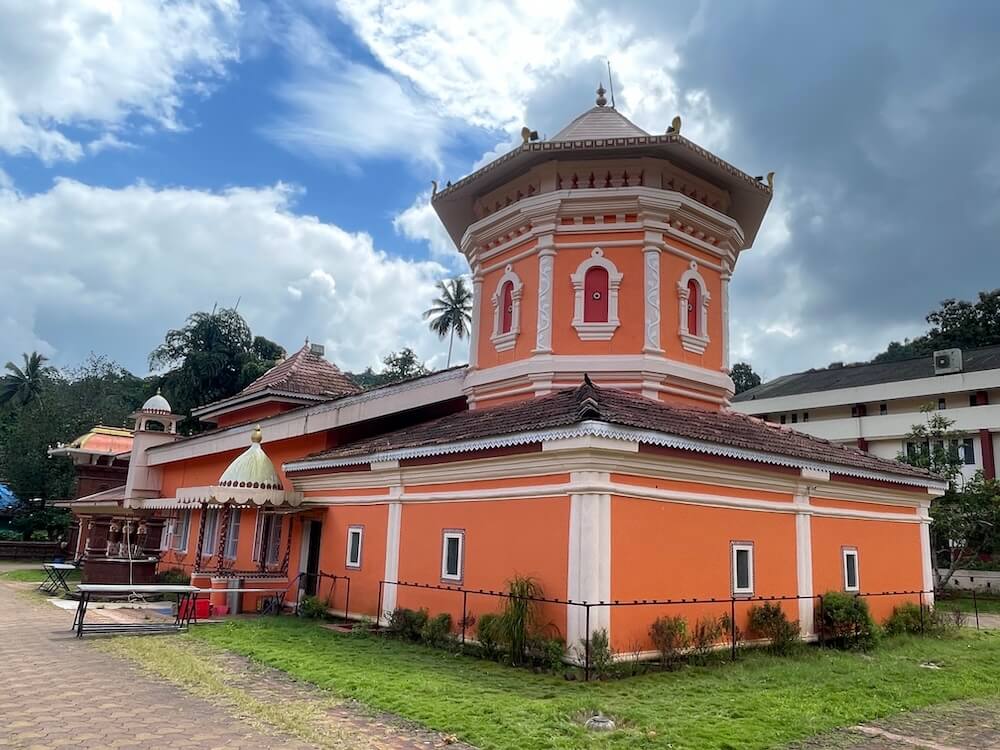
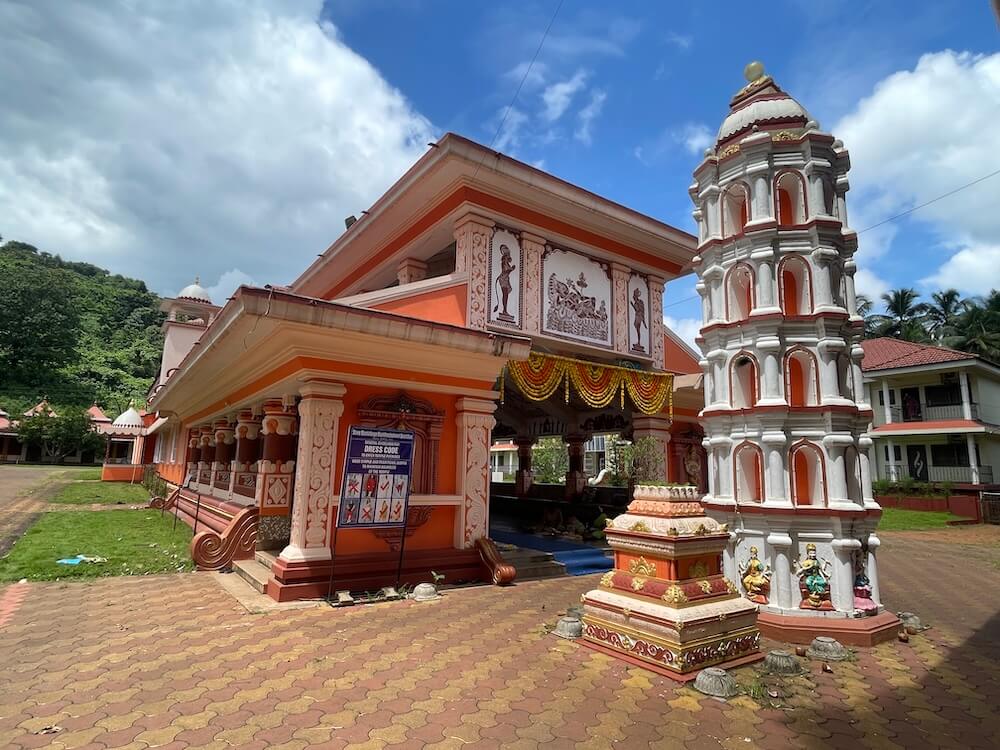
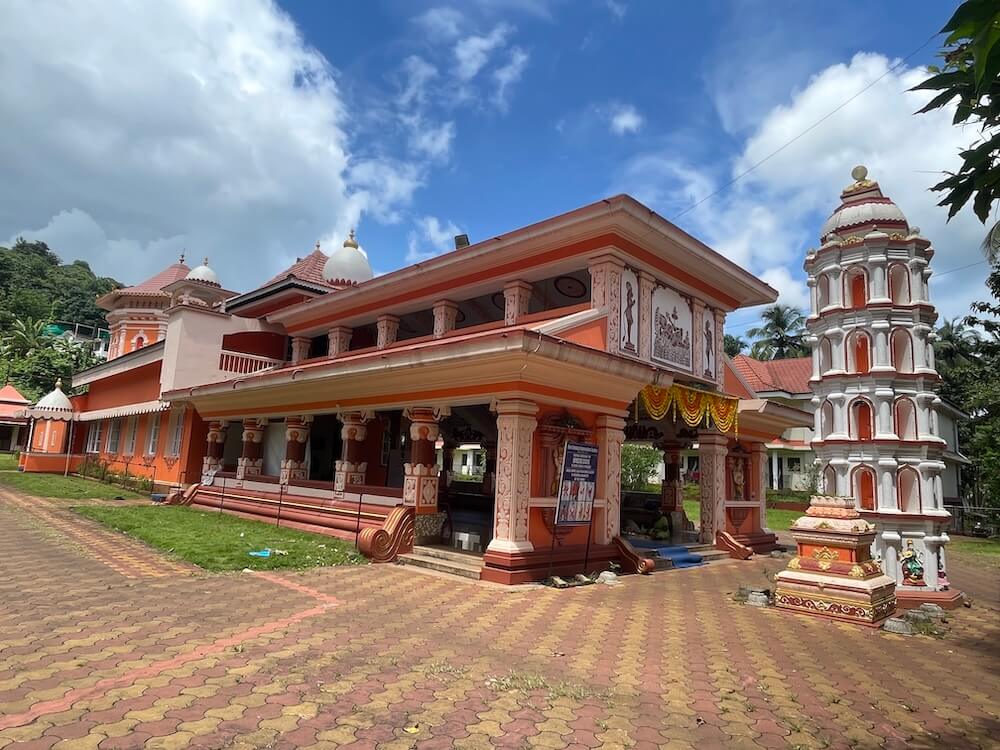
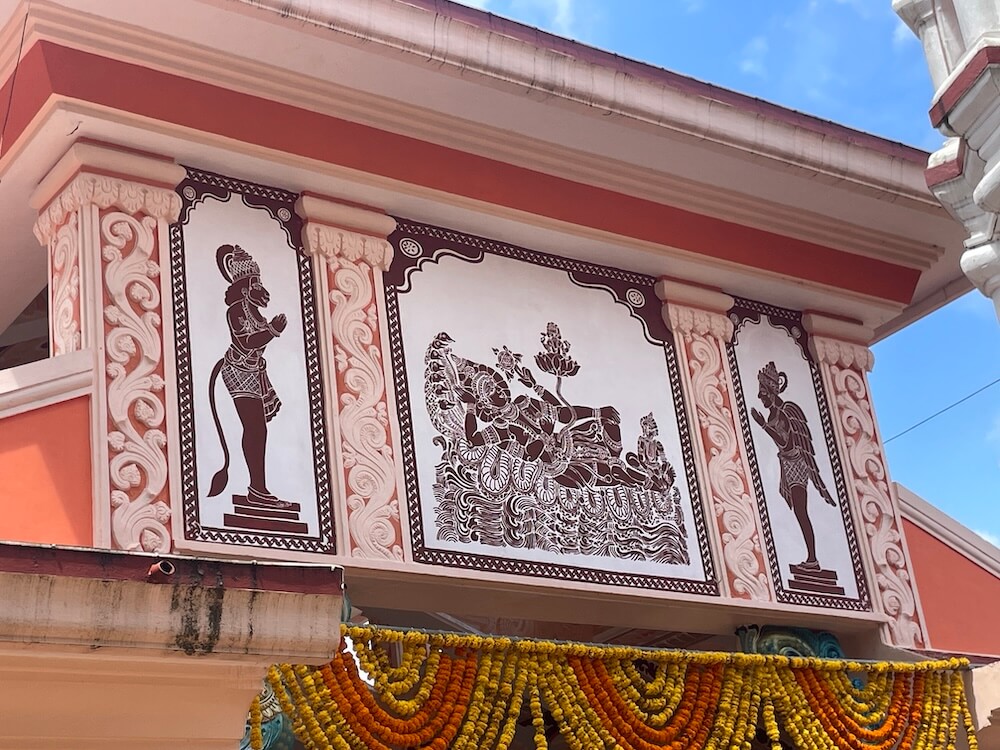
The temple of Goddess Shantadurga Shankhvaleshwari is situated in the quiet and picturesque surroundings of Gothan Wada, a short distance from Veling village. The vast courtyard of the temple has a large stone main gate. In front of this temple, situated in the center of the courtyard, is a six-tiered lamp pillar. There are relief sculptures of various gods and goddesses in the niches of its lower level. Next to it is a beautiful Tulsi Vrindavan. This temple is built in the distinctive Gomantak temple architectural style. The temple structure consists of a two-storied Sabhamandap, Ardhamandap, Mahamandap, and Garbhagriha. There is a circular spire with a Kalash on the Ardhamandap, while above the Garbhagriha, there is a sloping tiled roof on an octagonal tower-like structure. There is a Kalash on top of it. The Kavi art carvings on the walls and pillars are a notable feature of this temple. On the wall above the entrance of the Sabhamandap, there is an image of Sheshashayi Vishnu, Garuda, and Hanuman carved and painted in this same art style. The Sabhamandap has sloping roofs on both sides. Various types of carvings are etched on them, as well as on the beams below. On the wall under the roof, there is a relief sculpture of the deity’s palanquin, as well as Vyala sculptures. There is an arched entrance on the platform in front of the entrance of the Ardhamandap. The reception area of the temple is in the Ardhamandap. From here, one enters the Mahamandap. The wooden entrance of the Mahamandap is decorated with intricate carvings. On both sides of it are statues of Vaishnava Dwarapalas. There are circular pillars inside the Mahamandap. Brass bells, glass lamps, and chandeliers are hung from the ceiling. There is a circumambulation path from the Mahamandap to the Garbhagriha. Marble tiles have been installed on the front wall of the Garbhagriha.
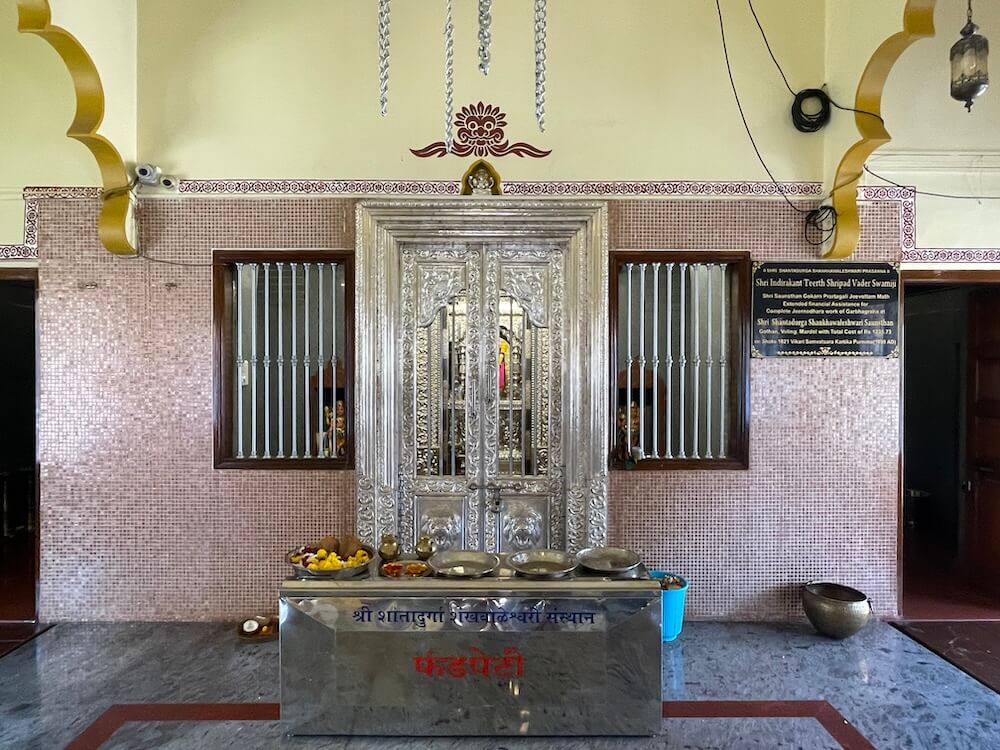
The entrance is adorned with intricately carved silver sheets. At the center of the lintel of the doorway, there is a silver idol of Lord Ganesha, surmounted by a Kirtimukha. On both sides of the entrance, there are windows fitted with steel bars. Inside, the mask-form idol of Goddess Shantadurga is enshrined on a high pedestal within a silver canopy. The Goddess wears a golden crown on her head. Behind her is a Prabhaval (halo) with a Kirtimukha carved upon it. Behind this halo of the Goddess lies the Royan or Rohan, which is an anthill, symbolizing Goddess Sateri. In front of the idol are small Panchadhatu (five-metal alloy) idols of Lakshmi-Narasimha and Vijayadurga. Among these, there is also a small stone idol of Lord Ganesha. A Panchadhatu idol of the Goddess is placed at the base of the canopy, where the Prasad-Kaul (divine consultation) is performed.
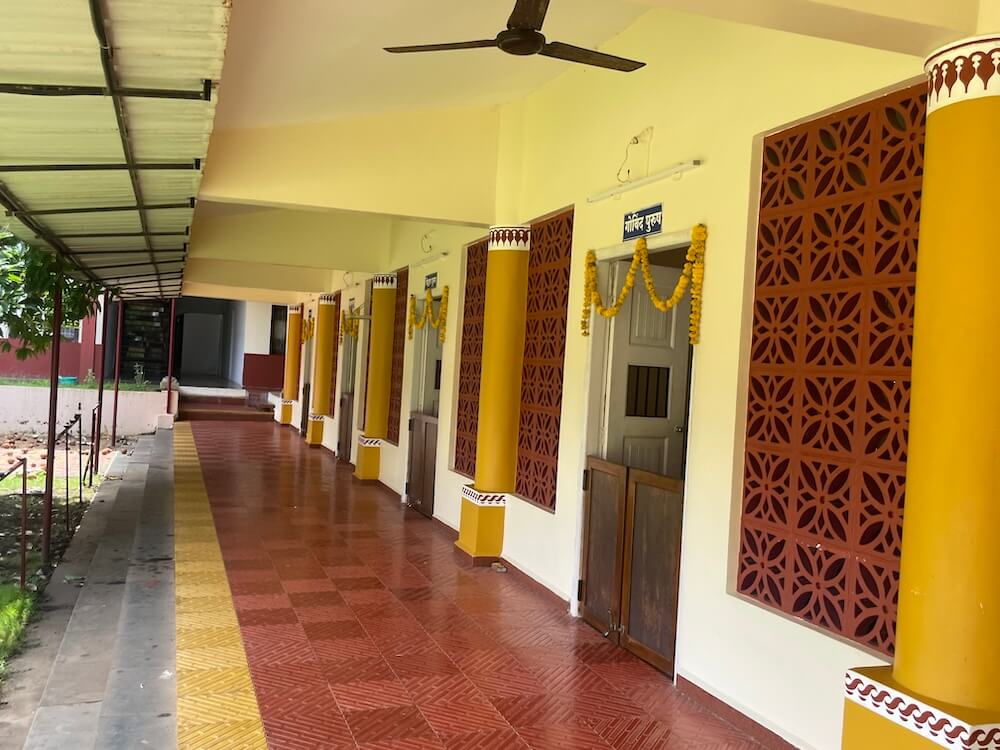
In the temple courtyard, there is a guest house named ‘Shantadurga Nilayam’. Behind the temple, in a row of small shrines, the Grampurush and ancestors of various Gotras are installed in the form of Lingas. One of these shrines houses the Dandapani or Kshetradhipati. The idol of Dandapani is made of standing black stone.
Festivals such as Varsha Pratipada, Akshaya Tritiya, Nag Panchami, and Navaratri are celebrated with great enthusiasm at this temple. A Shibikotsav (palanquin procession) is also held during these times. On the evening of Vijayadashami in the month of Ashwina, the palanquin of the Goddess is taken to a specific location for Simollanghan. There, the palanquins of three different deities—Shantadurga Shankhwaleshwari, Lakshmi-Narasimha, and Vetaleshwar—gather simultaneously. Thousands of devotees participate in this ceremony. A grand Makharotsav is held here during Navaratri. During this period, Chandi Parayan and Homa-Havan are organized. Similar to other temples in Gomantak, the tradition of Prasad-Kaul is practiced here as well.
This sacred temple stands as a testament to deep spiritual devotion, ancient architectural grandeur, and rich local cultural traditions.
The sanctum sanctorum houses the divine idol consecrated according to ancient Vedic traditions, surrounded by serene courtyards and traditional temple architecture.
Navratri, Maha Shivratri, Annual Temple Jatra & Deepotsav
Compare and book flights, secure top-rated local hotels near the temple, hire reliable guides, and rent cars instantly.
Extend your pilgrimage by visiting other highly sacred temples located nearby.


Add ₹999 more to unlock FREE SHIPPING!
Your sacred cart is currently empty.
Shop Photo FramesFill in your delivery details below to place your order.
Add comment