
Add ₹999 more to unlock FREE SHIPPING!
Your sacred cart is currently empty.
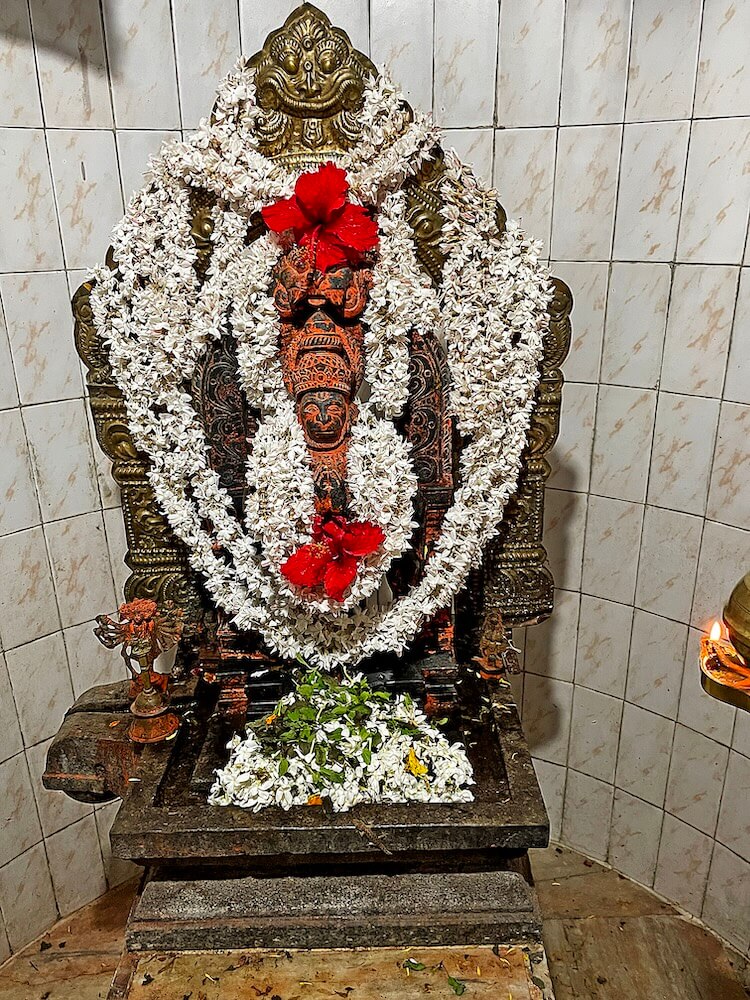
Shop Photo FramesIn theism, God is considered Nirguna (without attributes), Nirakar (formless), and Nirvikalpa (without change). In spiritual mysticism, it is said that God is beyond the reach of sensory perception. Being formless, no attributes can be imposed upon Him. Since ancient times, along with the Saguna-Sakara (manifested with form) worship of God, the worship of the Nirakar (formless) has also been practiced. The uniqueness of Mashem village lies in the fact that there is a temple of Nirakar here, and the deity worshipped as Nirakar is enshrined in the form of a carved pillar. According to popular belief, this temple is associated with the incarnation of Vishnu.
According to the ‘Bharatiya Sanskriti Kosha’ by Pandit Mahadevshastri Joshi, ‘Nirakari’ means formless or a deity conceived without an icon. There are many such places in Konkan. In folk belief, the word Nirakar has another meaning: ‘Niru’, meaning born from water or emerged from water. It is believed here that the Nirakar in the Mashem temple is related to water. It is said that where the Nirakar shrine stands today, there was once a landmass on the riverbank. During low tide, a cow would come to this land and release her milk at a specific spot. Out of curiosity, some boatmen investigated why the cow released her milk there. They discovered a pillar buried in the sand. That pillar was addressed as Nirakar, and a temple was built for it.
According to another legend about the temple, it is associated with the Narasimha avatar of Vishnu. According to the story in the Bhagavata Purana, to destroy Hiranyakashipu (original Sanskrit name – Hiranyakashipu), Lord Vishnu took the Narasimha avatar at the request of the devotee Prahlada and manifested from a pillar in the demon king’s court. The Nirakar pillar is therefore considered a symbol of Narasimha. The inscription in the temple also mentions that this temple is related to the Vishnu avatar. According to the knowledgeable elders of the village, there was originally a Vishnu idol here. During the Portuguese era, temples were attacked and idols were destroyed. At that time, the people of that period hid the original idol and began worshipping a pillar. The sanctum sanctorum of this ancient temple was renovated on the auspicious occasion of Akshaya Tritiya in 1994.
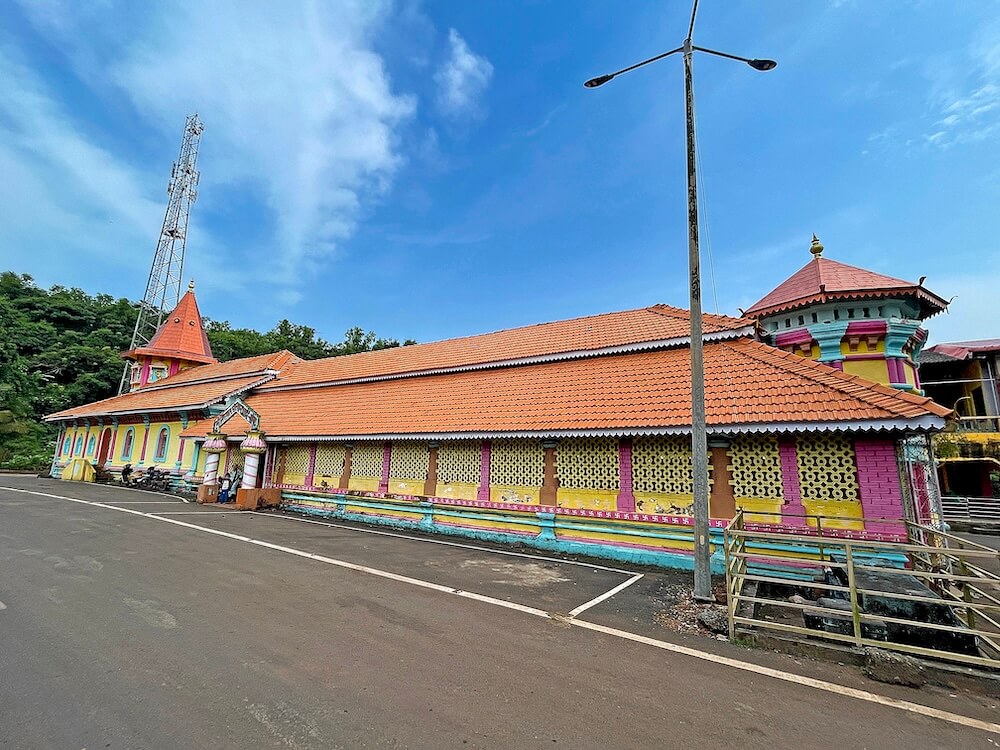
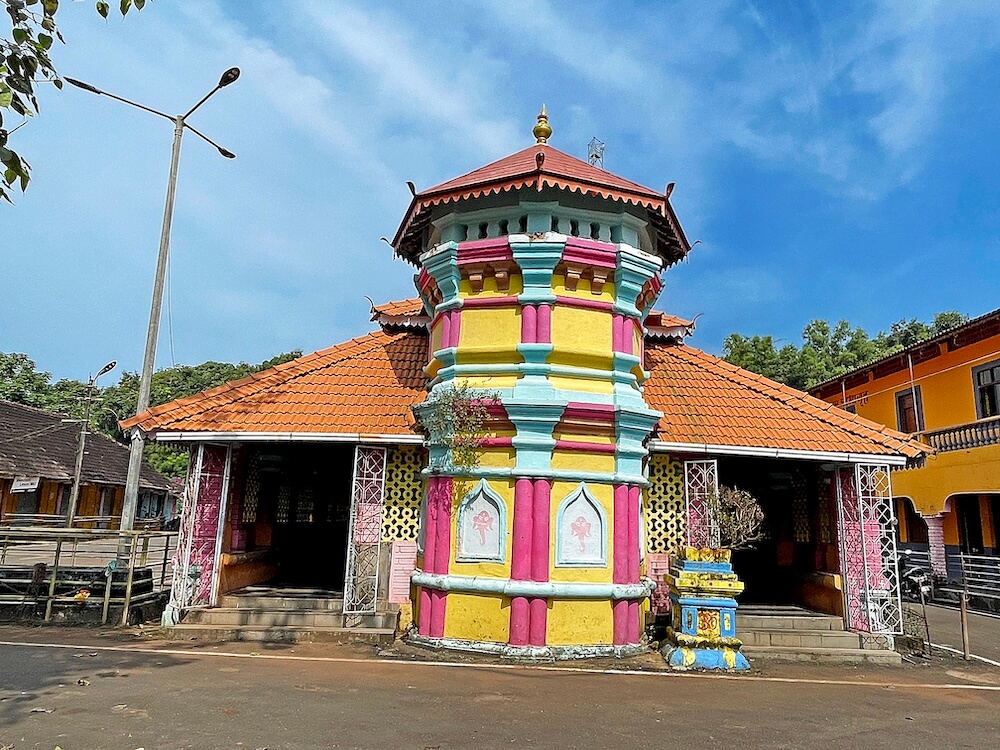
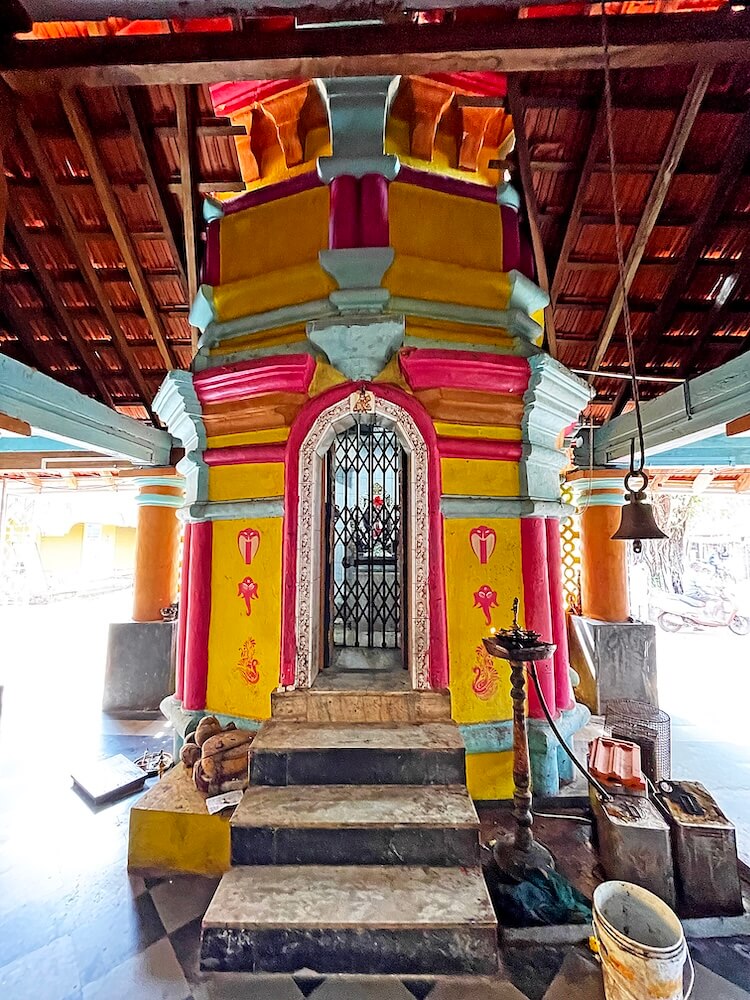
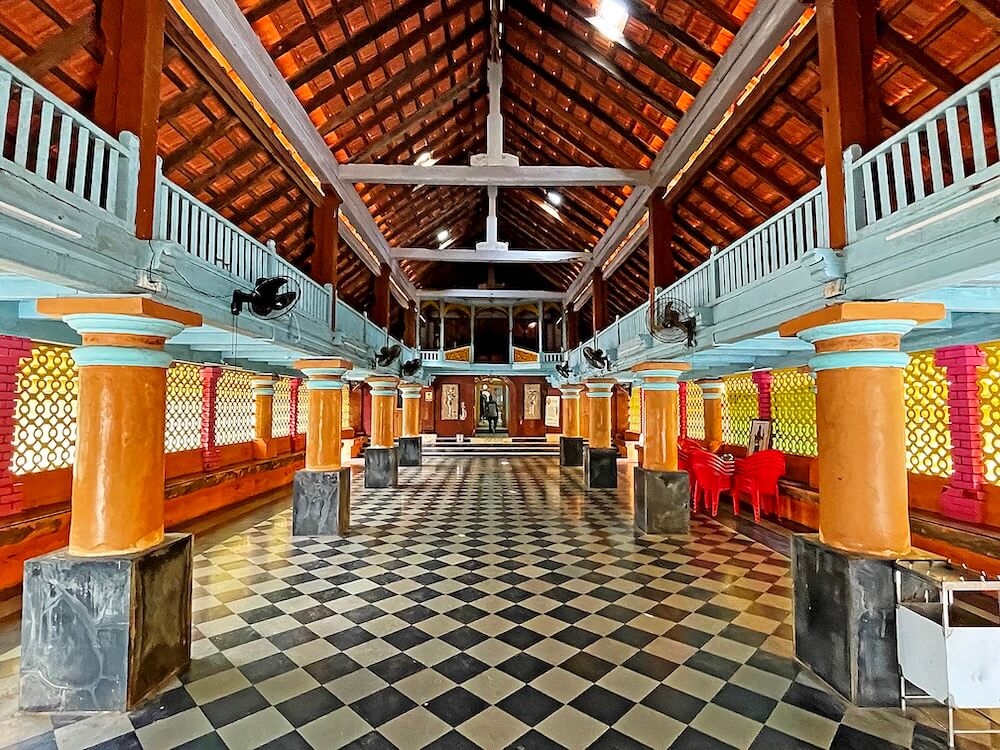
The architecture of this temple follows the traditional Goan style. The structure consists of a Mukhamandapa (entrance hall), Sabhamandapa (assembly hall), Ardhamandapa (half hall), Mahamandapa (great hall), Antarala (vestibule), and Garbhagriha (sanctum sanctorum). Wood has been used extensively in the construction of the temple. In front of the main entrance of the temple, there is a Goan-style Deepmala (lamp tower). In the center of the entrance is a small shrine of Hanuman. In the semi-open Sabhamandapa, there is a row of circular pillars. Above them is a balcony with wooden railings. The Sabhamandapa has a sloping tiled roof. From here, one climbs three steps to enter the Ardhamandapa. On the front wall of the Ardhamandapa, on both sides of the arched entrance, are metal-carved relief sculptures of Garuda and Hanuman. The Mahamandapa of the temple is enclosed. This hall features wide-girthed circular pillars, sturdy wooden beams and a wooden ceiling, glass chandeliers hanging from it, and a seating platform along the side walls. The Antarala of the temple has a wooden frame with vertical bars. On both sides of the entrance to the Antarala are statues of Dvarapalas (gatekeepers).
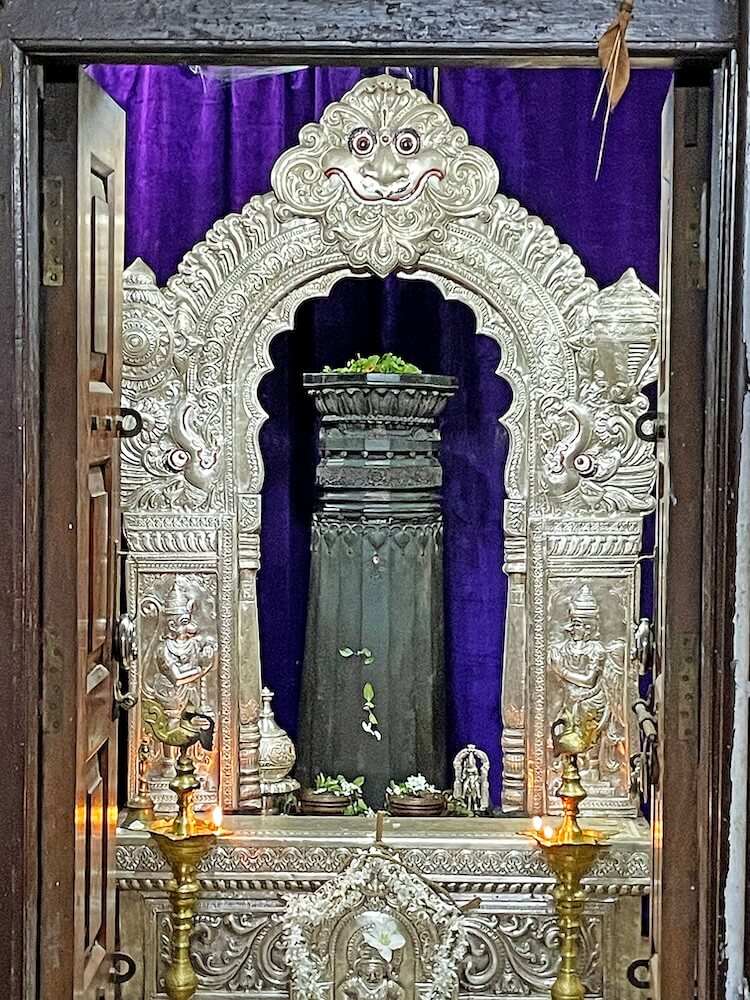
In the Garbhagriha, the Nirakar stone pillar is installed within a silver arch. On the pillars of this arch, there is a statue of Hanuman on the left and Garuda on the right. At the top center is a Kirtimukha. In front of the arch, on the ground, a Saguna-Sakara image of Nirakar is enshrined. It is said that previously, a tall wooden pillar with a thick girth was worshipped here. During festivals, a mask was placed on this pillar. Over time, the pillar would be replaced. This pillar was crafted from the trunk of a jackfruit tree that had a large girth and was untouched by any contamination. However, as it became difficult to find a suitable tree in changing times, this stone pillar was installed here on the advice of Gokarn Partagali Jivottam Mathadhipati Vidyadhiraja Tirtha Shripadwadeyar Swami. During the renovation of the sanctum sanctorum in 1994, this stone pillar was consecrated by the Swami. At the same time, a gold-plated finial was installed on the copper-plated spire of the temple. This temple is part of a Panchayatan. This Panchayatan includes Ganesha (four-armed form), Surya (Martanda Bhairava), Kartikeya, Betal (guardian spirit), and Ravalnath.
Devotees can have darshan in the main temple from 6 to 12 in the morning and from 4 to 8 in the evening. The main festival of the temple is the Jatrotsav, which is celebrated on Chaitra Purnima. In this two-day festival, a palanquin procession, Aarti, Bhajan-Kirtan, and Annadan (food distribution) take place. Thousands of devotees participate in it. Other festivals include Mahashivratri, Hanuman Jayanti, Ganesh Chaturthi, and Navratri. Apart from this, a Rathotsav (chariot festival) and Palkhi Utsav (palanquin festival) are held every full moon. There is a stage in the temple premises for cultural performances. There is also a hall in the building next to the temple. Similarly, accommodation has been provided for devotees here.
This sacred temple stands as a testament to deep spiritual devotion, ancient architectural grandeur, and rich local cultural traditions.
The sanctum sanctorum houses the divine idol consecrated according to ancient Vedic traditions, surrounded by serene courtyards and traditional temple architecture.
Navratri, Maha Shivratri, Annual Temple Jatra & Deepotsav
Compare and book flights, secure top-rated local hotels near the temple, hire reliable guides, and rent cars instantly.
Extend your pilgrimage by visiting other highly sacred temples located nearby.

Add ₹999 more to unlock FREE SHIPPING!
Your sacred cart is currently empty.
Shop Photo FramesFill in your delivery details below to place your order.
Add comment