
Add ₹999 more to unlock FREE SHIPPING!
Your sacred cart is currently empty.
Shop Photo FramesDevi Chamundeshwari is believed to be a form of Adishakti Parvati. This Goddess, who is the embodiment of Shakti, was the Kuldevta (family deity) of the Kadamba dynasty of Goa. Like the deities of many other temples in Goa, this Goddess was also relocated to Vargao near Pilgao about 500 years ago. Devotees believe that the presence of the Goddess here is vibrant, and many people come here to seek her blessings before starting any new endeavor. There is also a tradition of seeking ‘Kaul Prasad’ (divine guidance) from the Goddess here. A grand Jatrotsav (festival) of the Goddess is held here on the Krishna Pratipada of the month of Pausha.
Chamunda Devi, one of the Navadurgas, is known as Chamundeshwari Devi. The story of the Goddess’s origin is narrated in the seventh chapter of the ‘Devi Mahatmya’ in the ‘Markandeya Purana’. It states that the demons Shumbha and Nishumbha conquered the kingdom of the three worlds from Indra. To slay them, Ambika Devi was created from the body sheath of Mother Parvati. Chanda and Munda were the servants of Shumbha and Nishumbha. They saw Ambika and described her beauty to Shumbha. Shumbha sent a message to Ambika to become his wife. When Ambika rejected the proposal, Shumbha and Nishumbha sent Chanda and Munda to capture her. At that time, Kali, who emerged from Ambika’s body, killed Chanda and Munda. Because of this, Goddess Ambika named Kali Devi as Chamunda. In North India, she is worshipped by the name Chamunda, while in South India, she is worshipped as Chaundeshwari, Chaudeshwari, or Chamundeshwari.
Chamundeshwari was the Kuldevta of the Kadamba dynasty, which ruled in Gomantak (Goa) from 1000 to 1237 AD. Gopakpattan (Velha Goa, meaning Old Goa) on the island of Goa was the capital of the Kadambas. A magnificent temple of the Goddess was situated on a hill here. In 1237 AD, the Kadamba King Tribhuvanamalla was ruling here. The Yadava King Singhan of Devgiri had two generals named Bichan and Kholeshwar. Bichan was responsible for expanding the kingdom to the south. He attacked the Kadambas of Goa, killed King Tribhuvanamalla, annexed his kingdom to the Yadava Empire, and made the Kadambas his vassals. Later, in 1312 AD, Malik Kafur, the general of Alauddin Khilji, invaded the Yadavas of Devgiri. He killed Shankardevraya, the son of Ramdevraya, looted the region, and established a garrison at Devgiri. Malik Kafur was originally a Hindu from Mathura. He was a slave of a merchant from Khambhat in Gujarat. Since he was purchased for a thousand dinars, he was named ‘Hazar Dinari’. Later, he became the general of Alauddin. The Goa Gazetteer states that during the invasion by Malik Kafur in 1312, the Kadamba capital of Gopakpattan, i.e., Velha Goa, must have been destroyed. Consequently, the Kadambas shifted their capital to Chandrapur. In this turmoil, the Chamundeshwari temple at Velha Goa must have been damaged.
According to some scholars, the original temple of Chamundeshwari was not damaged by the Muslim army, but by the Portuguese military and clergy. In November 1510, the then-Viceroy of the Portuguese in India, Afonso de Albuquerque, conquered the island of Goa. The Hindus here welcomed the Portuguese rulers. Albuquerque had announced that he would grant religious freedom to the Hindus. However, he soon displayed his fanaticism by demolishing the Saptakoteshwar temple in Tiswadi and building a church there. In the following period, Portuguese atrocities continued to increase in the Tiswadi, Bardez, and Salcete regions. During this period, around 1530 AD, the Portuguese destroyed the Chamundeshwari temple in Velha Goa, Tiswadi. However, before that, the devotees and Mahajans of Chamundeshwari had safely brought the idol of the Goddess to Vargao. There is no concrete information available about exactly when, how, and by which route it was brought.
Evidence regarding the historicity of the Chamundeshwari temple has been obtained from an inscription found here. This three-line inscription in the Konkani language is carved on the back of a Kalbhairav idol found in the temple pond. It contains words like ‘Gonye Sinhasami’, ‘Gonye’, and ‘Gonyant Chandika’. According to Dr. Rohit Phalgavkar, a historian from Goa, this Kalbhairav idol dates back to 1579. It must have been installed here in 1583. When a new idol was installed in the temple, this idol was immersed in the pond. The words ‘Gonyant Chandika’ in this inscription and the fact that this idol was found in the Chamundeshwari temple pond make it clear that the temple existed here in 1579. It is said that the temple currently existing here was built in 1625 AD. The shikhara (spire) over the sanctum sanctorum was renovated in 1969. Similarly, on 21 December 2008, on the auspicious occasion of Sarvadhari Nama Samvatsara, Margashirsha Krishna Dashami, the re-installation of Chamundeshwari Devi was performed.
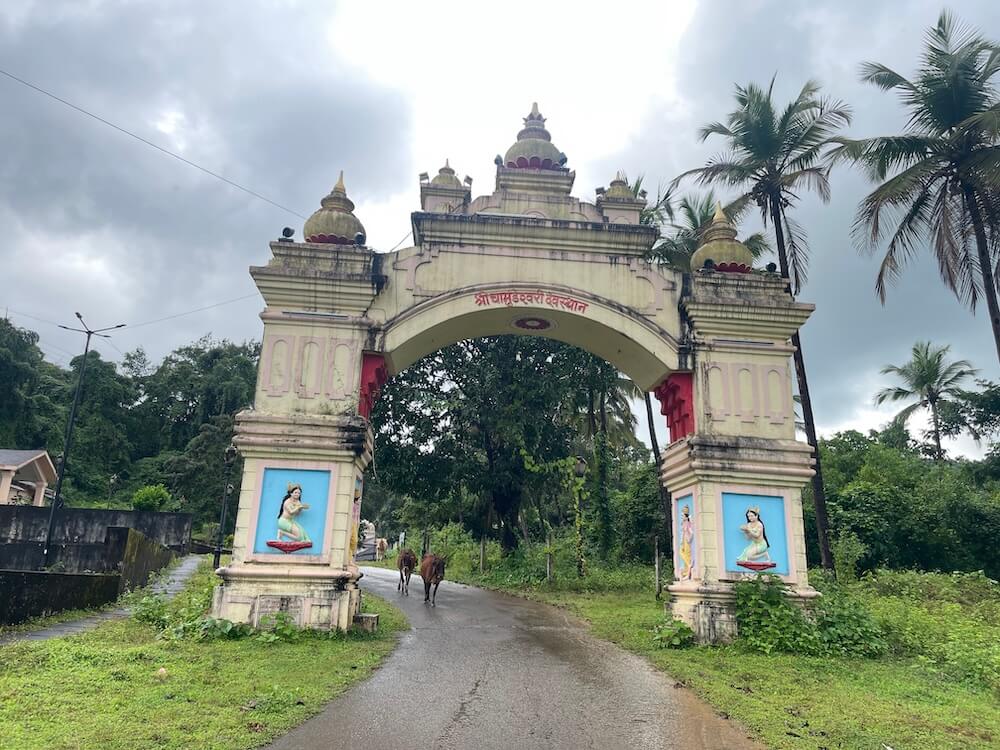
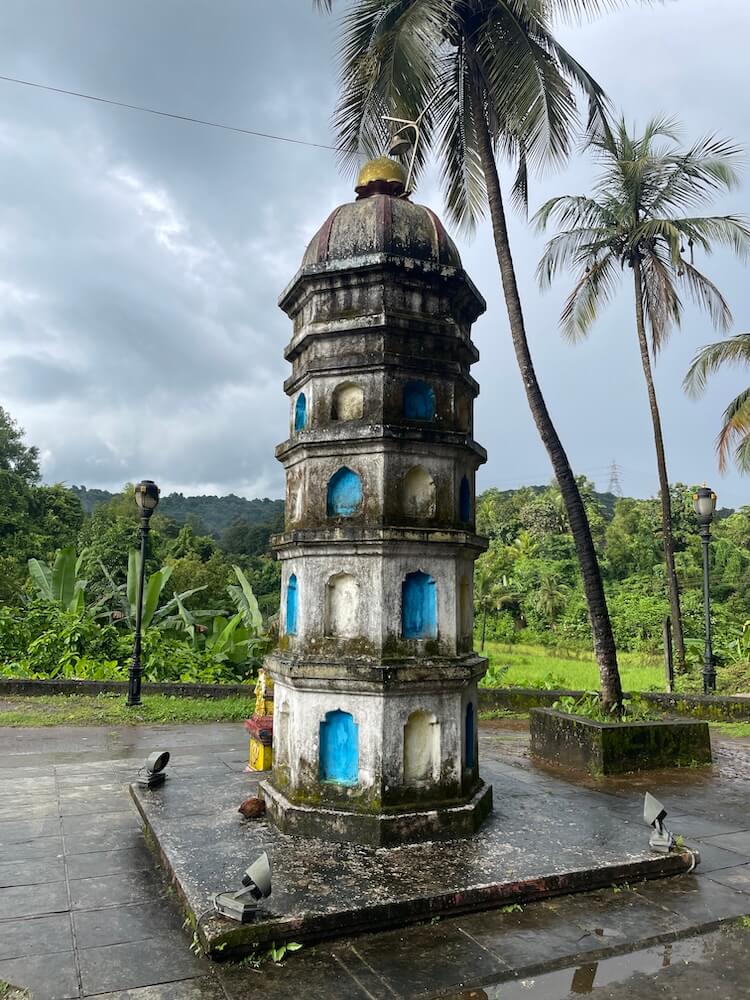
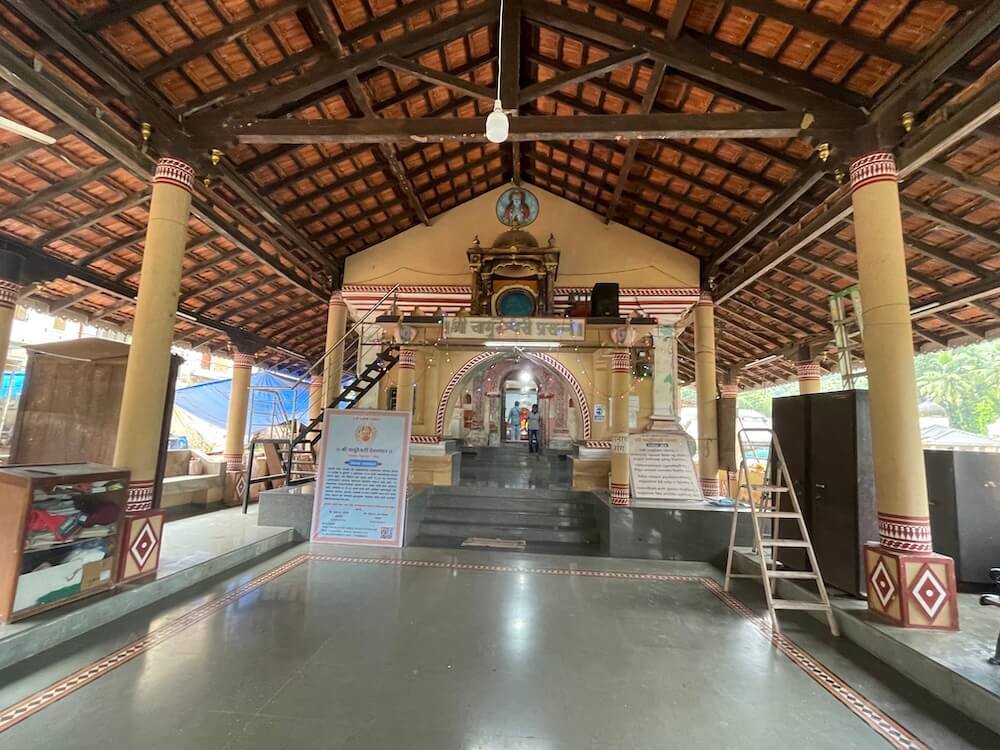
The structure of this temple consists of a grand Sabha Mandap (assembly hall), Ardha Mandap (half hall), Maha Mandap (main hall), and Garbhagriha (sanctum sanctorum). In front of the Sabha Mandap is a six-tiered Deepastambha (lamp pillar). The Sabha Mandap is tall, spacious, and open-style, with a sloping tiled roof on both sides. Inside, there are many circular pillars. There are side seating platforms (Kakshasana). In the center is the Homa Kunda (sacrificial fire pit). From here, one enters the Ardha Mandap by climbing four steps.
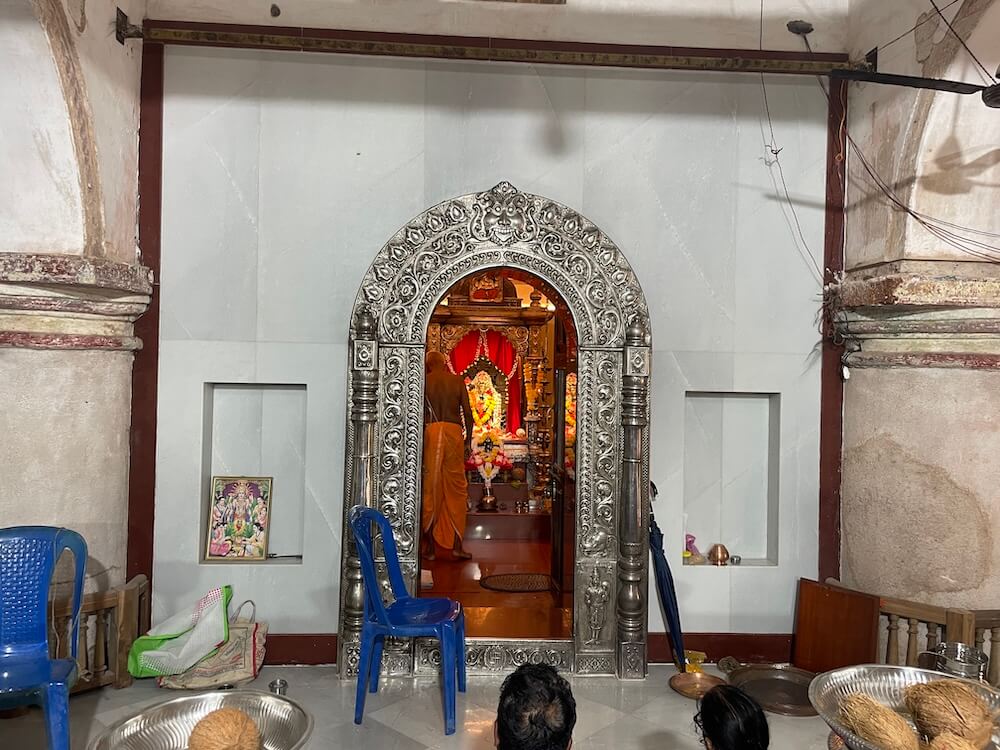
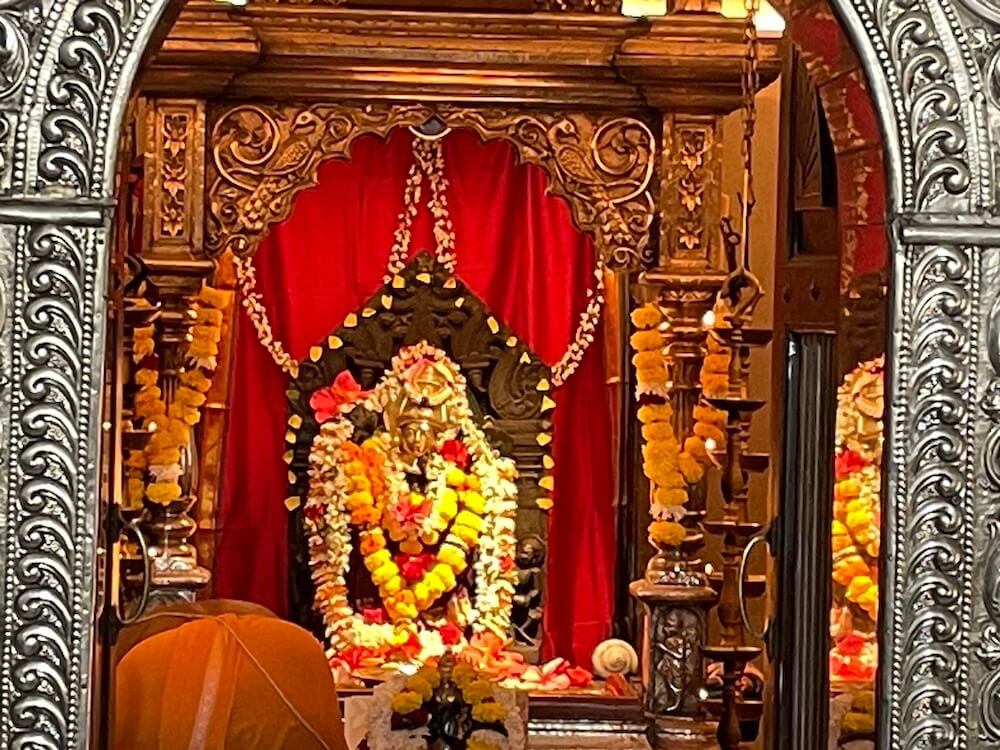
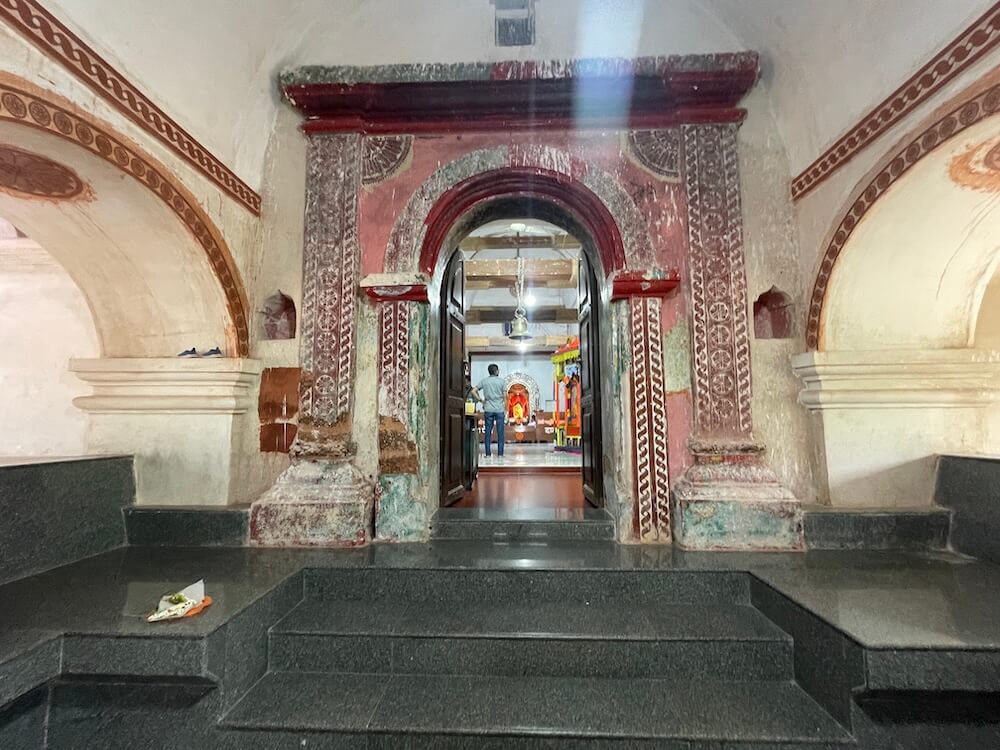
The Ardha Mandap has an arched entrance. A large shrine (Devhara) is installed above the entrance. Above it is an image of Krishna. The arch of the entrance, the pillars here, as well as the entrance to the Maha Mandap, feature carvings in the Kavi art style. In the Maha Mandap, there is a row of wide circular pillars at a distance from the outer walls on the left and right sides. These pillars are connected to each other by wide arches. A large brass bell is hung from the ceiling beam. The front wall of the sanctum sanctorum is fitted with marble tiles. The entrance here is as unique as the entrances of other temples in Goa. It is covered with silver plating featuring intricate carvings. At the lower part of the door frame are statues of Dwarapalas (gatekeepers), and a Kirtimukha is carved at the lintel. In the sanctum sanctorum, the black stone idol of Chamundeshwari is seated on a Vajrapitha (diamond throne) inside a large wooden Makhar (shrine). The idol is adorned with a brass mask and decorated with rich garments, ornaments, and flower garlands. Over the sanctum sanctorum is a shikhara, characteristic of Goan temple architecture, which is octagonal at the base and dome-shaped above.
Various religious festivals are celebrated with great enthusiasm in this temple throughout the year. The Sharadiya Navaratri festival is one of the largest among them. During this period, hundreds of devotees gather here to witness the Makhrotsav held in the temple. A grand fair is held here on the first day of the dark fortnight of Paush. On this night, an auction of the items offered to the Goddess by the devotees takes place. At 11 o’clock at night, the palanquin procession of Chamundeshwari begins. The palanquin is taken for a boat ride in the large lake adjacent to the temple. Every year, a Dashavatar play is performed during this fair. Not only from Goa, but a large number of Mahajans and devotees of the Goddess from Maharashtra and Karnataka participate in this fair.
This sacred temple stands as a testament to deep spiritual devotion, ancient architectural grandeur, and rich local cultural traditions.
The sanctum sanctorum houses the divine idol consecrated according to ancient Vedic traditions, surrounded by serene courtyards and traditional temple architecture.
Navratri, Maha Shivratri, Annual Temple Jatra & Deepotsav
Compare and book flights, secure top-rated local hotels near the temple, hire reliable guides, and rent cars instantly.
Extend your pilgrimage by visiting other highly sacred temples located nearby.


Add ₹999 more to unlock FREE SHIPPING!
Your sacred cart is currently empty.
Shop Photo FramesFill in your delivery details below to place your order.
Add comment