
Add ₹999 more to unlock FREE SHIPPING!
Your sacred cart is currently empty.
Shop Photo FramesThe Saptakoteshwar (Saptakotishwar) Temple at Narve is one of the oldest and most significant temples in Goa. Saptakoteshwar, who is revered today as the presiding deity of Goa, was the family deity of the Kadamba dynasty. Much like the Kadambas, Saptakoteshwar also shares a deep connection with the inspiring history of the Vijayanagara Empire and Chhatrapati Shivaji Maharaj. The temple here is the only one restored and built by Chhatrapati Shivaji Maharaj. The Government of Goa undertook the conservation and preservation of this temple a few years ago. Along with countless devotees, many history enthusiasts also visit this temple.
The mythological legend of Saptakoteshwar states that the Saptarishis (seven sages) worshipped Lord Shiva for seven crore years at the confluence of the sea and the Panchganga River. Pleased by their penance, Lord Shiva appeared before the sages and asked them to seek a boon. The sages requested Mahadev to reside at the place where they had performed penance for seven crore years. Shiva granted this prayer, and thus, the Mahadev here came to be known as ‘Saptakotishwar’. As the Lord of the seven sages, He also came to be called Saptanath. According to another legend, Lord Shri Krishna had to migrate from Mathura due to the invasions of Jarasandha. At that time, Krishna worshipped Saptakoteshwar at this very spot before establishing his kingdom in Dwarka.
According to the Goa Gazetteer, the deity Saptakoteshwar is a form of Khandoba of Jejuri in Maharashtra. In Goa, the deity Martand-Bhairav in the form of Ravalnath has been popular since ancient times. Ravalnath is seen as a family deity in many temples across Goa. The Gazetteer notes that it is possible that since the time of Shivachitta Kadamba (AD 1155), the Kadambas adopted this same Ravalnath in the form of Saptakoteshwar. In the book ‘Cultural and Religious Traditions in Temples of Goa’ (2004), published by the Publications Division of the Ministry of Information and Broadcasting of the Government of Goa, Kamala Mankekar states that in Goa, Khandoba is worshipped in the form of a Linga as Martand Bhairav or Saumya Bhairav. When his idol is crafted, it is four-armed, holding a damaru, trishul, sword, and a vessel. Saptakoteshwar is a form of this Khandoba. Renowned Goan historian P. P. Shirodkar has also proposed this concept.
The original location of Saptakoteshwar was Narve on Divar Island in Goa. This is a small island in the Mandovi River, north of Tiswadi. In the Sahyadri Khanda of the Skanda Purana, this island is mentioned as Deepvati. The Kadamba dynasty ruled Goa from AD 1000 to 1237. This dynasty had immense faith in Saptakoteshwar; He was their family deity. Kadamba King Shivachitta Permadidev and his queen Kamaladevi were devotees of Saptakoteshwar. The Degamve inscription of AD 1174 in Karnataka mentions that Kamaladevi offered holy water at the feet of Saptakotishwar and granted an agrahara to the Brahmins. Permadi’s nephew Jayakeshi III ascended the throne in 1187. His gold coins bore the title ‘Saptakotishwaralabdhavaraprasada’, meaning ‘one who has received the grace of Saptakotishwar’. Mentions of Saptakoteshwar are found in other inscriptions, copper plates, and coins of the Kadamba dynasty from the 12th to the late 13th century. Information regarding which king of this dynasty built the Saptakoteshwar temple in Narve-Divar is unavailable. However, the Degamve inscription confirms that this temple existed in AD 1174.
Later, the Amirs of South India rebelled against Muhammad Tughlaq of Delhi, leading to the rise of Muslim power under the leadership of Zafar Khan in AD 1347. Zafar Khan’s original name was Hasan Gangu. Legend has it that he was a servant of a Brahmin who had predicted that Hasan Gangu would one day become a great man. In gratitude to this Brahmin, Hasan Gangu adopted the name Bahmani. Over the next ten years, by AD 1358, this Bahmani power captured territory from Mandu in the north to Raichur in the south, and from Bhongir in the east to Dabhol and Goa in the west. During this Bahmani invasion, the Saptakoteshwar temple on Divar Island suffered great damage. The text ‘Konkanakhyan’ states that fearing the desecration of Saptakoteshwar by the Mlechhas, people took the Shiva Linga from the temple and buried it in a paddy field.
In AD 1378, the death of Sultan Mujahid created chaos in the Bahmani court. Taking advantage of this, Veer Vasant Madhav, alias Mallappa Odayar, captured Goa on the orders of Vijayanagara Emperor Harihara II. On 29 August 1380, the Vijayanagara Emperor appointed Veer Vasant Madhav (Madhav Mantri) as the Mahapradhan of the Konkan kingdom. Goapuri was the capital of this kingdom. He ruled here until 1390. ‘Goapuradhish’ Madhav Mantri was a brave general and also a shrewd ruler. It is recorded that he ‘destroyed the Turushkas and rebuilt the temples here, including the one for Saptanath’. Saptanath is Saptakoteshwar. This temple was erected here between 1380 and 1390. According to the travelogue of Italian traveler Gualiano de Medici, this temple, built of black stone, was very beautiful, featuring exquisite carvings and sculptures. For about a century after this, the Saptakoteshwar temple stood safely. Worship continued here even during the Adilshahi period. However, the Portuguese arrived in Goa in 1510, and times changed. On 25 November 1510, the Portuguese attacked the Adilshahi forces and captured the island of Goa within three days. The then-Viceroy of the Portuguese in India, Afonso de Albuquerque, initially declared religious freedom for Hindus. But within a few days, he demolished the Saptakoteshwar temple. In 1567, a church was built on the same site. It is said that the Shiva Linga of Saptakoteshwar was desecrated at that time.
This temple was situated on an island in the Mandovi River. At that time, the Adil Shahi regime held sway over the areas across the river. Upon learning of the desecration of the temple, the Adil Shahi Sardar, Narayanrao Suryarao Desai, sent some of his warriors to the island one night. Those men secretly retrieved the Shiva Linga. It was installed in a sanctum carved out of a large rock deep within a valley in the dense forests of the village of Hindale. This village began to be called Narve.
Lakham Sawant of Kudal in Konkan, along with Keshav Naik and Keshav Prabhu, were Desais who lived under Portuguese protection in Goa and caused disturbances for Swarajya. To discipline them and to deter the Portuguese, who were committing religious atrocities in Goa, Chhatrapati Shivaji Maharaj launched an attack on the Bardez and Salcete provinces of the Portuguese in November 1667. For three days—10, 11, and 12 November—the Maharaj’s army scoured the Bardez province and
returned to Dicholi (Bhatgram) with about 1300 prisoners and wealth amounting to 150 lakh hons. The Maharaj stayed here for a few days. During this time, the Maharaj visited the village of Narve. There, he had the darshan of Saptakoteshwar and ordered the renovation of this temple, which was the family deity of the Kadambas. In the book ‘Portuguese-Maratha Relations’ by S. S. Desai, a legend regarding this event is noted: ‘Saptakoteshwar appeared in his (the Maharaj’s) dream at night and gave a vision to renovate his temple.’
In ‘Shakkarthe Shivray – Volume Two’, Vijayrao Deshmukh stated that ‘He felt an inner inspiration to renovate this temple. He immediately took up the work of rebuilding the temple.’ The inscription carved on the main entrance of Saptakoteshwar still remains today. It reads: ‘Shri Saptakotesh, Shake 1590, Kilakabde, Kartik Krishna Panchamyam, Some, Shri Shivrajadnya Devalayasya Prarambhah.’ This date was 13 November 1668. Kartik Krishna Panchami of Shake 1590 was a Friday. Historian Vijayrao Deshmukh has stated that ‘Monday’ might have been inscribed in the inscription by mistake.
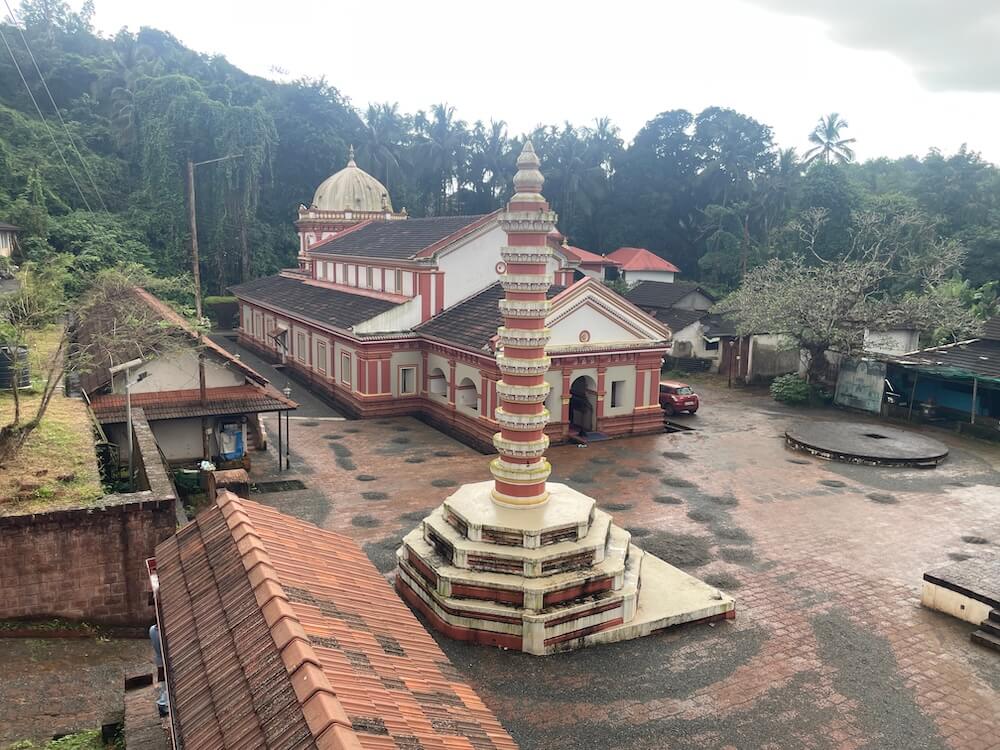
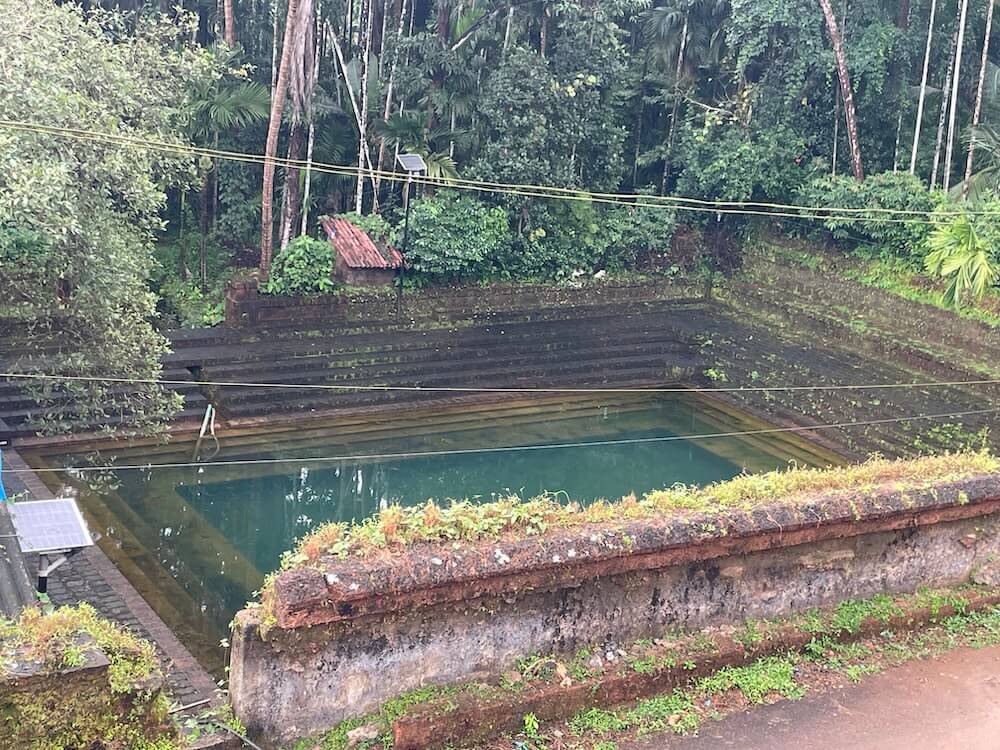
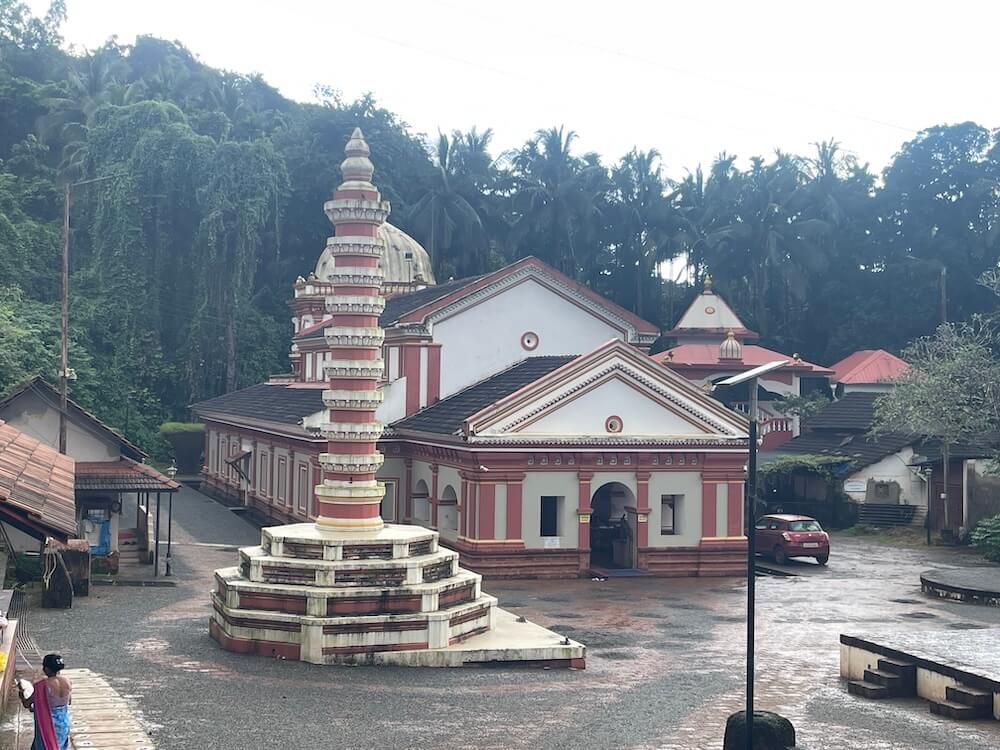
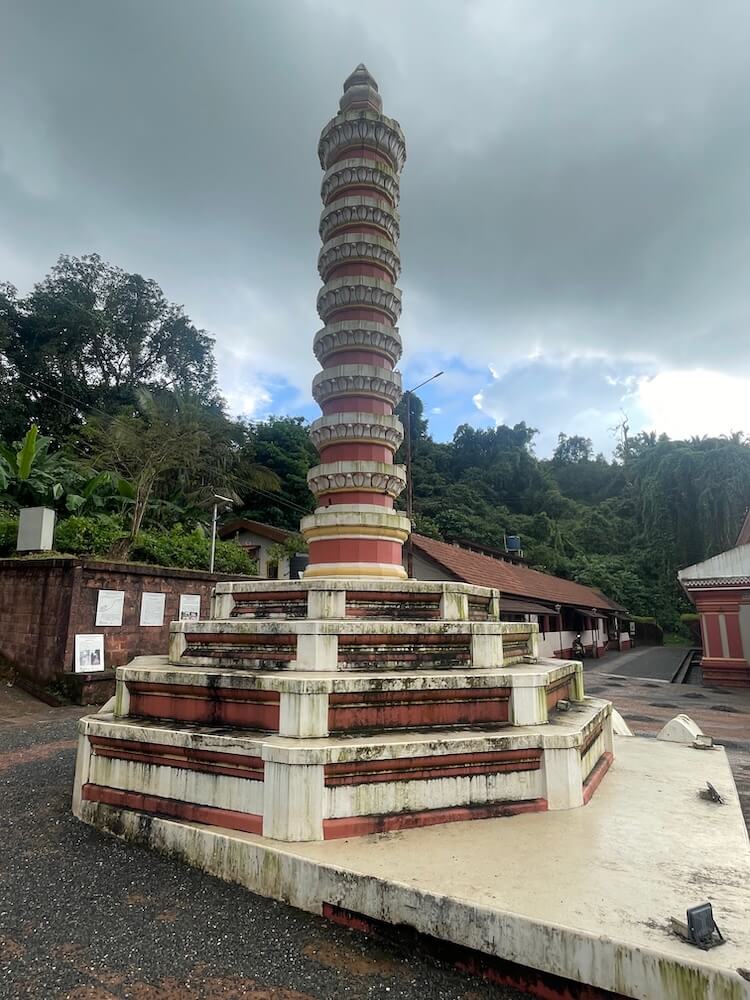
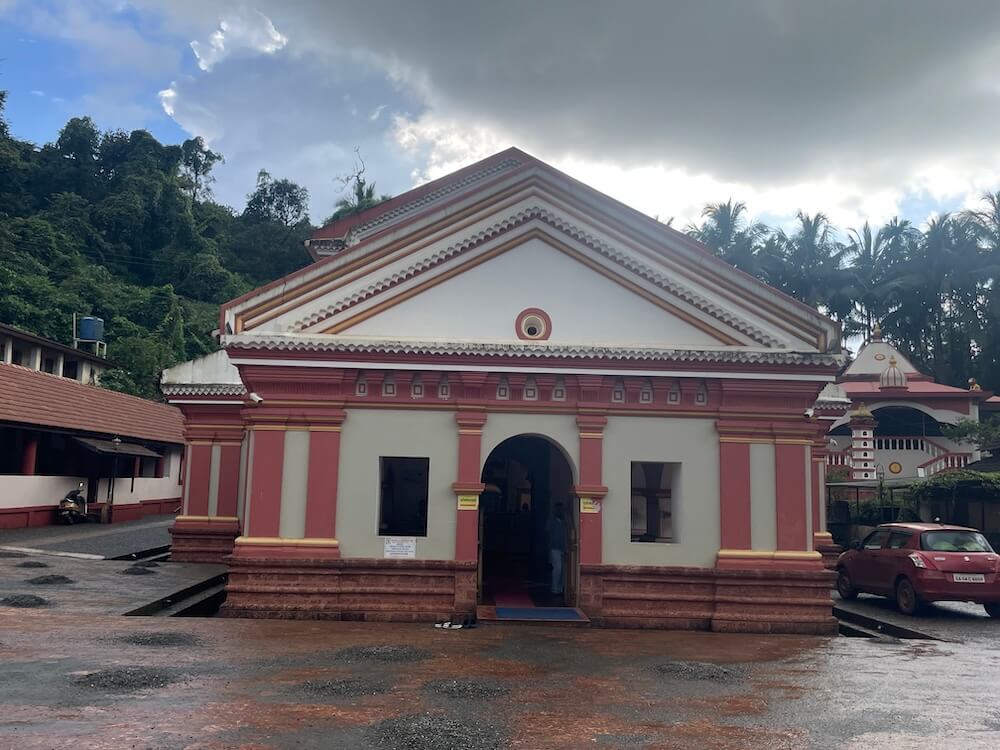
In the year 2019, this historic event completed 350 years. At that time, the Goa government decided to renovate this temple. This work was entrusted to the Archaeological Department. The ground-breaking ceremony for this work was performed by Shivshahir Babasaheb Purandare. At a cost of about 6.5 crore rupees, this conservation, preservation, and renovation work was completed on 11 February 2023. On that day, Shrimant Chhatrapati Shivendraraje Bhosale of Satara and Chief Minister of Goa Pramod Sawant inaugurated the conserved and renovated temple structure and premises. The structure of this temple has been declared a protected monument by the Archaeological Department. Nestled in a spacious courtyard in the lap of dense greenery, slightly below the road level, lies this historic temple of Saptakoteshwar. There are two ways to enter the temple premises. One is a staircase path, which is on the right side of the temple complex. The other is from the front of the temple. While coming from that paved road, the temple’s Pushkarini (sacred pond) appears on the right hand. Here, on the right side on an elevation, the temple of Kalbhairav is situated. There is a tall Deepastambha (lamp pillar) in the temple courtyard. This 11-tiered lamp pillar, adorned with circular Nagbandhas (serpent motifs), is erected on a four-tiered octagonal pedestal. In front of the lamp pillar is a small open stage. Behind it is a Tulsi Vrindavan. Right in front, against the backdrop of lush green foliage, stands the temple structure, which stands out in white and reddish hues. The temple is built entirely of red laterite stone and has been plastered with lime in the traditional manner.
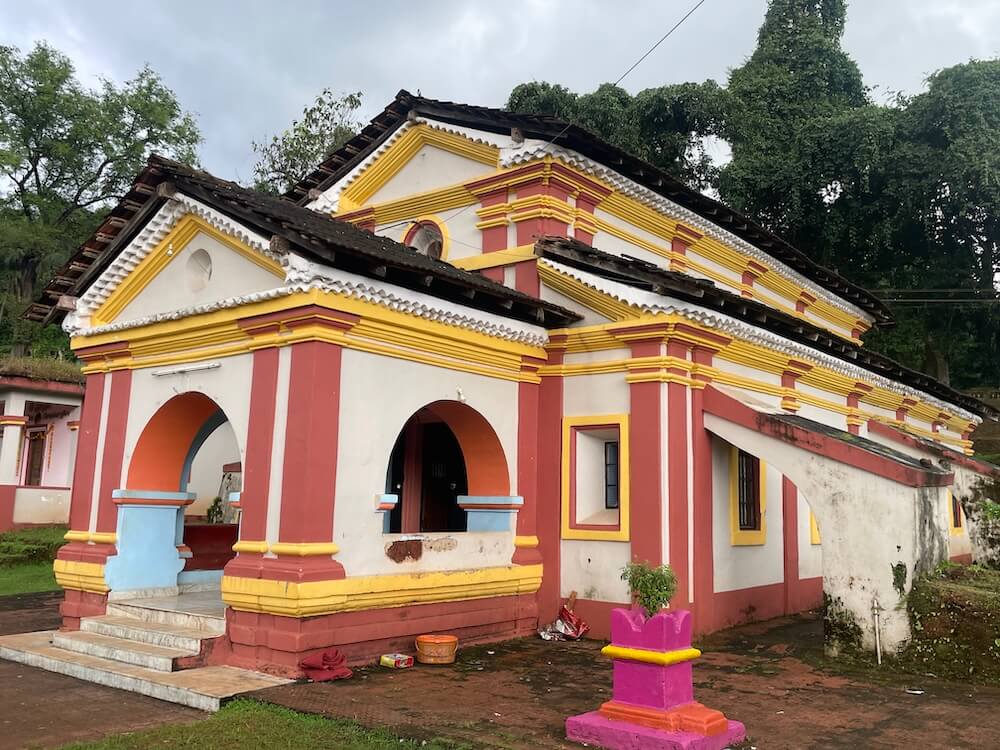
The structure of this temple consists of a Mukhamandapa (entrance hall), Mahamandapa (main hall), Antarala (vestibule), and Garbhagriha (sanctum sanctorum). These halls have sloping tiled roofs on both sides. The entrance of the Mukhamandapa is arched. There are large arched windows in the left and right walls of the hall. The entrance to the Mahamandapa is stone-built and arched. In its upper part, there is a historical inscription related to the construction of the temple, mentioning Chhatrapati Shivaji Maharaj. On the pedestal to the left of this entrance, a bust of Chhatrapati Shivaji Maharaj is seated. Entering through the doorway and climbing two steps, one enters the Mahamandapa. The Mahamandapa is spacious and tall. Its design follows the temple architectural style of Gomantak (Goa). Here, one can see the design of arches created by wide pillars at some distance from the outer left and right walls. Another specialty of this temple is the Kavi art carvings on the walls, pillars, and arches. This work has also been done in the old style using traditional colors. Glass chandeliers for lamps are installed on the pillars and ceiling of the Mahamandapa. Two brass bells are hung from the ceiling. The tall front wall of the Antarala is also adorned with Kavi carvings. On this wall, on both sides of the entrance, there are square niches. Stone idols of Ganesha and Hanuman are seated in them. In the large wooden shrine above the entrance is an image of Saptakoteshwar. In front of the entrance is a stone idol of Nandi. In the Garbhagriha, the Saptakoteshwar Linga is installed on the floor. This Linga is different and unique compared to the Shiva Lingas in other temples. It is above the ground level. It has three parts: the Brahmabhaga, the Vishnubhaga, and the Rudrabhaga. The lower part of the Linga is called the Brahmabhaga. The part above it is the Vishnubhaga, and the topmost part is called the Rudrabhaga. Often, the Brahmabhaga and Vishnubhaga are buried in the ground. In the Shiva Linga of this temple, both these parts are above the ground level. The Garbhagriha of this temple is very unique. It is not built but is in the form of a cave carved into a large rock block. In the upper part, there is a chamber carved into this very rock. There are also carved steps to reach that chamber. This structure can be seen while performing a circumambulation (Pradakshina) of the Garbhagriha. During the temple conservation work, a glass wall was installed on the outer side of this Garbhagriha. Above this sanctum is a tall Shikhara (spire) in the Goan architectural style.
Various festivals and celebrations are observed with great enthusiasm at this temple. The most significant among these are Mahashivratri and Gokulashtami. According to mythological legends, the day Lord Shiva granted darshan to the Saptarishis was the day of Gokulashtami. Therefore, this day is celebrated here with great fervor and in a deeply religious atmosphere. On this occasion, many devotees take a holy dip in the sacred pond here. On the day of Shivratri, thousands of devotees avail the benefit of darshan. Furthermore, similar to the Mahalakshmi Temple in Kolhapur, a Kiranotsav (Sunbeam Festival) is celebrated at this temple. Every year, at sunrise on the twenty-first of June, the sun’s rays illuminate the Shivalinga of Saptakoteshwar. Countless devotees arrive here to witness this phenomenon. Regarded as a symbol of the cultural and spiritual resurgence of Goa, this historic temple also attracts numerous history enthusiasts.
This sacred temple stands as a testament to deep spiritual devotion, ancient architectural grandeur, and rich local cultural traditions.
The sanctum sanctorum houses the divine idol consecrated according to ancient Vedic traditions, surrounded by serene courtyards and traditional temple architecture.
Navratri, Maha Shivratri, Annual Temple Jatra & Deepotsav
Compare and book flights, secure top-rated local hotels near the temple, hire reliable guides, and rent cars instantly.
Extend your pilgrimage by visiting other highly sacred temples located nearby.


Add ₹999 more to unlock FREE SHIPPING!
Your sacred cart is currently empty.
Shop Photo FramesFill in your delivery details below to place your order.
Add comment