
Add ₹999 more to unlock FREE SHIPPING!
Your sacred cart is currently empty.
Shop Photo FramesThe city of Karanja Lad is famous as the birthplace of Nrusimha Saraswati Maharaj. Nrusimha Saraswati, or Narasingha Saraswati, is considered the second complete incarnation of Shri Dattatreya after Shripad Shri Vallabha in the Datta tradition. His temple is located at Karanja Lad in the Washim district. This temple is known as the Gurumandir. Nrusimha Saraswati preached the worship of Shiva, Vishnu, Devi, Ganesha, and Nrusimha. During his travels, the villages of Karanja, Audumbar, Narsobawadi, and Gangapur became pilgrimage sites for devotees of Dattatreya. Through him, the worship of Dattatreya became popular in Maharashtra.
According to the book ‘Medieval Maharashtra – Social and Cultural Life’ by Professor M. Shri. Mate, ‘The Datta tradition is one of the sects that emerged in medieval Maharashtra. Like the Mahanubhava sect, the Datta tradition is also primarily prevalent in Maharashtra. The credit for the origin of this tradition goes to Shripad Shrivallabha and Nrusimha Saraswati. Both of them had studied the Vedas in the traditional manner, had undertaken pilgrimages, and both had attained great authority in the path of Yoga.’ Devotees consider Nrusimha Saraswati to be an incarnation of Shri Dattatreya. Nrusimha Saraswati was born in Karanja Lad, Washim district, in the year १३७८, during the time when Hasan Gangu Bahmani had established the Sultanate in Maharashtra.
The biography of Nrusimha Saraswati is described in the book ‘Gurucharitra’, written by Saraswati Gangadhar around the year १५४८ (Shaka १४७०). In its ११th chapter, it is stated that, ‘As soon as the child was born, he uttered the sacred Omkara sound.’ This means that immediately after birth, the chanting of Omkara began from his mouth. He never cried like a normal child. This surprised everyone. The astrologers of that time had predicted, ‘This boy will be worshipped in all three worlds. By his mere sight, the fallen will be purified.’ According to the Gurucharitra, his birth name was Shaligram. However, he was always called Narahari. Until he was seven years old, he could not speak any word other than the Omkara.
At the age of ten, in the year १३८८, the elderly ascetic Krishna Saraswati from Varanasi gave him Sannyasa initiation. He was the one who named him Nrusimha Saraswati. Later, until the age of thirty, he went on many pilgrimages and came to Karanja to meet his parents. After staying with his family for some time, the Maharaj asked for permission to go on a pilgrimage again. But while giving permission, his mother’s heart was overwhelmed with emotion. The Swami saw his mother’s condition and, looking at a wall in the house, told his mother that if she lit a lamp there and remembered him, he would appear to her. This wall in the house, located near the present-day Gurumandir, is known as the Narahari Wall. It is said that the Maharaj was born in the room adjacent to this wall. Devotees who come for the Swami’s darshan visit this house and pay their respects to this wall. Devotees believe that the Swami’s presence is still felt here today.
It is said that for ४०० years after Nrusimha Swami, no one knew about this birthplace of the Swami. Even the villagers of Karanja Lad were unaware of it. Vasudevananda Saraswati Tembe Swami visited Karanja Lad between the years १९०९ and १९१० and, after gathering complete information, declared that this house was indeed the birthplace of Nrusimha Saraswati Swami. There is an ancient banyan tree in front of this house, which has been there since the Swami’s birth. Tembe Swami expressed the desire that a temple of the Swami should be built at this place. However, as Tembe Swami attained Samadhi in १९१४, the work on the Nrusimha Saraswati temple was delayed. On ६ November १९३३, Shankaracharya Swami Brahmananda Saraswati came to Karanja Lad. Upon learning about the birthplace of Nrusimha Saraswati here, he immediately started the movement to build the temple. Within a month, on the auspicious occasion of Datta Jayanti on ३ December १९३३, the construction of the temple began, and it was completed in just four months.
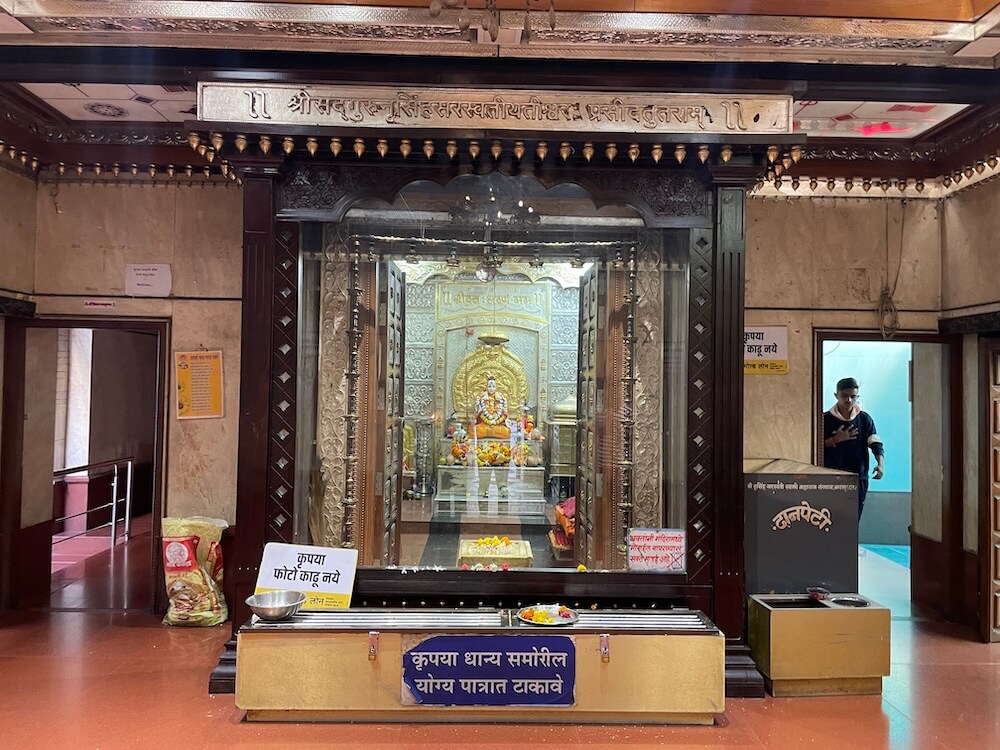
The idol of Nrusimha Saraswati Swami was to be installed in this temple. However, no information other than the description in the Gurucharitra was available about him. At that time, Brahmananda Saraswati Swami entrusted the responsibility of drawing the Swami’s portrait to the principal of the School of Art in Mumbai and his disciple, Mr. Dhurandhar, and the principal there, Solomon. It is said that when both of them submitted their respective drawings to Brahmananda Swami, they were exactly identical. Based on these drawings, a white marble idol was made in Jaipur and was consecrated here on १ April १९३४. Along with this, Shri Datta, Chintamani Ganpati, Kashi Vishweshwar, and the Padukas were also installed here.
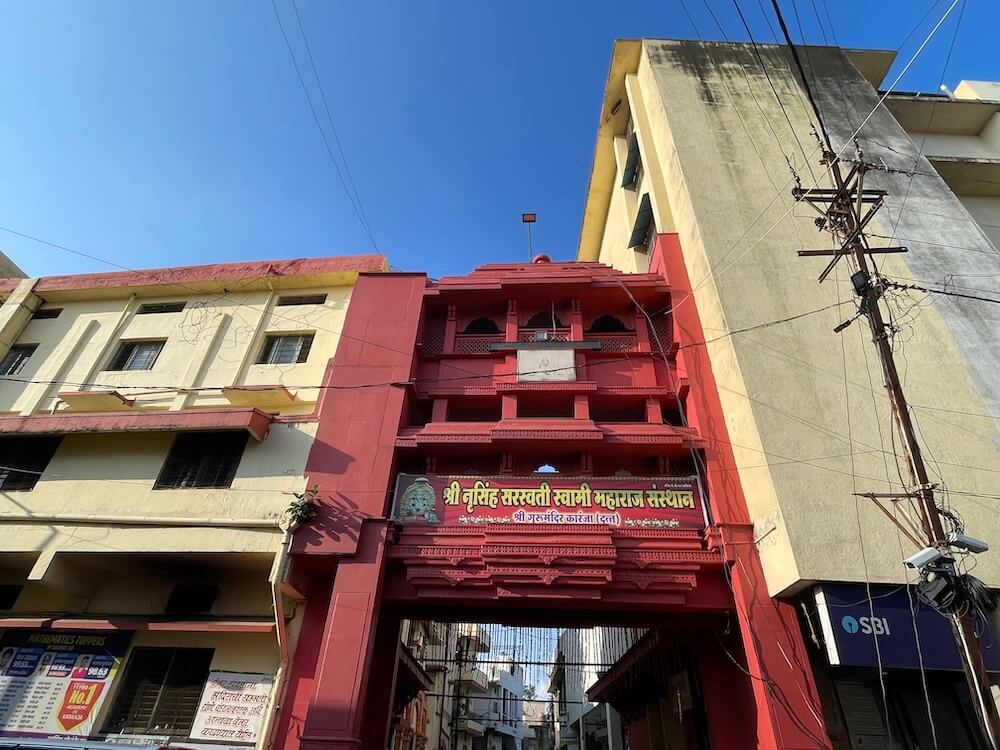
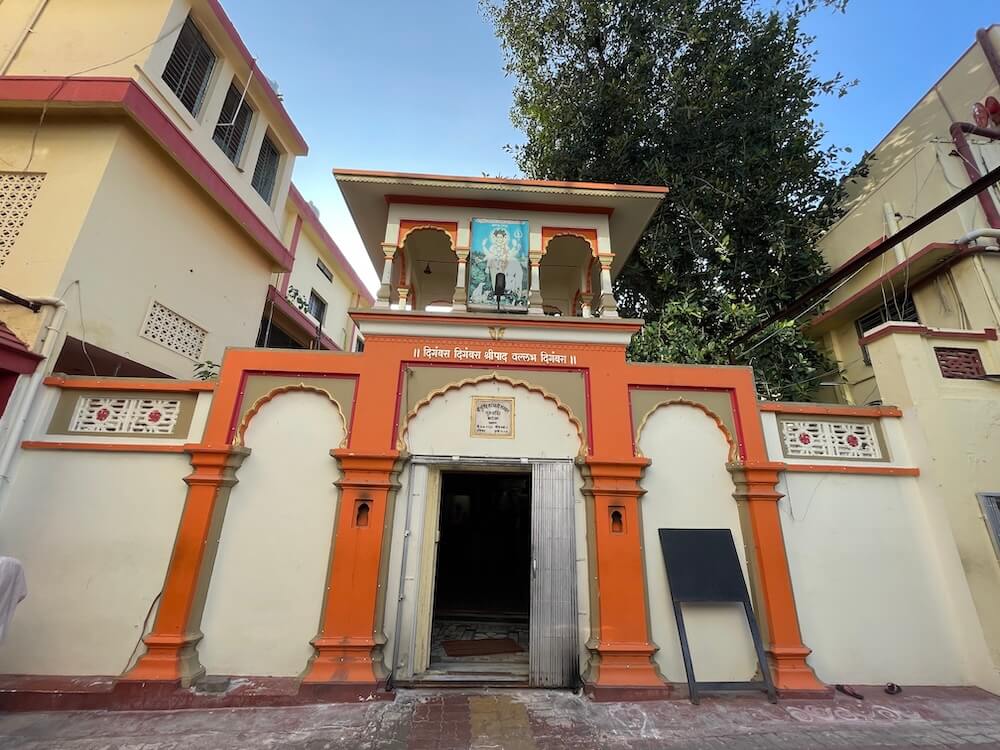
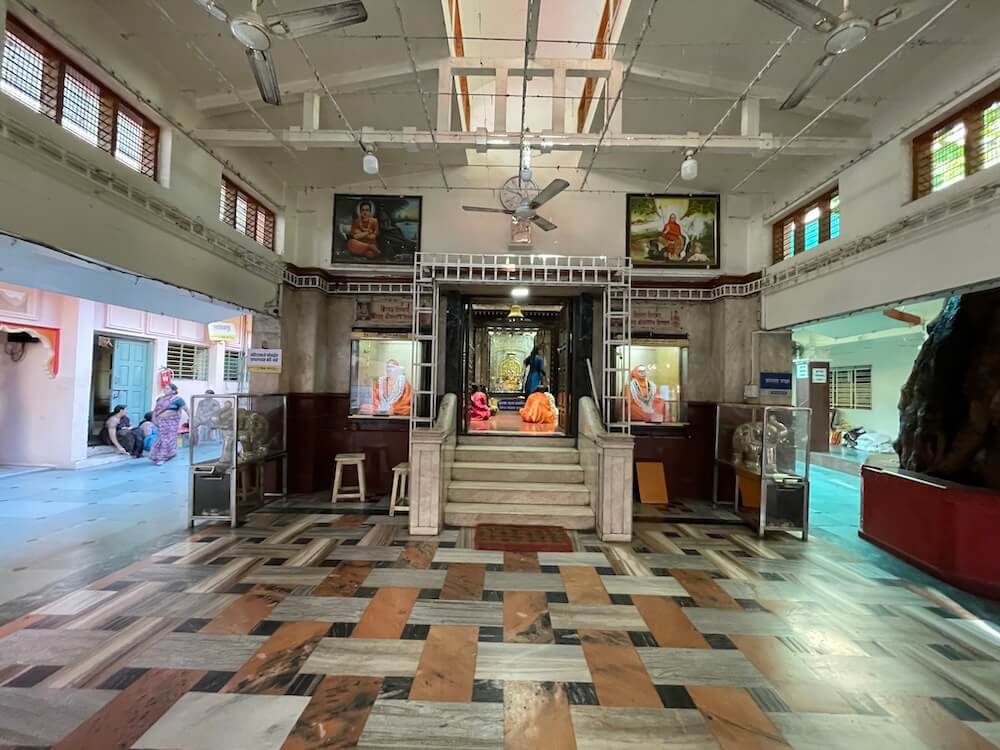
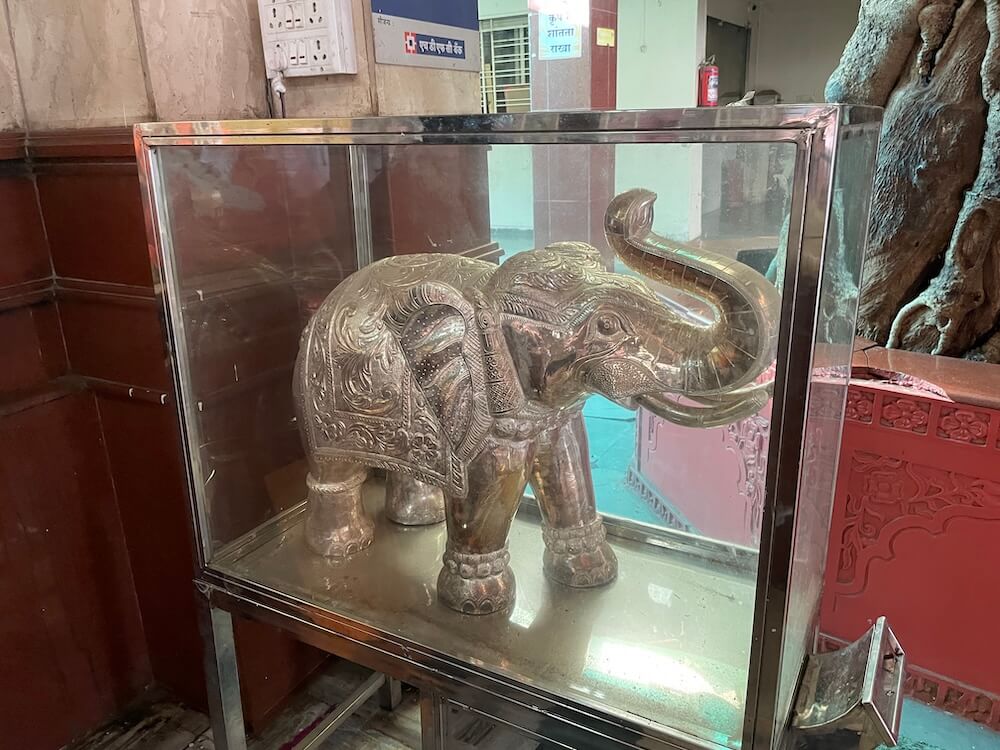
This Gurumandir is located just ५० meters away from the house that is the Swami’s birthplace. One enters the temple courtyard through a grand three-story entrance gate. There is a large image of Shri Dattatreya on the Nagarkhana above the main entrance of the temple. The structure of this temple consists of a Sabhamandap (assembly hall), Antarala (vestibule), and Garbhagriha (sanctum sanctorum). The ancient banyan tree is located next to the semi-open Sabhamandap. On the platform of this banyan tree, there is a Shiva Linga and an idol of Nandi. In the assembly hall, facing the wall of the inner sanctum, there are silver elephants placed in glass cases on both sides. Entering the inner sanctum requires climbing five steps from the assembly hall to reach a slightly elevated level. In the niches on both sides of the entrance to the inner sanctum, there are beautiful idols of Vasudevananda Saraswati Swami and Brahmananda Saraswati Swami, adorned in saffron robes.
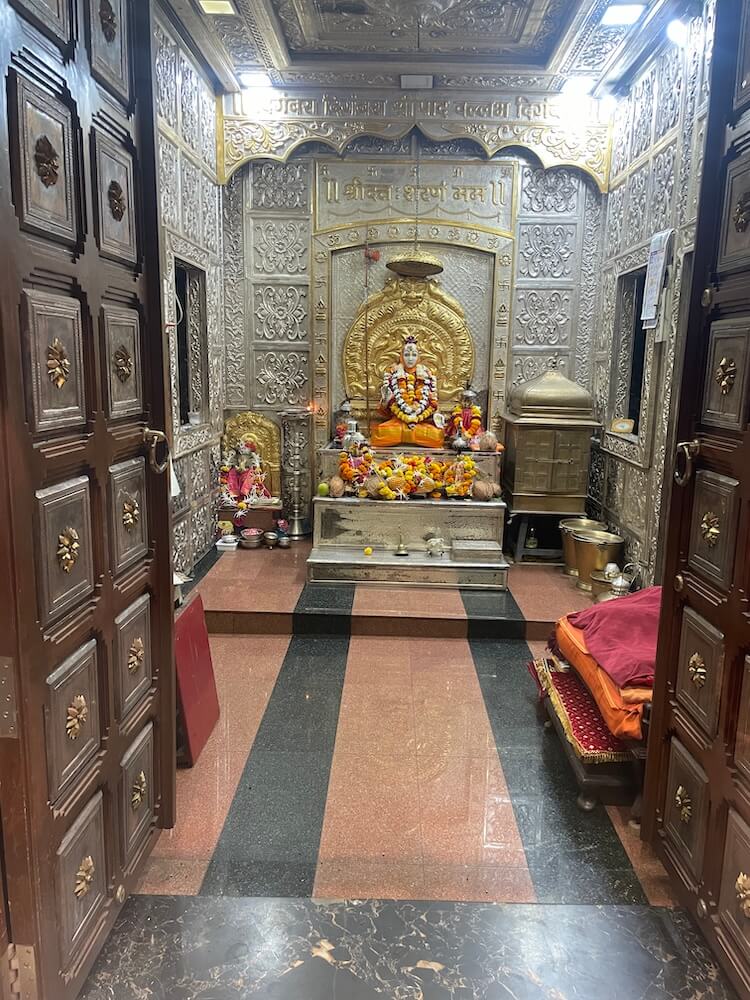
The inner sanctum is designed with a circumambulation path around the sanctum sanctorum. The entrance to the sanctum sanctorum features intricate silver carvings. Inside, on a golden pedestal, sits a white marble idol of Nrusimha Saraswati in his child form. Idols of Ganapati and Shri Datta are also present here. All rituals here are conducted in accordance with the traditions of the Gangapur Math. The Kakad Aarti takes place at five o’clock in the morning. From eight to eight-thirty in the morning, the Nirguna Padukas are anointed with sandalwood paste. The afternoon Aarti is held at twelve-thirty, followed by the distribution of Mahaprasad to the visiting devotees. Devotees can have Darshan here until nine-thirty at night. Every Thursday, a Palkhi procession of the Swami is taken out. Additionally, festivals such as Gudi Padwa, the Punyatithi of Vasudevananda Saraswati on Ashadha Shukla Pratipada, the Jayanti of Vasudevananda Saraswati on Shravana Vadya Panchami, the Shripada Shrivallabha Jayanti on Bhadrapada Shukla Chaturthi, the Punyatithi of Brahmananda Saraswati on Margashirsha Shuddha Dashami, and the Nrusimha Saraswati Jayanti on Pausha Shukla Dwitiya are celebrated here with great enthusiasm.
This sacred temple stands as a testament to deep spiritual devotion, ancient architectural grandeur, and rich local cultural traditions.
The sanctum sanctorum houses the divine idol consecrated according to ancient Vedic traditions, surrounded by serene courtyards and traditional temple architecture.
Navratri, Maha Shivratri, Annual Temple Jatra & Deepotsav
Compare and book flights, secure top-rated local hotels near the temple, hire reliable guides, and rent cars instantly.
Extend your pilgrimage by visiting other highly sacred temples located nearby.


Add ₹999 more to unlock FREE SHIPPING!
Your sacred cart is currently empty.
Shop Photo FramesFill in your delivery details below to place your order.
Add comment