
Add ₹999 more to unlock FREE SHIPPING!
Your sacred cart is currently empty.
Shop Photo FramesSage Gautama, one of the Saptarishis (seven great sages), is the author of many hymns in the Vedas. When Lord Indra deceitfully violated his wife Ahalya, the sage cursed both Indra and Ahalya. Later, he also granted them a reprieve from the curse. Consequently, the thousand marks on Indra’s body turned into eyes, earning him the name Sahastraksha, and Ahalya, who had turned into stone, was restored to life by the touch of Lord Rama’s feet. In the name of this great sage, the Gautameshwar Mahadev Temple is situated on the banks of the Gomati River in the village of Prakasha, in the Shahada taluka of Nandurbar district.
The ninth chapter of the ‘Tapi Mahatmya’ contains information regarding Prakasha. It states: “Shri Rudra Uvacha, Prakashakamidam Tirtham Sarvapapaprashanam. Prakashatvam Gatayatra Payoshyantargata Sarit. Sarvadevamidam Kshetram Durlabham Vatsa Bhutale. Ashesham Papa Dahanam Visheshadyottarayane.” This means that Lord Mahadeva declared that the pilgrimage site of Prakasha is a destroyer of all sins. The lost Payoshni River has manifested at Prakasha. “O child, it is very rare to find such a sacred region on earth. Especially during Uttarayana, performing a holy bath in this region destroys all sins.”
Regarding the name ‘Prakasha’ for this village, the legend goes that in ancient times, there were six months of night and six months of day on Earth. To ensure the eternal presence of Lord Mahadeva, the work of building temples containing 108 Shiva Lingas in a single night was started at Prakasha. However, by the time 107 Shiva Lingas were installed, the light of dawn appeared, and the work remained incomplete. Thus, the village came to be known as Prakasha, and this pilgrimage site began to be referred to as ‘Dakshin Kashi’ (the Kashi of the South). It is believed that for devotees undertaking a pilgrimage to Uttar Kashi, the pilgrimage is not considered complete without a darshan at Prakasha.
The legend of the Gautameshwar Mahadev Temple in Prakasha states that Sage Gautama’s powers had diminished due to the curse and subsequent reprieve given to his wife Ahalya and Lord Indra. To regain them, he went to the Himalayas. While traveling to Nashik for the Simhastha Kumbh Mela after regaining his powers, he reached this place. By then, the Simhastha Kumbh Mela had already begun. He felt distressed for not being able to reach the Simhastha on time. At that moment, Lord Mahadeva appeared before him at this site and told him that by taking a holy bath at the Triveni Sangam (confluence of three rivers) here, he would receive the same merit as the Simhastha. Following Mahadeva’s instruction, he bathed at the Triveni Sangam and installed a Shiva Linga. Because he installed it, this Shiva Linga became known as Gautameshwar Mahadev.
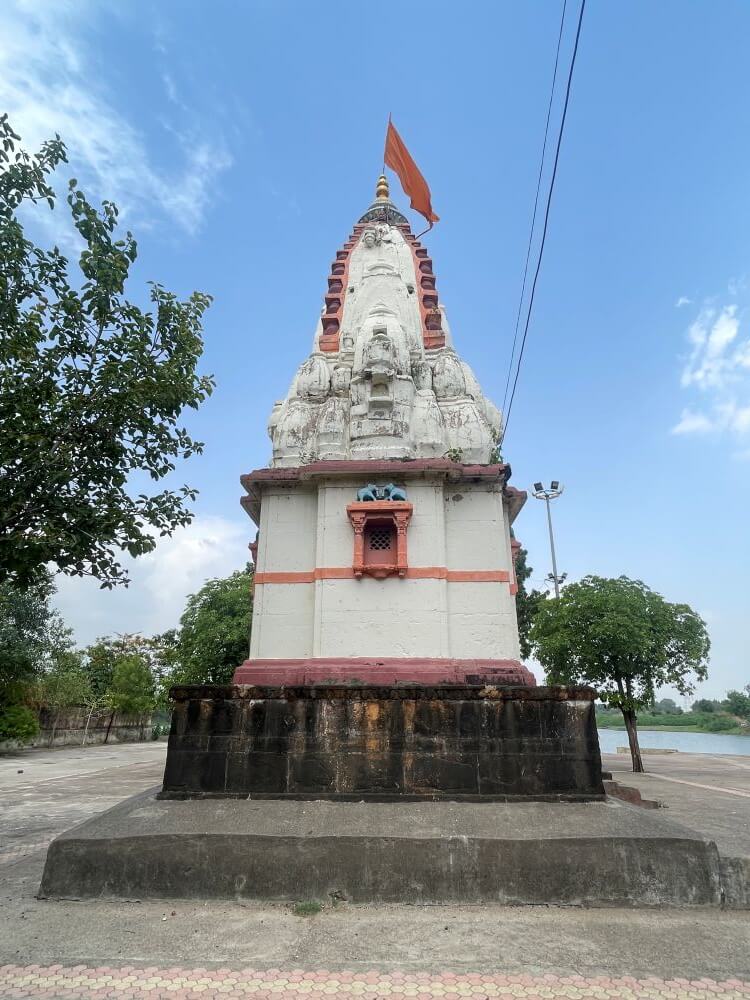
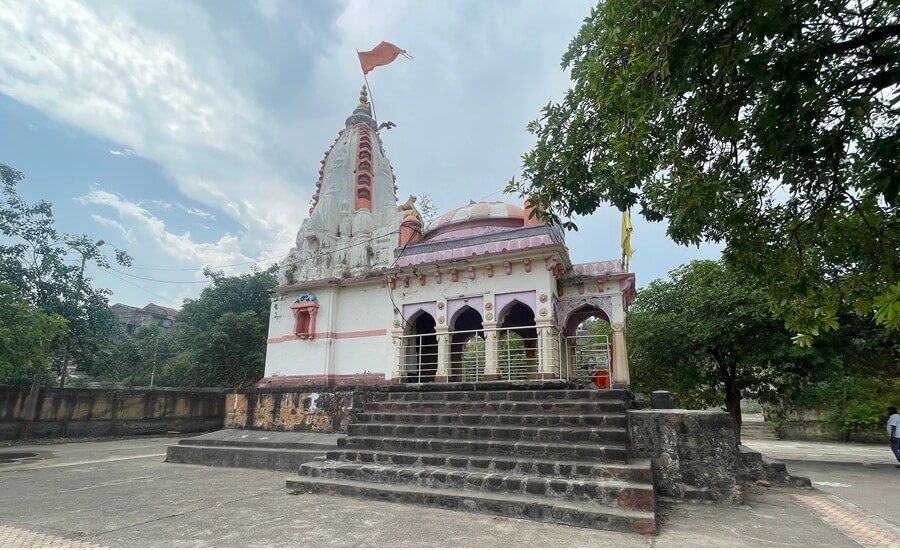
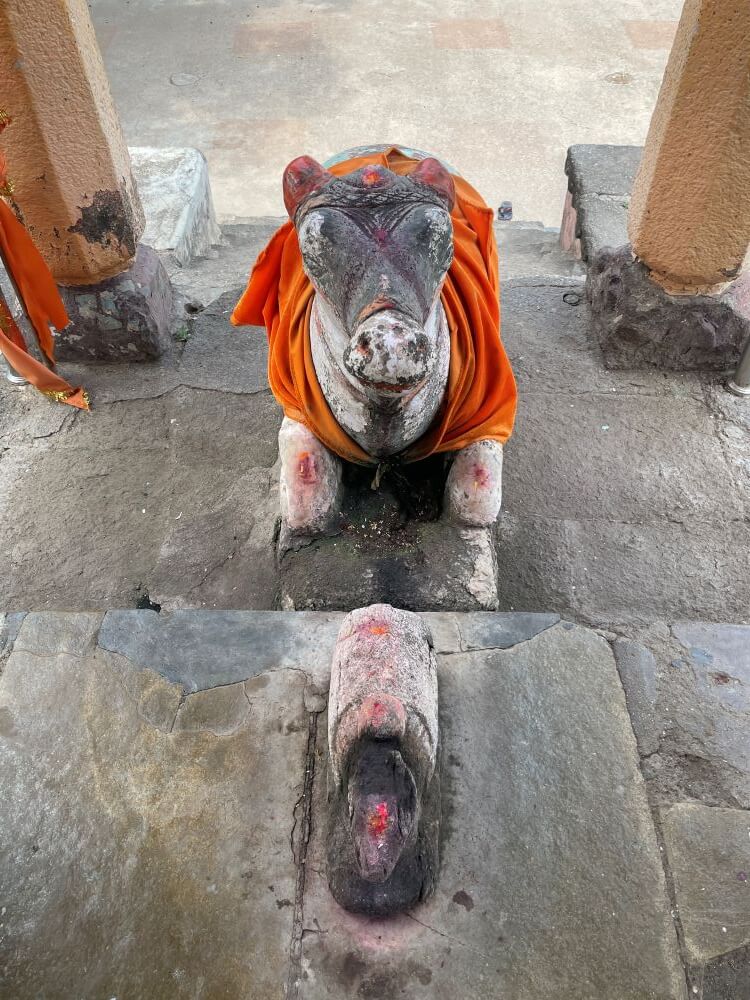
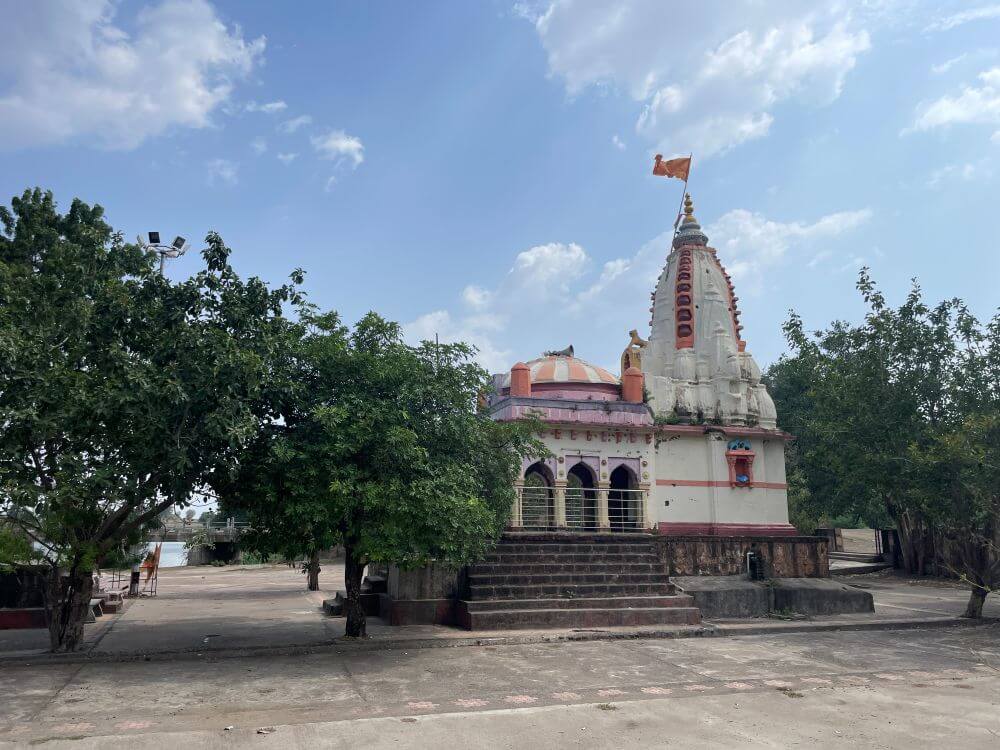
This temple, located on the banks of the Gomati River, is said to date back to the thirteenth or fourteenth century. The temple courtyard is enclosed by a wall on three sides, excluding the side facing the river. One enters the temple courtyard through an entrance in this wall. The Gautameshwar Temple stands in the center of the spacious courtyard. The temple structure consists of a Mukhamandapa (entrance porch), Sabhamandapa (assembly hall), Antarala (vestibule), and Garbhagriha (sanctum sanctorum). There are nine steps each in front of the Mukhamandapa and on the left and right sides of the Sabhamandapa. Due to its location on the riverbank and the risk of flooding, the temple is constructed about seven feet higher than the courtyard. On both sides of the steps in front of the Mukhamandapa, there are platforms with Shiva Lingas. In the Mukhamandapa, there is an idol of Nandi carved from a single piece of black stone on a platform.
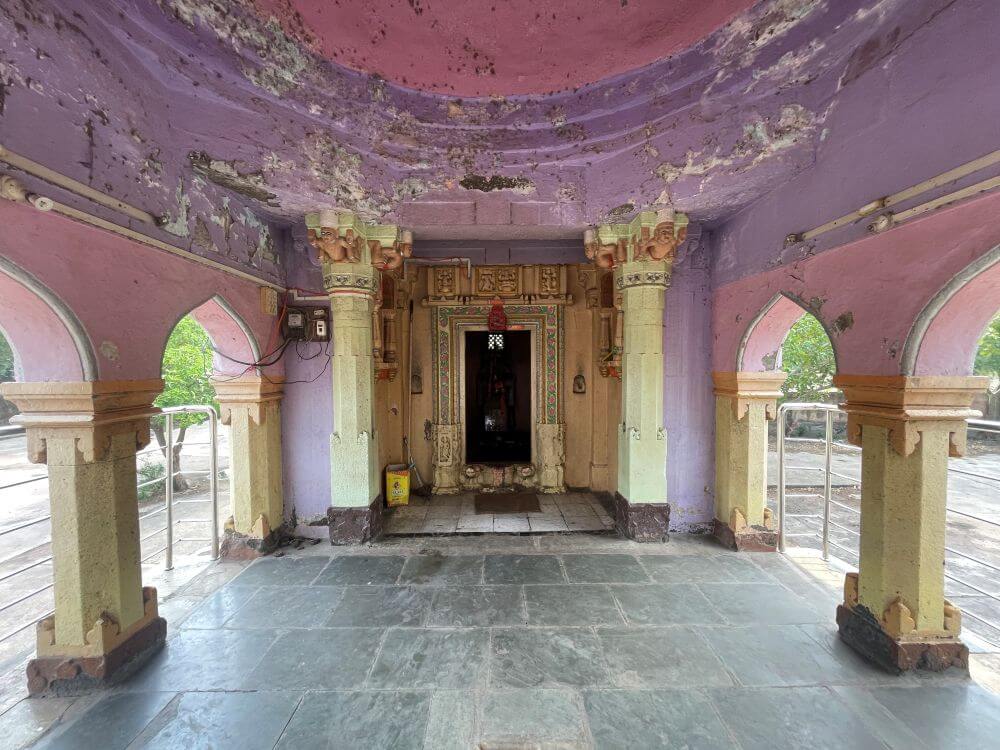
The Sabhamandapa of the temple is semi-open. On both sides of the Sabhamandapa, there are four octagonal ornate pillars. All these pillars are connected to each other by crescent-shaped arches. On the pillars of the Antarala, there are load-bearing Yaksha sculptures at the top. In the Antarala, there are lamp niches on the front wall of the Garbhagriha. Further ahead is the entrance to the Garbhagriha. On the lintel of the entrance, there are Kirtimukhas on both sides. On the lower part of the door jambs are figures of guardians, and on the upper part are floral, vine, and leaf motifs. There is an idol of Lord Ganesha on the Lalatabimba (central block), and above it, on the upper sections, are four sculptures of various deities.
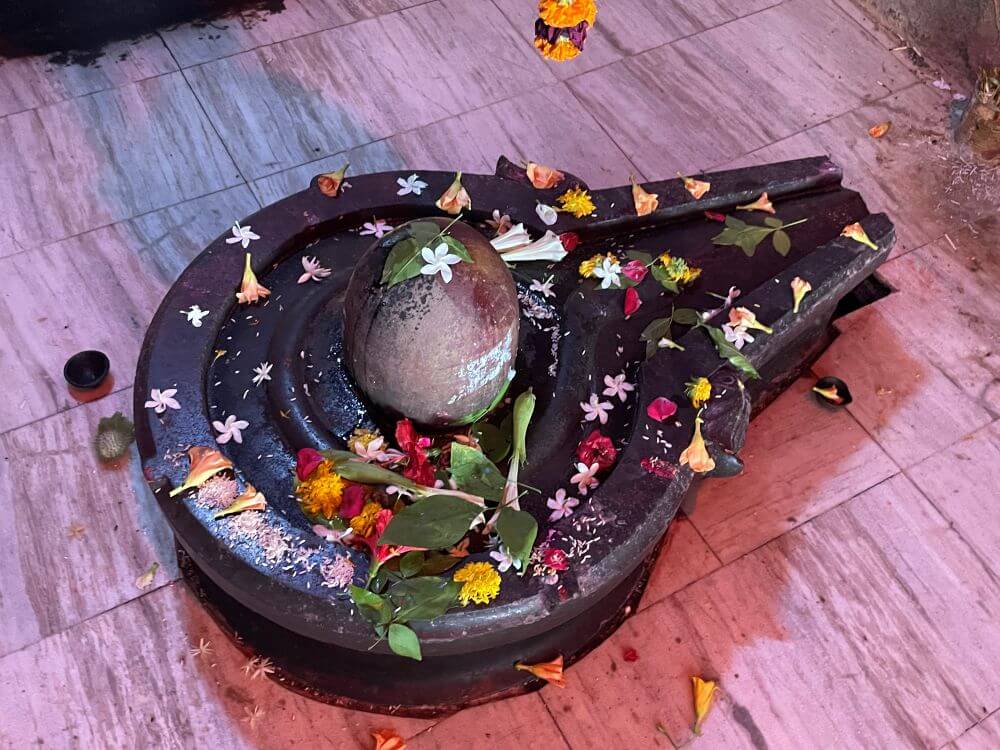
Inside the Garbhagriha, there is a Shiva Linga in the center on the floor. The Shalunka (base) of the Shiva Linga is made of black stone, while the Linga itself is of a reddish hue. In all four corners of the Garbhagriha, there are ornate pillars with brackets supporting beams. A dome is formed from an octagonal stone structure on the beams, and the ceiling features circular carvings. There are ventilators to allow air into this enclosed sanctum. The roof of the Sabhamandapa has a dome-shaped Shikhara (spire) topped with a Kalasha. There are four smaller spires on the four corners of the roof. The roof of the Garbhagriha has a square Shikhara with a niche in the front containing a deity image, and a tiger sculpture above the niche roof.
In front of this temple, on a high platform with three steps, is a Maruti (Hanuman) temple. The temple houses a stone idol of Maruti smeared with vermilion. The idol is unique, with a mace in one hand and a flower in the other. Further ahead, along the riverbank, is a vast ghat with steps. The fair held here once every twelve years during the Simhastha is particularly famous. At this time, thousands of devotees from across the country come here for a holy bath. Thousands of devotees visit the temple on Mahashivratri and every Monday of the Shravan month. Various peace rituals and funeral rites are performed on the ghat here. There is a crowd of devotees and tourists every Monday, on Amavasya (new moon day), and on holidays.
This sacred temple stands as a testament to deep spiritual devotion, ancient architectural grandeur, and rich local cultural traditions.
The sanctum sanctorum houses the divine idol consecrated according to ancient Vedic traditions, surrounded by serene courtyards and traditional temple architecture.
Navratri, Maha Shivratri, Annual Temple Jatra & Deepotsav
Compare and book flights, secure top-rated local hotels near the temple, hire reliable guides, and rent cars instantly.
Extend your pilgrimage by visiting other highly sacred temples located nearby.


Add ₹999 more to unlock FREE SHIPPING!
Your sacred cart is currently empty.
Shop Photo FramesFill in your delivery details below to place your order.
Add comment