
Add ₹999 more to unlock FREE SHIPPING!
Your sacred cart is currently empty.
Shop Photo FramesGayatri Devi is one of the five forms of the primordial energy, Prakriti. Temples of Gayatri Devi, who is the Vedamata or the Mother of the Vedas, are rare in Maharashtra. Among these, the Panchamukhi (five-faced) idol of the Goddess is considered even rarer. While one-faced or three-faced idols of the Goddess can be seen in many places, there is a temple that is over one hundred years old, housing a Panchamukhi idol of the Goddess, in Goregaon near Mangaon in Raigad district. It is believed that the Goddess here is the bestower of strength and wisdom. It is said that this is the only temple of Gayatri Devi in the entire district.
In the Shatapatha Brahmana (१४.८.१५.७), the meaning of Gayatri is given as follows: ‘Sa haisha gayamstratret. Prana vai gayastatpranamstratret tad gayamstratret tasmad Gayatri nama.’ This means that Gayatri protected the Gayas, that is, the vital breaths (Pranas). The vital breaths are called Gaya. Because Gayatri protected those Gayas, she came to be known as Gayatri. In the Brihad Yogiyajnavalkya Smriti (४.१६), it is stated that Just as honey is the essence of flowers, ghee is the essence of milk, and milk is the essence of all fluids, similarly, the Gayatri is said to be the essence of all the Vedas. In the Skanda Purana, it is also stated, “Gayatri Veda-Janani Gayatri-Brahmana-Prasuh,” which means that the Gayatri is the mother of the Vedas and the Brahmanas.
Information about Goddess Gayatri is provided in the first volume of the book ‘Adishaktiche Vishwaswaroop Arthat Devikosh’, written by Pralhad Krishna Prabhudesai and published by Tilak Maharashtra Vidyapeeth in the year 1968. According to this, Brahma, Vishnu, and Mahesh are considered the three feet (tripad) of Gayatri. People from both Shaiva and Vaishnava sects worship this Goddess. Gayatri is the embodiment of the three times (trikala). Her form during the three times is Gayatri in the morning, Savitri in the afternoon, and Saraswati at night. The forms of each of these are distinct. This Goddess is considered to be five-faced (panchamukhi). Five types of Gayatri have been mentioned: Shiva Gayatri, Vignesh Gayatri, Garuda Gayatri, Durga Gayatri, and Vishnu Gayatri. Perhaps it is from this that Gayatri became five-faced. should be so, stated Prabhudesai. In the scripture ‘Gayatri Rahasyam’ by Pandit Veniram Sharma Gaud Vedacharya, it is stated that ‘Gayatri is a Vedic deity. She is to be worshipped only by the Dwijas and not by women and Shudras. Therefore, temples of Gayatri are not found everywhere.’
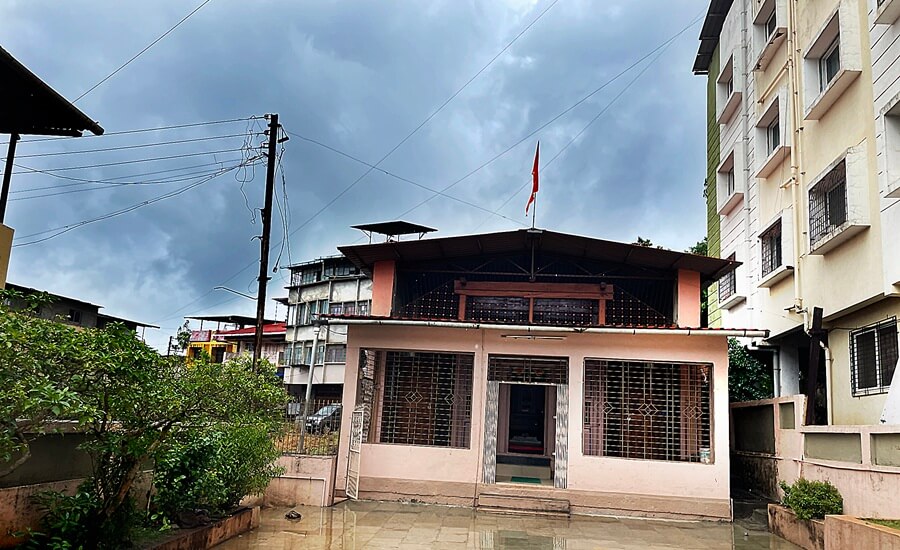
The famous temple of this Goddess in Raigad is situated at Goregaon, about 3 km from Lonere village near Mangaon, along the Mumbai-Goa National Highway. It is inscribed on the front wall of the sanctum sanctorum that this temple was built by Lakshmanshastri Sadashiv Ranade in the year 1904. Even after more than 120 years have passed, this wooden-structured temple remains in its original form and is well-maintained. There is a boundary wall around this temple located by the roadside. The temple courtyard is paved. In front of the temple, there are ancient lamp pillars (Deepmalas). In the niche below them, there is a small idol of Lord Ganesha carved out of red coral (Pavale). There is a 120-year-old marble inscription on the lamp pillar.
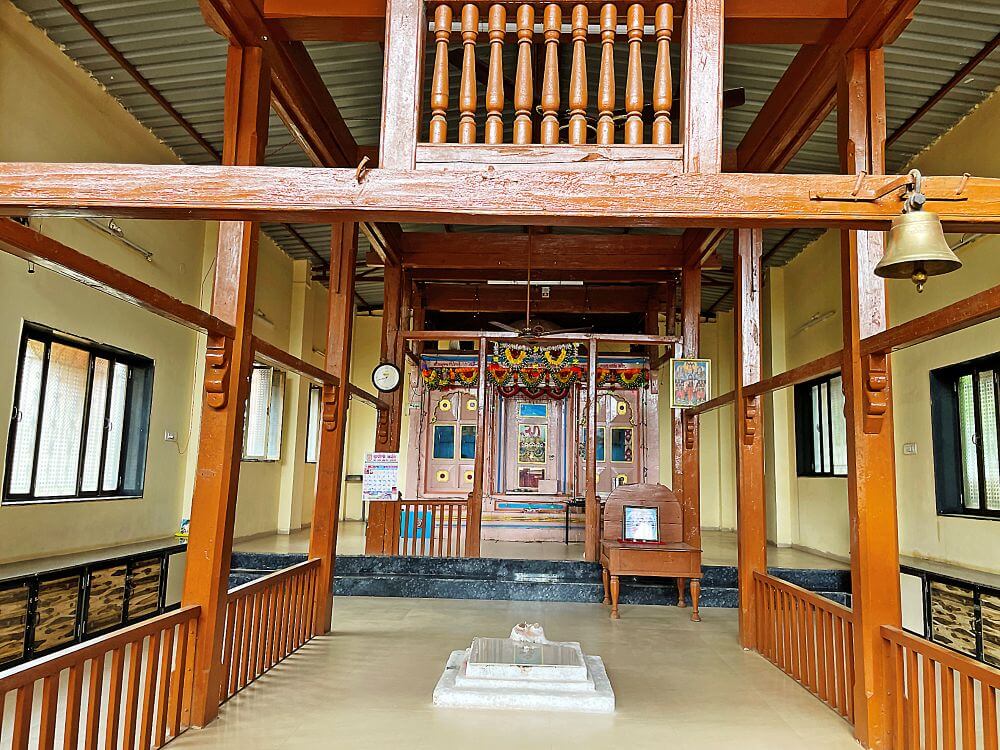
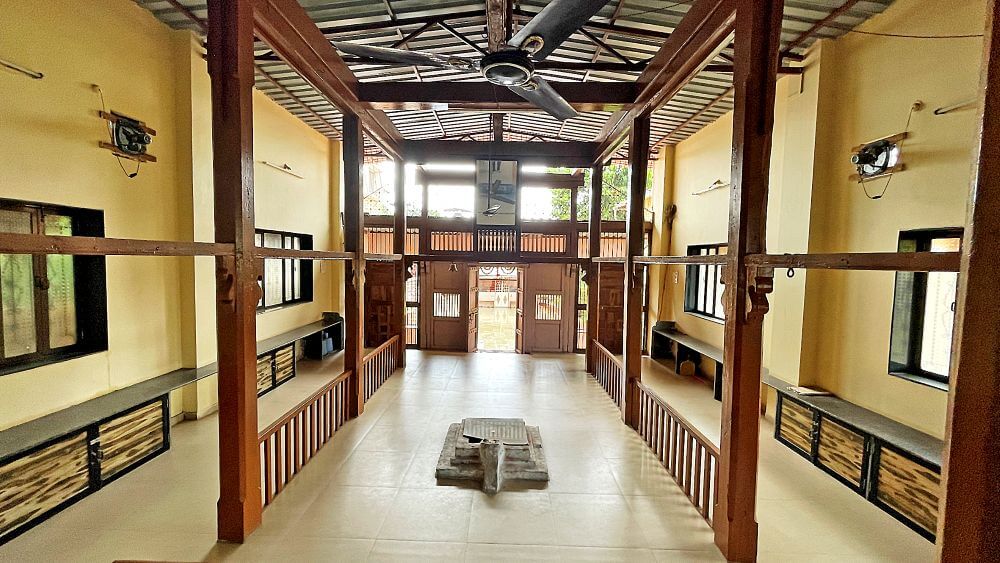
The structure of this temple consists of a Mukhamandapa (entrance hall), Sabhamandapa (main assembly hall), Antarala (vestibule), and Garbhagriha (sanctum sanctorum). Built entirely of teak wood, this two-story temple remains in excellent condition even today. There are three steps to enter the Mukhamandapa of this temple, which stands on a high plinth. The Mukhamandapa, which has railings on three sides, is fitted with iron grilles. Ahead lies the entrance to the Sabhamandapa. The enclosed Sabhamandapa has windows for ventilation and light. In the center of the Sabhamandapa is a Yagnakunda. During Navaratri, rituals such as Homahavan are performed in this Kunda. In the Sabhamandapa, there are two rows of five square wooden pillars each. The pillars have wooden brackets in the middle, topped by beams. All the pillars here are connected at the base by wooden railings. Along the walls of the Sabhamandapa, there are wooden benches for devotees to sit.
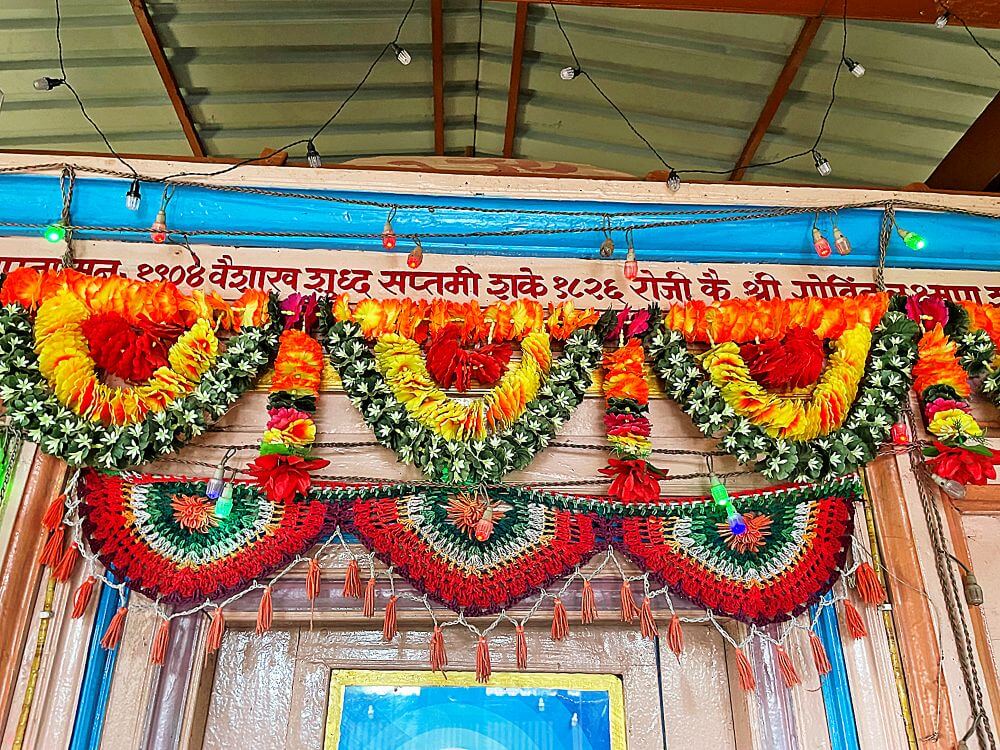
There are two steps to ascend to the Antarala, which is situated at a higher level than the Sabhamandapa. In front of the Antarala, there are four wooden pillars, an entrance between them, and wooden railings on both sides. Further ahead lies the wooden Garbhagriha. The door frames of the Garbhagriha feature vertical carvings, and the wooden shutters here are fitted with transparent glass. Because of this, one can have Darshan of the deity inside even when the doors are closed. On both sides of the entrance, there are ornate wooden windows. The shutters of these windows feature square and circular carvings, with glass panels set in the center.
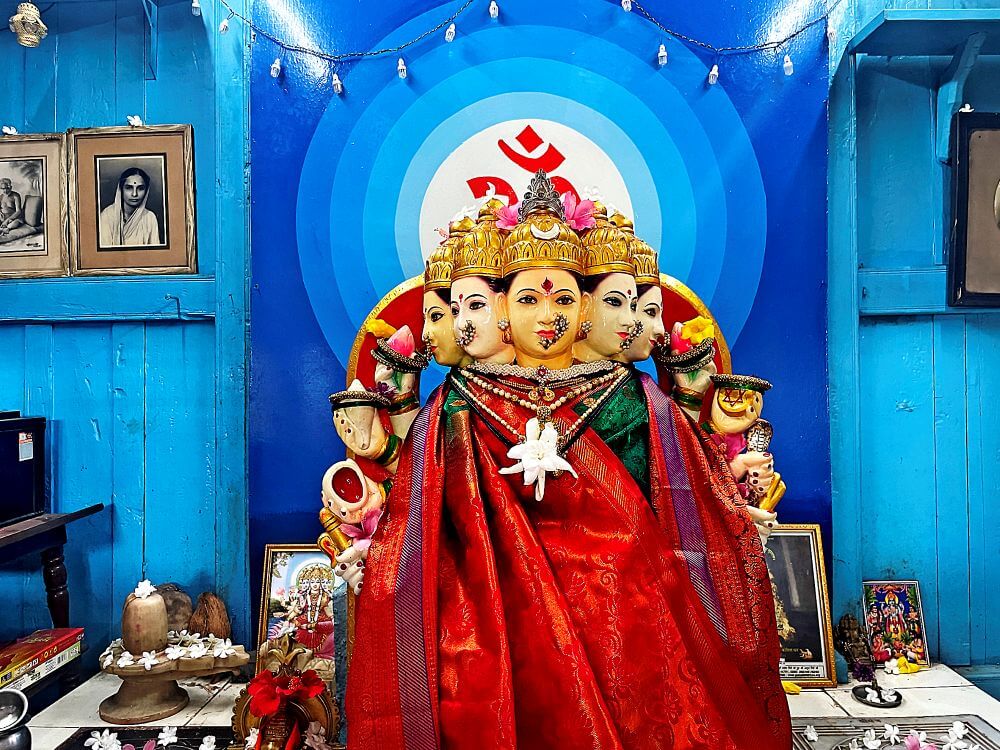
In the sanctum sanctorum, upon a Vajra-peetha, resides the five-faced and ten-armed idol of Goddess Gayatri. It is said that this idol was brought here from Jaipur. Facing the east, the Goddess is seated on a lotus flower, with her right leg resting downwards. Among the five faces, the central one is that of Goddess Gayatri. The first face on the right, saffron in color, is in the form of Lord Ganesha, and the second, pearl-colored face, is in the form of the Sun God. The first face on the left, blue in color, represents the Goddess in the form of Yama, while the second, white-colored face, represents the Goddess in the form of Lord Vishnu. The Goddess holds weapons such as the pasha (noose), ankusha (goad), sutrabandha, kapala (skull cup), shankha (conch), and chakra (discus) in her hands. One of the Goddess’s hands is in the Abhaya Mudra (gesture of fearlessness) and another is in the Varada Mudra (gesture of bestowing boons). The idol is adorned with exquisite garments and ornaments. Beside the Goddess is a brass idol of Lord Ganesha. Every morning, the ritualistic worship of the Goddess is performed here. In the evening, the Aarti is conducted. The Sharadiya Navaratri festival is the main annual celebration at the temple, observed with great enthusiasm. For ten days, programs such as Homa-Havana, Bhajans, Kirtans, discourses, night-long vigils, Gondhal, and Mahaprasada are organized in the temple. During this time, hundreds of devotees from Mumbai, Pune, and the district come to seek the blessings of the Goddess. Art camps for painting, music, and study classes for students are conducted in the temple. The number of devotees visiting the temple for daily Abhisheka and Aarti is also significant.
This sacred temple stands as a testament to deep spiritual devotion, ancient architectural grandeur, and rich local cultural traditions.
The sanctum sanctorum houses the divine idol consecrated according to ancient Vedic traditions, surrounded by serene courtyards and traditional temple architecture.
Navratri, Maha Shivratri, Annual Temple Jatra & Deepotsav
Compare and book flights, secure top-rated local hotels near the temple, hire reliable guides, and rent cars instantly.
Extend your pilgrimage by visiting other highly sacred temples located nearby.


Add ₹999 more to unlock FREE SHIPPING!
Your sacred cart is currently empty.
Shop Photo FramesFill in your delivery details below to place your order.
Add comment