
Add ₹999 more to unlock FREE SHIPPING!
Your sacred cart is currently empty.
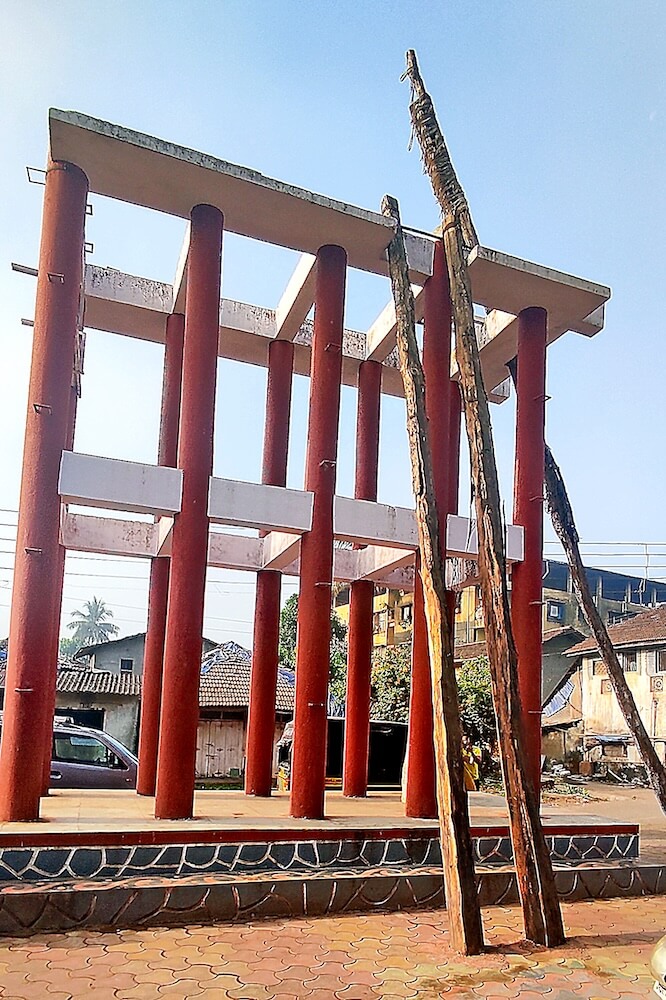
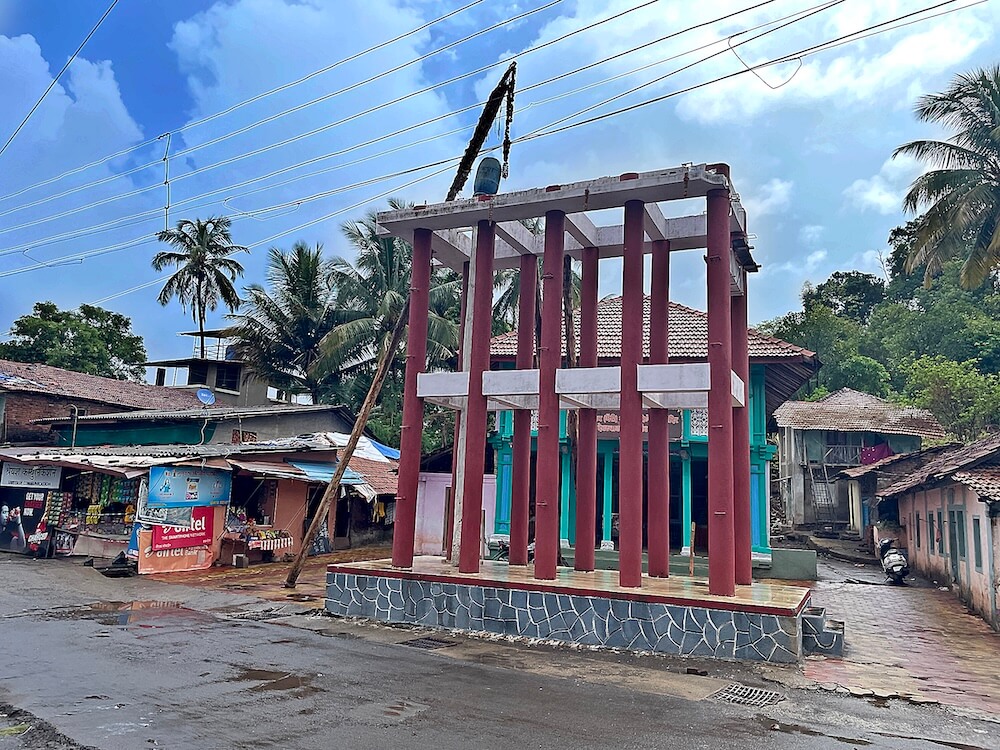
Shop Photo FramesIn the Bhairavnath Temple at Goregaon in Raigad district, all three deities—Bhairi, Bhavani, and Jogeshwari—are enshrined in one sacred place. The villagers hold a firm faith in this awakened shrine, which is the presiding deity of eighty-four surrounding villages. A unique feature here is the centuries-old procession of Bhairideva’s ‘Laat’ (log), where a forty-foot long divine log is rotated on a ‘Bagad’ (a tall wooden or cement structure). For this ‘Laat’, an equally large and tall ‘Bagad’ stands before the temple. It is also renowned as one of the tallest ‘Bagads’ in the state, making this a truly distinctive and widely celebrated fair.
Many small and large rivers originate in the Sahyadri mountain ranges. The Kaal and Ghod are two such west-flowing rivers. The small, historic town of Goregaon in Mangaon Taluka is situated at the confluence of these rivers. After the confluence, the Ghod river (or Godi river) flows further to meet the Savitri. Before that, it has a dam named Goregaon. There is a legend about the name of this village: During the time of Chhatrapati Shivaji Maharaj, Kumbheghat and Devghat were two popular routes to descend from the Ghats to the Konkan. Ghodegaon, located on these routes, emerged as a major trading center at that time. As there was extensive horse trading here, the village was named Ghodegaon. Later, this name was corrupted to Goregaon, which is the name prevalent today. To the west of the village, on a hill, lies an even more ancient village called Ghodeghum. ‘Ghum’ is a corrupted form of ‘Gum’, and ‘Gum’ means village. In ancient times, the original Ghodegaon (or Goregaon) might have been Ghodeghum. However, as trade flourished, a new village might have been settled at the foot of the hill for the convenience of traders, travelers, and passengers. It is believed that ‘Hippokura’, mentioned in Ptolemy’s descriptions in one hundred and fifty CE, might be Goregaon. In Shivकालीन history, Goregaon was within the jurisdiction of the Janjira state. Among the twelve famous ‘Mahals’ of the Janjira state at that time, one ‘Mahal’ was also in Goregaon. More recently, the ‘Kulaba Bhuvarnan’ (Description of Kulaba) published in nineteen thirty-one, mentions Goregaon as a major trading center. Furthermore, the ‘Kulaba Varnan’ (Description of Kulaba) published in nineteen fifty-four, refers to five to six rice mills in Goregaon during that period. The ‘Salvati’ sarees woven on handlooms here were famous throughout Maharashtra. Similarly, ‘Kulaba Varnan’ also mentions the presence of factories in Goregaon that produced ‘ghongadis’ (woolen blankets) and copper-brass utensils.
This famous Bhairavnath temple is located in Goregaon, three kilometers from Lonere on the Mumbai-Goa Highway. This shrine is also recognized as the village deity of Goregaon. As the temple is situated in a densely populated area, there isn’t much open space around it. Surrounding it are single-story and multi-story tiled houses. In the square in front of the temple stands the ‘Bagad’. In ancient times, this ‘Bagad’ was made of wood. Over time, as the wooden parts of the ‘Bagad’ deteriorated, a new main wooden pillar was erected in the center, and a cement ‘Bagad’ was built around it. It is considered one of the tallest ‘Bagads’ in the state. During the fair, the ‘Kaalbhairavachi Laat’ (log of Kaalbhairav) is rotated on this very ‘Bagad’.
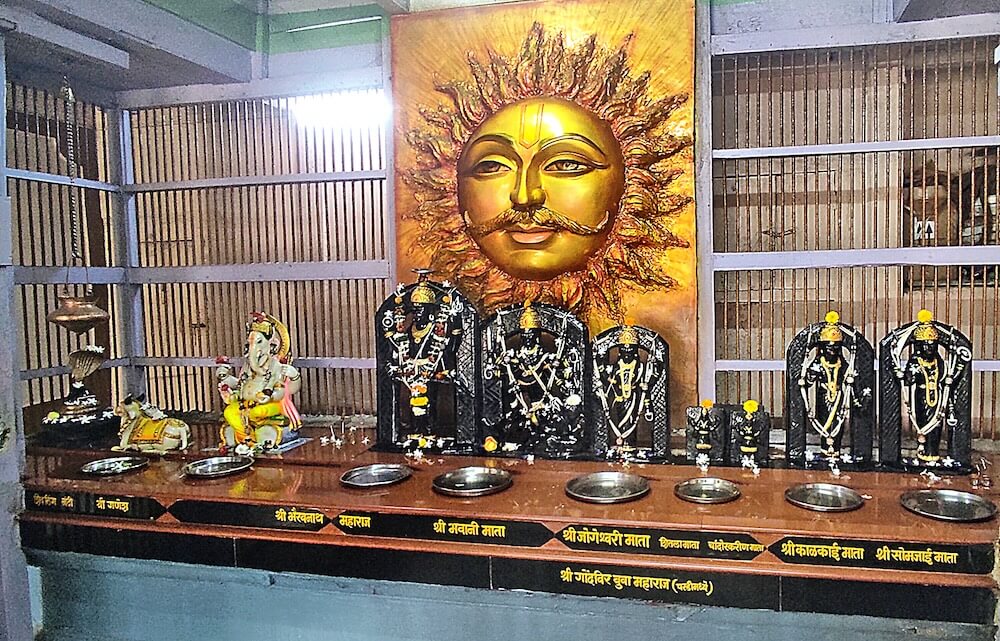
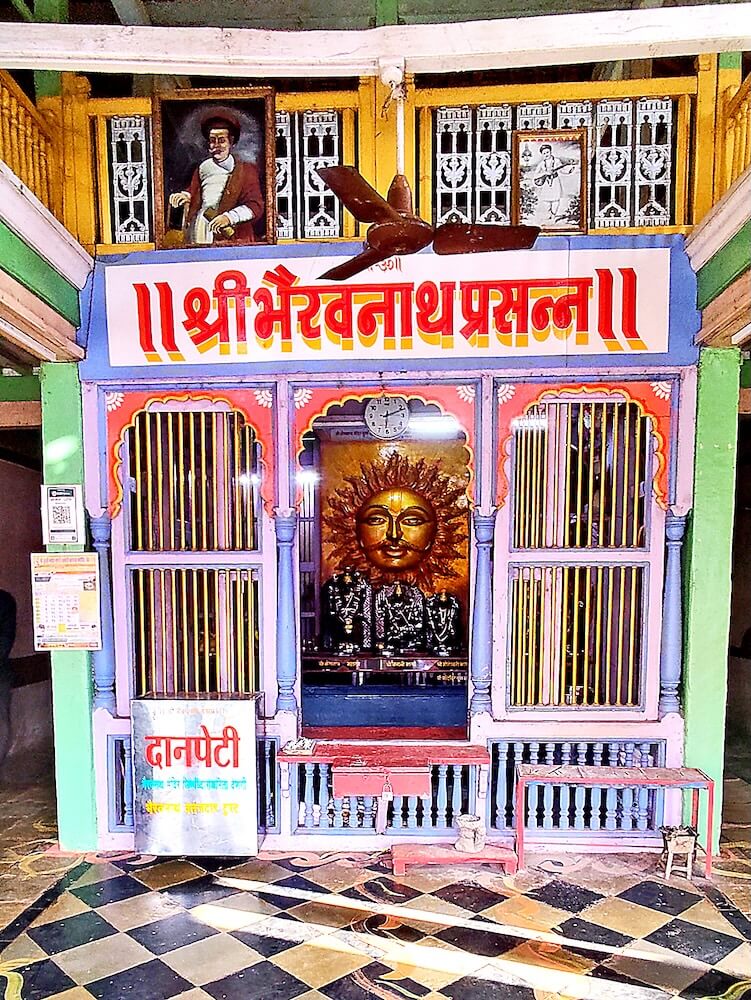
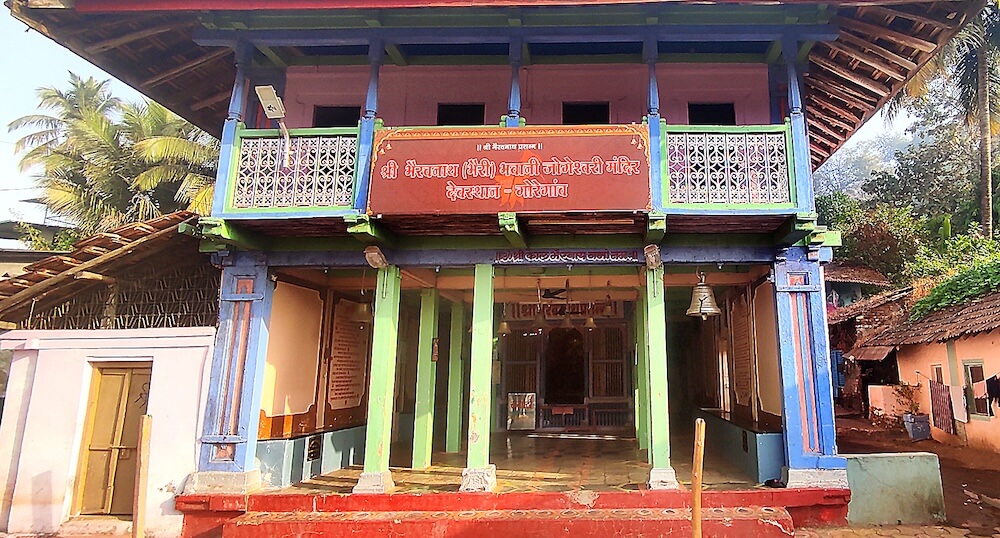
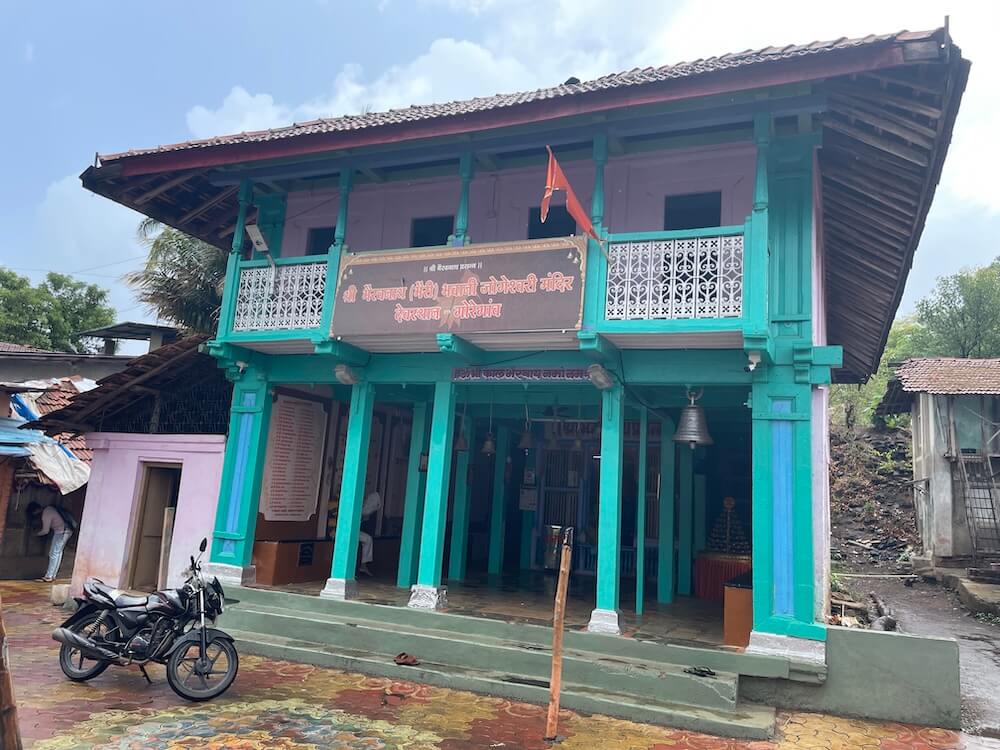
With its sturdy wooden pillars and earthen tiles, this temple preserves its ancient glory. This two-story temple has a structure comprising a ‘Sabhamandap’ (assembly hall) and a ‘Garbhagriha’ (sanctum sanctorum). One enters the semi-open ‘Sabhamandap’ of the temple by ascending three steps from the ground. In the ‘Sabhamandap’, wooden pillars stand on stone bases near the ground. On the left and right sides of this ‘Sabhamandap’ are seating areas for devotees. Beyond the ‘Sabhamandap’, leaving a circumambulation path, is the ‘Garbhagriha’. In the ‘Garbhagriha’, on a medium-sized ‘Vajrapitha’, from left to right, are a Shivlinga, Nandi, an idol of Ganesha, and in the center, black stone idols of Bhairavnath Maharaj, Bhavani Mata, and Jogeshwari Mata. Behind these idols is a large image of Suryadeva. To the left of the idols are small idols of Shitalamata and Chandorkarin Mata. Further ahead are idols of Kaalkai Mata and Somjai Mata.
The greatest attraction of this temple is the fair held in the month of Chaitra. Preparations for this Bhairavnath fair, which takes place on the Chaturdashi of the Krishna Paksha in the month of Chaitra, begin right from Ram Navami. Villagers from Goregaon and the eighty-four surrounding villages come together to prepare for this fair. From the forest east of Goregaon, the villagers search for the divine ‘Laat’ (the trunk of an Ain tree). After selecting a suitable tree, it is worshipped, and then felled. For this, all the villagers camp in the forest a day in advance. The next day, after performing rituals and offering ‘Naivedya’ to the ‘Laat’, a ‘Mahaprasad’ (grand feast) is prepared right in the forest. Thereafter, the villagers carry the approximately forty-foot long divine ‘Laat’ on their shoulders and walk to the village. On the day of the fair, in the early morning, a golden mask is placed on Bhairideva, and ‘Oti’ (offerings) are made to Bhavani and Jogeshwari. After the fair begins, revered ‘Kathya’ (decorated staffs) from the eighty-four surrounding villages arrive at the temple with great fanfare. In the palanquin procession that sets out in the evening, there is the golden mask of the deity and an image of Gondirbuwa, Bhairideva’s brother.
Nearby, on a hill, is the Pirbaba Dargah, where the palanquin is taken, and a call is made to the Pir. The palanquin then proceeds, inviting everyone to attend this festival. After the palanquin approaches the temple, the ‘Laat’ is hoisted onto the ‘Bagad’. As per tradition, after the rituals, the ‘Laat’ is rotated on the tall ‘Bagad’ in front of the temple by the local dignitaries. Chants of “Chal Bhairi, Chal Re Chal, Har Har Mahadev” resonate, accompanied by the sounds of drums, ‘tashe’ (percussion instruments), and bells. This ‘Laat’ is rotated three or five times. Revered palanquins and many tall ‘Kathya’ are danced amidst this. The Pir of the Pirbaba Dargah also receives special honor at this time. Bhairideva (Bhairav) holds a special place, especially among the Maratha, Koli, Agri, Gawali, Kunbi, Bhandari, Kharvi, Bhoi, Karadi, Sutar, and Kumbhar communities of the district. Devotees believe that if one offers a prayer during the fair, Bhairavnath fulfills their desires. Devotees can visit this temple for ‘darshan’ daily from six AM to one-thirty PM and from five PM to nine PM.
This sacred temple stands as a testament to deep spiritual devotion, ancient architectural grandeur, and rich local cultural traditions.
The sanctum sanctorum houses the divine idol consecrated according to ancient Vedic traditions, surrounded by serene courtyards and traditional temple architecture.
Navratri, Maha Shivratri, Annual Temple Jatra & Deepotsav
Compare and book flights, secure top-rated local hotels near the temple, hire reliable guides, and rent cars instantly.
Extend your pilgrimage by visiting other highly sacred temples located nearby.


Add ₹999 more to unlock FREE SHIPPING!
Your sacred cart is currently empty.
Shop Photo FramesFill in your delivery details below to place your order.
Add comment