
Add ₹999 more to unlock FREE SHIPPING!
Your sacred cart is currently empty.
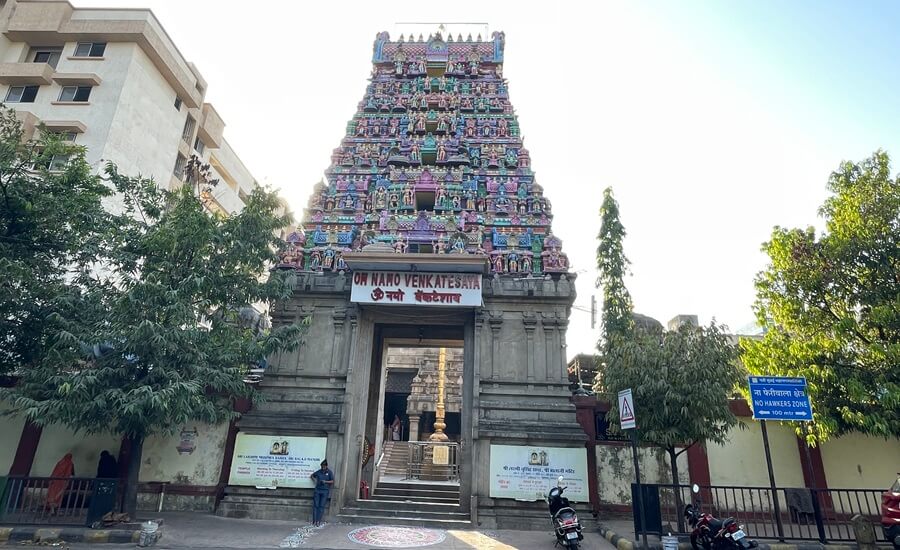
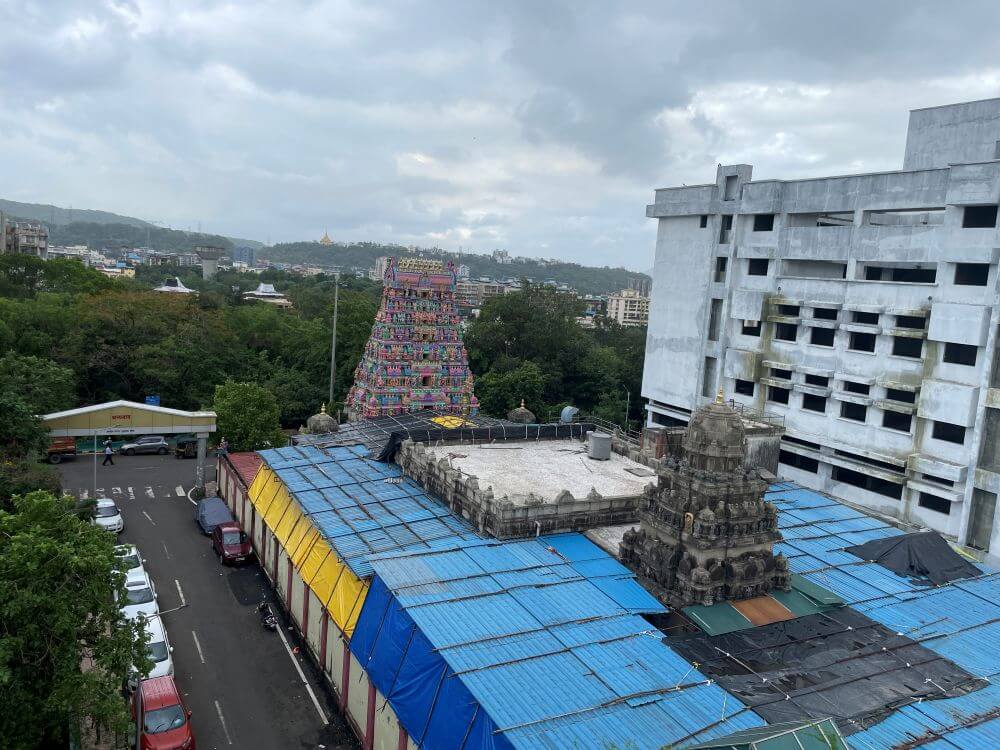
Shop Photo FramesThe Balaji Temple, situated on a small hill in Nerul, Navi Mumbai, is renowned. Built on the lines of the famous Venkateswara Temple in Tirupati, the design of this temple follows ancient architectural scriptures. This temple is an excellent example of South Indian architectural style. Similar to the idol in the Balaji Temple at Tirupati, this temple houses an idol made of black granite, approximately 10 feet in height. Adjacent to the main entrance of the temple stands a 60-foot-tall Rajagopuram, adorned with sculptures of over two hundred deities.
In the scholarly book ‘Shri Vitthal: Ek Mahasamanvay’, the great researcher Ra. Chi. Dhere has noted that Vitthal of Pandharpur and Venkatesh of Tirupati are both deities of the same nature. Both are unrelated to the Puranic incarnations or forms of Vishnu, yet have attained the status of Vishnu. Vitthal is considered to be Balakrishna, while Venkatesh is known by the name Balaji. Vitthal’s consort, on the pretext of Radha, remained sulking in Dindirvana, while Venkatesh’s consort, angered by her husband tolerating the insult by Bhrigu, stayed away first in Karveer and later in Tiruchanur. The name of Venkatesh’s consort is Padmavati, while the name of Vitthal’s beloved is Padma. Like Vitthal, Venkatesh is weaponless, silent, and stands with his left hand on his waist, while his right hand bestows blessings upon his devotees. Such devotees of Balaji are found in large numbers in Maharashtra, just as they are in Andhra.
To ensure that these devotees could also have the darshan of Tirupati Balaji in Navi Mumbai, the South Indians residing here came together to build this temple in Nerul. The ‘Shri Lakshmi Nrusimha Sabha’, an organization engaged in spiritual, cultural, and social work since the decade of 1980, took the initiative for this. The temple of Tirupati Balaji is situated on the Tirumala hills in Andhra Pradesh. That temple is at least one thousand five hundred years old. It is said that Pallava Queen Samavai built the first altar of this temple in the year 614 CE. Along with the Chola and Pallava kings, Maratha General Raghuji Bhosale also contributed to the construction and maintenance of that temple. After Vatican City in Rome, this is considered the richest place of worship in the world. This temple of Tirupati Balaji is in the Dravidian style, and the Balaji temple in Nerul has also been built in the same temple architectural style.
For this temple, this plot of land on the Brahmagiri hill in Nerul West was taken on lease from CIDCO in the year 1991. The Bhumi Pujan of this temple was performed by Jagadguru Shri Jayendra Saraswati Shankaracharya Swami, the head of Kanchi Kamakoti Peetham, while the Pranapratishtha ceremony of this temple was conducted by Shriranga Ramanuja Jeer Swami of Tirumala Tirupati. Along with the traditional temple architecture, the organization has also built a multi-storey building here for spiritual, cultural, and social activities. This building houses the Guruji Hall and a hall with a seating capacity of one thousand for various programs.
According to the Dravidian temple architectural style, the temple features an Avarabhinta (compound wall), Gopuram, Mandapam, and Manimandapam. The temple structure consists of the Antarala (vestibule), the Garbhagriha (sanctum sanctorum), and the Vimana, which is the tower-like structure above the sanctum, topped by the Shikhara. The temple compound wall features a magnificent Gopuram, which serves as the grand entrance to the temple premises. It is tall and multi-tiered. The Gopuram of this temple is known as the Rajagopuram. At its base, there is a grand stone gateway, and above its roof stands an eight-tiered rectangular Gopuram. Each tier gradually decreases in size, and every level is adorned with intricate carvings. It features numerous sculptures of various deities and niches for divine figures.
One enters the temple courtyard through this grand gateway. The forms of the deities, based on the legendary Divya Desam pilgrimage sites, which are carved onto many South Indian temples, can also be seen in this temple in Navi Mumbai. The holy places praised by the twelve Tamil Vaishnava saint-poets known as the Alvars, who lived between the years 500 and 850, are called Divya Desams. They identified 106 such Maha Vishnu shrines, or Divya Desams. The forms of the deities from those sites can also be seen in this temple.
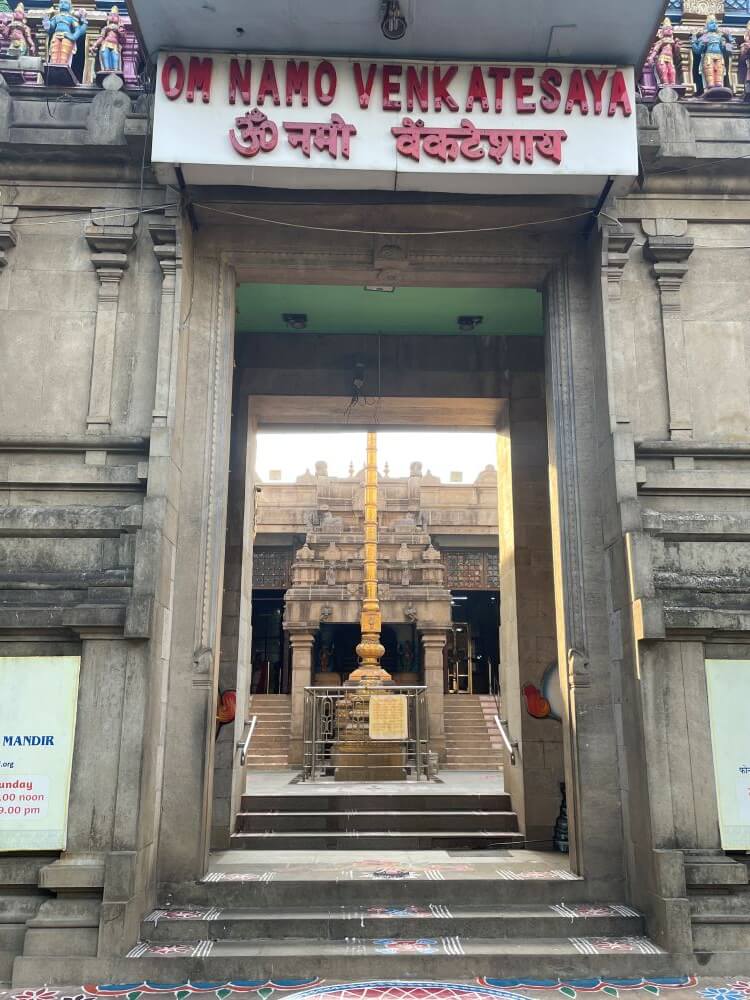
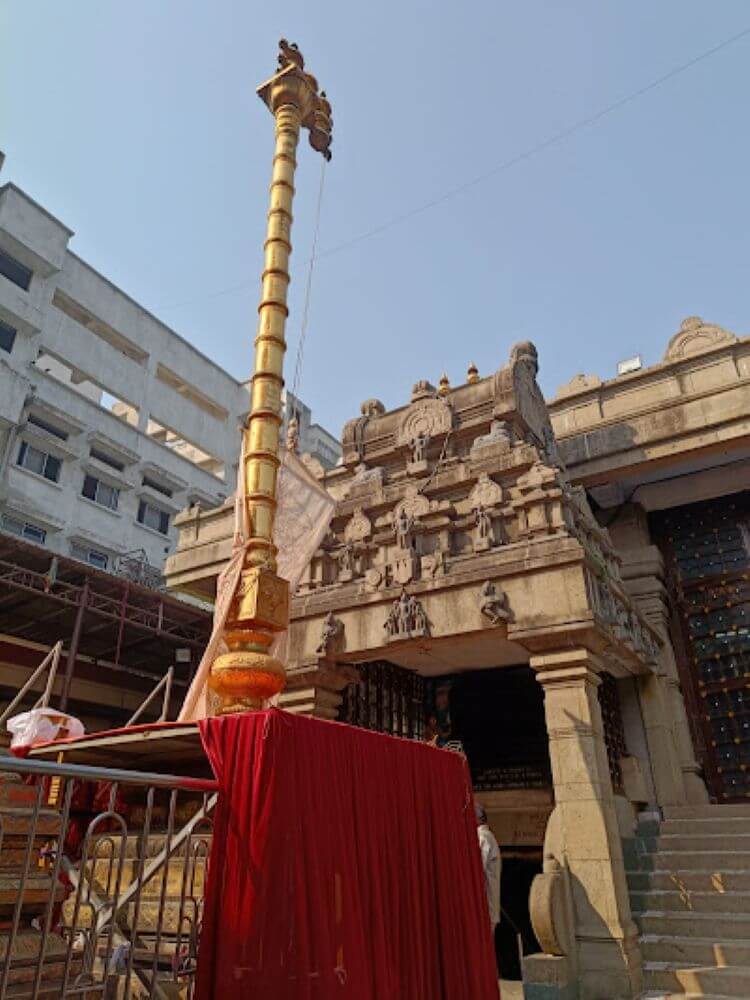
In the space between the temple and the entrance gate, there is the Balipitham. Beyond it, on a stone platform, stands a tall, gold-plated metal flagstaff (Dhvajastambha). There are eleven steps to ascend to this temple, which is situated on a slightly elevated plinth (Jagati). The Sabha Mandapa (assembly hall) of the temple is constructed using cement and granite, creating a beautiful confluence of ancient and modern architectural styles. On the front pillars of the Mani Mandapa, there are large statues of Vaishnava Dwarapalas (gatekeepers) on both sides. Similarly, there is also a statue of Garuda, the vehicle of Lord Vishnu. From this Mani Mandapa, one can have the Darshan of the idol of Balaji.
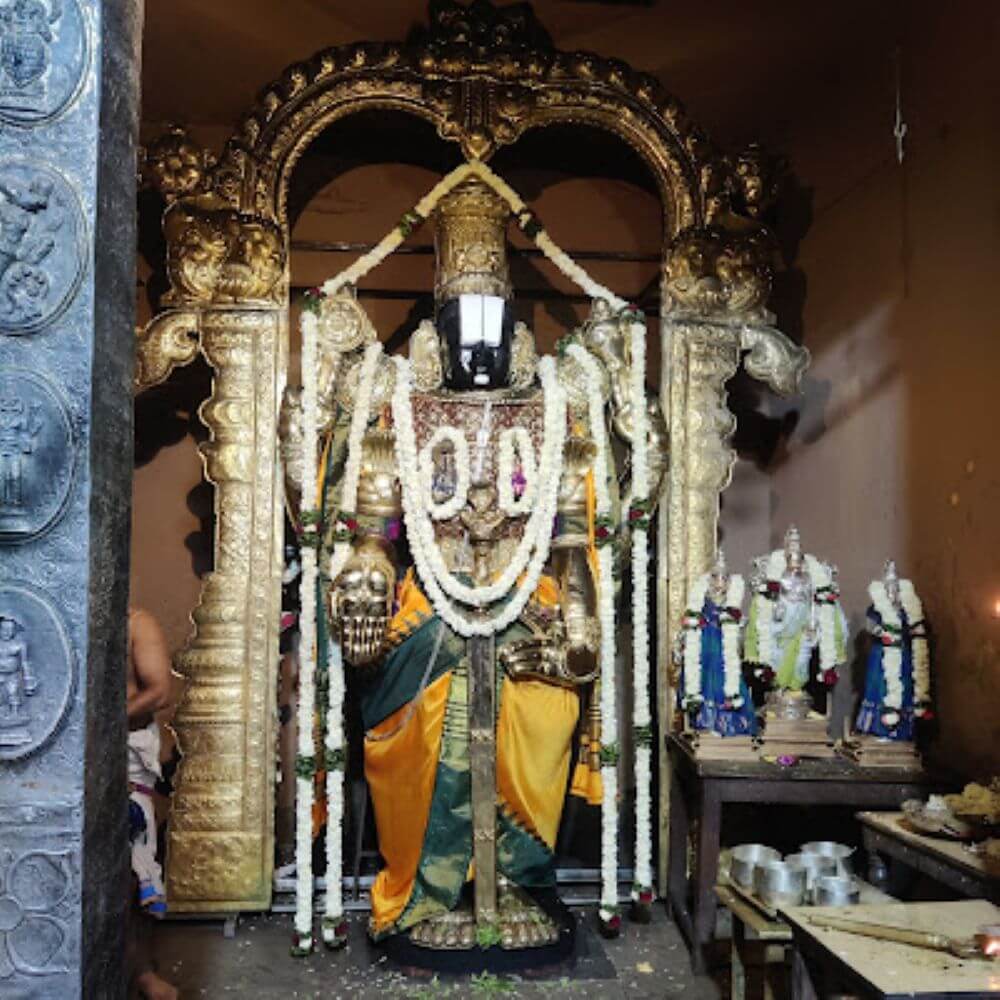
In the sanctum sanctorum, there is a standing, ten-foot-tall, dark-complexioned idol of Balaji in the Varada Mudra (boon-bestowing gesture). This idol is carved from granite stone according to the principles of Shilpa Shastra and was brought from Mahabalipuram. The idol is seated within a tall, golden archway (Makhar). The pillars and the arch of this structure are adorned with intricate carvings, with a Kirtimukha carved at the apex. The idol wears a crown on its head, earrings in its ears, and a serpent on its shoulders. A Vaijayanti garland adorns its neck. In the upper two hands, the deity holds the Panchajanya conch and the Sudarshana Chakra; one hand is in the boon-bestowing gesture, while the other rests on the waist. The hands and feet of the idol are made of gold. The idol is adorned with garments, ornaments, and flower garlands. From the forehead down to the eyes, strips of pure camphor in the shape of the English letter V are applied. Because of this, the eyes of the idol remain closed at all times.
Regarding this, it is said that Balaji’s eyes are always open. These radiant eyes possess immense energy, which has the potential to scorch the entire universe. Therefore, they are usually kept closed by applying this special type of camphor. Another explanation provided for this is that Balaji’s lotus-like eyes are extremely beautiful. If they were kept open, devotees would be so mesmerized by the sight that they would never want to leave. Hence, they are covered. The camphor is removed only during the time of Netra Darshan (viewing of the eyes). At that moment, devotees are able to behold Balaji’s eyes. Notably, the eyes of the gatekeepers and certain other deities in this temple are also covered with similar camphor strips.
In the sanctum sanctorum, alongside the main idol of Balaji, resides the Utsava Murti of Balaji, known as Kautukabera. This idol is made of silver and is a replica of the original deity. Additionally, there are smaller idols of Sridevi, Bhudevi, Rama-Lakshmana-Sita, Krishna-Rukmini, and Sudarshana. Apart from the main temple, there are shrines dedicated to Balaji’s consort Padmavati, Vidya Ganapati, Vishwaksena, Yoga Anjaneyar (Maruti), Lakshmi-Narasimha, Ramanujacharya, Sudarshanar, Vishwakesanar, and the Navagrahas. These are referred to as Sannidhis. The outer walls of all these temples feature beautiful carved sculptures of Garuda and other deities. The deities in all the temples here are adorned with flowers daily. Worship is conducted in the South Indian tradition, primarily following the Pancharatra Agama method according to the Tamil Iyengar tradition.
The foundation day of the ‘Shri Lakshmi Narasimha Sabha’ is celebrated with great enthusiasm on Akshaya Tritiya at this temple, and an Annakoot is also held on that day. Furthermore, festivals like Pratishtha Din and Jyeshthabhishekam are celebrated on dates determined each year in June or July. A Pavitrotsavam is held during Vijayadashami and the following five days, while a twenty-one-day Adhyayana Utsavam takes place in December or January. During this period, thousands of devotees arrive every morning to chant the verses from the ‘Thiruppavai’, a poetic work composed by Saint Andal. The festival of Hanuman Jayanti is also celebrated on a grand scale at this temple. Devotees can have Darshan of Balaji from Monday to Thursday between 6:30 AM and 11:30 AM and from 4:30 PM to 9:00 PM, and from Friday to Sunday between 6:30 AM and 12:00 PM and from 4:00 PM to 9:00 PM.
This sacred temple stands as a testament to deep spiritual devotion, ancient architectural grandeur, and rich local cultural traditions.
The sanctum sanctorum houses the divine idol consecrated according to ancient Vedic traditions, surrounded by serene courtyards and traditional temple architecture.
Navratri, Maha Shivratri, Annual Temple Jatra & Deepotsav
Compare and book flights, secure top-rated local hotels near the temple, hire reliable guides, and rent cars instantly.
Extend your pilgrimage by visiting other highly sacred temples located nearby.


Add ₹999 more to unlock FREE SHIPPING!
Your sacred cart is currently empty.
Shop Photo FramesFill in your delivery details below to place your order.
Add comment